Pélagornis
Pelagornis sandersi is the largest flying bird that ever lived: a 6-to-7-metre wingspan, twice the wandering albatross, for only 22 to 40 kilograms. Its beak carried pseudo-teeth, bony spikes rather than true teeth, a structure with no equivalent among birds. It soared above the oceans between 25 and 2.5 million years ago.
Pelagornis lived primarily during the Miocene, approximately 25 to 2.5 million years ago, though some related species are known from as early as the Paleocene. The genus was first described in 1857 by Edmond Lartet from fossils discovered in France. The most famous species, Pelagornis sandersi, described in 2014, holds the record for the largest flying bird ever discovered. These pelagic birds belonged to the extinct family Pelagornithidae, characterized by bony pseudo-teeth along the beak, a unique adaptation for capturing slippery fish from the ocean surface.
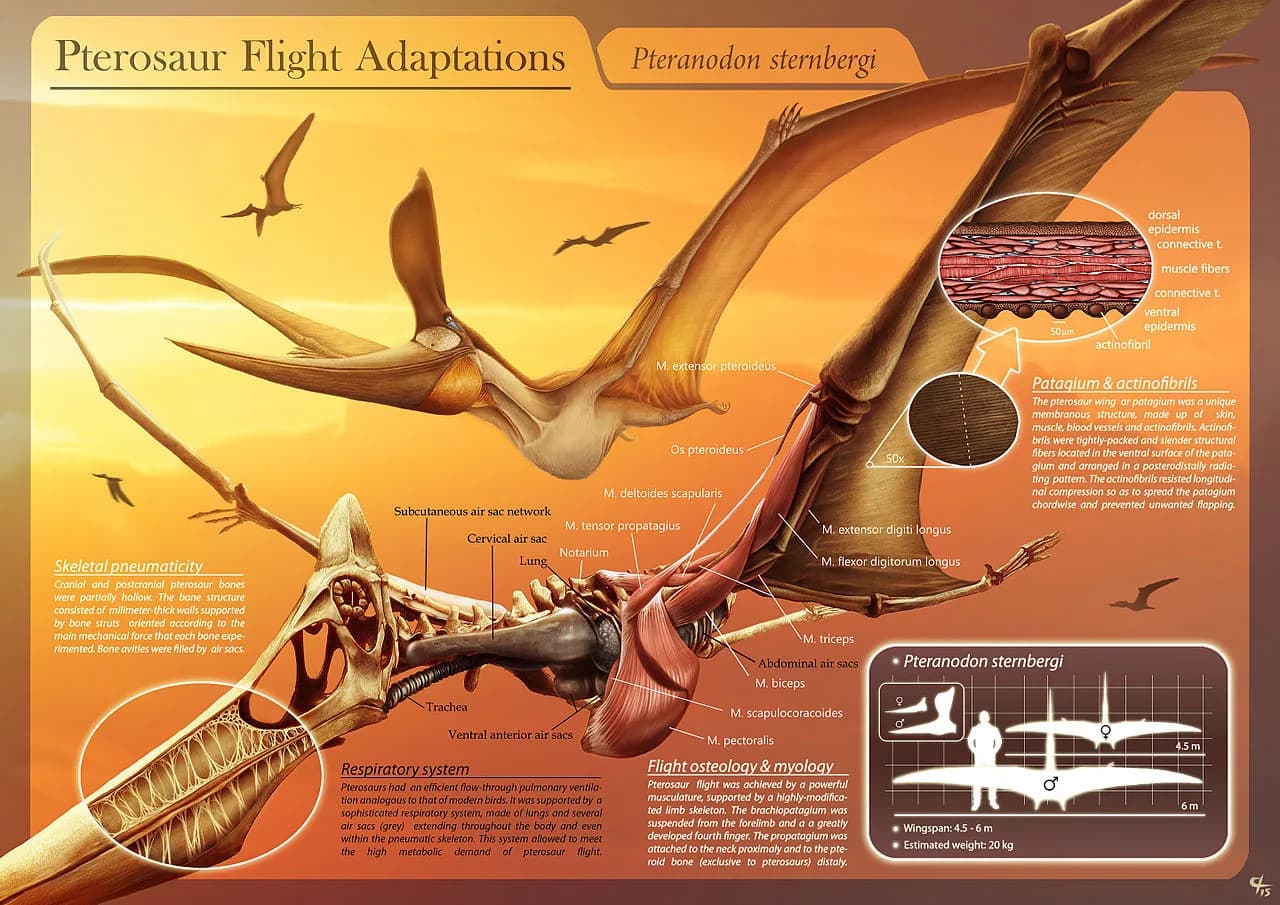
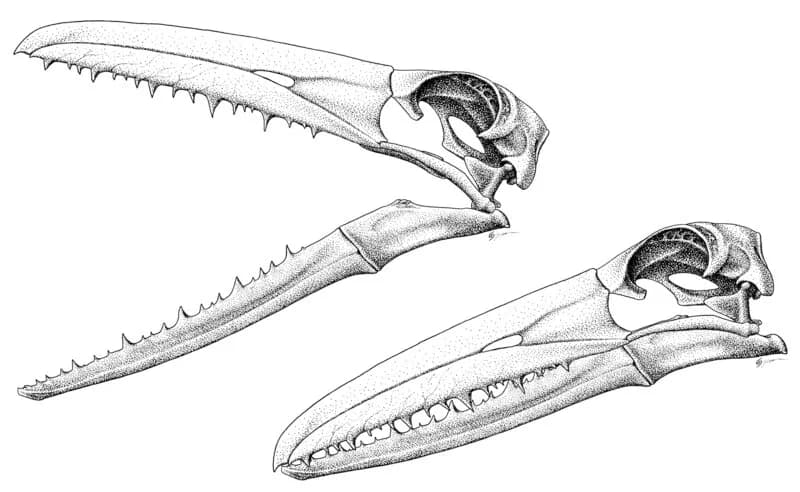
Pelagornis sandersi possessed a staggering wingspan of 6 to 7 meters, far surpassing any living flying bird and even the pterosaur Pteranodon. Despite this colossal wingspan, its weight remained remarkably light, estimated between 22 and 40 kilograms thanks to extremely pneumatized hollow bones. Its standing height reached approximately 1.2 meters. The elongated, gracile skull measured nearly 40 centimeters and bore rows of pointed bony pseudo-teeth along both jaws, creating a perfect trap for seizing fish and squid at the ocean surface during low gliding passes.
A specialized piscivore, Pelagornis fed primarily on fish and squid that it captured by skimming the ocean surface with its long toothed beak during extended gliding flights. The bony pseudo-teeth, unlike the true teeth of reptiles, were outgrowths of the maxillary bone forming regularly spaced sharp points, ideal for gripping slippery prey. Its fishing technique likely resembled that of modern albatrosses, gliding just above the waves for long hours before dipping its beak into the water. It could also feed on jellyfish and pelagic crustaceans floating near the surface of the open ocean.
Pelagornis was a truly pelagic bird, spending most of its life soaring above the open oceans, far from coastlines. Its fossils have been discovered on every continent, attesting to an exceptional cosmopolitan distribution across the world's oceans. Specimens are known from France, Chile, Morocco, South Carolina, New Zealand, and Peru. It likely nested on isolated islands or coastal cliffs, safe from terrestrial predators. The warm Miocene ocean currents provided rich fishing zones teeming with fish and invertebrates that supported these enormous birds.
The anatomy of Pelagornis represents a masterpiece of natural aerodynamic engineering. Its bones were extraordinarily pneumatized, with walls as thin as paper, drastically reducing total weight despite the gigantic wingspan. Long, narrow wings optimized for dynamic soaring allowed it to exploit updrafts above waves with minimal energy expenditure. The strongly keeled sternum supported powerful pectoral muscles for takeoff phases. The pseudo-teeth, numbering several dozen, were arranged in regular rows along both the upper and lower beak, forming an efficient prey-capture mechanism.
Pelagornis adopted a strictly pelagic lifestyle, spending weeks or even months in continuous flight above the oceans, landing only to nest and reproduce on shore. Its dynamic soaring technique, similar to that of modern albatrosses, allowed it to cover thousands of kilometers with minimal muscular effort by exploiting wind speed differences above the waves. Computer simulations suggest it was incapable of taking off by wing-flapping alone and had to use cliffs or strong winds to become airborne initially, a constraint directly linked to its gigantic size and wing loading.
The genus Pelagornis was described in 1857 by French paleontologist Edmond Lartet from Miocene fossils discovered in Armagnac, France. The most spectacular species, P. sandersi, was described in 2014 by Daniel Ksepka from a remarkably preserved partial skeleton discovered in 1983 near Charleston Airport, South Carolina. Biomechanical analyses of this specimen established the undisputed record for the largest flying bird of all time. The family Pelagornithidae, to which it belongs, includes over thirty species distributed across every continent from the Paleocene through the Pleistocene epoch.
| Period | Miocène / Miocene |
| Era | Cénozoïque / Cenozoic |
| Age | 25-2.5 Ma |
| Location | Cosmopolite (tous les continents) / Worldwide |
| Length | 1.5 m (corps) / 6-7 m (envergure) |
| Height | 1.2 m |
| Weight | 22-40 kg |
| Diet | Piscivore |
| Discovery | 1857 |
Pelagornis sandersi was a true bird — not a non-avian dinosaur. It belongs to the extinct family Pelagornithidae and lived during the Miocene, 25 to 2.5 million years ago. With a wingspan of 6 to 7 meters, it holds the record for the largest flying bird of all time, described in 2014 by Daniel Ksepka.
Biomechanical simulations suggest that Pelagornis sandersi was unable to take off by wing-flapping alone from a flat surface. It had to use cliffs or strong winds to become airborne, like albatrosses in calm conditions. Once in dynamic soaring above the waves, its pneumatized bones with walls as thin as paper allowed it to glide thousands of kilometers with minimal muscular effort.
Pelagornis's pseudo-teeth were not true teeth but bony outgrowths of the maxilla, unlike reptile teeth that grow in separate alveoli. Arranged in regular rows along the upper and lower beak of the 40 cm skull, they formed an ideal trap for gripping slippery fish and squid captured by skimming the ocean surface during extended gliding passes.
Reconstruction of Pelagornis sandersi in soaring flight
Liz Bradford, CC BY-SA 4.0
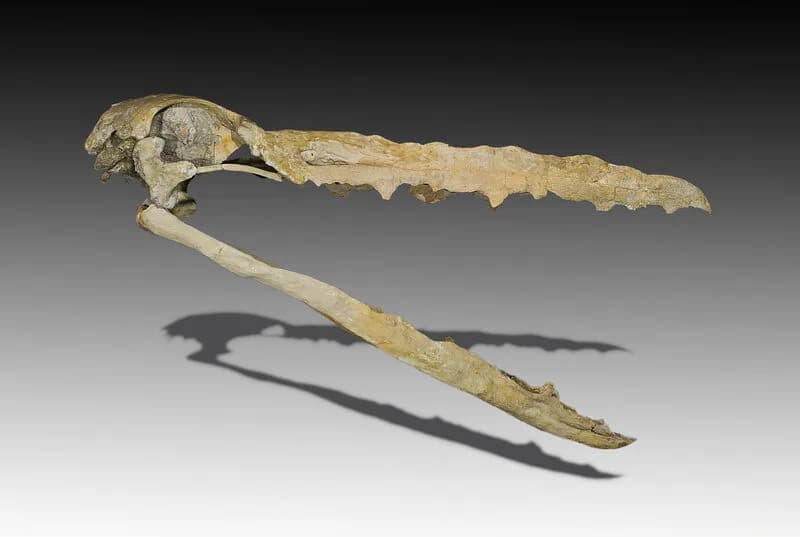
Fossil skull of Pelagornis mauretanicus showing pseudo-teeth
Wikimedia Commons, CC BY-SA