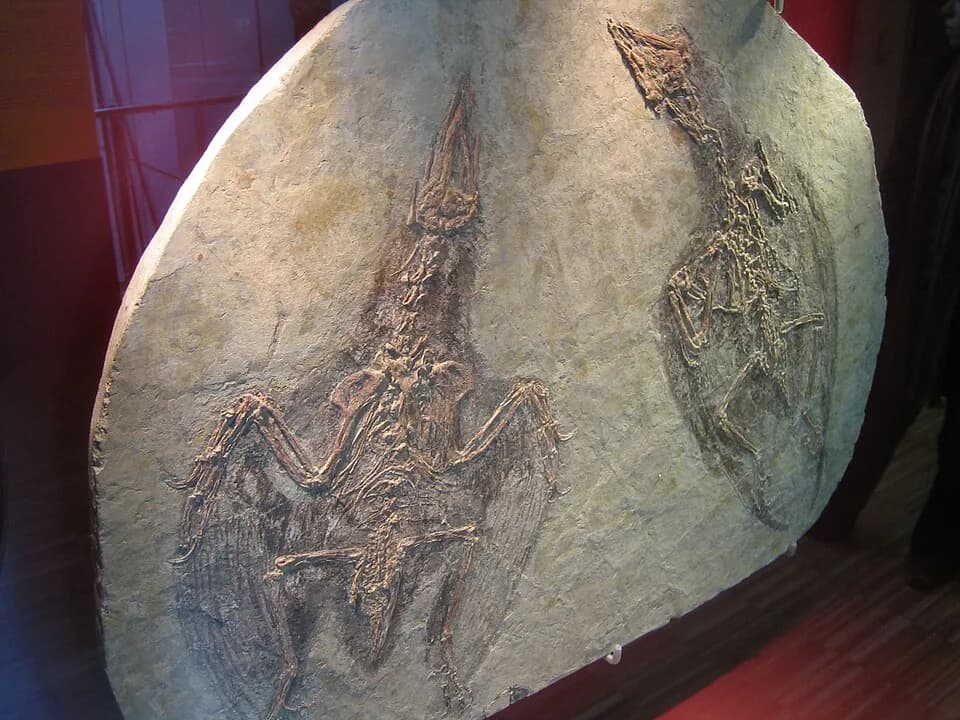
Confuciusornis
Confuciusornis sanctus is the earliest known bird with a beak entirely free of teeth, the structure every living bird shares. Its body measured 25 centimetres for around 200 grams, and it lived 125 to 120 million years ago in the Yixian Formation of Liaoning. More than a thousand specimens have been collected: by far the most abundant fossil bird of the Mesozoic.
Confuciusornis lived during the Early Cretaceous (Aptian), approximately 125 to 120 million years ago, in the forests and lacustrine zones of what is now Liaoning Province in China. It is one of the most important birds in paleontological history because it represents the earliest known bird to possess a toothless beak — a feature that would become the norm in all modern birds. Confuciusornis was discovered in the famous Jehol Biota deposits, an Early Cretaceous lacustrine ecosystem that produced some of the best-preserved fossils in the world, including feathers, soft tissues, and even colors. Thousands of specimens have been collected, making it one of the most abundant and best-documented Mesozoic birds.
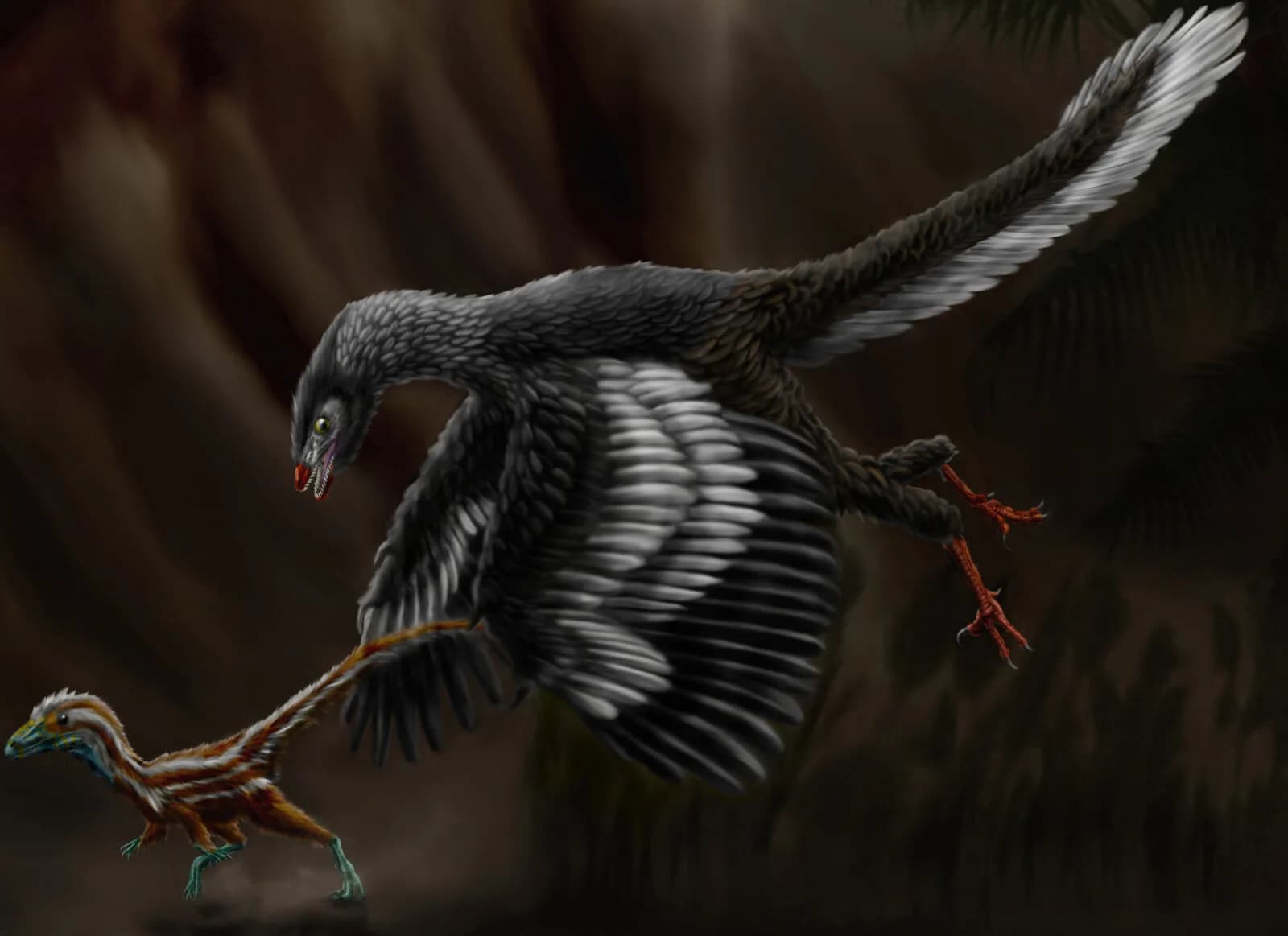
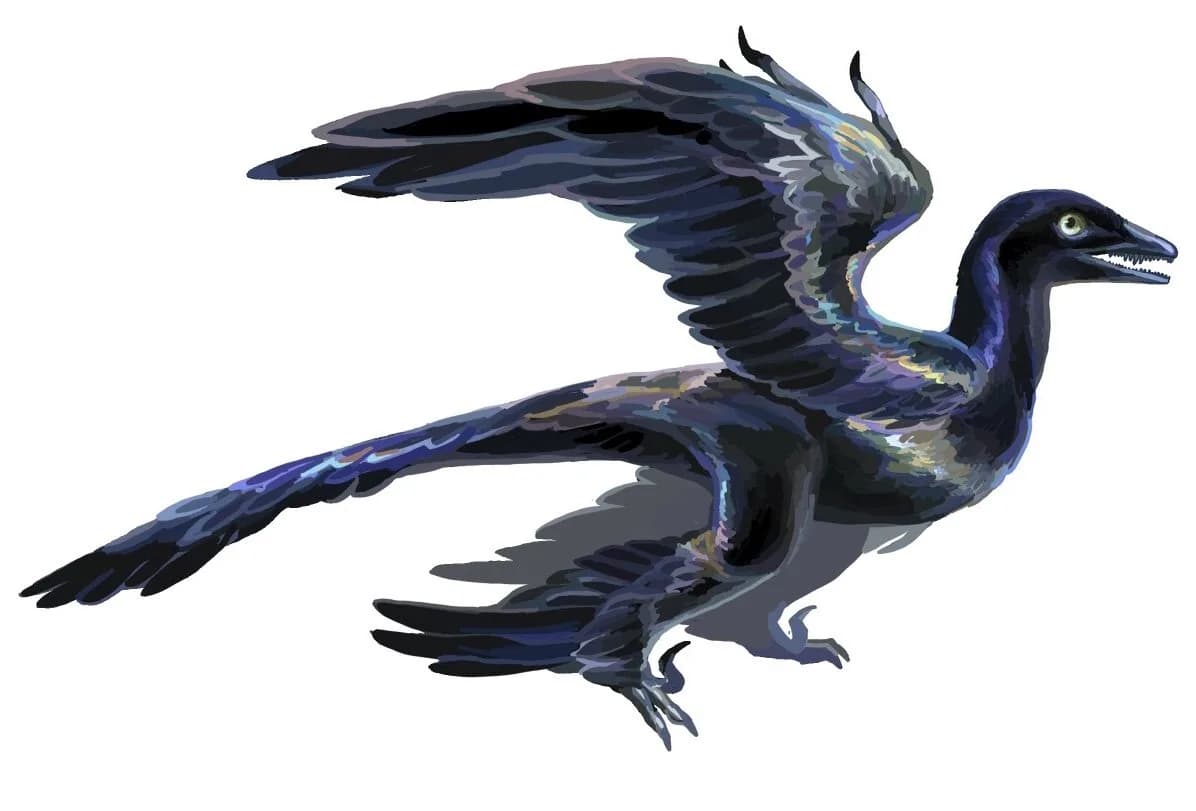
Confuciusornis was a small bird, measuring about 25 centimeters in body length (without tail feathers), roughly the size of a modern pigeon. Its wingspan was about 70 centimeters, with well-developed wings but still retaining claws on the fingers. The most spectacular feature of some specimens is a pair of very long ribbon-like tail feathers, reaching 25 to 40 centimeters — sometimes longer than the bird's entire body! These ornamental feathers were present only in certain individuals, interpreted as males, making it one of the earliest known examples of sexual dimorphism in birds.
Confuciusornis' diet remains actively debated among paleontologists. Its short, robust, completely toothless beak has been interpreted in several different ways: as a granivore specialized in crushing seeds, as a frugivore feeding primarily on fruits, as a generalist omnivore, or even as a piscivore catching fish from lakes. Some exceptionally preserved specimens contain gastric contents including identifiable fish remains and seeds, strongly suggesting an opportunistic omnivorous diet. Beak shape varies notably among different species within the genus and may reflect distinct dietary adaptations. Confuciusornis is the earliest known bird to have developed a horny beak replacing the toothed jaws of its theropod dinosaur ancestors — a major dietary innovation allowing considerably more versatile food manipulation.
Confuciusornis lived in the conifer forests and lacustrine zones of the Jehol Biota, an Early Cretaceous ecosystem in northeastern China. This environment included shallow lakes surrounded by dense forests of ginkgos, conifers, and ferns, with a warm temperate climate. Regional volcanic activity created ash that periodically buried lacustrine communities, preserving organisms in extraordinary detail. Confuciusornis shared its habitat with other feathered dinosaurs (Microraptor, Sinosauropteryx), pterosaurs, primitive mammals, and diverse aquatic fauna. The exceptional preservation of the Jehol Biota revolutionized our understanding of bird and feather evolution.
Confuciusornis possessed a noteworthy mix of primitive and modern features. Its toothless horny beak was a major innovation, but it still retained claws on the three fingers of each wing — a vestige of its theropod ancestors. Its skeleton showed a pygostyle (fused tail bone, present in all modern birds), but its pectoral girdle and sternum were still relatively primitive, with a less developed keel than in modern birds. Its feathers were essentially modern in structure, including asymmetrical flight feathers (indicating flight capability), contour feathers, and down. The long ornamental tail feathers of presumed males were modified feathers without pennaceous structure (like ribbons).
Confuciusornis was probably an arboreal bird living in Early Cretaceous forests, though its exact flight capability is debated — some researchers think it was a good flier, others that it was a limited glider. Its wing claws probably allowed it to climb tree trunks, like modern young hoatzins. The long tail feathers of males certainly served for courtship display and sexual selection, making it one of the earliest known examples of avian sexual signaling. The large number of specimens found together (sometimes hundreds on a single slab) suggests gregarious behavior, possibly nesting colonies around volcanic lakes.
Confuciusornis sanctus was described in 1995 by Hou Lianhai and colleagues, from Early Cretaceous fossils of the Yixian Formation, Liaoning Province, China. The name honors the Chinese philosopher Confucius (Kong Fuzi). Since its discovery, THOUSANDS of specimens have been collected — it is the most abundant Mesozoic bird in terms of fossils, with probably over 1,000 known individuals. Several species have been described: C. sanctus, C. dui, C. feducciai. The Jehol Biota deposits preserve feathers in extraordinary detail, even allowing studies on fossilized melanin to reconstruct original plumage colors. In 2010, chemical analyses revealed that Confuciusornis probably had black plumage with iridescent reflections in males.
| Period | Crétacé inférieur (Aptien) / Early Cretaceous (Aptian) |
| Era | Mésozoïque / Mesozoic |
| Age | 125-120 Ma |
| Location | Formation de Yixian, Liaoning, Chine / Yixian Formation, Liaoning, China |
| Length | 25 cm (corps) |
| Height | 15 cm |
| Weight | ~200 g |
| Diet | Omnivore |
| Discovery | 1995 |
Yes, Confuciusornis sanctus is the earliest known bird to possess a true toothless horny beak, a major innovation that appeared 125 to 120 million years ago (Aptian, Early Cretaceous). Its theropod ancestors and even Archaeopteryx had teeth. This versatile beak, which would become the norm across the 10,000 species of modern birds, allowed more diverse food manipulation.
The thousands of Confuciusornis sanctus specimens found together (sometimes hundreds on a single slab) in the Yixian Formation, Liaoning (China), reflect probable gregarious behavior — nesting colonies around volcanic lakes. Periodic Early Cretaceous eruptions rapidly buried these gatherings, preserving in detail the feathers, soft tissues, and even melanin pigments.
Yes, Confuciusornis sanctus retained functional claws on the three fingers of each wing, a direct vestige of its theropod dinosaur ancestors. These claws probably served for climbing tree trunks, like modern young hoatzins. Despite this primitive trait, its skeleton already showed a pygostyle (fused caudal bone) and modern asymmetrical flight feathers, indicating a genuine flight capability.
Confuciusornis sanctus fossil with preserved feathers, Liaoning, China
Wikipedia Commons
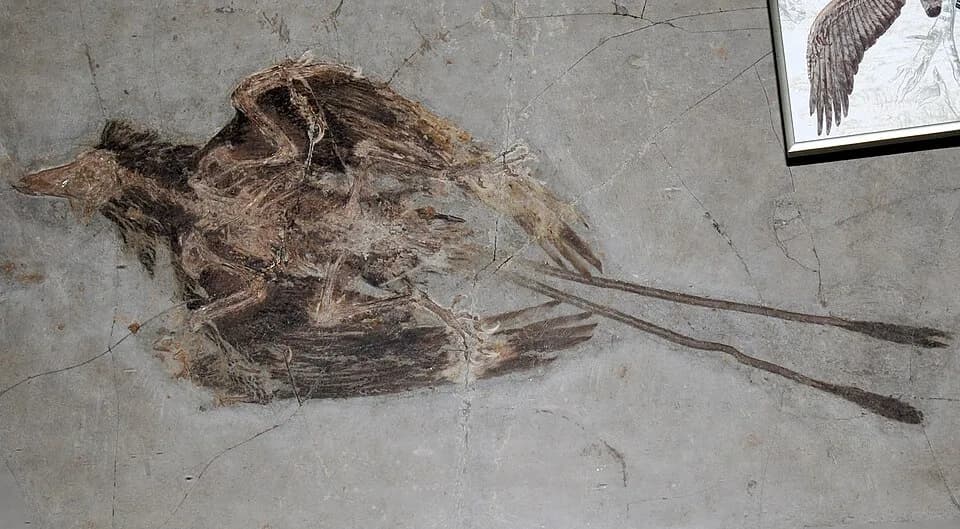
Male Confuciusornis reconstruction with its long tail feathers
Wikipedia Commons