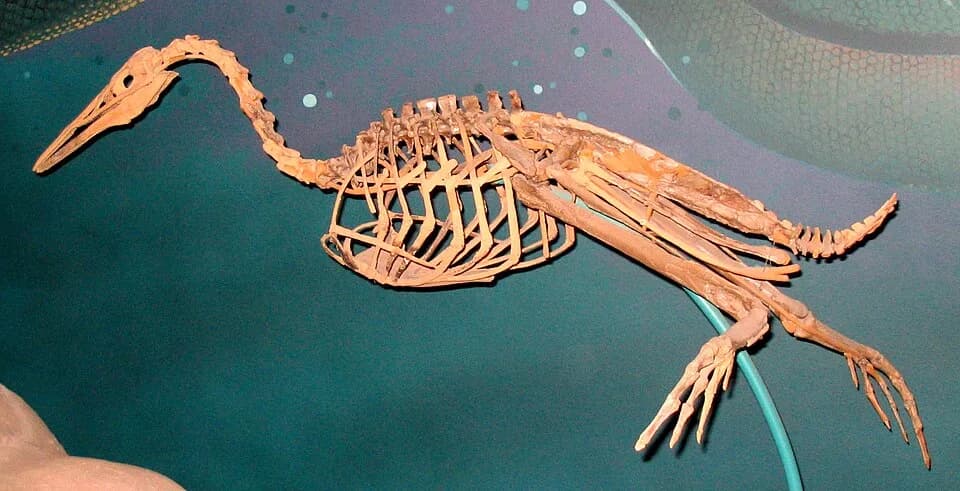
Hesperornis
Hesperornis regalis was a marine bird from Kansas, described in 1872 and dated to 83 to 72 million years ago. Standing 1.5 to 1.8 metres and around 20 kilograms, it still had teeth — a legacy of its dinosaur ancestry that Darwin himself cited as evidence linking the two groups. On land it crawled on its belly like a seal.
Hesperornis lived during the Late Cretaceous (Campanian), approximately 83 to 72 million years ago, in the Western Interior Seaway that divided North America into two continents. It was one of the few truly aquatic birds of the Mesozoic, coexisting with the last non-avian dinosaurs, giant mosasaurs, and plesiosaurs. Hesperornis belonged to the Hesperornithiformes, an order of toothed birds specialized for diving, representing a unique evolutionary lineage that went completely extinct at the end of the Cretaceous. Unlike modern birds, Hesperornis still had teeth in its jaws — a vestige of its dinosaurian heritage.
Hesperornis was a large aquatic bird, measuring about 1.5 to 1.8 meters from beak to tail. Its body was elongated and streamlined for underwater swimming, with a long, flexible neck and a narrow beak with small pointed teeth. Its legs, situated very far back on the body (like modern loons), were powerful with broad lobed feet adapted for aquatic propulsion. Its wings were extremely reduced — mere vestigial stumps totally incapable of flight. Hesperornis was therefore unable to fly and must have been extremely awkward on land, but it was an exceptional swimmer and diver.
Hesperornis was a specialized piscivore, hunting fish and cephalopods in the waters of the Cretaceous interior sea. Its jaws bore rows of small pointed teeth angled backward — perfect for grasping and retaining slippery fish. Its long, flexible neck allowed rapid striking movements underwater to capture prey. It probably hunted by diving from the surface, like modern cormorants and loons, propelled by its powerful hind legs. Fossilized stomach contents confirm a diet composed primarily of small fish. Hesperornis itself was prey for large mosasaurs and sharks of the interior sea.
Hesperornis lived exclusively in the waters of the Western Interior Seaway, a shallow epicontinental sea that stretched from the Gulf of Mexico to the Arctic Ocean, dividing North America into two landmasses (Laramidia to the west and Appalachia to the east). This warm, shallow sea hosted spectacular marine fauna: giant mosasaurs (Tylosaurus, Mosasaurus), plesiosaurs, sharks, giant bony fish (Xiphactinus), and ammonites. Hesperornis evolved in coastal and open waters, probably in colonies like modern seabirds. Fossils come primarily from the Chalk Formation of Kansas.
Hesperornis possessed an anatomy highly specialized for aquatic life. Its skeleton showed dense, minimally pneumatic bones (unlike flying birds), reducing buoyancy to facilitate diving. Its hind legs, positioned at the extreme rear of the body, functioned as powerful propulsors with lobed (not webbed) feet — each toe bearing an independent cutaneous lobe. Its wings were reduced to tiny vestiges, without functional flight feathers. Its sternum had lost the keel (carina), confirming the total loss of flight capability. A defining characteristic for a Cretaceous bird was the presence of teeth: small pointed teeth in the lower jaw and palate, but not in the premaxilla (which was covered by a horny beak).
Hesperornis spent nearly its entire life at sea, probably only coming ashore to breed, like modern seals. On land, it must have moved by crawling on its belly, its legs being positioned too far back for effective walking — similar to modern loons which are nearly incapable of walking. At sea, it was an expert diver, using its powerful lobed feet to propel itself below the surface in pursuit of fish. It probably nested in colonies on rocky shores or low islands, laying its eggs near the water to minimize terrestrial travel. Despite its size and teeth, Hesperornis was vulnerable to large marine predators like mosasaurs.
Hesperornis regalis was described in 1872 by famous American paleontologist Othniel Charles Marsh, from fossils discovered in the Smoky Hill Chalk of Kansas. The name means 'western bird' (Greek: hesperos 'western' + ornis 'bird'). The discovery was a triumph for Marsh in his rivalry with Edward Drinker Cope (the Bone Wars), as Hesperornis demonstrated the link between dinosaurs and birds through its teeth — a key argument in favor of Darwin's theory of evolution. Charles Darwin himself mentioned Hesperornis in the 6th edition of 'On the Origin of Species.' Marsh published a masterful monograph in 1880, 'Odontornithes: A Monograph on the Extinct Toothed Birds of North America,' which remains a classic reference.
| Period | Crétacé supérieur (Campanien) / Late Cretaceous (Campanian) |
| Era | Mésozoïque / Mesozoic |
| Age | 83-72 Ma |
| Location | Mer intérieure occidentale, Kansas, USA / Western Interior Seaway, Kansas, USA |
| Length | 1.5-1.8 m |
| Height | 60 cm |
| Weight | ~20 kg |
| Diet | Piscivore |
| Discovery | 1872 |
Hesperornis regalis was completely incapable of flight: its wings were reduced to tiny vestiges and its sternum had lost the keel (carina) needed for flight muscles. On land, it moved by crawling on its belly, its hind legs positioned too far back for effective walking — like modern loons. In the sea, its powerful lobed feet made it an expert diver.
Hesperornis regalis retained small pointed teeth in its lower jaw and palate, a vestige of the dinosaurian heritage of birds. These backward-angled teeth were ideal for gripping slippery fish. The discovery of Hesperornis by Othniel Charles Marsh in 1872 provided Charles Darwin with a key argument for his theory of evolution, the animal demonstrating the anatomical link between dinosaurs and modern birds.
Hesperornis regalis lived exclusively in the Western Interior Seaway, a shallow epicontinental sea that divided North America into two landmasses during the Campanian (83-72 Ma). This sea harbored giant mosasaurs like Tylosaurus and Mosasaurus, plesiosaurs, and sharks that posed direct threats to the bird. Most fossils come from the Chalk Formation of Kansas.
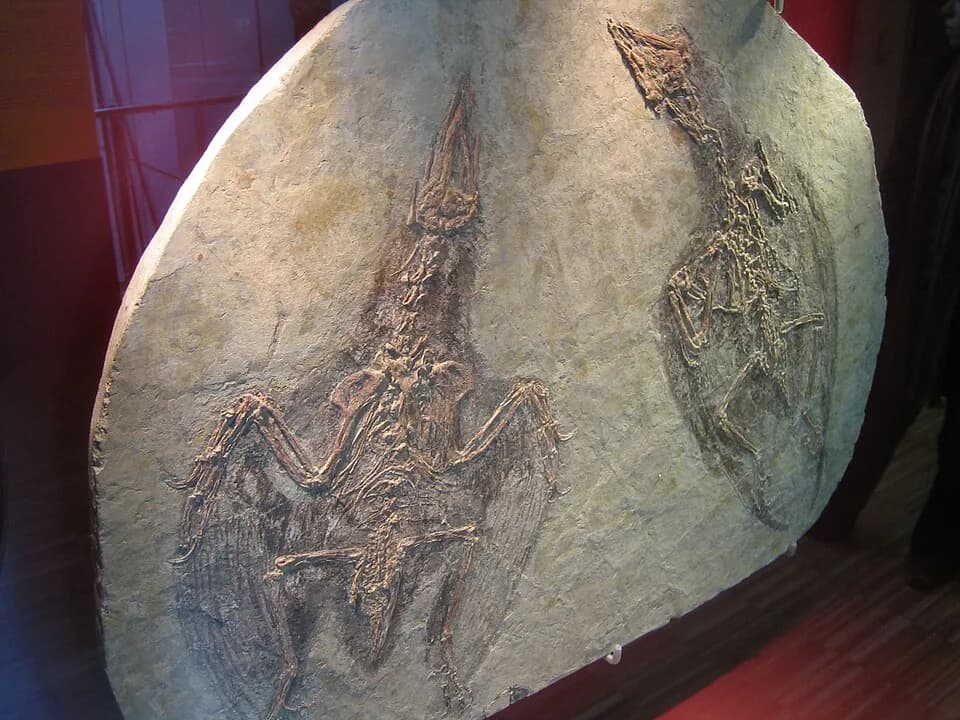
Hesperornis regalis skeleton showing its aquatic adaptation
Wikipedia Commons
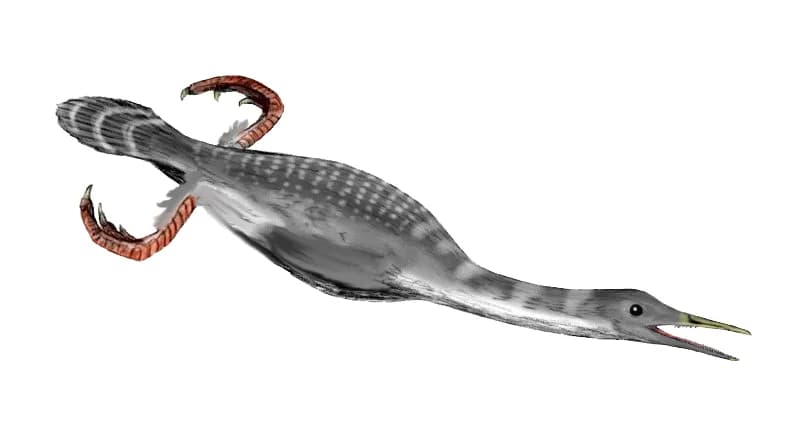
Hesperornis regalis reconstruction, toothed diving bird of the Cretaceous
Nobu Tamura, CC BY-SA 3.0