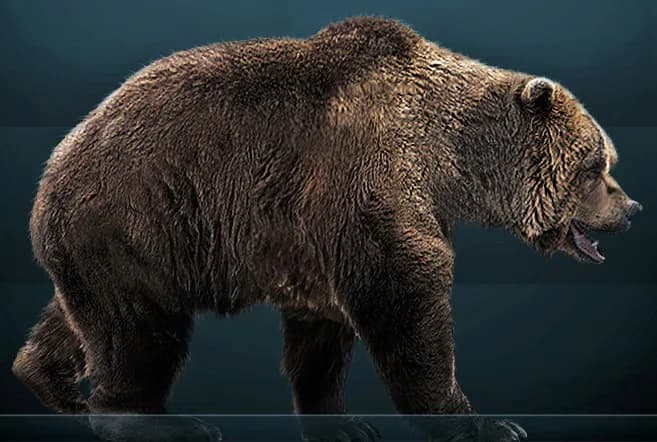
Ours des cavernes
Ursus spelaeus owes its name to the thousands of skeletons found in European caves, where individuals died during hibernation: Austria's Drachenhöhle alone yielded over thirty thousand. Standing 2.5 to 3 metres upright and weighing 400 to 1,000 kilograms, it lived between 300,000 and 24,000 years ago, on a largely plant-based diet.
The cave bear (Ursus spelaeus) lived during the Pleistocene, approximately 300,000 to 24,000 years ago, primarily across Europe. This massive ursid appeared in the Middle Pleistocene, likely descending from Ursus deningeri, and became one of the largest terrestrial mammals of its era on the European continent. It coexisted for tens of thousands of years with Neanderthals, and then briefly with the first Homo sapiens who arrived in Europe around 45,000 years ago. The cave bear disappeared around 24,000 years ago during the Last Glacial Maximum, victim of a combination of factors: intense climate cooling drastically reduced the temperate forests on which it depended for plant food, while increasing competition with humans for cave shelter accelerated its decline. Recent genetic studies suggest that population decline had begun well before final extinction, indicating a structural vulnerability of the species to environmental changes.
The cave bear was approximately 30% larger than the modern grizzly, making it one of the most imposing terrestrial carnivores of Pleistocene Europe. Adult males stood about 1.7 meters at the shoulder on all fours and could reach 3.5 meters when standing upright, towering over any prehistoric human. Male weight ranged between 400 and 1,000 kg, with the largest specimens rivaling the biggest modern Kodiak bears. Females were notably smaller, weighing between 225 and 250 kg, revealing a pronounced sexual dimorphism typical of ursids. Its massive skull, measuring up to 55 cm in length, featured a characteristically domed forehead and a broad muzzle. Its bones were remarkably thick and robust, reflecting the powerful musculature needed to support this considerable mass during seasonal movements between forested valleys and mountain caves.
Despite what its impressive size might suggest, the cave bear was primarily herbivorous, even nearly exclusively vegetarian according to the most recent isotopic analyses. Stable carbon and nitrogen isotope studies from bone collagen of hundreds of European specimens demonstrate a plant-dominated diet: grasses, berries, roots, tubers, mushrooms, and young tree shoots constituted the bulk of its nutrition. Its broad, flat molars with extensive grinding surfaces were perfectly adapted for chewing tough plant material, a striking contrast with the shearing teeth of more carnivorous ursids. Dental wear patterns observed on numerous specimens confirm an abrasive diet rich in plant fibers and mineral particles. Some populations, particularly in more northern regions, occasionally supplemented their diet with insects, honey, carrion, and possibly fish, adopting more omnivorous behavior when plant resources became scarce.
The cave bear primarily occupied temperate forests and mountainous areas of Europe, from Spain and Britain in the west to the Urals and Caucasus in the east. Its range covered a vast east-west band across central and southern Europe, including the Alps, Carpathians, Pyrenees, and Balkans. As its name suggests, this ursid maintained a close relationship with caves, using them primarily as hibernation sites during the long glacial winters. Some caves accumulated bones over tens of thousands of years, creating spectacular deposits of thousands of skeletons. During the active season, the cave bear roamed mixed forests and alpine meadows in search of plant food. It preferred sheltered valleys offering dense vegetation and easy access to mountain caves for autumn hibernation.
The cave bear's anatomy reflected its adaptation to a primarily herbivorous lifestyle in European glacial environments. Its skull was distinguished from the brown bear's by a markedly more domed forehead, forming a prominent dome above the eyes, and a proportionally wider muzzle housing powerful chewing muscles. Its jaw featured reduced premolars and enlarged molars with complex grinding surfaces, a dentition clearly oriented toward processing plant material rather than meat. The canines remained impressive — up to 10 cm — serving more for intimidation and intraspecific combat than for predation. Its massive skeletal structure was characterized by thick long bones, robust joints, and a wide pelvis supporting considerable musculature. Its forelimbs were powerful, equipped with non-retractile claws reaching up to 15 cm, used for digging roots, turning over stones, and scraping tree bark. The rib cage was spacious, housing voluminous lungs adapted for physical exertion at altitude.
The cave bear led a largely solitary existence, except during the breeding season and the period of cub-rearing by females. Hibernation was the most critical aspect of its annual cycle: each autumn, these massive bears retreated deep into limestone caves to spend winter in torpor, surviving on fat reserves accumulated during the summer and autumn months. Caves also served as birthing sites, with females giving birth during hibernation, as with modern bears. Deep claw marks found on the walls of numerous European caves testify to their prolonged presence in these underground shelters. Competition for the best caves was likely intense, both among cave bears and with Neanderthals and early Homo sapiens who coveted the same shelters. Taphonomic studies suggest that mortality was particularly high during hibernation, especially among juveniles and elderly or weakened individuals.
The cave bear was first described by German physician and anatomist Johann Christian Rosenmüller in 1794, from skulls discovered in caves of Franconia, Bavaria. The scientific name Ursus spelaeus literally means 'cave bear' in Latin. What makes this species unique in the fossil record is the extraordinary abundance of its remains: tens of thousands of bones have been found in caves throughout Europe. The Drachenhöhle (Dragon's Cave) in Austria yielded the remains of over 30,000 individuals, while the Pestera cu Oase cave in Romania and Chauvet Cave in France rank among the most important sites. Chauvet Cave is particularly remarkable because it houses not only cave bear bones and claw marks, but also 36,000-year-old cave paintings depicting this animal, created by the earliest European Homo sapiens. In 2005, the complete mitochondrial genome of the cave bear was sequenced, confirming its close relationship with the modern brown bear (Ursus arctos), from which it diverged approximately 1.2 million years ago.
| Period | Pléistocène / Pleistocene |
| Era | Cénozoïque / Cenozoic |
| Age | 300 000 – 24 000 ans / 300,000 – 24,000 years |
| Location | Europe / Europe |
| Length | ~2.5–3 m |
| Height | ~1.7 m (épaule), ~3.5 m (debout) / ~1.7 m (shoulder), ~3.5 m (standing) |
| Weight | 400–1 000 kg |
| Diet | Herbivore |
| Discovery | 1794 |
No. Isotopic analyses of bone collagen from hundreds of European specimens confirm that Ursus spelaeus was primarily herbivorous, or even nearly exclusively vegetarian. Its broad, flat molars contrast sharply with the sharper teeth of more carnivorous ursids. Some northern populations occasionally supplemented with insects or carrion, but plants formed the dietary base.
Ursus spelaeus used caves as hibernation sites for tens of thousands of years. Mortality was high during this period, especially among juveniles and weakened individuals. The Drachenhöhle in Austria yielded remains of over 30,000 individuals, an accumulation resulting from continuous occupation over millennia without rapid decomposition in the underground environment.
The cave bear disappeared around 24,000 years ago during the Last Glacial Maximum. Genetic studies show its population decline had begun well before final extinction. Climate cooling reduced the temperate forests it depended on, while increasing competition with Homo sapiens and Neanderthals for cave shelters accelerated its decline.
Life reconstruction of Ursus spelaeus
Sergiodlarosa, CC BY-SA 3.0, via Wikimedia Commons
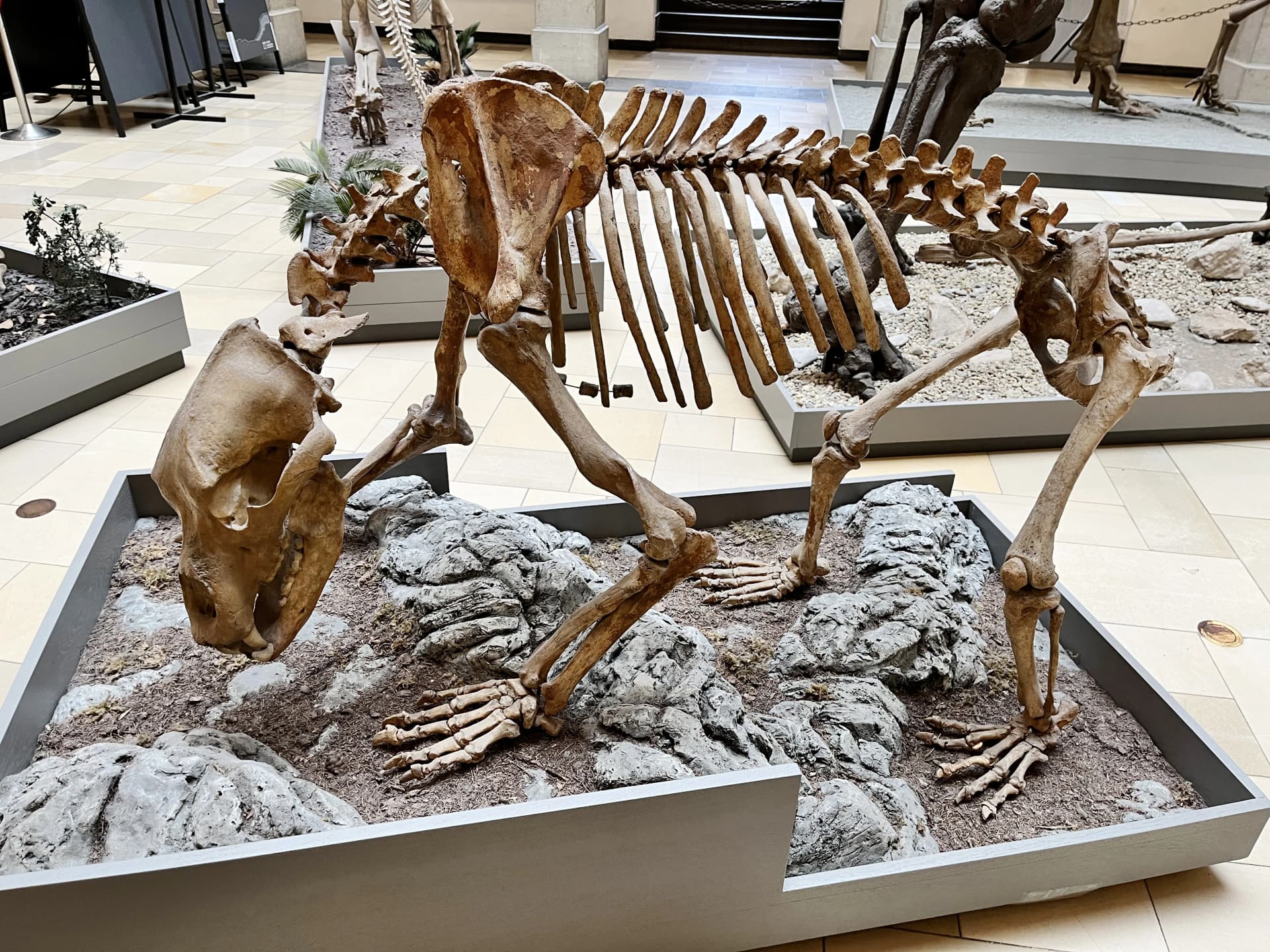
Complete cave bear skeleton
Ra'ike, CC BY-SA 3.0, via Wikimedia Commons