Ouranosaurus
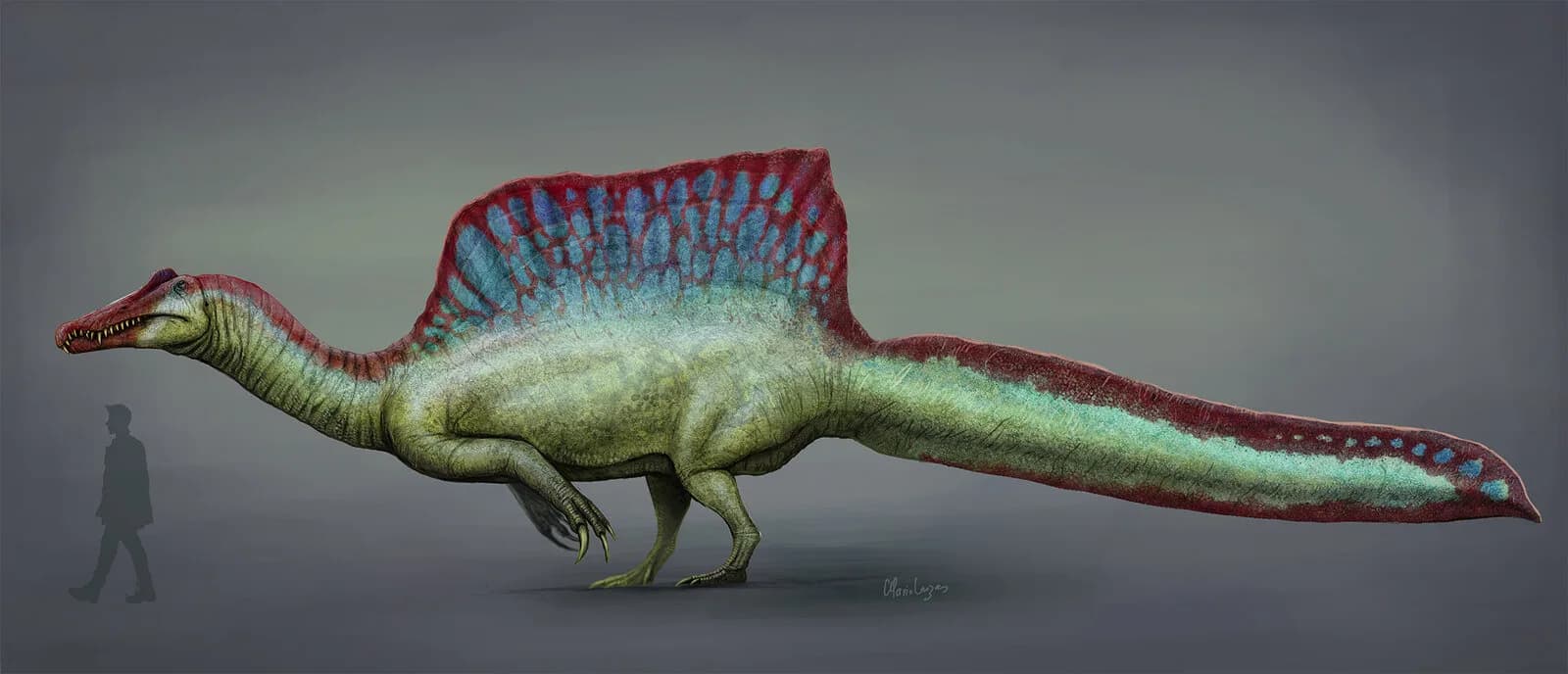
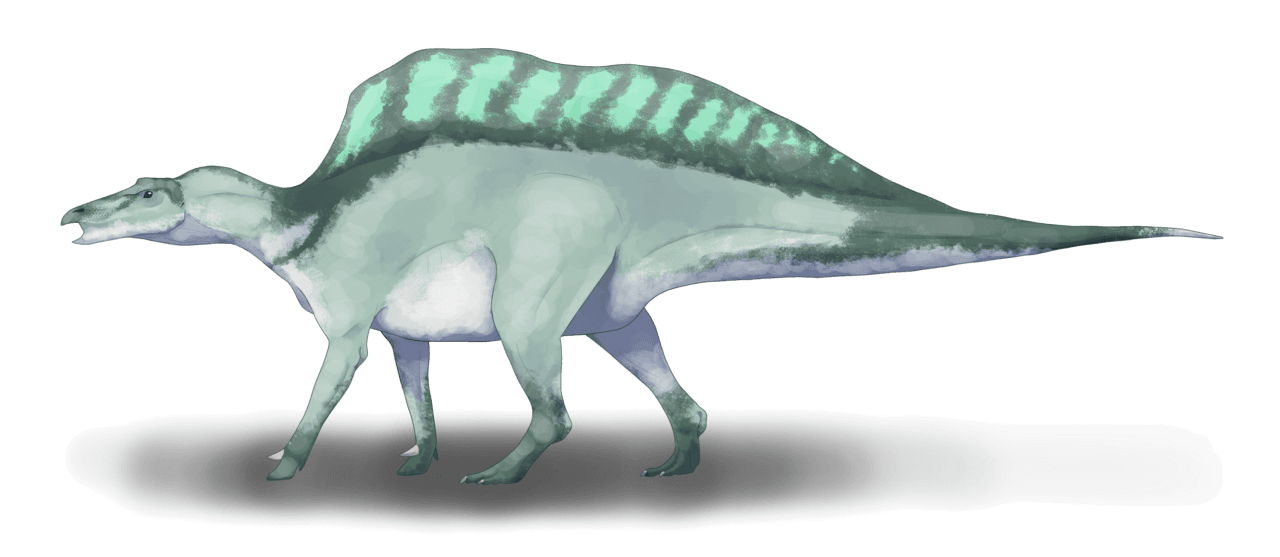
Ouranosaurus nigeriensis carried a row of greatly elongated neural spines along its back. Specialists still debate their function: a thermoregulating sail, as in Spinosaurus, or a fatty hump, as in a dromedary. Seven metres long and 2.2 tonnes, it was uncovered at Gadoufaoua in Niger, and lived 112 million years ago.
Ouranosaurus lived during the Early Cretaceous period, approximately 112 million years ago (Albian stage), on the African continent. At that time, the modern Sahara was not a desert but a vast green expanse crossed by rivers and lakes, populated by a diverse fauna. Ouranosaurus belongs to the Hadrosauriformes, a group of advanced ornithopods closely related to the duck-billed hadrosaurs, though not directly part of that family. It was contemporary with large theropod predators such as Suchomimus and Kryptops, as well as the gigantic sauropod Nigersaurus. Its name, meaning 'brave lizard' from the Tuareg Arabic word ourane, reflects the local culture of the region where its fossils were discovered.
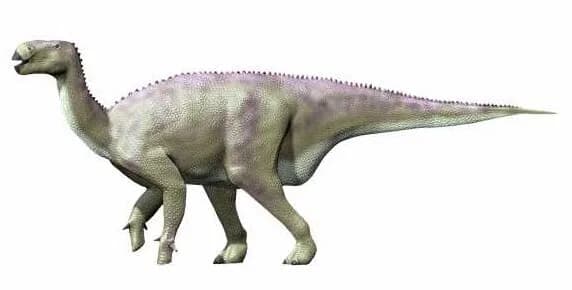
Ouranosaurus reached approximately 7 meters in length with an estimated weight of 2.2 metric tons, making it a respectably sized iguanodontian. Its stature was comparable to that of a large modern rhinoceros. The powerful and robust hind limbs supported most of the weight during bipedal locomotion, while the shorter but sturdy forelimbs allowed for occasional quadrupedal walking. The skull was elongated and laterally compressed, with a broad snout typical of hadrosauriforms. The long muscular tail served as a natural counterbalance during bipedal walking, effectively maintaining the overall balance of the body during movement.
An exclusive herbivore, Ouranosaurus possessed a broad flat horny beak at the front of the jaw, perfectly adapted for cutting and tearing vegetation. At the back of the mouth, batteries of tightly packed teeth allowed efficient grinding of fibrous plant material before swallowing. Its diet likely included ferns, horsetails, low-growing conifers, and various primitive flowering plants that were beginning to diversify during the Early Cretaceous. Ouranosaurus could feed both at ground level in a quadrupedal stance and at moderate heights by rearing up on its hind legs, thus exploiting a wide range of available plant resources in its environment.
Ouranosaurus inhabited the Gadoufaoua region of Niger, an exceptional fossil site located in the Ténéré Desert. During the Early Cretaceous, this area was a lush fluvial environment with wide rivers, fertile floodplains, and dense vegetation composed of tree ferns, conifers, and primitive flowering plants. The climate was hot and humid, vastly different from the modern Saharan aridity. Ouranosaurus shared this rich ecosystem with a remarkable fauna including Nigersaurus (a grazing sauropod), Suchomimus (a fish-eating theropod), Sarcosuchus (a 12-meter giant crocodilian), and Lurdusaurus (a massive iguanodontian). This faunal community testifies to a particularly productive aquatic and terrestrial ecosystem.
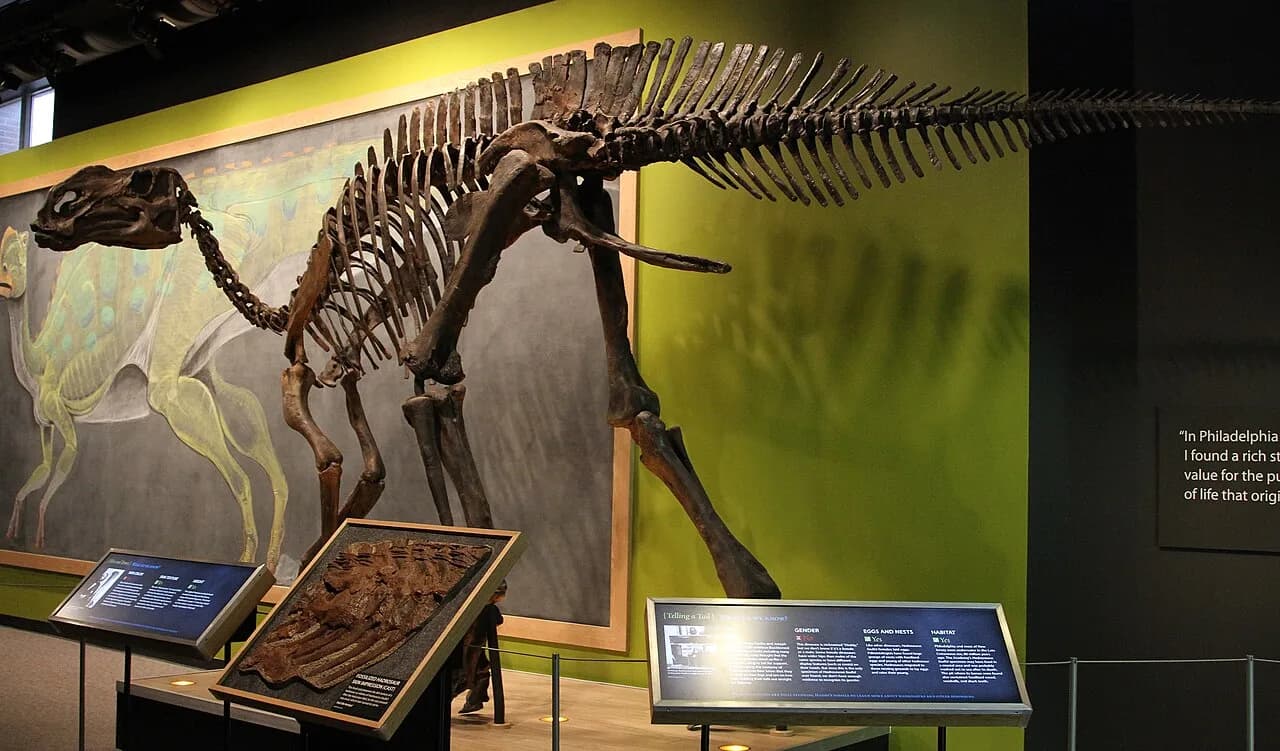
The most striking anatomical feature of Ouranosaurus is the presence of highly elongated neural spines on the dorsal and lumbar vertebrae, forming a prominent structure along the animal's back. These spines could reach over 60 centimeters in height, creating a spectacular sail-like or hump-like dorsal structure. Unlike Spinosaurus whose spines clearly formed a sail, those of Ouranosaurus were thicker, and some paleontologists suggest they supported a fatty hump similar to that of a bison or dromedary camel. The skull also featured a small nasal bump, a unique characteristic among iguanodontians. Ouranosaurus possessed a thumb modified into a bony spur, typical of iguanodontians, which likely served as defense against predators.
The dorsal sail or hump of Ouranosaurus has generated numerous behavioral hypotheses among paleontologists. The thermoregulation hypothesis proposes that this richly vascularized structure allowed the animal to dissipate body heat in the warm Early Cretaceous African environment, functioning as a biological radiator. Another hypothesis favors a role in visual communication and sexual selection, with the sail serving as a display organ during courtship or rival confrontations. If the structure was indeed a fatty hump, it could have served as an energy reserve for seasonal periods of food scarcity. Ouranosaurus was likely gregarious, moving in small groups along waterways to feed and mutually protect against large theropod predators.
Ouranosaurus was discovered in 1966 by French paleontologist Philippe Taquet during an expedition to the Gadoufaoua region in Niger, in the Ténéré Desert. Two remarkably complete skeletons were excavated, which is exceptional for an Early Cretaceous African dinosaur. The species was officially described and named Ouranosaurus nigeriensis by Taquet in 1976, after ten years of meticulous study. The generic name derives from the Tuareg word ourane meaning brave or courageous. The original specimens are housed at the Muséum national d'Histoire naturelle in Paris. Ouranosaurus recently gained wider recognition through its appearance in Apple TV Plus documentary series Prehistoric Planet, which depicted it with a fatty dorsal hump rather than a sail.
| Period | Crétacé inférieur / Early Cretaceous |
| Era | Mésozoïque / Mesozoic |
| Age | 112 Ma |
| Location | Gadoufaoua, Niger / Gadoufaoua, Niger |
| Length | 7 m |
| Weight | 2.2 tonnes |
| Diet | Herbivore |
| Discovery | 1966 |
The debate remains open. The neural spines of Ouranosaurus nigeriensis reached over 60 cm in height. The vascular sail hypothesis (thermoregulation) and the fatty hump hypothesis (energy reserve, like a dromedary camel) are both supported. Since the spines are thicker than Spinosaurus's, the hump interpretation is now favored by several paleontologists, particularly since the Prehistoric Planet series.
Ouranosaurus nigeriensis lived 112 million years ago at Gadoufaoua in Niger (today's Ténéré Desert), then a tropical river plain. It cohabited with Sarcosuchus imperator (a 12 m crocodilian), Spinosaurus, Suchomimus, Nigersaurus, and Lurdusaurus — an exceptional Early Cretaceous African aquatic and terrestrial ecosystem.
Ouranosaurus nigeriensis measured approximately 7 meters long and weighed 2.2 tonnes. Like the European Iguanodon, it had a defensive thumb spike and a wide beak. Its main distinction lies in its highly elongated dorsal spines forming a sail or hump, absent in Iguanodon, and its African origin (Niger, Albian, ~112 Ma).
Ouranosaurus nigeriensis restoration
Wikimedia Commons
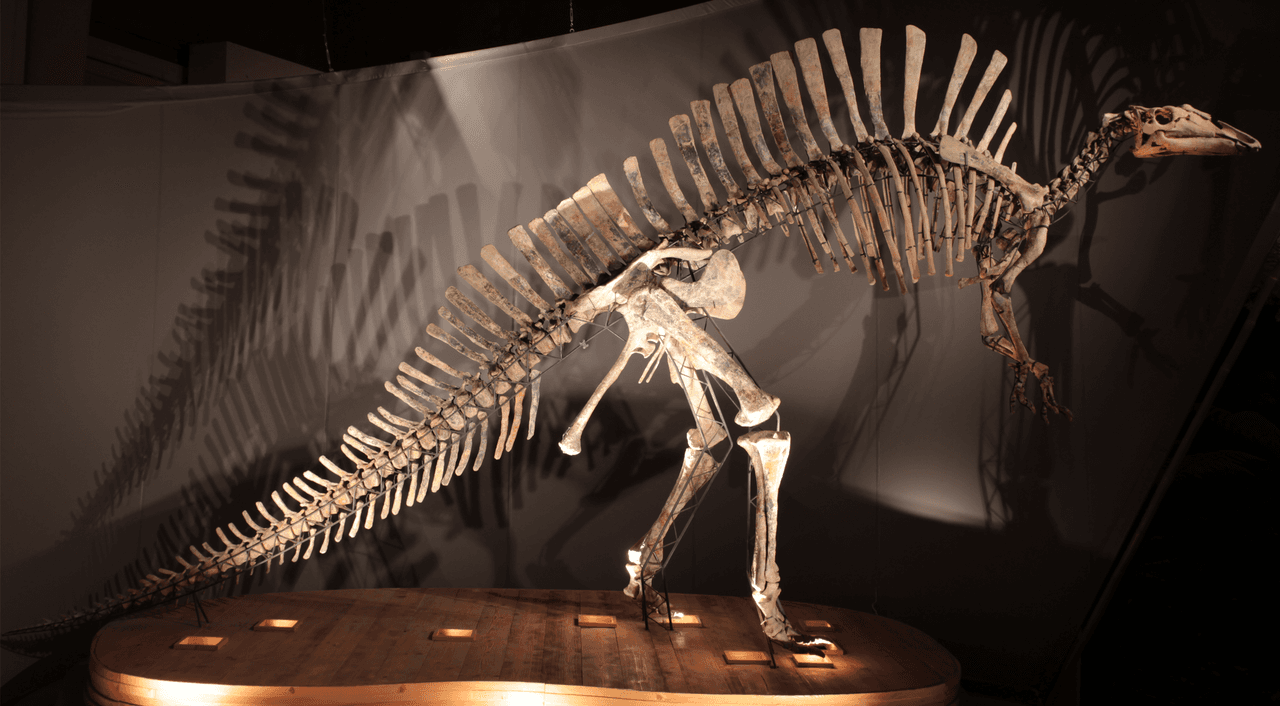
Ouranosaurus museum skeleton
Wikimedia Commons