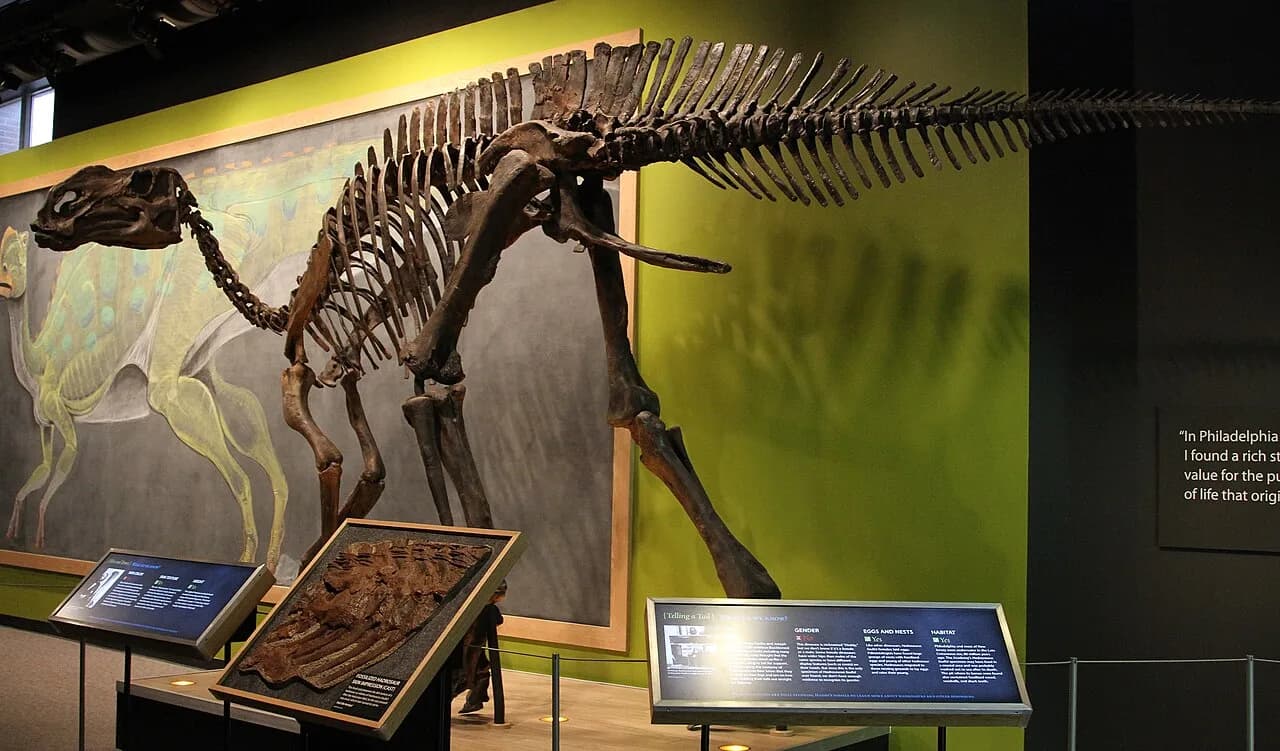
Hadrosaurus
Hadrosaurus foulkii was a herbivorous hadrosaur from New Jersey, described in 1858 and dated to around 80 million years ago. At 7 to 8 metres and 2 to 4 tonnes, it was the first nearly complete dinosaur skeleton ever found. Its discovery at Haddonfield set off a wave of dinomania, and it is now New Jersey's official state dinosaur.
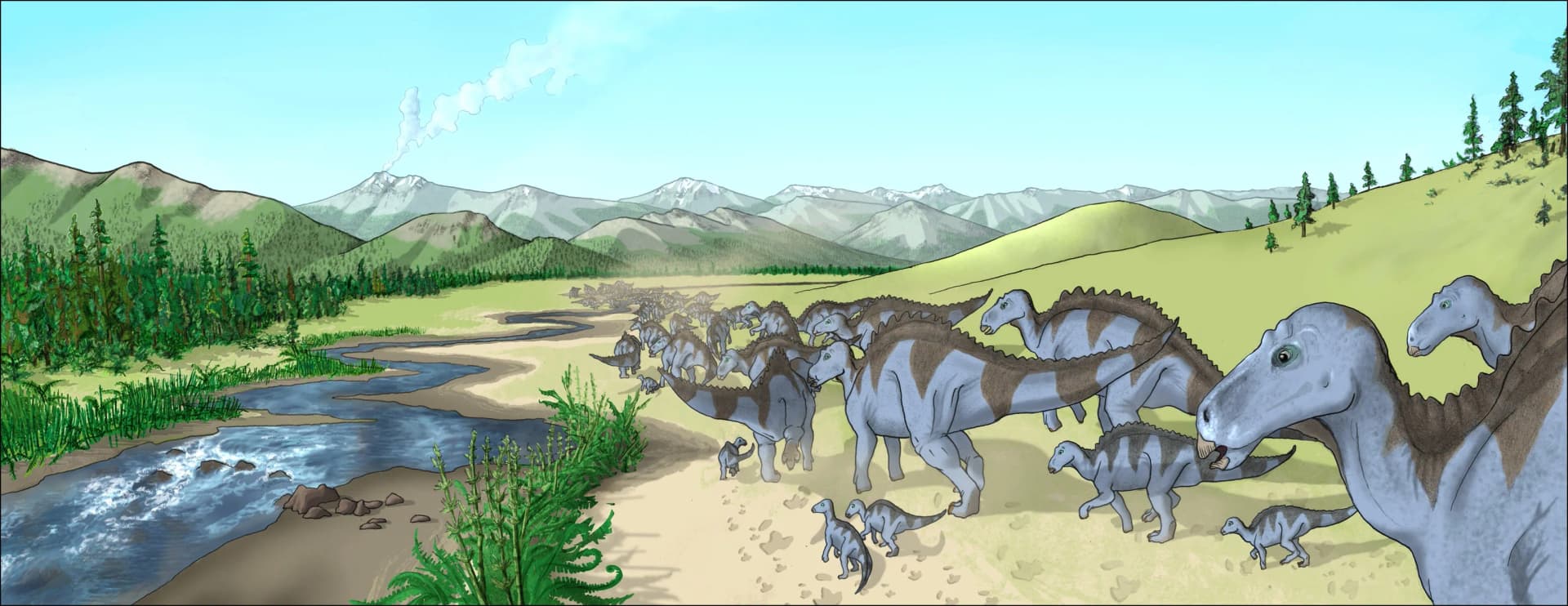
Hadrosaurus lived during the Late Cretaceous period, approximately 80 million years ago (Campanian stage), in eastern North America. At that time, the North American continent was divided into two landmasses by the Western Interior Seaway: Laramidia to the west and Appalachia to the east. Hadrosaurus inhabited the eastern coast of Appalachia, in what is now New Jersey. Its environment consisted of marshy coastal plains bordered by coniferous forests and tree ferns. The climate was warm and humid, conducive to lush vegetation that supported numerous herbivores. Hadrosaurus coexisted with crocodilians, sea turtles, and other poorly known dinosaurs from the eastern Appalachian fauna.
Hadrosaurus was a medium-to-large hadrosaur, measuring between 7 and 8 meters in total length with an estimated weight of 2 to 4 tons. Its hip height reached approximately 3 meters, allowing it to rear up on its hind legs to reach higher vegetation. Its hind limbs were significantly longer and more robust than its forelimbs, a characteristic typical of primitive hadrosaurs. The long, stiffened tail served as a counterbalance when the animal moved in a bipedal position. Compared to giant hadrosaurs like Shantungosaurus, Hadrosaurus remained relatively modest in size, but it was still one of the largest animals in its Appalachian ecosystem.
An exclusive herbivore, Hadrosaurus possessed the characteristic duck-shaped beak of hadrosaurs, perfectly adapted for tearing and cutting low to medium vegetation. Its dental batteries, composed of hundreds of teeth arranged in columns and constantly renewed, allowed it to efficiently grind fibrous and tough plants. Its diet likely included ferns, conifers, cycads, and the early flowering plants (angiosperms) that were beginning to diversify during the Late Cretaceous. The position of its head and beak morphology suggest it fed primarily at ground level and medium height, browsing in the undergrowth of the humid coastal forests of ancient New Jersey.
Hadrosaurus occupied the coastal plains of eastern North America, specifically in the region corresponding to present-day Haddonfield, New Jersey. Its habitat was situated on the continent of Appalachia, separated from Laramidia by the vast Western Interior Seaway. The environment was dominated by coastal marshes, estuaries, and alluvial plains bordered by dense forests of conifers, ferns, and primitive flowering plants. The warm, humid subtropical climate supported abundant year-round vegetation. Marine sediments mixed with terrestrial fossils indicate that Hadrosaurus lived in close proximity to the coastline, in a transitional zone between land and sea.
The anatomy of Hadrosaurus remains incompletely known because no skull has ever been found with certainty associated with this species. The postcranial skeleton reveals a typical hadrosaur with a massive body, powerful hind limbs, and shorter forelimbs equipped with four-fingered hands. The vertebral column was reinforced by ossified tendons along the back and tail, providing rigidity and support during bipedal locomotion. The absence of a skull makes it difficult to determine whether it possessed a crest — a variable trait among hadrosaurs. The limb bones show robust muscle attachments, indicating an animal capable of rapid movement despite its size. The pelvic structure suggests an ability to alternate between bipedal and quadrupedal posture as needed.
Like most hadrosaurs, Hadrosaurus likely exhibited gregarious behavior, moving in herds for protection against predators. Its ability to move in both bipedal and quadrupedal positions offered great versatility: bipedal for running and reaching high vegetation, quadrupedal for ground-level browsing and slow movement. Hadrosaurs are known for their complex vocalizations, although the absence of a Hadrosaurus skull prevents confirmation of this ability for this particular species. It likely lived near waterways and coastal wetlands where vegetation was most abundant. Its size offered relative protection against medium-sized predators, while herd behavior deterred the larger theropods of the region.
Hadrosaurus holds a unique place in the history of paleontology: it was the first nearly complete dinosaur skeleton ever discovered in the world. In 1858, William Parker Foulke unearthed the bones in a marl pit in Haddonfield, New Jersey, after hearing about large vertebrae found at the site twenty years earlier. Paleontologist Joseph Leidy of the Academy of Natural Sciences of Philadelphia described and named the species Hadrosaurus foulkii in honor of its discoverer. This discovery revolutionized the understanding of dinosaurs by demonstrating for the first time that they were bipedal, not simply giant quadrupedal lizards. Hadrosaurus triggered a worldwide 'dinomania' and inspired the first life-size dinosaur reconstruction, created by Benjamin Waterhouse Hawkins in 1868 for the Philadelphia Academy.
| Period | Crétacé supérieur / Late Cretaceous |
| Era | Mésozoïque / Mesozoic |
| Age | 80 Ma |
| Location | Haddonfield, New Jersey, États-Unis / Haddonfield, New Jersey, USA |
| Length | 7-8 m |
| Height | ~3 m |
| Weight | 2-4 t |
| Diet | Herbivore |
| Discovery | 1858 |
Hadrosaurus foulkii is the first nearly complete dinosaur skeleton ever discovered worldwide, unearthed in 1858 by William Parker Foulke at Haddonfield, New Jersey. Its description by Joseph Leidy proved for the first time that dinosaurs were bipedal, overturning the image of giant quadrupedal lizards. The first life-size reconstruction was created by Benjamin Waterhouse Hawkins in 1868, triggering a worldwide 'dinomania.'
Hadrosaurus foulkii measured 7 to 8 meters long, weighing an estimated 2 to 4 tonnes. A strict herbivore, it had dental batteries of hundreds of continuously renewed teeth for grinding fibrous plants, ferns, and conifers. Its duck-shaped beak cut vegetation, while its longer hind limbs allowed it to rear up to reach high vegetation or browse the ground in quadrupedal posture.
Hadrosaurus foulkii inhabited the continent of Appalachia, the eastern part of North America separated from Laramidia by the Western Interior Seaway. 80 million years ago, its region (present-day New Jersey) consisted of subtropical coastal marshes and estuaries, with a warm, humid climate. Marine sediments mixed with terrestrial fossils indicate a life in direct contact with the coastline.
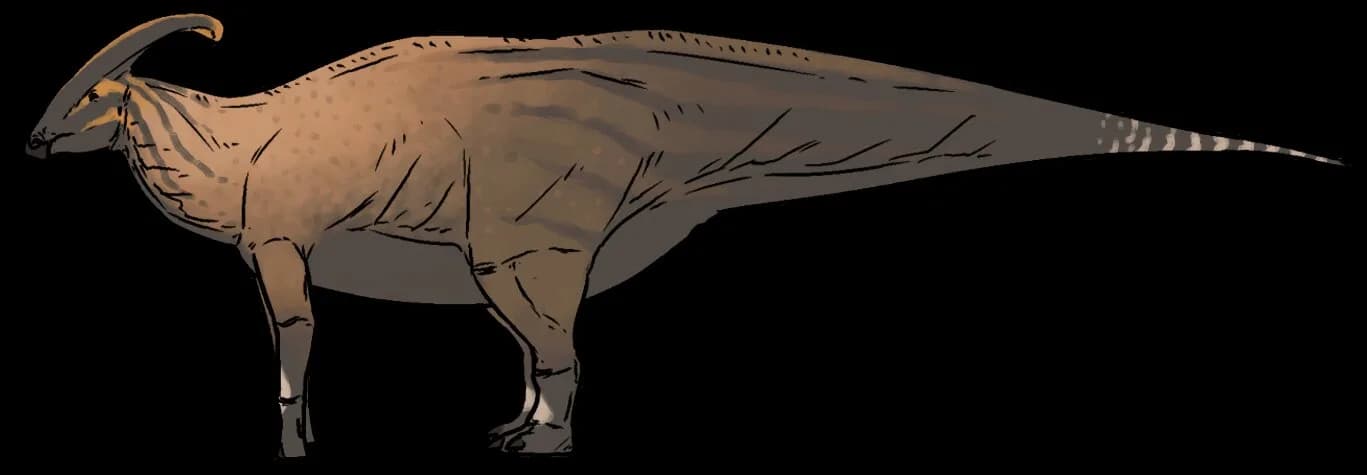
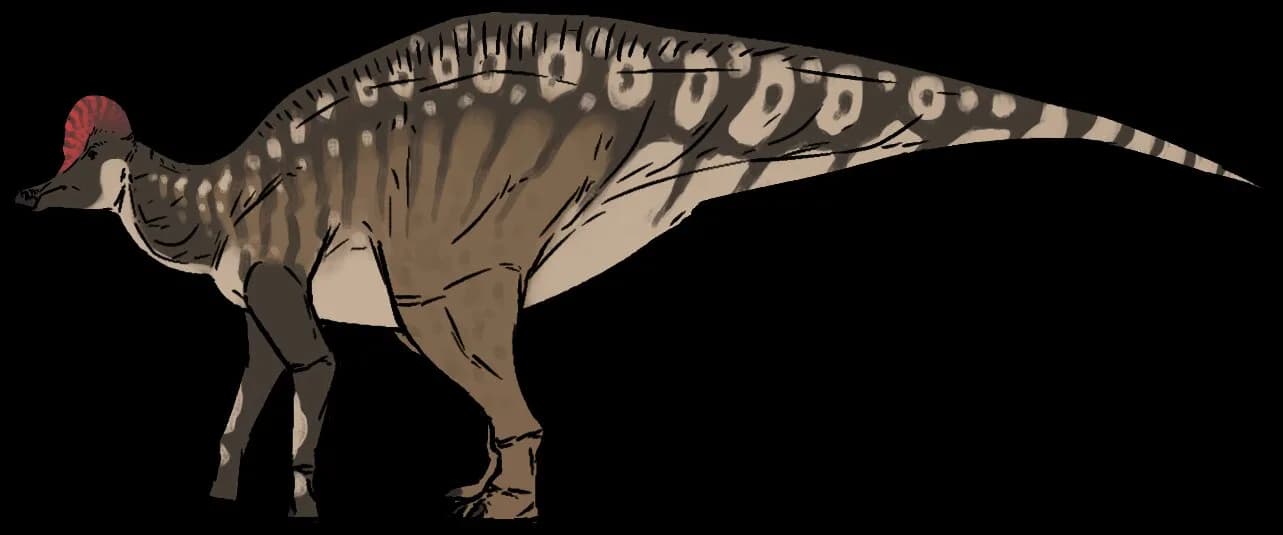
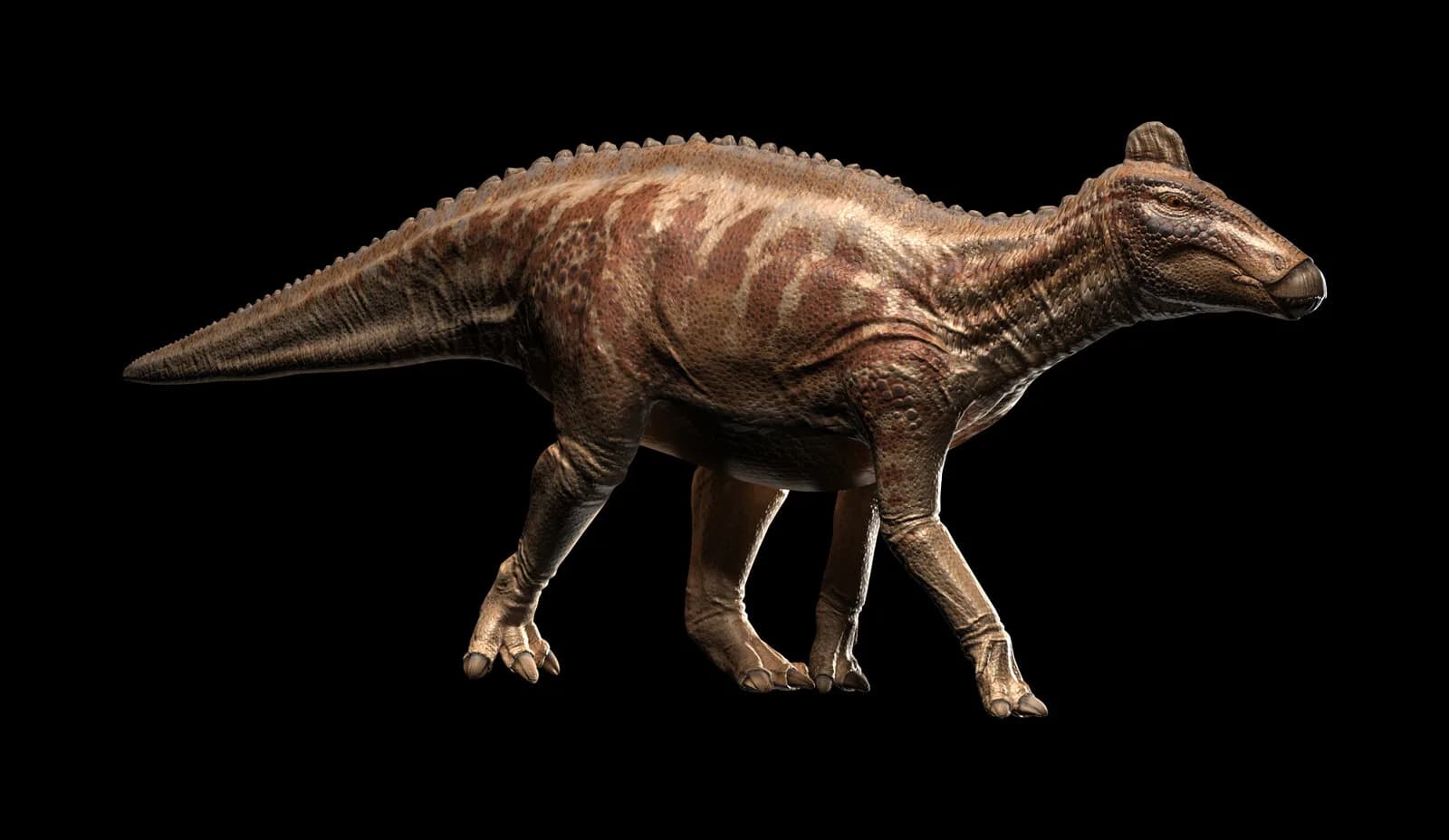
Hadrosaurus foulkii reconstruction
Wikimedia Commons
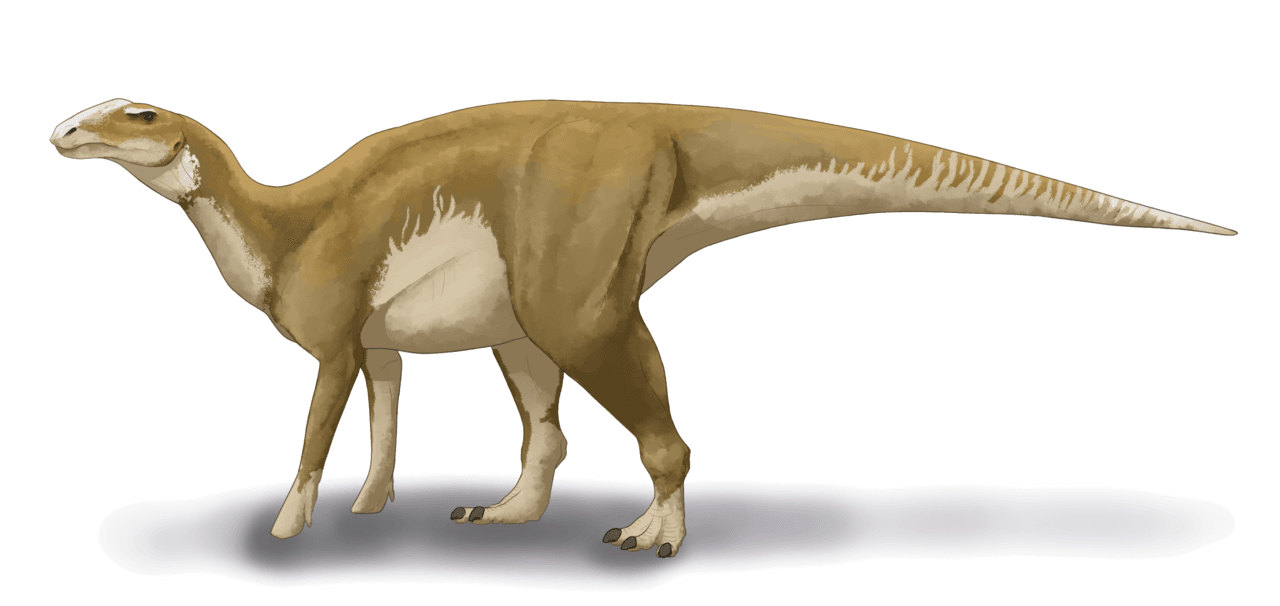
Hadrosaurus foulkii restoration
Wikimedia Commons