Cameroceras
Cameroceras trentonense is the largest invertebrate of the Ordovician: a straight-shelled cephalopod 6 to 9 metres long, weighing around 200 kilograms, which hunted 470 to 443 million years ago, some 200 million years before the first dinosaurs. Its chambered shell worked like a submarine: by adjusting the gas in its internal chambers, it rose or sank through the water column.
Cameroceras lived during the Middle to Late Ordovician, approximately 470 to 443 million years ago, reigning over the primitive oceans as the largest predator of its time. The Ordovician was a period of great marine diversification, sometimes called the 'Great Ordovician Biodiversification Event' (GOBE), during which marine life reached unprecedented complexity. Cameroceras belonged to the order Endocerida, a group of straight-shelled cephalopods (orthocones) that dominated Paleozoic seas. Before the appearance of giant predatory fish like Dunkleosteus in the Devonian, endocerids like Cameroceras were the undisputed masters of the oceans. The end of the Ordovician was marked by a massive extinction event linked to global glaciation that annihilated about 85% of marine species.
Cameroceras is one of the largest invertebrates that ever existed, and certainly the largest known animal of the Ordovician. Size estimates vary considerably: siphuncle fossils (the internal tube of the shell) suggest shells up to 6 meters in length, although older estimates went up to 9 or even 11 meters. Its straight conical shell (orthocone) was massive and calcified, with a diameter that could exceed 30 centimeters at the opening. The living animal, with its tentacles deployed, could probably reach 7 to 8 meters in total length. For perspective, at this time most marine animals measured a few centimeters — Cameroceras was a true giant.
Cameroceras was the undisputed apex super-predator of Ordovician seas, a role comparable to that of modern great sharks. Its powerful tentacles, probably equipped with suckers or hooks, allowed it to capture prey of substantial size. Its diet likely included trilobites (extremely abundant in the Ordovician), smaller cephalopods, primitive eurypterids (sea scorpions), conodonts, and various marine invertebrates. Like modern nautiluses, Cameroceras probably possessed a powerful horny beak capable of crushing the exoskeletons of its prey. Its large size ensured near-immunity from other predators of the era.
Cameroceras inhabited the tropical and subtropical epicontinental seas of the Ordovician, which covered much of the present-day continents. Fossils have been found primarily in North America (Trenton Formation, New York; Kentucky) and Europe (Scandinavia, Estonia). During the Ordovician, Laurentia (proto-North America) and Baltica (proto-Europe) were situated at tropical to subtropical latitudes, separated by the Iapetus Ocean. Cameroceras probably evolved in relatively shallow waters of continental shelves, rich in bryozoan, stromatoporoid, and tabulate coral reefs. These environments hosted a teeming marine biodiversity that formed the food base for this giant.
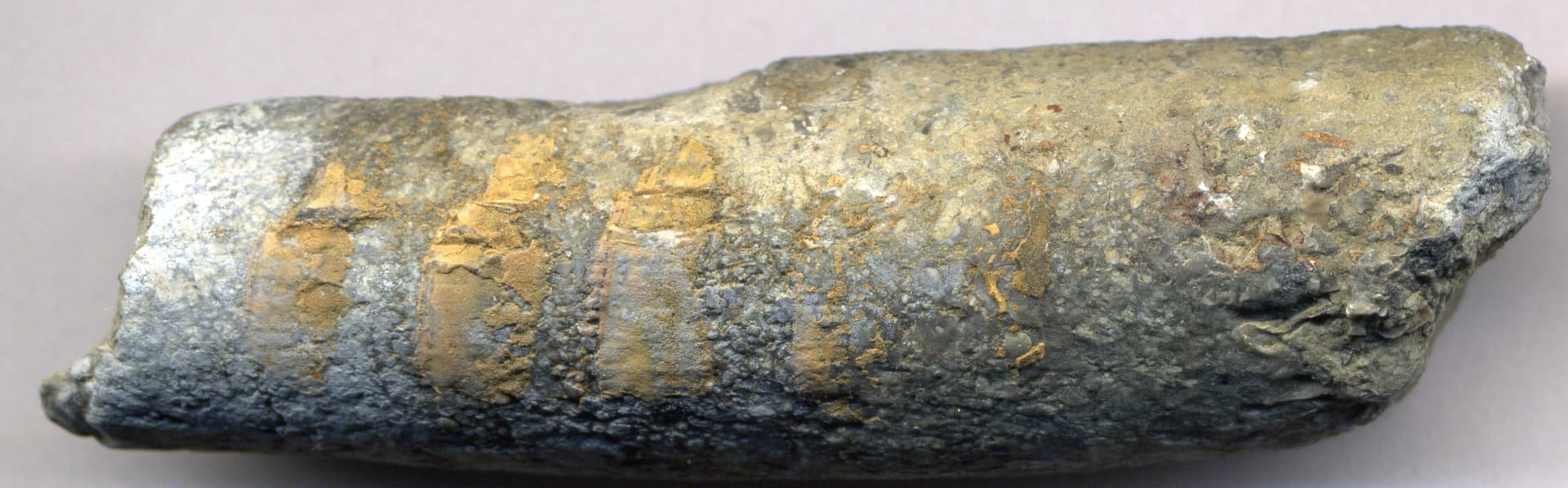
Cameroceras possessed a straight conical shell (orthocone) characteristic of endocerids, radically different from the coiled shell of ammonites and nautiluses. This massive shell contained gas-filled chambers separated by partitions (septa), connected by a large siphuncle — a vascular tube that traversed all chambers and served to regulate buoyancy by adjusting gas-to-liquid proportions. Cameroceras' siphuncle was exceptionally wide, reaching up to one-third of the shell diameter, and contained calcified endosiphuncular deposits that probably served as ballast. The animal lived in the body chamber at the shell opening, from which its head and tentacles emerged. Like modern cephalopods, it probably possessed well-developed eyes and a complex nervous system.
Cameroceras was probably an ambush predator rather than an active hunter. Its straight, massive shell did not allow the rapid maneuvers of coil-shelled cephalopods or modern shell-less squids. It moved slowly by adjusting its buoyancy through its siphuncle and using jet propulsion (water expulsion through the hyponome), a locomotion mechanism common to all cephalopods. Cameroceras probably patrolled just above the seafloor or in the mid-water column, surprising prey with its tentacles. Its large size and powerful beak deterred most potential predators. Endocerids could probably also move vertically in the water column by adjusting the buoyancy of their chambers.
Cameroceras was first described in 1842 by Timothy Abbott Conrad, from fossils discovered in the Ordovician limestones of the Trenton Formation in New York State. The name means 'chambered horn' (Greek: kameros 'vaulted' + keras 'horn'). The largest siphuncle fossils attributed to Cameroceras (or related endocerids like Endoceras) have been found in Scandinavia and Estonia, in exceptionally well-preserved Ordovician limestones. The taxonomy of giant endocerids is complex and controversial — some specimens attributed to Cameroceras may actually belong to Endoceras or Vaginoceras. Regardless of the exact name, these fossils testify to the existence of giant cephalopods that dominated the oceans 200 million years before the first dinosaurs.
| Period | Ordovicien moyen à supérieur / Middle to Late Ordovician |
| Era | Paléozoïque / Paleozoic |
| Age | 470-443 Ma |
| Location | Amérique du Nord (New York, Kentucky), Scandinavie, Estonie / North America (New York, Kentucky), Scandinavia, Estonia |
| Length | 6-9 m (coquille / shell) |
| Weight | ~200 kg (estimation) |
| Diet | Carnivore |
| Discovery | 1842 |
Cameroceras trentonense had a shell reaching 6 to 9 meters in length, with an opening diameter exceeding 30 cm. The complete animal with deployed tentacles could reach 7 to 8 meters. It was undisputedly the largest known animal of the Ordovician, 470 to 443 million years ago, dominating the oceans as the greatest predator of its time.
Cameroceras moved by jet propulsion, expelling water through its hyponome like modern cephalopods. Its wide siphuncle — a tube traversing all shell chambers, reaching up to one-third of the shell diameter — regulated buoyancy by adjusting gas-to-liquid ratios in its chambers, allowing it to rise or sink in the water column.
Timothy Abbott Conrad described Cameroceras in 1842 from fossils found in the Trenton Formation, New York State. Fossils have also been found in Kentucky and northern Europe (Scandinavia, Estonia). The largest known siphuncles, attributed to Cameroceras or the closely related genus Endoceras, come from well-preserved Ordovician limestones in Scandinavia and Estonia.
Cameroceras inaequabile fossil nautiloid from northern Kentucky
Wikipedia Commons
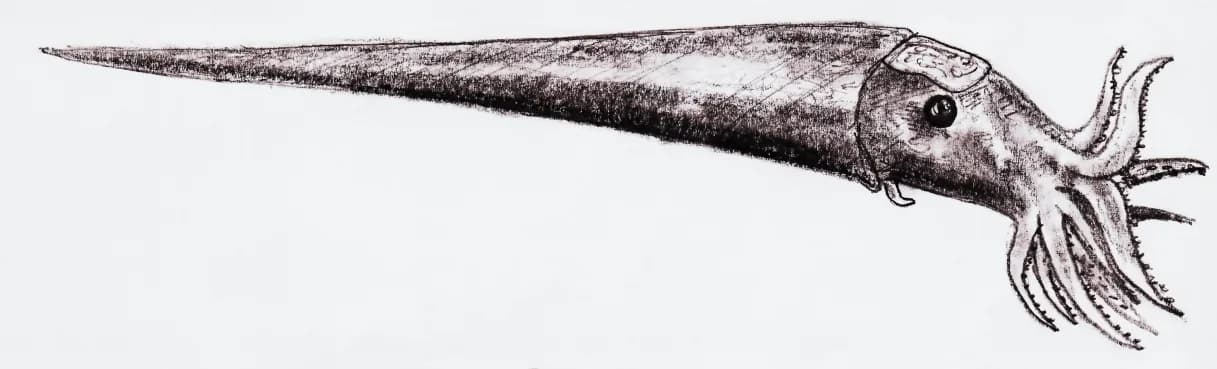
Reconstruction of Cameroceras, giant Ordovician cephalopod
Wikipedia Commons