Onchopristis
Onchopristis numidus was a prehistoric sawfish from North Africa, described in 1905 and dated to 112 to 95 million years ago. At 6 to 8 metres and 500 to 1,000 kilograms, it carried barbed rostral teeth that worked like hooks. Its fossils turn up alongside Spinosaurus so often that they are the main evidence for that dinosaur's fish diet.
Onchopristis lived during the Early to Middle Cretaceous, approximately 112 to 95 million years ago (Albian to Cenomanian). This giant sawfish belonged to the extinct order Sclerorhynchiformes, a group of rostrum-toothed rays not directly related to modern sawfish (Pristidae) despite striking morphological convergence. It evolved in the estuarine and coastal environments of what is now North Africa, within a rich tropical ecosystem that included the famous Spinosaurus. Its extinction coincides with the Cenomanian-Turonian environmental changes that radically transformed North African coastal ecosystems.
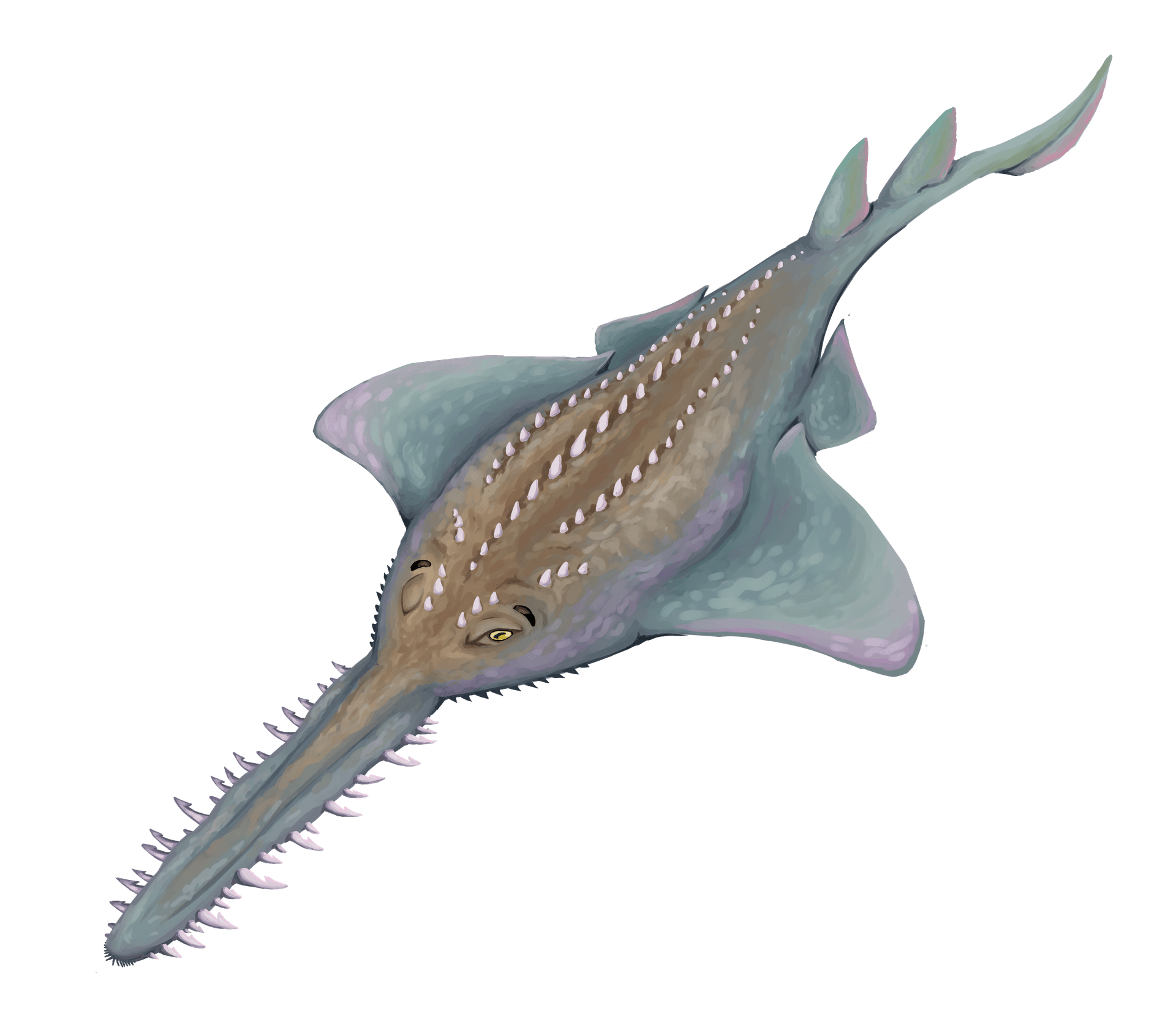
Onchopristis is one of the largest known sclerorhynchids, with an estimated length between 6 and 8 meters for the largest specimens. Its rostrum (elongated saw-like snout) alone could measure 2 to 2.5 meters long and bore characteristic large barbed rostral teeth — each tooth measuring approximately 2 to 5 centimeters with one or two distinctive lateral barbs that make them easily identifiable in the fossil record. Its weight is estimated between 500 kilograms and one tonne. Its dorso-ventrally flattened body was typical of rays, with broad pectoral fins forming a flattened disc.
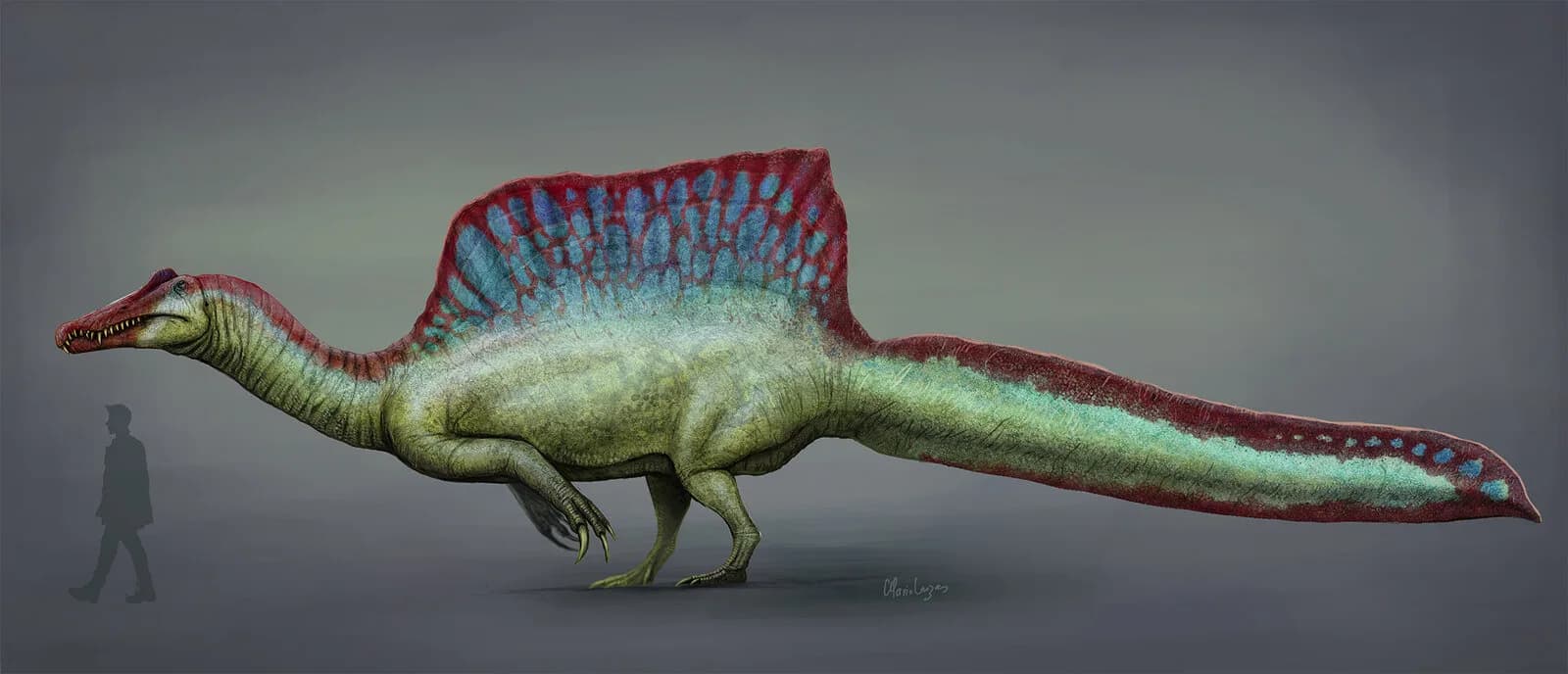
Onchopristis was a specialized benthic predator that used its toothed rostrum to probe sediments and flush out fish, crustaceans, and mollusks buried in the seafloor or riverbed. Its barbed rostral teeth acted like harpoons, preventing prey from escaping once impaled. It could also sweep its rostrum laterally through fish schools to stun or impale prey, a technique similar to modern sawfish. Ironically, Onchopristis was itself an important prey item for Spinosaurus — numerous Onchopristis rostral teeth have been found in association with Spinosaurus remains, and Spinosaurus teeth have been found embedded in Onchopristis bones.
Onchopristis inhabited the coastal, estuarine, and fluvial environments of what is now the Sahara, at a time when this region was a lush tropical delta crossed by immense rivers. Its fossils are primarily known from the Kem Kem formations of Morocco and Algeria, as well as equivalent formations in Egypt and Tunisia. These deposits represent a vast tropical fluvio-deltaic system, with mangroves, floodplains, and freshwater to brackish channels. It shared this habitat with an impressive fauna including Spinosaurus, Carcharodontosaurus, Sarcosuchus, and the giant coelacanth Mawsonia.
The anatomy of Onchopristis is characterized by its spectacular rostrum — an extension of the skull bearing rows of barbed rostral teeth. Unlike modern sawfish whose rostral teeth are smooth, those of Onchopristis bore one or two backward-curving lateral barbs, like fishhooks, making extraction of impaled prey nearly impossible. Its dorso-ventrally flattened body with broad pectoral fins fused to the body formed a typical ray disc. Its ventral mouth, located beneath the head, bore small pavement-like teeth adapted for crushing shelled prey. Its eyes were positioned dorsally, allowing it to watch for predators from the bottom.
Onchopristis probably spent most of its time near the bottom, partially buried in the soft sediments of tropical estuaries and rivers. It used its electrosensitive rostrum to detect buried prey through ampullae of Lorenzini — electrical receptors sensitive to the bioelectric fields emitted by hidden prey muscles. Its hunting technique combined electrical detection, sediment probing, and rapid lateral movements of the rostrum to stun fish. Despite its imposing size, it was regularly hunted by Spinosaurus, as evidenced by numerous fossil associations between these two species in Kem Kem deposits.
Onchopristis was first described by French paleontologist Haug in 1905 from isolated rostral teeth found in Algeria. The name means 'hook saw' (from Greek onkos 'hook' + pristis 'saw'). Its barbed rostral teeth are among the most abundant and recognizable fossils from the Kem Kem beds of Morocco, where they are commonly sold in local markets. Two species are recognized: O. numidus (North Africa) and O. dunklei (North America). The discovery of multiple Onchopristis teeth in direct association with Spinosaurus remains provided crucial evidence for reconstructing the famous sail-backed theropod's piscivorous diet.
| Period | Crétacé inf.-moyen / Early-Middle Cretaceous |
| Era | Mésozoïque / Mesozoic |
| Age | 112-95 Ma |
| Location | Afrique du Nord (Maroc, Algérie, Égypte), Amérique du Nord / North Africa (Morocco, Algeria, Egypt), North America |
| Length | 6-8 m |
| Weight | 500-1000 kg |
| Diet | Carnivore (piscivore) |
| Discovery | 1905 |
No, Onchopristis numidus was not related to modern sawfish (Pristidae) despite a striking resemblance. It belonged to the Sclerorhynchiformes, an extinct order of rostrum-toothed rays. Its similarity to Pristidae is an example of convergent evolution — two distinct lineages independently developed a toothed rostrum for the same purpose. Described by Haug in 1905 from Algerian rostral teeth, it lived 112 to 95 million years ago.
Onchopristis numidus reached 6 to 8 meters in length with a weight of 500 to 1,000 kilograms. Its rostrum could measure 2 to 2.5 meters. Unlike modern Pristidae whose rostral teeth are smooth, those of Onchopristis bore one or two backward-curving lateral barbs — like fishhooks. An impaled prey could no longer free itself. These fossil barbed teeth are so abundant in the Kem Kem beds (Morocco) that they appear on local markets.
Onchopristis numidus rostral teeth have been found in direct association with Spinosaurus remains in the Kem Kem deposits (Morocco-Algeria), and Spinosaurus teeth have been embedded in Onchopristis bones. These fossil associations constitute the primary evidence for Spinosaurus's piscivorous diet. Onchopristis was both a major prey item of this giant theropod and a central player in the tropical fluvio-deltaic ecosystem that covered the present Sahara 112 to 95 million years ago.
Onchopristis numidus reconstruction
Wikipedia Commons
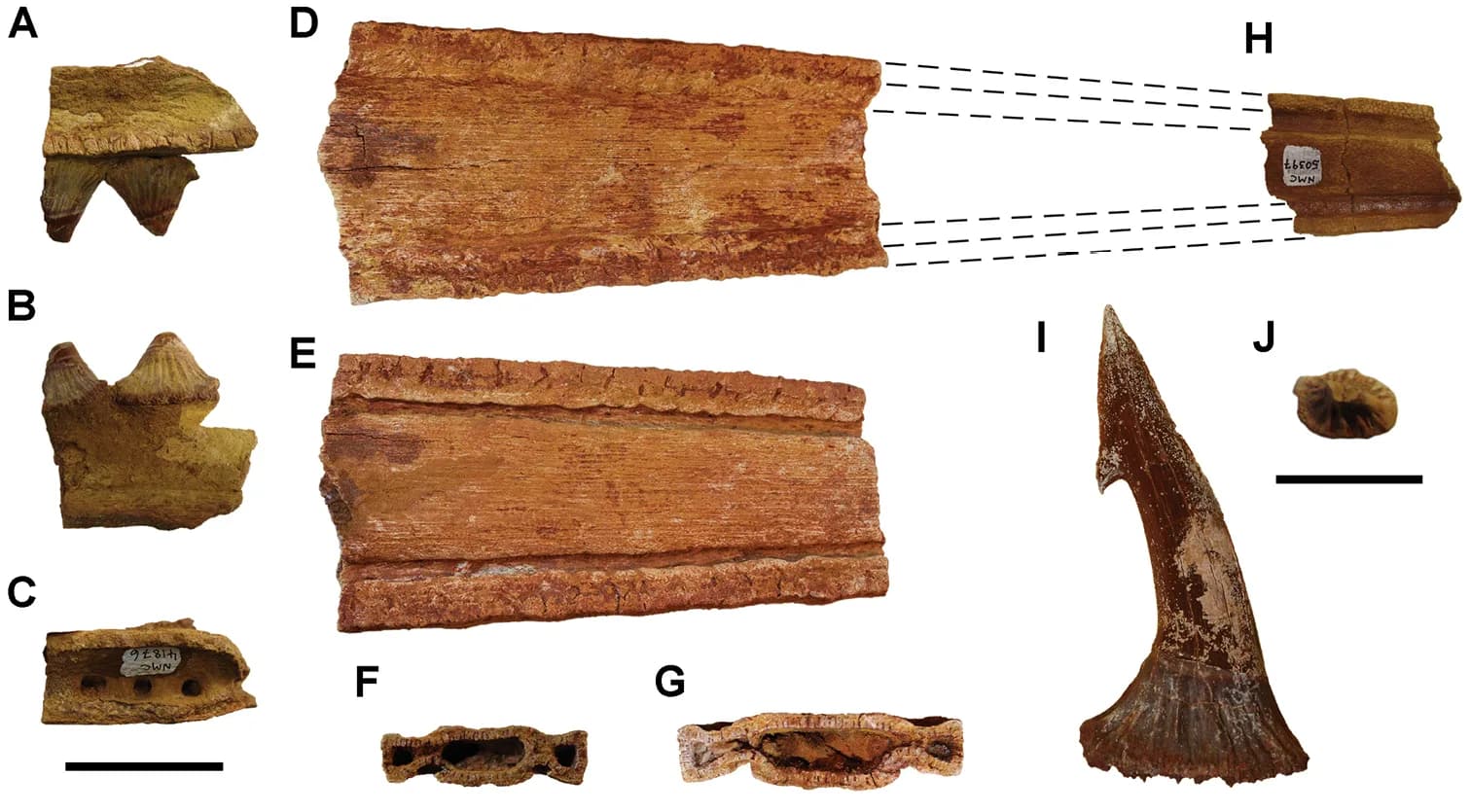
Onchopristis numidus fossil remains
Wikipedia Commons