Titan de cygne
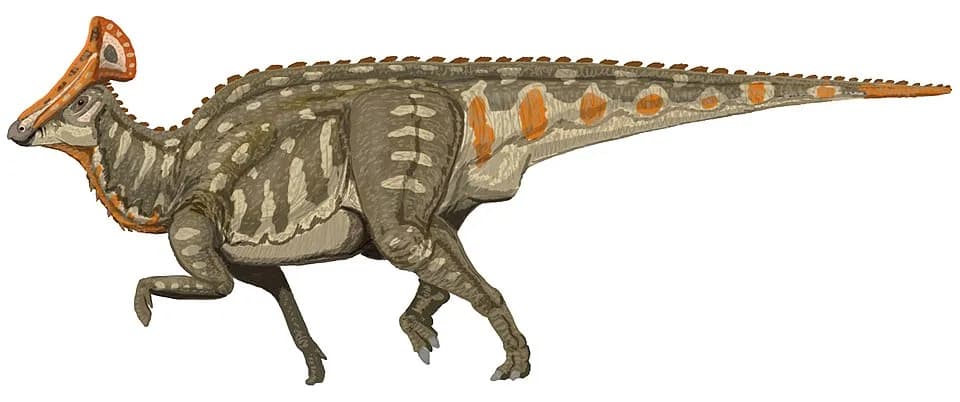
Olorotitan arharensis means « swan titan », after a neck unusually long for a hadrosaurid. Its hollow, hatchet-shaped crest acted as a resonating chamber able to carry low sounds through the forest. Eight to 12 metres long and 3 to 5 tonnes, described in 1999 in Khabarovsk Krai, it lived 70 to 66 million years ago.
Olorotitan lived during the Late Cretaceous, approximately 70 to 66 million years ago, in what is now the Russian Far East. This large lambeosaurine hadrosaur is one of the best-preserved dinosaurs ever discovered in Russia, representing a unique dinosaur fauna at the eastern edge of Asia. Olorotitan lived in the last few million years before the mass extinction at the end of the Cretaceous that ended the reign of dinosaurs. Its existence in eastern Russia demonstrates that crested hadrosaurs had a truly worldwide distribution, covering North America, Asia, and Europe in the final stages of the age of dinosaurs.
Olorotitan was a large hadrosaur, one of the largest known lambeosaurines, measuring between 8 and 12 meters long with an estimated weight of 3 to 5 tonnes. Its height in bipedal posture could reach 4 meters, and its hollow crest added further to its impressive silhouette. Its skull, adorned with a spectacular hatchet-shaped crest, measured approximately 70 centimeters without the crest. Its overall morphology was typical of lambeosaurine hadrosaurs, with a massive body, a long laterally flattened tail, powerful hindlimbs for bipedal and quadrupedal locomotion, and a broad, toothless beak for efficiently browsing vegetation.
Olorotitan was an herbivore whose diet included a variety of Late Cretaceous plants from the Far East. Its dental batteries, composed of hundreds of small teeth stacked in replaceable rows, constituted one of the most efficient masticatory systems of all dinosaurs, capable of grinding even the toughest vegetation. It likely consumed conifers, ferns, angiosperms, and cycads, selecting the most nutritious parts with its broad, precise beak. Its ability to alternate between bipedal and quadrupedal posture allowed it to reach vegetation at different heights, from the ground to low tree branches, maximizing dietary diversity.
Olorotitan inhabited the temperate forests and coastal plains of the Russian Far East during the Late Cretaceous, in the region that corresponds to today's Khabarovsk Krai near the Amur River. The Kundur geological formation, where its fossils were discovered, represents a paleo-environment of temperate coastal forests, markedly different from the subtropical environments where most North American hadrosaurs lived. The climate was cooler, with pronounced seasons possibly including cold winters, making Olorotitan one of the few dinosaurs adapted to near-subarctic conditions. It shared this ecosystem with other hadrosaurs, ankylosaurs, and poorly known theropods.
The anatomy of Olorotitan is remarkable for its spectacular cranial crest, one of the most complex of all hadrosaurs. This hollow hatchet or fan-shaped crest rose toward the back of the skull, formed by the expansion of the nasal and frontal bones into a hollow structure connected to the nasal passages. The internal cavities of the crest formed a network of resonating chambers that amplified vocalizations, making Olorotitan a particularly vocal dinosaur. Its neck was unusually long for a hadrosaur, composed of 18 cervical vertebrae instead of the usual 15, giving it increased flexibility for reaching vegetation. Its tail, long and stiffened by ossified tendons, served as a counterbalance during bipedal locomotion.
Olorotitan's behavior was likely highly social, like that of most lambeosaurine hadrosaurs. Its hollow crest functioned as a natural wind instrument, capable of producing deep, resonant sounds that carried over great distances through temperate forests. These calls likely served to maintain herd cohesion, signal danger, and communicate during breeding periods. The unique shape of its crest probably allowed a species-specific acoustic signature, avoiding confusion with vocalizations of other hadrosaurs sharing the same habitat. It lived in herds that could number dozens or hundreds of individuals, possibly migrating seasonally.
The fossils of Olorotitan were discovered in 1999 near the town of Kundur in Khabarovsk Krai in the Russian Far East by paleontologist Pascal Godefroit and the Russian-Belgian team. The holotype specimen, described by Godefroit, Bolotsky, and Alifanov in 2003, is one of the most complete dinosaur skeletons ever found in Russia, including a nearly entire skull with its intact crest, the majority of the vertebral column, and limb elements. The exceptional quality of this specimen allowed a detailed anatomical description that revealed several unique characters, notably the elongated neck and the distinctive crest shape. This discovery established eastern Russia as a major paleontological region for terminal Cretaceous dinosaurs.
| Period | Crétacé supérieur / Late Cretaceous (Maastrichtien) |
| Era | Mésozoïque / Mesozoic |
| Age | 70–66 millions d'années / 70–66 million years ago |
| Location | Russie (Kraï de Khabarovsk) / Russia (Khabarovsk Krai) |
| Length | 8–12 m |
| Height | ~4 m |
| Weight | 3–5 tonnes |
| Diet | Herbivore |
| Discovery | 1999 |
Olorotitan arharensis's hollow hatchet-shaped crest — formed by expansion of nasal and frontal bones — is one of the most complex of all lambeosaurines. Its internal resonating chambers amplified vocalizations, producing deep calls carrying over great distances in Russia's Far East forests. Its neck had 18 cervical vertebrae instead of the usual 15 — a unique feature among hadrosaurs. Described in 2003 by Godefroit, Bolotsky, and Alifanov.
Olorotitan arharensis measured between 8 and 12 meters long with a weight of 3 to 5 tonnes. In bipedal position, its height reached 4 meters. It inhabited the temperate coastal forests of Khabarovsk Krai (Kundur Formation, Maastrichtian, 70–66 Ma) — a cooler, more seasonal environment than the subtropical habitats of North American hadrosaurs. This makes it one of the few dinosaurs adapted to near-subarctic conditions.
Olorotitan arharensis fossils were discovered in 1999 near Kundur (Khabarovsk Krai) by paleontologist Pascal Godefroit and a Russian-Belgian team. The holotype — one of the most complete dinosaur skeletons ever found in Russia — includes a nearly entire skull with its intact crest and most of the vertebral column. This discovery established Russia's Far East as a major paleontological region for terminal Cretaceous dinosaurs.
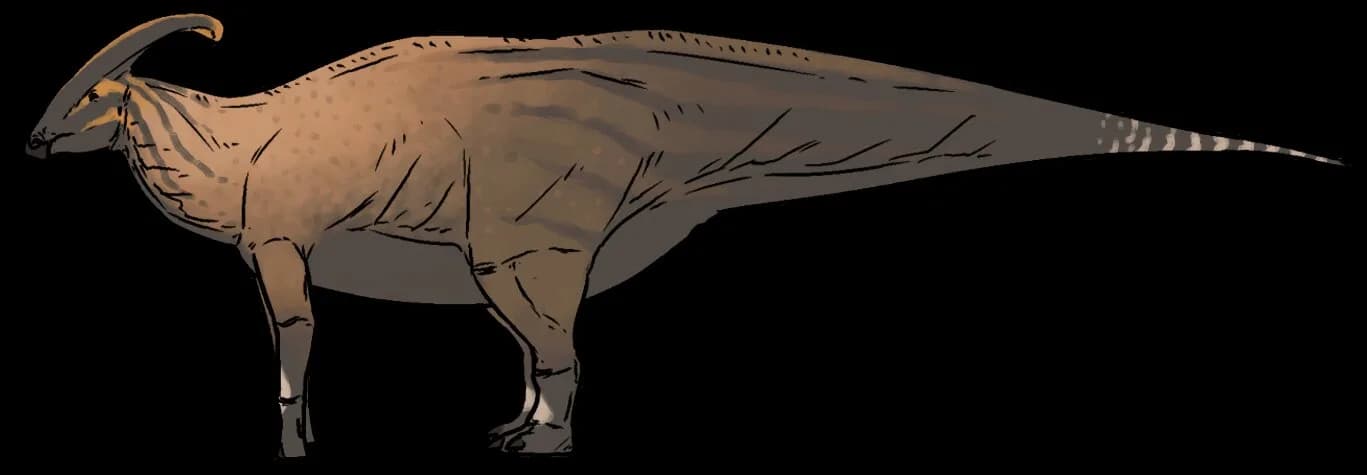
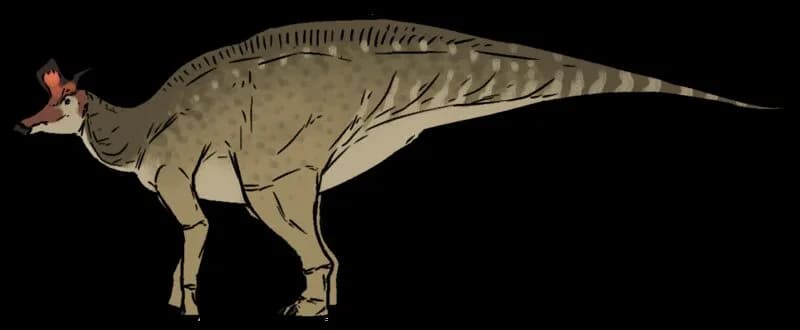
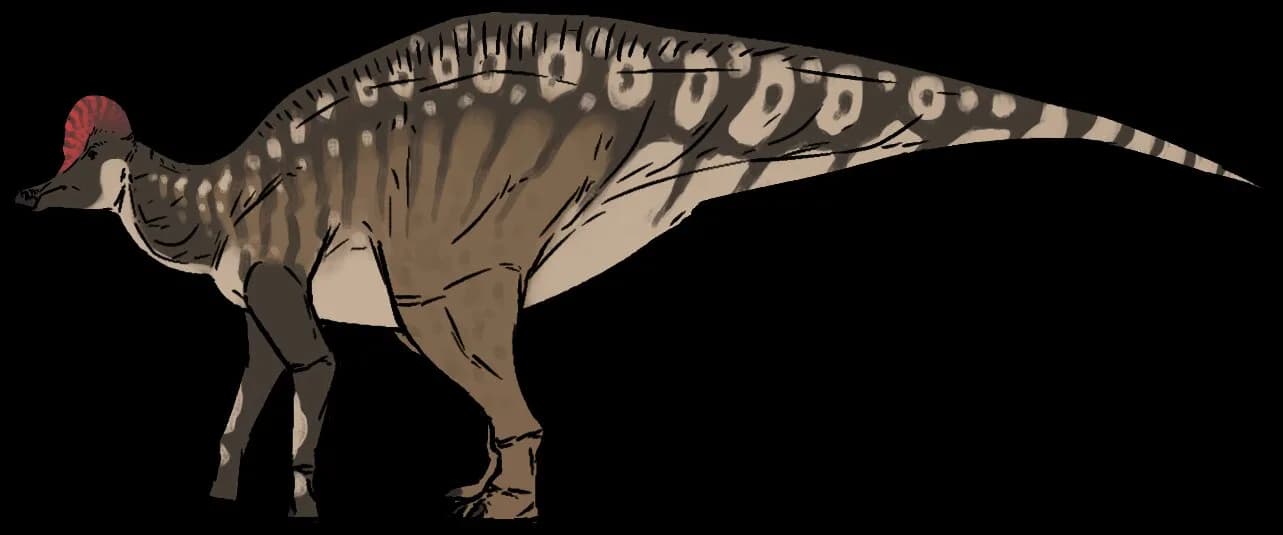
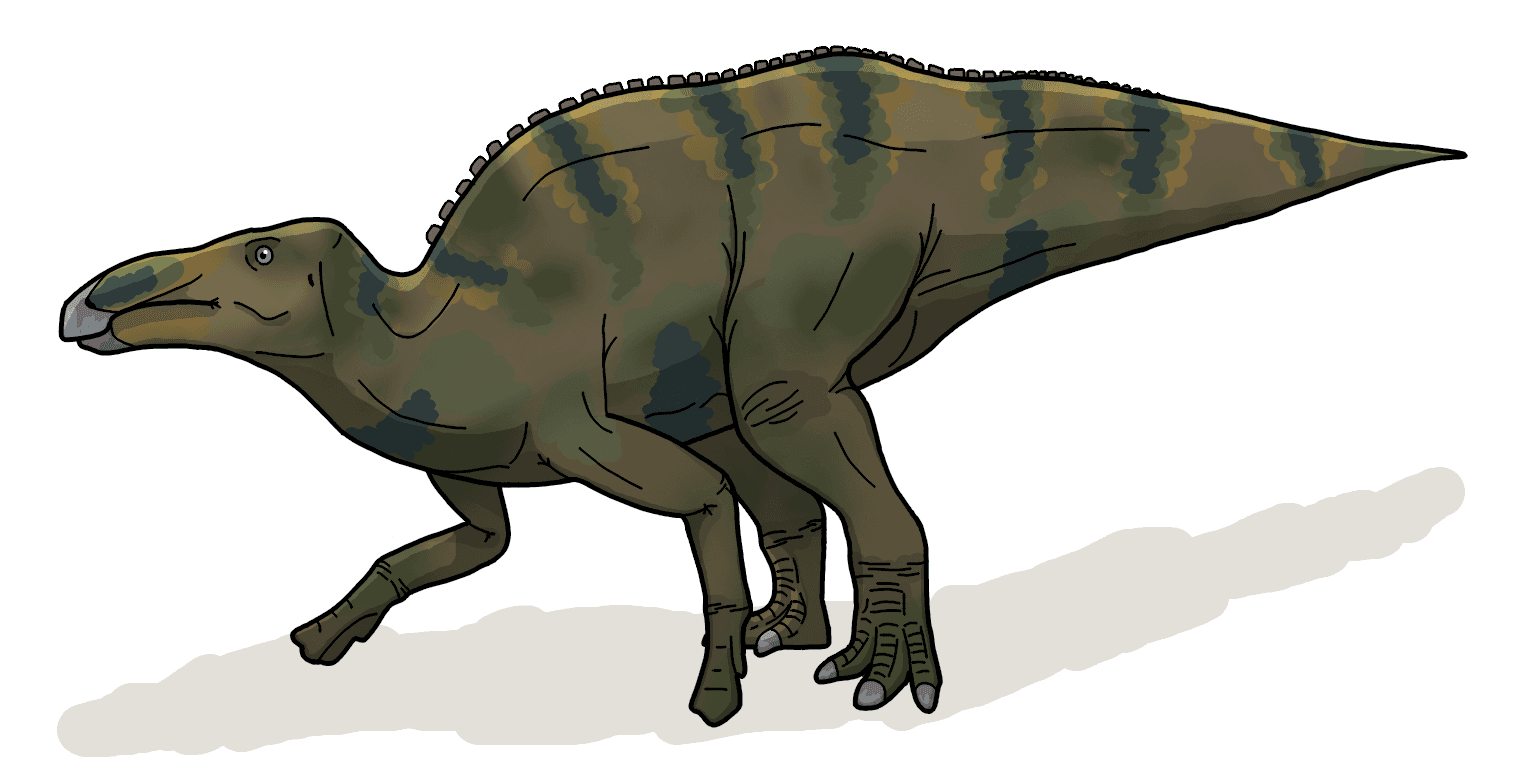
Artistic reconstruction of Olorotitan arharensis with its fan-shaped crest
Wikimedia Commons / Dmitry Bogdanov
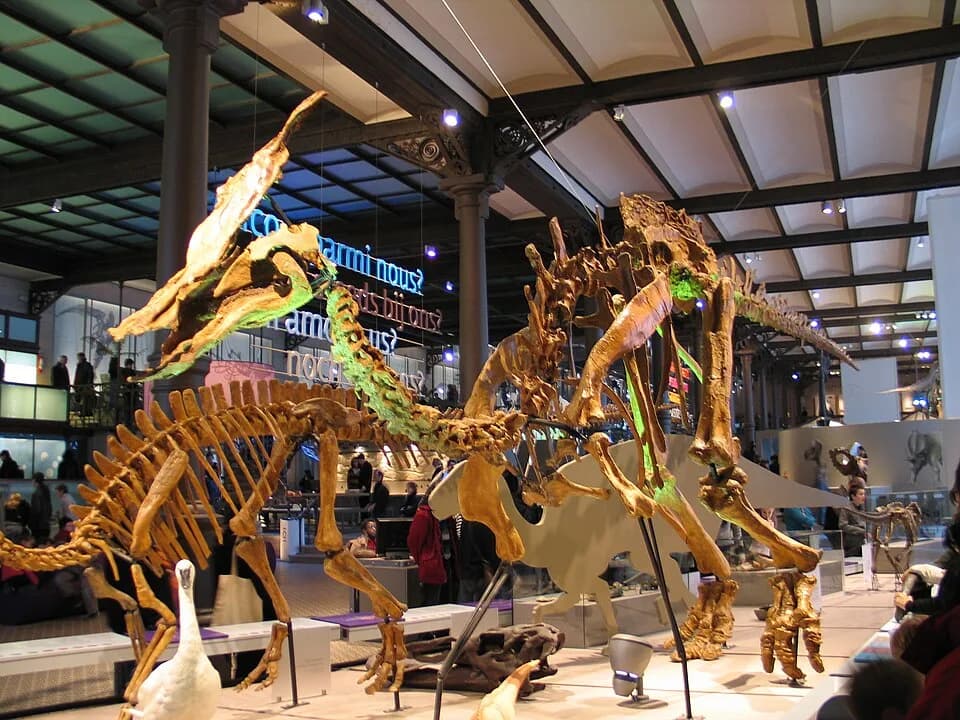
Mounted skeleton of Olorotitan arharensis on display
Wikimedia Commons