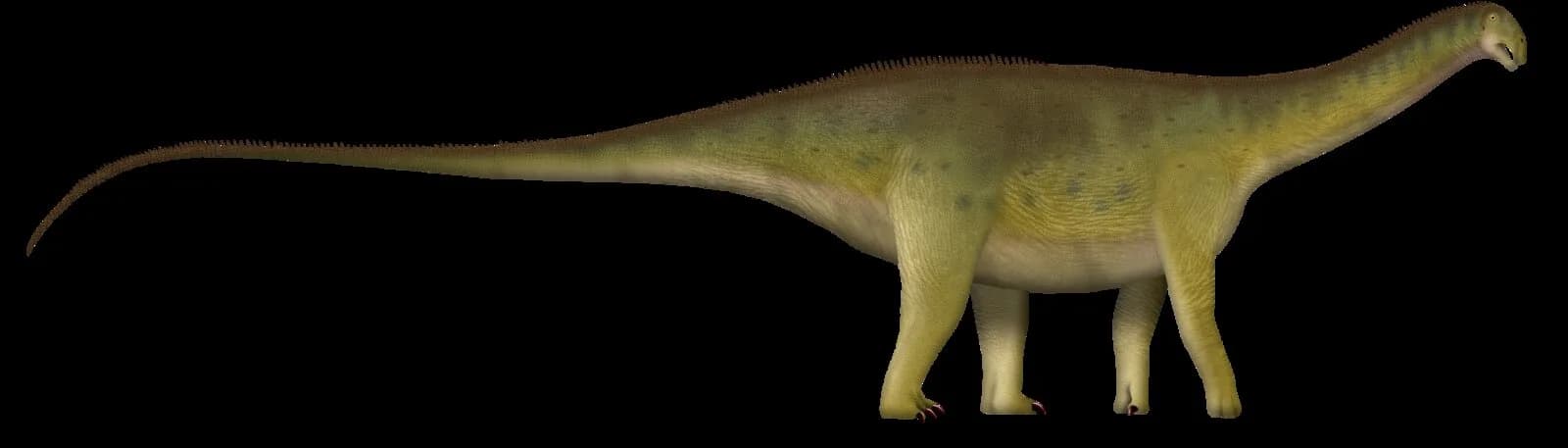
Nigersaurus
Nigersaurus taqueti kept more than five hundred active teeth at all times, each backed by nine replacements stacked behind it and renewed every fourteen days. Its jaw, flattened crosswise, scraped low vegetation like a mower. Nine to 15 metres long and 1.9 to 4 tonnes, it browsed Niger 115 to 105 million years ago.
Nigersaurus lived during the Early to Middle Cretaceous, approximately 115 to 105 million years ago, during the Aptian to Albian stages. Present-day Niger, where it was discovered, was then a vast, fertile alluvial plain crossed by great rivers, with a humid tropical climate. West Africa was still part of Gondwana, and this region harbored a rich and diverse ecosystem. Nigersaurus became famous for its extraordinary jaw, dubbed the 'Mesozoic vacuum cleaner' due to its unique shape adapted for ground-level grazing.
Nigersaurus was a small sauropod, measuring about 9 meters long with an estimated weight of 1.5 to 4 tonnes. This is considerably smaller than most sauropods, barely larger than a modern elephant. Its neck was relatively short for a sauropod, with only 13 highly lightened cervical vertebrae. Its skull was surprisingly wide and short, with a flattened snout that extended wider than the skull base. Its body was gracile and light, with extremely pneumatized (air-filled) bones that considerably reduced its weight.
Nigersaurus was a herbivore with a unique diet among sauropods. Its wide, flattened jaw, oriented directly toward the ground, functioned as a biological lawn mower. Its dental batteries contained over 500 active teeth at any time, arranged in tight rows along the straight edge of its widened jaw. Each tooth position had a column of 9 replacement teeth stacked behind the active tooth, ensuring continuous renewal — the fastest replacement rate known in dinosaurs (approximately every 14 days). It grazed on ferns, horsetails, and low-growing vegetation at ground level.
Nigersaurus inhabited the lush alluvial plains of the Elrhaz Formation in the Gadoufaoua region of Niger. This landscape was a vast plain crossed by seasonal rivers and bordered by riparian forests. The climate was tropical and humid, supporting dense vegetation of ferns, horsetails, and conifers. It shared its environment with other dinosaurs, notably the large sauropod Jobaria, the theropod Suchomimus (a spinosaurid), and the ornithopod Ouranosaurus. The abundance of low vegetation in this environment perfectly suited its ground-level feeding mode.
Nigersaurus anatomy is remarkable for its extreme adaptations to grazing. Its skull is one of the strangest of all dinosaurs: the upper jaw was wider than the rest of the skull, with tooth rows arranged in a straight transverse line along the front edge, oriented directly downward. The cranial bones were so thin and pneumatized that some walls measured only one millimeter thick. Its vertebrae were also extremely lightened, with more air than bone, making its skeleton fragile but light. Its neck, naturally held in a low position, probably could not be raised above horizontal.
Nigersaurus was a highly specialized grazer that spent most of its time mowing vegetation at ground level, with its head perpetually lowered toward the earth. Its short, downward-oriented neck, combined with its unique mower-shaped jaw, allowed it to sweep wide strips of vegetation without moving its body, much like a cow grazing a pasture. It moved slowly between grazing areas, probably in small herds for safety. Its bone fragility and lack of apparent defenses suggest it relied on group numbers and constant vigilance for protection from predators like the formidable Suchomimus.
The first Nigersaurus remains were collected in 1965-1972 by French paleontologist Philippe Taquet in the Elrhaz Formation in Niger, but the material remained long undescribed due to the extreme fragility of the bones. It was not until 1999 that Paul Sereno and his team found more complete specimens during an expedition to the same region. The species was described in 2007 by Sereno et al. as Nigersaurus taqueti, honoring Philippe Taquet. The skull, reconstructed by CT scanning, revealed anatomy so unusual that Sereno called it 'the weirdest dinosaur we've ever seen.' CT scans showed the columns of replacement teeth and the exceptional pneumatic structure of the skull.
| Period | Crétacé inférieur-moyen / Early-Middle Cretaceous (Aptien–Albien) |
| Era | Mésozoïque / Mesozoic |
| Age | 115–105 Ma |
| Location | Afrique / Africa (Niger) |
| Length | 9–15 m |
| Height | ~2 m |
| Weight | 1 900–4 000 kg |
| Diet | Herbivore |
| Discovery | 1997 |
Nigersaurus taqueti's jaw was wide, flattened, and oriented directly downward, functioning as a biological lawn mower. Its dental batteries contained over 500 active teeth at any time, arranged in a straight transverse row. Each tooth position had 9 stacked replacement teeth, renewed every 14 days — the fastest known replacement rate among dinosaurs. This 9-meter sauropod grazed ferns and horsetails at ground level in Cretaceous Niger.
Nigersaurus taqueti measured about 9 meters long with an estimated weight of 1,900 to 4,000 kilograms — modest for a sauropod. Its skeleton was extremely lightweight: some cranial bone walls measured only one millimeter thick, and vertebrae contained more air than bone. Its short neck (13 lightened cervical vertebrae) was naturally oriented downward and probably could not be raised above horizontal.
The first Nigersaurus taqueti remains were collected in 1965–1972 by Philippe Taquet in Niger. The species was described in 2007 by Paul Sereno et al., who honored Taquet in the species name. It lived in the Elrhaz Formation (Gadoufaoua, Niger) 115 to 105 million years ago alongside the spinosaurid Suchomimus, the giant sauropod Jobaria, and the ornithopod Ouranosaurus.
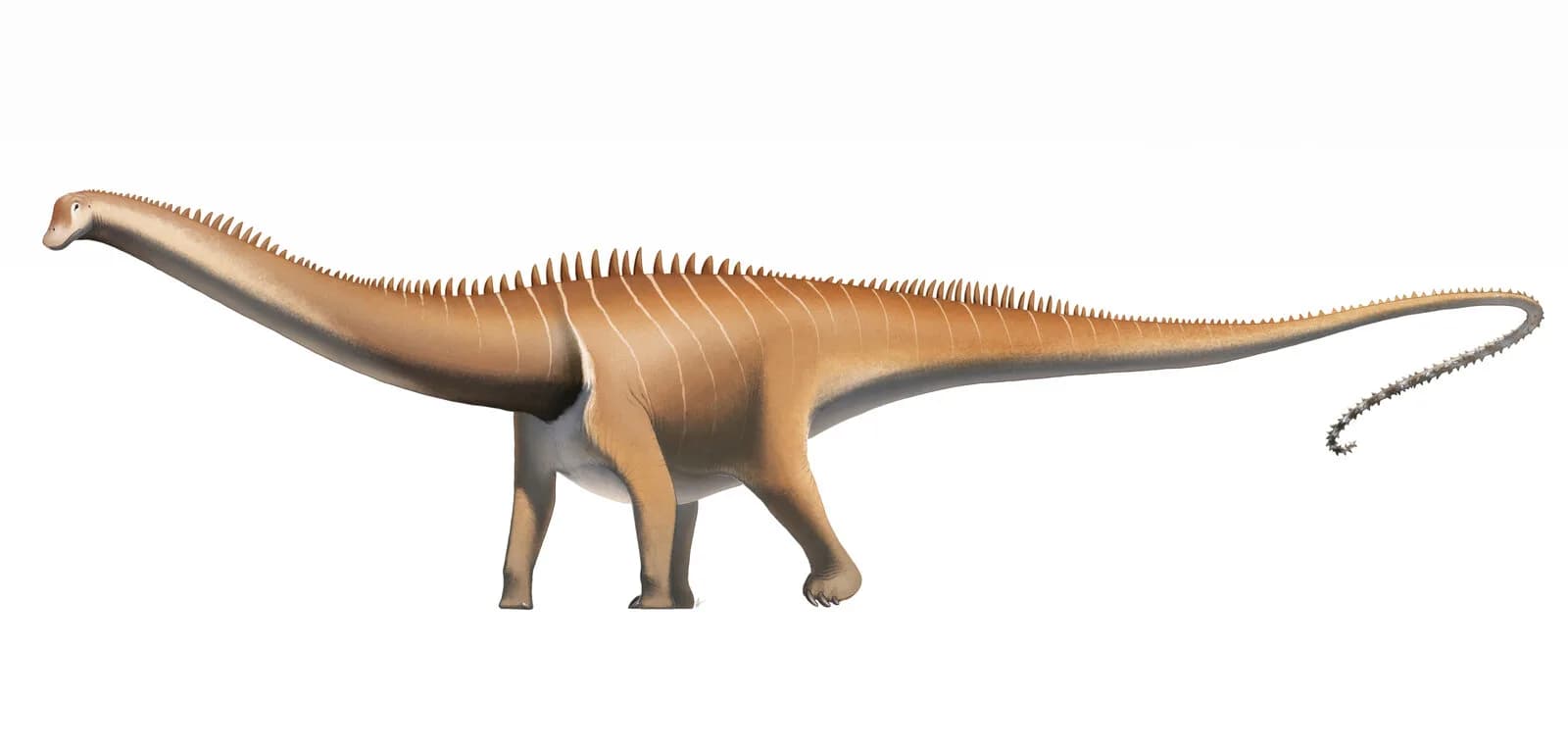
Life reconstruction of Nigersaurus taqueti
TotalDino, CC BY 4.0, via Wikimedia Commons
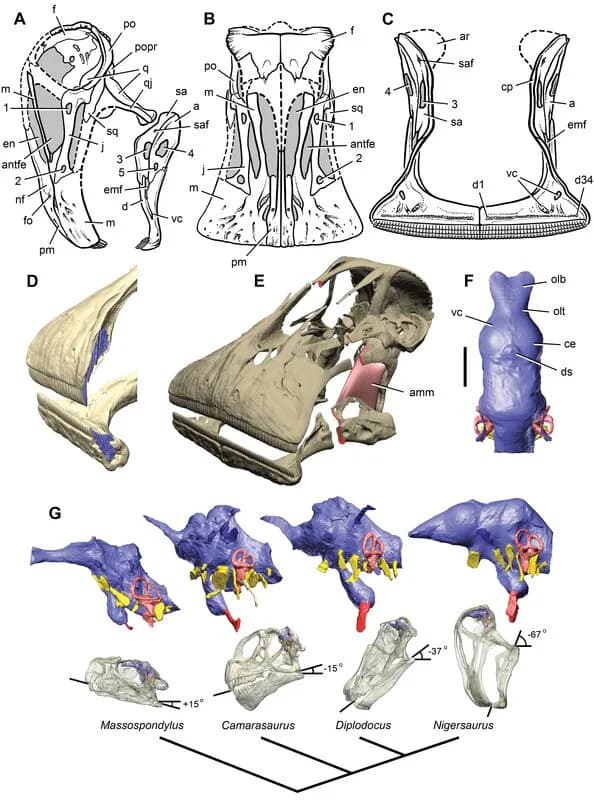
Nigersaurus taqueti fossil skull
Sereno et al., CC BY 2.5