Nasutocératops
Nasutoceratops titusi was a herbivorous ceratopsian from North America, described in 2013 and dated to 76 to 75 million years ago. At 4.5 metres and 1.5 tonnes, its name means big-nosed horned face, a reference to an unusually broad snout. Its long brow horns curve forward, recalling those of cattle.
Nasutoceratops lived during the Late Cretaceous, approximately 76 to 75 million years ago (Campanian), in what is now Utah. It belongs to the subfamily Centrosaurinae within the family Ceratopsidae. Its discovery significantly enriched our understanding of ceratopsian diversity in southern Laramidia, an island continent formed by the Western Interior Seaway of North America. The single recognized species is Nasutoceratops titusi, named in honor of Alan Titus, a paleontologist with the Bureau of Land Management in Utah who played a key role in excavations of the Kaiparowits Formation. The official scientific description was published in 2013 by Scott Sampson and colleagues.
Nasutoceratops was a modestly sized ceratopsian, measuring approximately 4.5 meters in length and reaching about 1.5 meters in height at the shoulder, with an estimated weight of 1.5 tonnes. It was thus considerably smaller than its cousin Triceratops, yet remained an imposing herbivore for its time and ecosystem. Its skull, though robust, was proportionally less massive than in giant ceratopsids, with a relatively short and thick frill ornamented with small blunt spines along its edges. Its stocky silhouette and strong limbs gave it a robust appearance, well adapted to navigating the coastal and marshy environments of the Kaiparowits Formation.
A strict herbivore, Nasutoceratops fed primarily on low-growing vegetation and fibrous plants available in its coastal subtropical environment. Its powerful horny beak allowed it to efficiently sever tough stems and resistant leaves of cycads, ferns, and primitive angiosperms that populated the floodplains and riparian forests of Cretaceous Utah. Like all ceratopsids, it possessed complex dental batteries composed of hundreds of continuously replaced teeth, forming true vegetable shears capable of grinding the hardest plant matter. Its ecological niche as a robust browser made it a key actor in the Kaiparowits ecosystem, alongside other large herbivores such as the hadrosaur Parasaurolophus and the ankylosaur Akainacephalus.
Nasutoceratops inhabited the low coastal plains and deltaic environments of southern Laramidia, in the region corresponding to modern-day Utah. The Kaiparowits Formation, rich in fluvial and lacustrine sediments, records a warm and humid environment dominated by dense subtropical forests, floodplains, and coastal swamps bordering the Bearpaw Sea to the north. This rich and diverse environment hosted an extraordinarily varied fauna — one of the densest of the Cretaceous in North America. The high density of different ceratopsians in the same formation suggests strong ecological niche partitioning, with each species exploiting slightly different plant resources according to their distinctive cranial morphology.
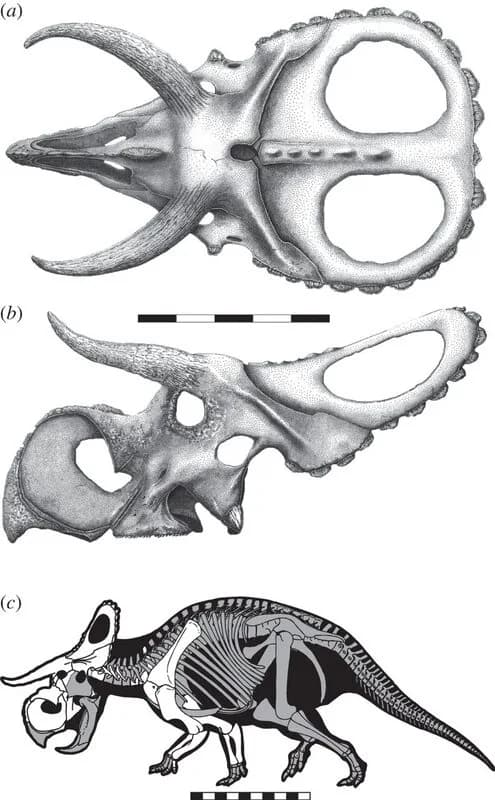
The most striking anatomical feature of Nasutoceratops is its extraordinarily large and developed snout — its generic name literally means 'large-nosed face' in Latin. Unlike most other ceratopsians whose large horns are placed above the eyes pointing upward, Nasutoceratops bears long, curving supraorbital horns remarkably similar to those of domestic cattle, oriented forward and slightly downward rather than upward. The nasal horn, by contrast, is small and poorly developed, almost vestigial. Its relatively short frill is rounded in shape with a thickened rim ornamented with blunt spines. This unique combination of anatomical traits — large nose, bovine-like horns, small nasal horn — immediately distinguishes it from all known relatives.
The behavior of Nasutoceratops is inferred from its anatomy and comparisons with close relatives. Its long curved supraorbital horns, similar to those of modern cattle, strongly suggest they were used in ritualized intraspecific combat to establish social dominance and access to reproductive partners — in the same way that bulls compete by locking horns. The colorful frill likely also played an important role in visual signaling within the group. As a probable gregarious large herbivore, it likely moved in herds for better protection against the predators of Kaiparowits, notably tyrannosaurs such as the formidable Teratophoneus curriei, the apex predator of its ecosystem.
Fossils of Nasutoceratops titusi come exclusively from the Kaiparowits Formation in Grand Staircase-Escalante National Monument in southern Utah. Discovered specimens include several partial skulls and postcranial elements, including the holotype specimen UMNH VP 16800 described by Sampson et al. in 2013. Excavations in this long-inaccessible and difficult-to-explore region have revealed an exceptionally diverse Campanian fauna, distinct from that of northern Laramidia. The Kaiparowits Formation thus represents a precious window into the southern biodiversity of Cretaceous North America, demonstrating that the insular geography of Laramidia promoted rapid speciation and marked regional endemism among dinosaurs.
| Period | Crétacé supérieur / Late Cretaceous |
| Era | Mésozoïque / Mesozoic |
| Age | 76-75 Ma |
| Location | Amérique du Nord / North America |
| Length | 4.5 m |
| Height | 1.5 m |
| Weight | 1.5 tonnes |
| Diet | Herbivore |
| Discovery | 2013 |
Nasutoceratops titusi bore long supraorbital horns curving forward and slightly downward, strikingly similar to those of domestic cattle — unlike most ceratopsians whose horns point upward. Its nasal horn, by contrast, was small and nearly vestigial. Its extraordinarily large snout earned it its name (Latin: 'large-nosed face'). Described in 2013 by Sampson et al. from Utah, Campanian (76–75 Ma).
Nasutoceratops titusi measured approximately 4.5 meters long with a shoulder height of 1.5 meters and an estimated weight of 1.5 tonnes. It lived in the Kaiparowits Formation (Utah, Grand Staircase-Escalante National Monument) 76 to 75 million years ago. This coastal subtropical ecosystem of southern Laramidia also included Parasaurolophus, the ankylosaur Akainacephalus, and the tyrannosaur Teratophoneus curriei as apex predator.
The insular geography of Laramidia — a narrow continent divided by the Bearpaw Sea — promoted rapid speciation and strong regional endemism. The Kaiparowits Formation represents southern Laramidia, a fauna distinct from the north. The coexistence of several ceratopsians in the same formation (including Nasutoceratops titusi) is explained by dietary niche partitioning — each species exploiting slightly different vegetation based on its skull morphology.
Skull and skeleton composite of Nasutoceratops titusi, showing its long curved horns and characteristic large snout
Wikimedia Commons, CC BY-SA
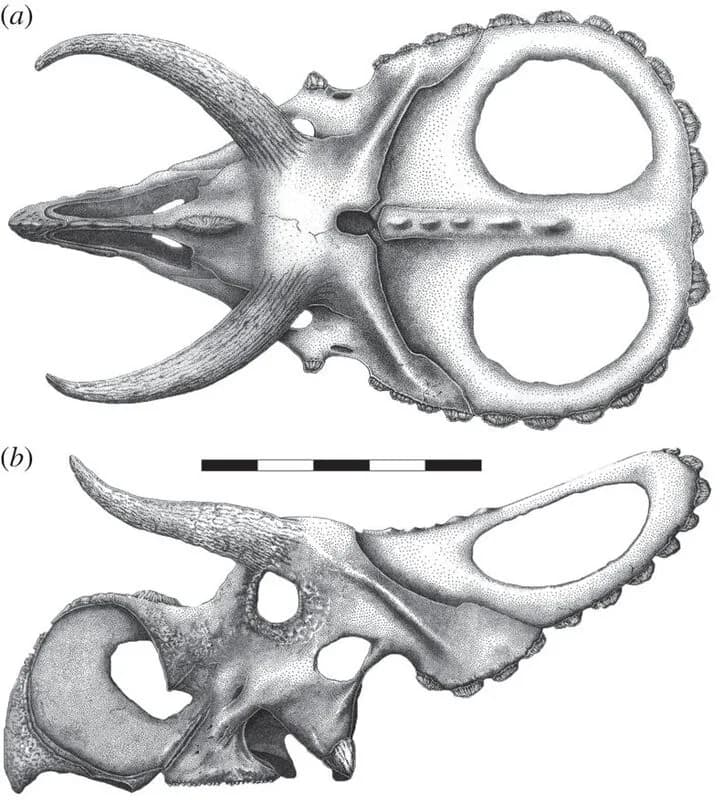
Skull specimen of Nasutoceratops titusi illustrating the unique morphology of its broadened snout and bovine-like supraorbital horns
Wikimedia Commons, CC BY-SA