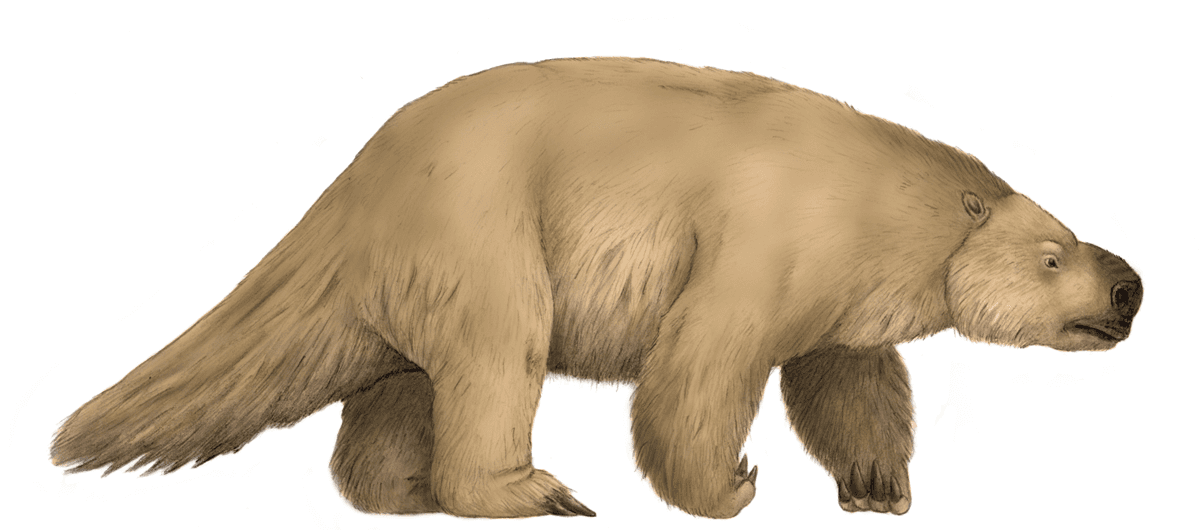
Mylodon
Mylodon darwinii was a giant ground sloth from Patagonia, present from 1.8 million years ago until 10,000 years before the present. At 3 metres and 1 to 2 tonnes, it was named by Richard Owen in 1840 from fossils brought back by Charles Darwin himself. In 1895 a piece of its skin turned up in a Chilean cave, remarkably preserved.
Mylodon lived during the Pleistocene, approximately 1.8 million to 10,000 years ago, at the heart of the South American Ice Age. This giant ground sloth appeared at the beginning of the Pleistocene in South America, a continent that then harbored an extraordinarily diverse and spectacular megafauna. The genus Mylodon belongs to the family Mylodontidae, a group of ground sloths distinct from the Megatheriidae to which the famous Megatherium belongs. Mylodon thrived during the successive Pleistocene glaciations, perfectly adapted to the cold, windswept conditions of Patagonia and the southern cone of the continent. It coexisted with the first humans who arrived in South America around 14,000 years ago, as evidenced by archaeological remains found in the Cueva del Milodón in Chile. Its disappearance, around 10,000 BCE, coincides with the massive extinction of South American megafauna, likely caused by a combination of rapid climate change and increasing human hunting pressure.
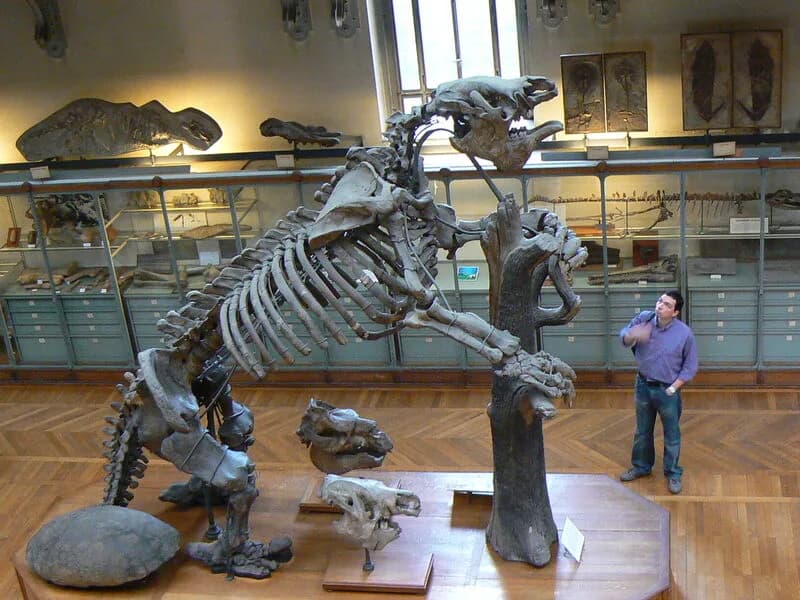
Mylodon was an imposing animal, measuring approximately 3 meters in total length from snout to tail, with a shoulder height of about 1.5 meters when walking on all fours. Its estimated weight ranged between 1 and 2 tonnes, making it one of the largest terrestrial mammals in Pleistocene Patagonia. Although considerably smaller than its cousin Megatherium — which could reach 6 meters long and weigh 4 tonnes — Mylodon was still a giant compared to modern tree-dwelling sloths that weigh no more than 8 kg. When rearing up on its hind legs, as it likely did to reach higher vegetation or to intimidate predators, it could stand over 2.5 meters tall, towering over most other animals in its environment. Its stocky, massive build, with a wide pelvis and robust limbs, reflected an animal built for power rather than speed.
Mylodon was a generalist herbivore that fed on a wide variety of plants available in the grasslands and semi-arid zones of Patagonia. Isotopic analysis of its bone remains and preserved fur indicates a mixed diet of grazing and browsing, combining cold-resistant grasses with low shrubs, herbs, and possibly mosses. Its teeth, lacking enamel but continuously growing, were perfectly adapted to grinding tough, fibrous vegetation loaded with abrasive silica. Its powerful jaw and well-developed masticatory muscles enabled it to efficiently chew the toughest plants of the Patagonian steppe. Unlike modern tree sloths that feed primarily on tender leaves, Mylodon had to consume enormous quantities of vegetation to sustain its imposing body mass, probably several tens of kilograms per day.
Mylodon primarily inhabited open grasslands, steppes, and semi-arid environments of Patagonia and southern South America. Its range extended from present-day southern Chile and Argentina to more northerly regions of the continent. The climatic conditions of its environment were harsh: cold, windy winters, cool dry summers, with vegetation dominated by grasses and cold-adapted shrubs. Mylodon also used caves and natural rock shelters as refuges from harsh weather and predators. The most famous of these caves is Cueva del Milodón, located in Torres del Paine National Park in Chile, where significant remains of the animal were discovered. This monumental cave, measuring 200 meters deep and 30 meters high, provided an ideal shelter from the glacial winds of Patagonia and predators such as Smilodon.
Mylodon's anatomy featured remarkable adaptations that set it apart from any living mammal today. Its most extraordinary characteristic was the presence of osteoderms — small bony nodules embedded within the thickness of its skin, forming a true dermal armor beneath its thick fur. These osteoderms, ranging from pea-sized to walnut-sized, were arranged in tight rows and provided effective protection against the claws and fangs of predators, particularly Smilodon. This natural armor was unique among sloths and more closely resembled the protection of armadillos or ankylosaurs. Its fur was long, thick, and coarse, perfectly insulating against the Patagonian cold. Its massive, curved claws, particularly well-developed on the forelimbs, were used to tear up vegetation and possibly to dig. Its thick, muscular tail formed a tripod with its hind legs when it reared up to reach food at height.
Mylodon was most likely a slow-paced, methodical animal that moved at low speed across the Patagonian grasslands in search of food. Like related ground sloths, it walked on the outer edges of its feet with its curved claws turned inward, a characteristic gait that left distinctive fossil trackways. One of its most remarkable behavioral traits was its use of natural caves as shelters. Cueva del Milodón in Chile has yielded thick layers of Mylodon dung, indicating prolonged and regular occupation of the cave over thousands of years. Some researchers have even suggested that the first humans to arrive in Patagonia may have kept Mylodons in semi-captivity in these caves, using them as a food source. While this hypothesis remains controversial, the coexistence between humans and Mylodons is attested by lithic tools and Mylodon bones bearing cut marks found in the same stratigraphic layers.
The genus Mylodon was first described in 1840 by the famous naturalist Richard Owen, based on fossil remains brought back by Charles Darwin himself during his voyage on the HMS Beagle to South America. The scientific name Mylodon darwinii directly honors Darwin, who collected bones of the animal in Patagonia in 1834. The most spectacular discovery occurred in 1895, when Captain Hermann Eberhard found a remarkably preserved piece of skin in a cave near Puerto Natales in Chile — the future Cueva del Milodón. This skin, still bearing reddish hair and studded with osteoderms, was so well preserved that some scientists of the era initially believed the animal was still alive in remote regions of Patagonia, triggering several search expeditions. The cave also yielded enormous quantities of dung, claws, bones, and tufts of fur, providing an extraordinarily detailed portrait of this extinct animal. Cueva del Milodón is now a Chilean national natural monument and one of the most visited paleontological sites in South America.
| Period | Pléistocène / Pleistocene |
| Era | Cénozoïque / Cenozoic |
| Age | 1,8 Ma - 10 000 ans |
| Location | Patagonie, Chili / Patagonia, Chile |
| Length | 3 m |
| Height | 1.5 m (au garrot / at shoulder) |
| Weight | 1-2 tonnes |
| Diet | Herbivore |
Mylodon darwinii measured about 3 meters long with a 1.5-meter shoulder height and a weight of 1 to 2 tonnes. Its cousin Megatherium reached 6 meters and 4 tonnes. Both were giant ground sloths, but Mylodon belonged to the Mylodontidae — a distinct family from Megatheriidae. Mylodon was also unique for its osteoderms (bony nodules embedded in skin) forming a dermal armor absent in Megatherium.
Mylodon darwinii was described in 1840 by Richard Owen from bones brought back by Charles Darwin during the HMS Beagle voyage in Patagonia in 1834. Darwin collected these bones at Punta Alta and Bahía Blanca (Argentina). The name darwinii directly honors the naturalist. It is one of the few prehistoric animals whose discovery is directly linked to the father of evolutionary theory.
Cueva del Milodón (Torres del Paine, Chile) yielded in 1895 a piece of Mylodon darwinii skin so well preserved — complete with reddish hair and osteoderms — that scientists initially believed the animal was still alive. The cave also contained thick layers of dung accumulated over thousands of years, claws, bones, and tufts of fur. It is now a Chilean national natural monument and one of the most visited paleontological sites in South America.
Mylodon darwinii restoration
Wikimedia Commons
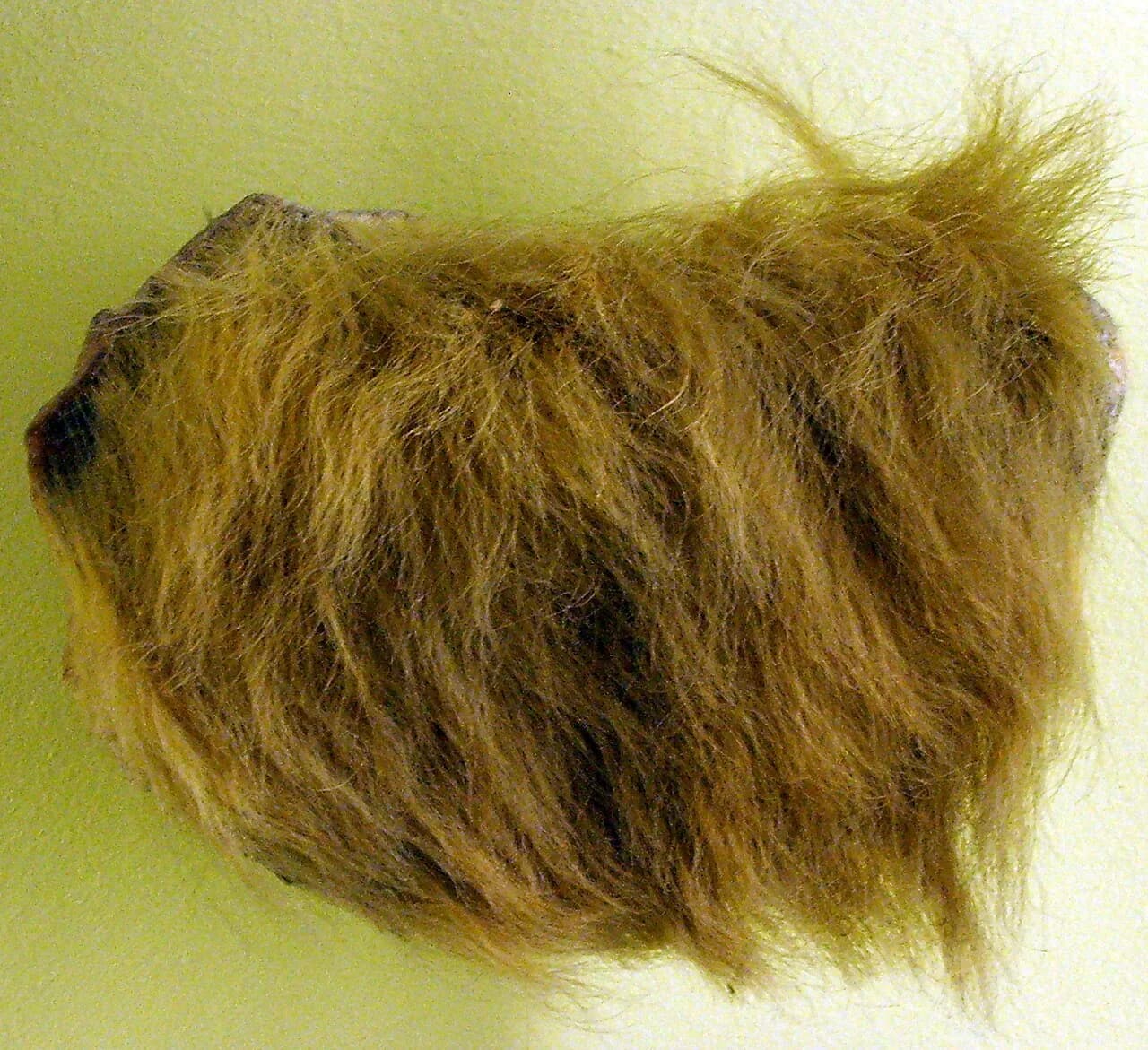
Mylodon fossil fur
Wikimedia Commons