Glyptodon
Glyptodon clavipes is an armoured mammal 3.3 metres long and 1,500 to 2,000 kilograms, present in Argentina, Brazil and Uruguay between 2.6 million and 10,000 years ago. Its shell was solid enough for the first humans in South America to use as shelter. Charles Darwin collected its fossils in 1833: their resemblance to armadillos fed his thinking.
Glyptodon lived during the Pleistocene, approximately 2.6 million to 10,000 years ago, primarily in South America, its continent of origin. This giant xenarthran belongs to the superfamily Glyptodontoidea, related to modern armadillos, though its size and morphology were radically different. Glyptodonts appeared in South America during the Miocene, about 20 million years ago, and diversified into numerous species throughout the Pliocene and Pleistocene. During the Great American Biotic Interchange, approximately 3 million years ago, Glyptodon and its relatives colonized North America via the Isthmus of Panama, reaching the southern United States. Glyptodon disappeared at the end of the Pleistocene, around 10,000 BCE, likely due to hunting by early humans and climate changes that transformed its grassland habitats into forests.
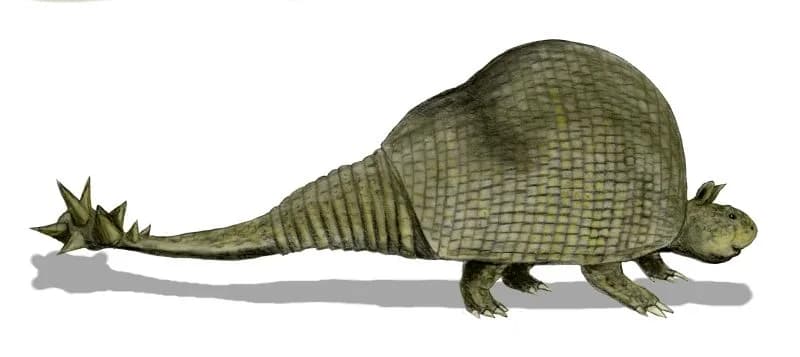
Glyptodon was one of the largest xenarthrans that ever existed, rivaling the size of a small car. The type species, G. clavipes, measured approximately 3.3 meters from snout to tail tip and reached 1.5 meters in height at the top of its domed carapace. Its weight is estimated between 1,500 and 2,000 kilograms, equivalent to a modern white rhinoceros. The bony carapace, composed of over a thousand fused hexagonal osteoderms, could measure up to 5 centimeters thick and weighed several hundred kilograms on its own. The tail, also armored, ended in some related species with a bony club studded with spines, though G. clavipes had a simpler caudal tube made of interlocking bony rings. Its short, massive legs supported a low center of gravity, making the animal extremely stable.
Glyptodon was a strict herbivore, feeding primarily on grasses, low-growing plants, and prairie vegetation. Its jaw lacked front teeth (incisors and canines) and possessed only columnar ever-growing molars, similar to those of modern horses, perfectly adapted for grinding tough and abrasive plant matter. Carbon isotope studies of its fossil teeth reveal a diet dominated by C4 plants (tropical grasses), confirming its status as an open-plain grazer. The limited mobility of its short, rigid neck restricted its ability to reach tall vegetation, confining it to grasses and creeping plants within reach of its snout. Its daily food requirements must have been considerable, estimated at several tens of kilograms of vegetation per day to maintain its colossal body mass.
Glyptodon primarily occupied temperate grasslands and open savannas of South America, particularly the Argentine pampas, Uruguayan plains, and Brazilian cerrados. Its anatomy as a plains grazer, with short legs, a rigid neck, and dentition adapted to grasses, indicates a marked preference for open habitats with low vegetation. The animal likely avoided dense forests where its massive carapace and poor turning radius would have been major handicaps for movement. The richest fossil sites are found in Buenos Aires province, eastern Patagonia, and southern Brazil, regions that during the Pleistocene alternated between wet grasslands and drier steppes according to glacial cycles. After the Great American Biotic Interchange, some glyptodont species ventured into Central America and as far as Texas and Florida.
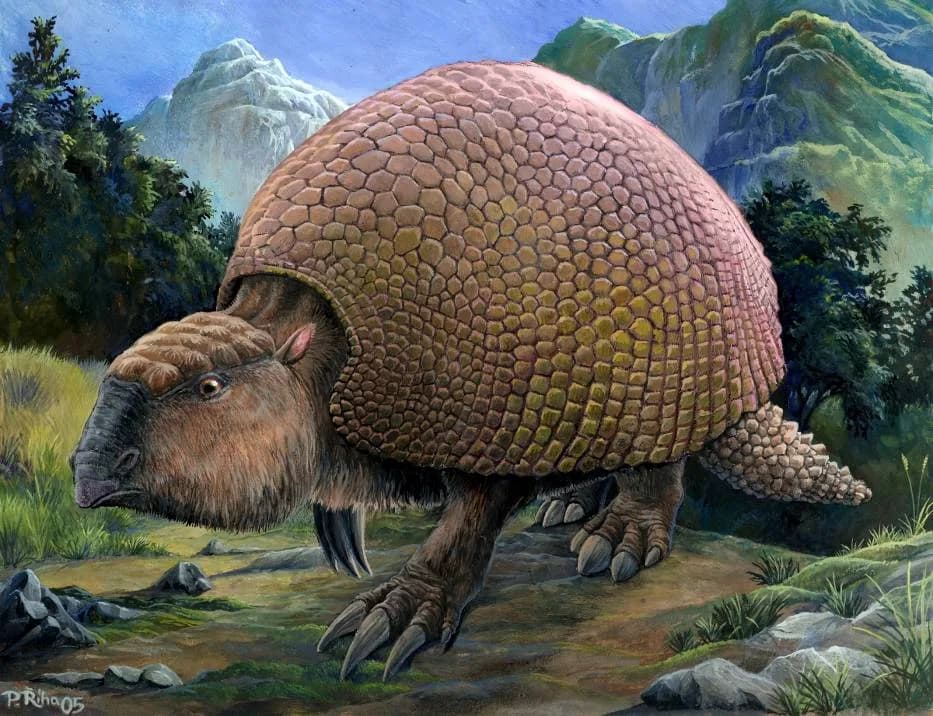
Glyptodon's anatomy was dominated by its spectacular dorsal carapace, a structure unique in the animal kingdom formed of over a thousand hexagonal osteoderms (bony plates) fused together, creating a rigid, curved dome. Unlike modern armadillos whose shells are articulated and flexible, Glyptodon's was entirely fused, preventing any trunk flexion. The skull, short and deep, was protected by a bony cap separate from the main carapace, allowing minimal head mobility. The spine was partially fused to support the enormous weight of the carapace, and the pelvis was welded to the dorsal shell by bony extensions called iliac tubes. The legs, short and robust, ended in broad feet with blunt claws adapted for walking on soft ground. The armored tail, composed of articulated bony rings, likely served as both a counterweight and a defensive weapon against predators.
Glyptodon was likely a solitary or loosely gregarious animal, living in small scattered groups across grasslands, similar to modern rhinoceroses. Its massive carapace provided exceptional passive defense against Pleistocene South American predators, notably Smilodon and short-faced bears (Arctotherium). When threatened, Glyptodon could partially withdraw beneath its carapace, protecting its vulnerable belly, while its armored tail could be swung laterally as a defensive weapon. Biomechanical studies on fossil carapaces have revealed impact marks consistent with intraspecific combat, suggesting males fought for territory or female access by striking each other with their armed tails. Its locomotion was slow and plantigrade, with an estimated maximum speed of a few kilometers per hour, making flight from predators impossible.
The first Glyptodon fossils were discovered in Argentina in the early 19th century and described by English naturalist Richard Owen in 1839. The name Glyptodon means 'carved tooth' (Greek: glyptos 'carved' + odous 'tooth'), referring to the characteristic grooves on its molars. Charles Darwin himself collected glyptodont remains during his voyage on HMS Beagle in 1833, in Buenos Aires province, and noted the striking resemblance to modern armadillos, which contributed to his thinking on evolution. The richest deposits are found in the Argentine pampas, Uruguay, and southern Brazil, where complete carapaces and articulated skeletons have been unearthed. In North America, fossils of related glyptodonts (Glyptotherium) have been found in Texas, Florida, and Arizona. Indigenous South American populations used overturned carapaces as shelters, and archaeological remains confirm the coexistence and active hunting of glyptodonts by the first Americans.
| Period | Pléistocène / Pleistocene |
| Era | Cénozoïque / Cenozoic |
| Age | 2.6 Ma - 10 000 ans |
| Location | Amérique du Sud (Argentine, Brésil, Uruguay) / South America (Argentina, Brazil, Uruguay) |
| Length | 3.3 m |
| Height | 1.5 m |
| Weight | 1 500 - 2 000 kg |
| Diet | Herbivore |
| Discovery | 1839 |
Glyptodon clavipes measured about 3.3 meters long and 1.5 meters tall, weighing an estimated 1,500 to 2,000 kilograms — equivalent to a white rhinoceros. Its bony carapace, composed of over a thousand fused hexagonal osteoderms, could reach 5 centimeters thick and weighed several hundred kilograms on its own.
Glyptodon belonged to the superfamily Glyptodontoidea, closely related to modern armadillos (family Chlamyphoridae). Charles Darwin himself noted the resemblance during his 1833 HMS Beagle voyage in Argentina. Unlike armadillos whose shell is articulated and flexible, Glyptodon's carapace was entirely fused — the animal could not curl into a ball.
Glyptodon vanished around 10,000 BCE at the end of the Pleistocene. Paleontologists point to two main causes: hunting by early humans who arrived in South America (archaeological remains confirm they used overturned carapaces as shelters) and rapid climate changes that converted grasslands into forests, destroying the habitat of this open-plain grazer.
Reconstruction of Glyptodon with its characteristic carapace made of fused bony plates
Pavel Riha, CC BY-SA 3.0
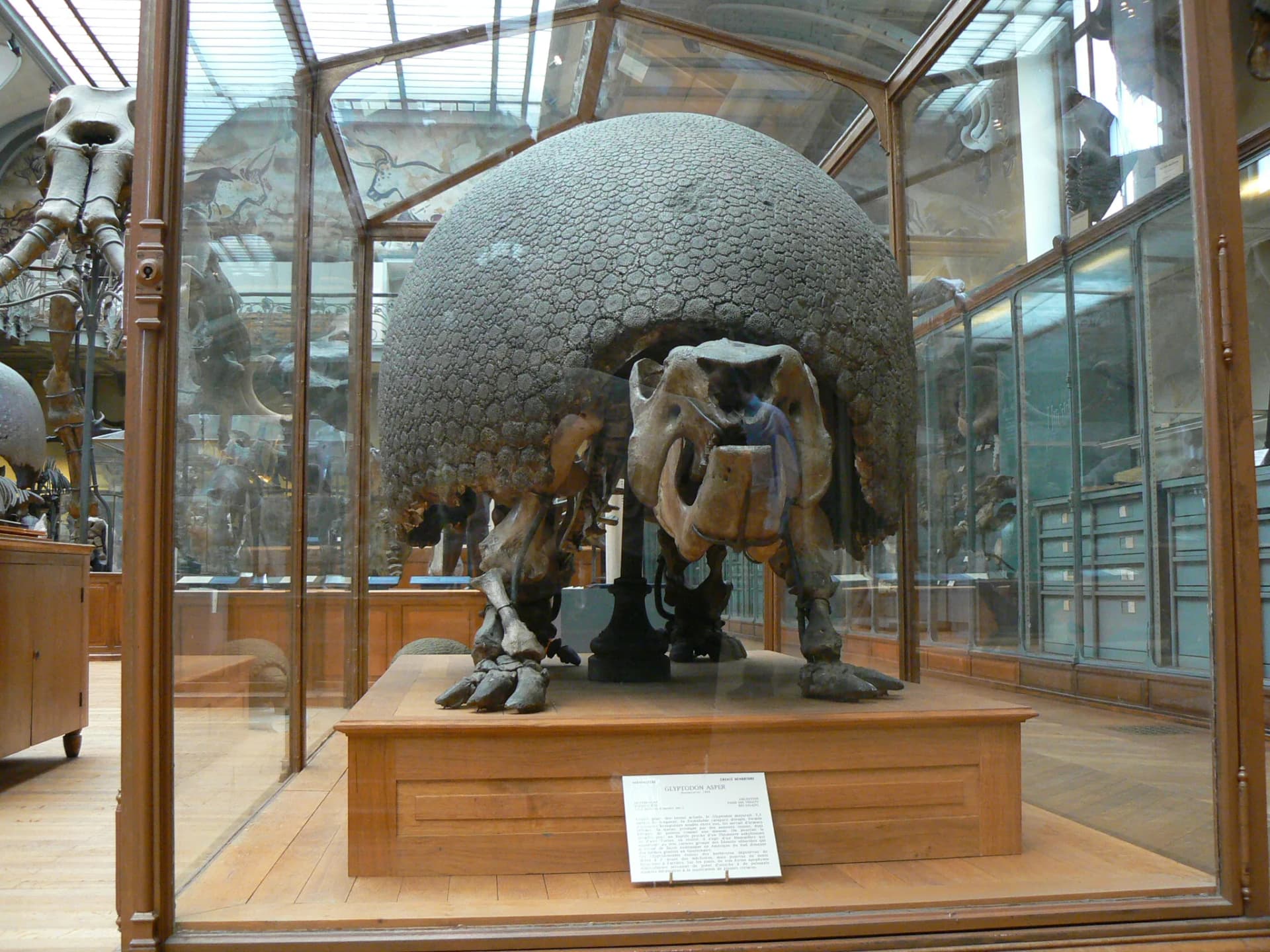
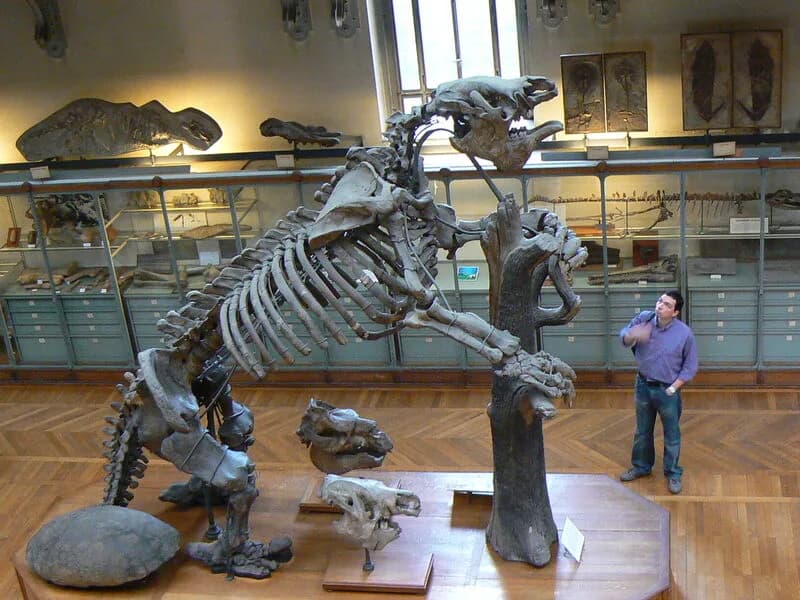
Complete skeleton of Glyptodon asper on museum display, showing the internal structure of the carapace
LadyofHats, Public domain