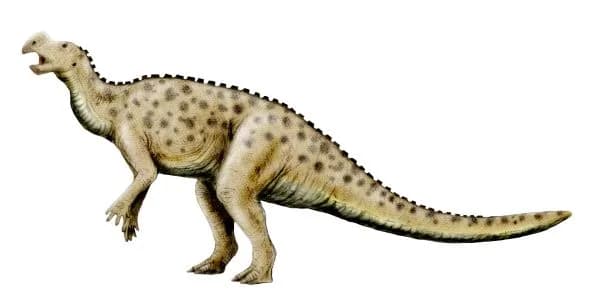
Muttaburrasaure
Muttaburrasaurus langdoni carried an enlarged nasal chamber, a hollow bulge at the front of the skull that most likely worked as a sound amplifier. Seven metres long and 2.8 to 4 tonnes, described in 1963 in Queensland, it browsed Australia 103 to 100 million years ago. It is among the best-known Australian dinosaurs, from two partial skeletons.
Muttaburrasaurus lived during the Early Cretaceous, approximately 103 to 100 million years ago (Albian), on the Australian continent which was still part of the Gondwana supercontinent at that time. During this era, Australia was connected to Antarctica and situated much further south than today, with cool temperatures but a humid climate and dense forests of conifers and tree ferns. Muttaburrasaurus shared its habitat with other Australian dinosaurs such as the theropod Australovenator and the sauropod Diamantinasaurus. It belongs to the order Ornithischia and the clade Ornithopoda, although its exact phylogenetic position within ornithopods remains debated. Some paleontologists place it as a basal rhabdodontomorph, while others consider it closer to the iguanodontians.
Muttaburrasaurus was a large ornithopod, measuring approximately 7 meters in length with an estimated height of 2.5 to 3 meters at the hips and a weight of approximately 2.8 to 4 tonnes. Its robust build was comparable to that of the European Iguanodon, with powerful and muscular hind limbs that likely allowed occasional bipedal locomotion, although it moved primarily in a quadrupedal posture for browsing. Its forelimbs were shorter but sturdy, ending in five-fingered hands with the thumb bearing a conical spur characteristic of basal ornithopods. The skull, approximately 65 centimeters in length, featured a prominent nasal bump that constitutes the most distinctive characteristic of this Australian dinosaur.
An exclusive herbivore, Muttaburrasaurus fed on the abundant vegetation of the Early Cretaceous Australian forests, composed primarily of conifers, cycads, tree ferns, and horsetails. Its horny beak at the front of the jaw served to cut and tear leaves and stems, while its shearing cheek teeth functioned in a distinctive manner. Unlike hadrosaurs that possessed complex dental batteries for grinding vegetation, Muttaburrasaurus used a lateral shearing motion of its jaws to slice through fibrous plants. This unique chewing mechanism, similar to a pair of scissors, was remarkably effective for processing the tough leaves of cycads and the thick fronds of ferns.
Muttaburrasaurus inhabited the floodplains and coastal forests of central Queensland, Australia, at a time when a vast inland sea — the Eromanga Sea — covered a large portion of the continent. Fossils come primarily from the Mackunda Formation and the Allaru Formation, in the Eromanga Basin. The environment was a landscape of wooded alluvial plains bordering this epicontinental sea, with podocarp conifer forests, fern understories, and marshy areas rich in horsetails. The climate, although situated at polar latitudes, remained temperate and humid thanks to the global greenhouse effect of the Cretaceous. Rivers and streams crossed these plains, creating an ideal habitat for a large quadrupedal herbivore.
The anatomy of Muttaburrasaurus is dominated by its remarkable enlarged nasal chamber, forming a prominent bump on top of the snout. This hollow structure, composed of hypertrophied premaxillary and nasal bones, likely contained a cavity filled with highly vascularized mucosal tissue. Paleontologists believe it served to amplify the animal's vocalizations, allowing it to produce powerful sound calls audible over great distances through the dense Cretaceous forests. This chamber could also have played a role in thermoregulation by cooling the blood circulating to the brain. The rest of the skeleton presents a robust construction typical of medium to large ornithopods, with a vertebral column reinforced by ossified tendons and a long rigid tail serving as a counterbalance.
Muttaburrasaurus was likely a gregarious animal, moving in small herds through the wooded plains of Cretaceous Queensland. Its enlarged nasal chamber strongly suggests elaborate vocal communication behaviors, possibly used to maintain group cohesion, signal danger, or attract mates during the breeding season. Like most ornithopods, it likely alternated between a quadrupedal posture for ground-level browsing and a bipedal stance for reaching higher vegetation or fleeing from predators. Its imposing size and robustness afforded it some protection against medium-sized theropods, but against large predators such as the Australian megaraptorans, group flight remained its best survival strategy.
The first Muttaburrasaurus skeleton was discovered in 1963 by stockman Doug Langdon near the small town of Muttaburra, in central Queensland, Australia. The relatively complete specimen was described and named by paleontologists Alan Bartholomai and Ralph Molnar in 1981, with the species M. langdoni honoring its discoverer. This holotype skeleton (QM F6140) included much of the skull, vertebral column, and limbs, which is exceptional for an Australian dinosaur — the continent's fossil record being notoriously poor compared to that of North America or Asia. A second partial specimen was discovered in 1987 near Lightning Ridge, in New South Wales, preserved as opal — a fossilization mode unique to Australia. Additional fragments have been found in the Mackunda Formation and the Allaru Formation.
| Period | Crétacé inférieur / Early Cretaceous |
| Era | Mésozoïque / Mesozoic |
| Age | 103-100 Ma |
| Location | Queensland, Australie / Queensland, Australia |
| Length | 7 m |
| Height | ~3 m |
| Weight | 2 800–4 000 kg |
| Diet | Herbivore |
| Discovery | 1963 |
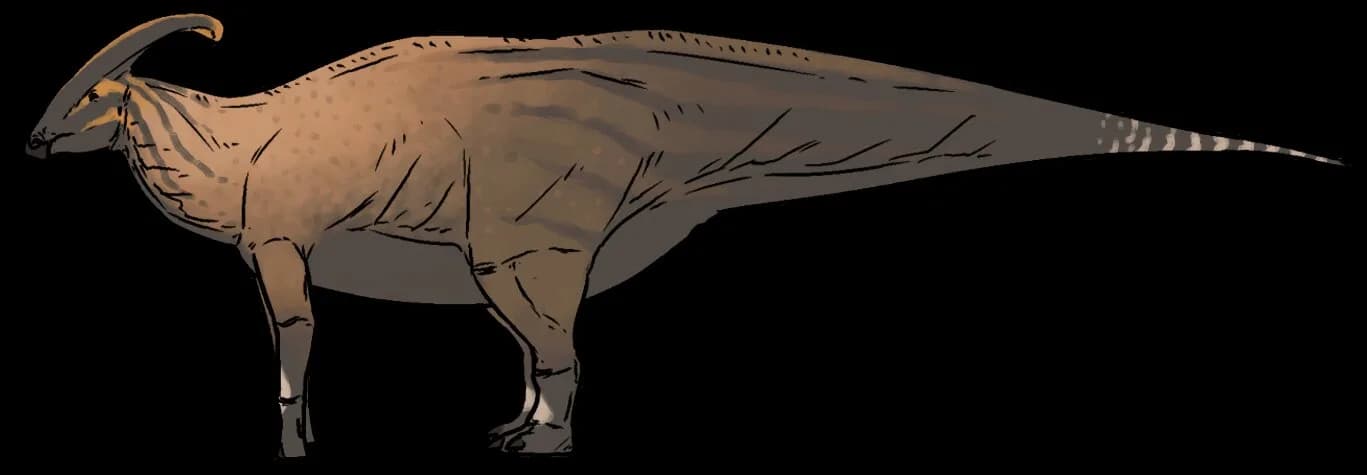
Muttaburrasaurus langdoni's enlarged nasal chamber — formed by hypertrophy of the premaxillary and nasal bones — likely served to amplify vocalizations, enabling powerful calls audible over great distances in Cretaceous forests. It may also have played a thermoregulatory role by cooling blood flowing to the brain. This mechanism resembles that of Parasaurolophus, though the structure differs.
Muttaburrasaurus langdoni measured approximately 7 meters long with a hip height of 2.5 to 3 meters and a weight of 2.8 to 4 tonnes. Its skull reached 65 centimeters. Discovered in 1963 by stockman Doug Langdon near Muttaburra (Queensland), it was described in 1981 by Bartholomai and Molnar. Holotype QM F6140 is one of the most complete Australian dinosaur skeletons ever found.
Unlike hadrosaurs which used complex dental batteries to grind vegetation, Muttaburrasaurus langdoni sheared plants with a lateral jaw motion, functioning like a giant pair of scissors. This unique mechanism was particularly effective for cutting the tough leaves of cycads and thick fern fronds that dominated Early Cretaceous Australia 103 to 100 million years ago.
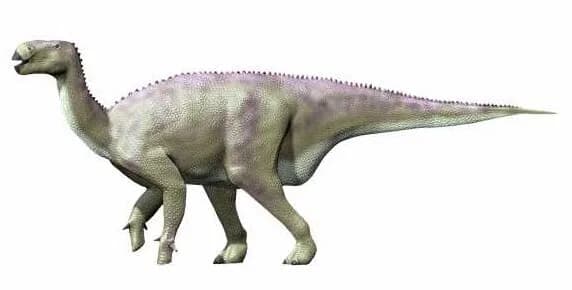
Muttaburrasaurus langdoni life reconstruction
Nobu Tamura, CC BY 3.0
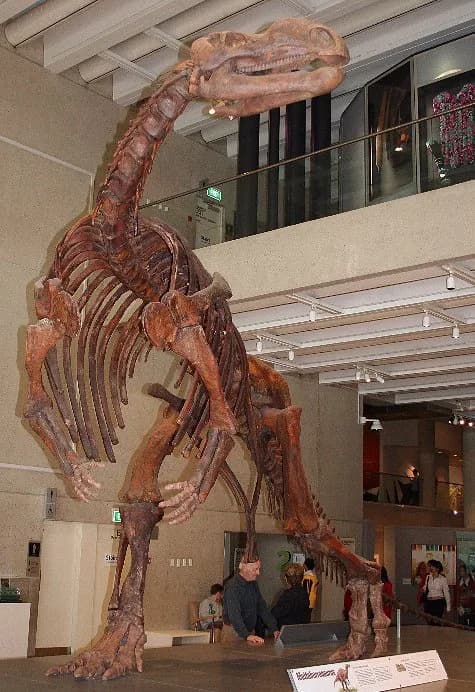
Mounted Muttaburrasaurus skeleton at Queensland Museum
Wikimedia Commons