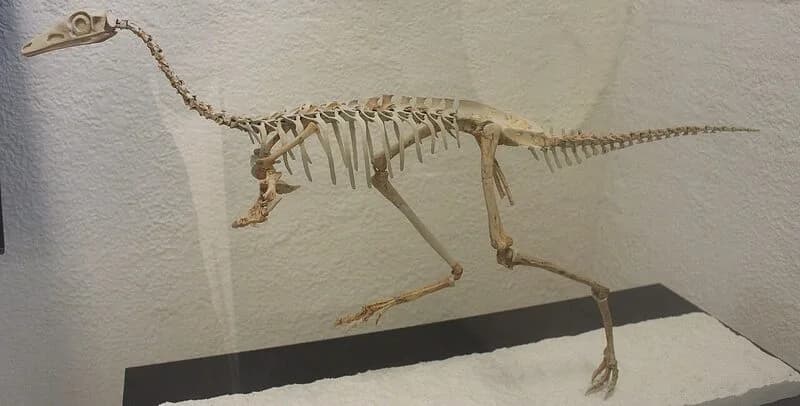
Mononykus
Mononykus olecranus carried a single large claw on each forelimb, hence its Greek name meaning « one claw ». This small theropod, a metre long and 3 to 4 kilograms, lived in Mongolia 70 million years ago. Its short, powerful arms most likely served to break open termite mounds. It ranks among the dinosaurs closest to living birds.
Mononykus olecranus lived during the Late Cretaceous period, approximately 70 million years ago, during the Maastrichtian stage. This era represented one of the final chapters in the age of non-avian dinosaurs, just before the mass extinction event that ended the Mesozoic. The climate of the region was warm and relatively arid throughout Central Asia, with pronounced seasonal variations and semi-desert environments that shaped the unique adaptations of this remarkable animal. Mononykus shared its ecosystem with other iconic dinosaurs of the Asian Late Cretaceous fauna, including various oviraptorosaurs and small theropods from the Nemegt Formation.
Mononykus was an extremely small dinosaur by theropod standards, measuring approximately one meter in total body length from snout to tail tip, with a shoulder height of around 40 centimeters. Its body weight has been estimated between 3 and 4 kilograms, making it roughly comparable in stature to a large chicken or small turkey. Despite its diminutive size, its body plan was remarkably specialized, with long, slender hindlimbs adapted for rapid bipedal locomotion and highly modified forelimbs that set it apart dramatically from virtually all other theropod dinosaurs known from the fossil record.
Mononykus was most likely an insectivore with a strong specialization for exploiting social insects living in colonies, such as termites and ants. Its single large claw on each forelimb would have been highly effective for breaking open termite mounds and wood-boring insect nests. This hypothesis is strongly supported by comparisons with modern convergent mammals such as anteaters, echidnas, and pangolins, all of which display remarkably similar morphological adaptations for feeding on social insects. The elongated and narrow snout of Mononykus further supports this paleoecological interpretation, as it would have been well-suited for probing into narrow cavities after breaking them open.
Mononykus inhabited the semi-arid and desert environments of the Gobi Desert, in what is now present-day Mongolia and parts of northern China. This habitat was characterized by open plains, sand dunes, rocky outcrops, and scarce water sources, with sparse vegetation consisting of ferns, conifers, and early flowering plants. The climatic conditions were harsh, with strong temperature fluctuations between day and night, which may have favored some degree of endothermy in this physiologically advanced alvarezsaurid. The Nemegt Formation sediments suggest that at least some parts of the region retained seasonal rivers and more vegetated floodplain areas alongside the more arid zones.
The anatomy of Mononykus is among the most bizarre of any known dinosaur. Its most striking feature is the extreme reduction of its forelimbs, transformed into short but robust appendages each bearing a single large pick-like claw — from which its name, meaning literally 'one claw' in Greek, is derived. Two vestigial smaller digits were present on each hand but were far too reduced to serve any practical function. Its hindlimbs were conversely long, slender, and well-developed, indicating fast bipedal locomotion. A strongly keeled sternum, similar to that of modern birds, suggests the presence of powerful pectoral muscles required to drive the forelimb claws with sufficient force to break open insect colonies.
Mononykus was most likely a diurnal or crepuscular animal, active across the open expanses of the Gobi Desert in search of insect nests and colonies. Its locomotor speed was probably considerable, allowing it to escape from larger predators such as the dromaeosaurids and tyrannosauroids that shared its environment. Some researchers have proposed that Mononykus may have been capable of scratching or digging into the ground in a manner similar to modern armadillos, although its very short forelimbs appear better adapted for piercing hard materials rather than excavating extended burrows. Its social behavior remains unknown, but its small body size suggests it was likely vulnerable to predation by multiple contemporary carnivores.
The fossils of Mononykus olecranus were first discovered in the Nemegt Formation of Mongolia during paleontological expeditions conducted in the early 1990s. The type specimen was formally described in 1993 by Perle, Novas, Chiappe, Clark, Dashzeveg, and Novacek in a landmark article published in the journal Nature. The recovered remains included elements of the skull, vertebral column, limb bones, and pectoral girdle, providing a relatively comprehensive picture of this animal's anatomy. The discovery of Mononykus fundamentally reshaped scientific understanding of the evolutionary relationships between theropod dinosaurs and modern birds, confirming the deep avian affinities of the alvarezsaurid lineage.
| Period | Crétacé supérieur / Late Cretaceous |
| Era | Mésozoïque / Mesozoic |
| Age | 70 Ma |
| Location | Mongolie / Mongolia |
| Length | 1 m |
| Height | 0.4 m |
| Weight | 3-4 kg |
| Diet | Insectivore |
| Discovery | 1993 |
Mononykus olecranus — whose Greek name means 'one claw' — bore a single large pick-like claw on each extremely short forelimb, with two other digits vestigial. This claw broke open termite mounds and wood-boring insect nests, a convergent specialization shared with modern anteaters, echidnas, and pangolins. Its strongly keeled sternum indicates powerful pectoral muscles for driving these claws. Described in 1993 in Nature by Perle et al.
Mononykus olecranus measured about 1 meter long with a weight of 3 to 4 kilograms — comparable to a large chicken. It lived 70 million years ago in the semi-arid and desert environments of the Gobi, Mongolia (Nemegt Formation). Its long, slender hindlimbs suggest rapid running to escape the dromaeosaurids and tyrannosauroids that shared this Cretaceous habitat.
Mononykus olecranus belongs to the alvarezsaurids, a group of theropods closely related to modern birds. Its 1993 description in Nature provided major evidence of the kinship between theropod dinosaurs and birds. Its keeled sternum — like that of flying birds — and its bird-like slender bones make it an emblematic example of the deep evolutionary links between theropods and avians, despite its radically modified forelimbs.
Mononykus fossil skeleton
Wikimedia Commons, CC BY-SA
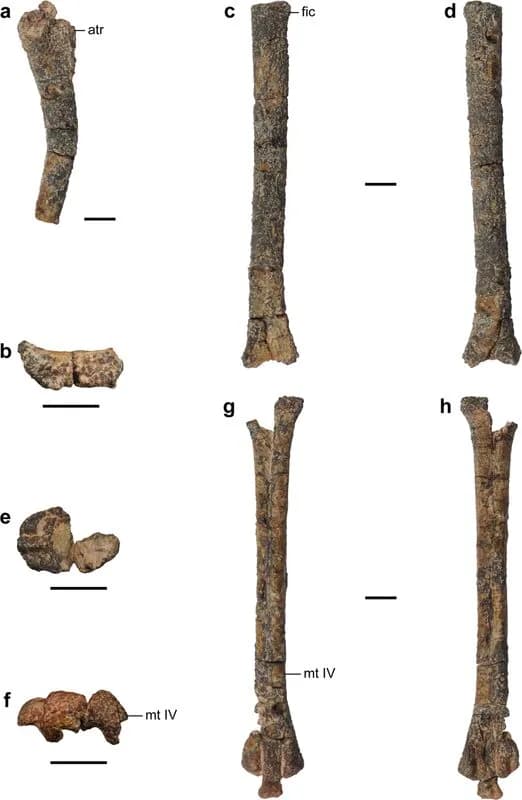
Mononykus fossil hindlimb
Wikimedia Commons, CC BY-SA