Bête du lac Moeris
Moeritherium lyonsi ranks among the oldest known relatives of elephants, despite an outline closer to a dwarf hippopotamus. About 3 metres long and 200 to 250 kilograms, described in 1901, it lived 37 to 35 million years ago in Egypt, Senegal and Libya. Its unusually dense bones worked as ballast for walking along the bottom of swamps.
Moeritherium lived during the late Eocene, approximately 37 to 35 million years ago, in regions that correspond to modern-day North Africa. This semi-aquatic mammal is one of the earliest known members of the order Proboscidea, the group that includes modern elephants, although it bore little resemblance to them. Moeritherium appeared in a warm, humid tropical world dominated by dense forests and marshy areas along the coasts of the ancient Tethys Sea. Its name derives from Lake Moeris in Egypt's Fayum region, an area that today constitutes one of the richest fossil deposits in African paleontology.
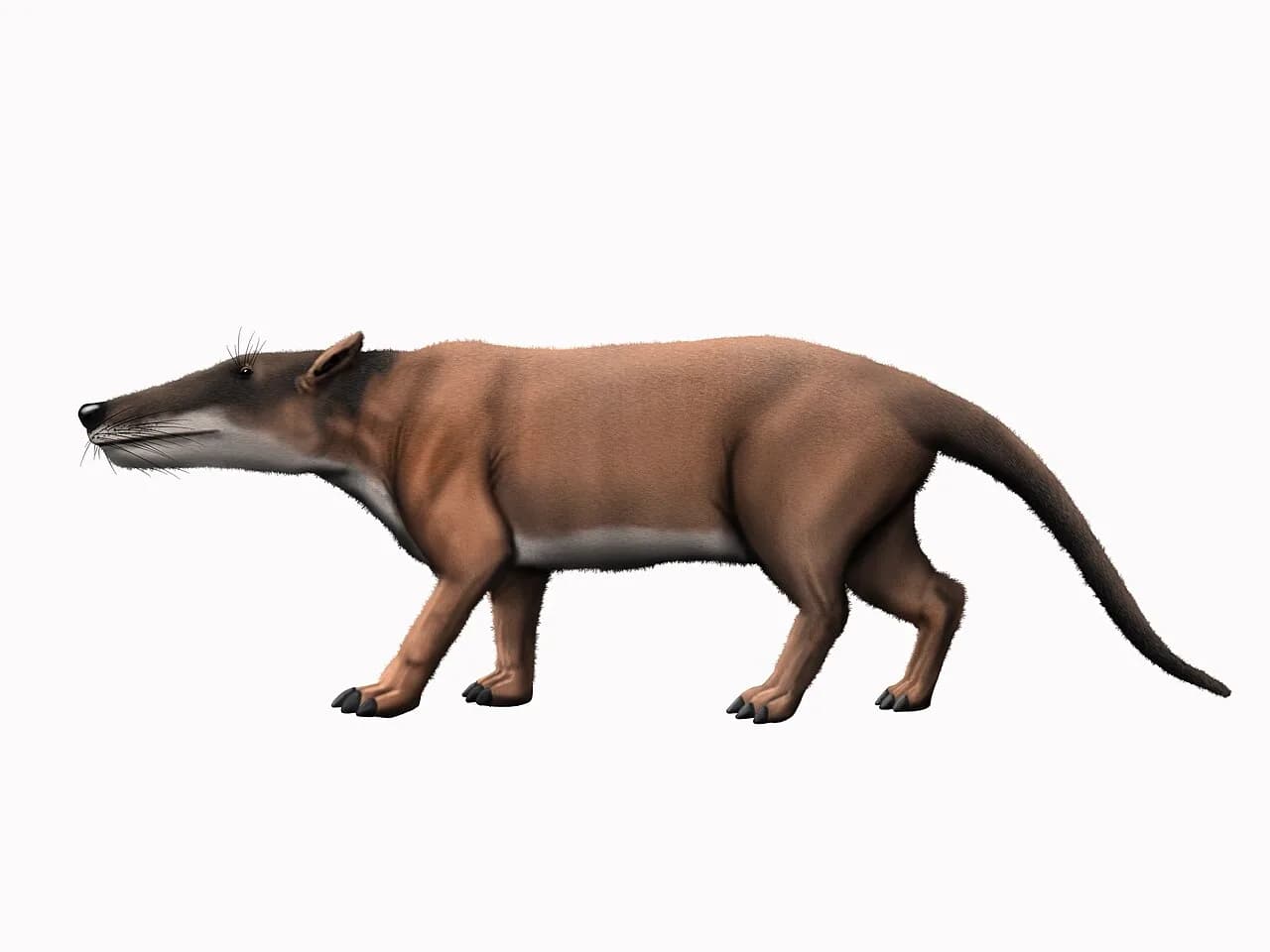
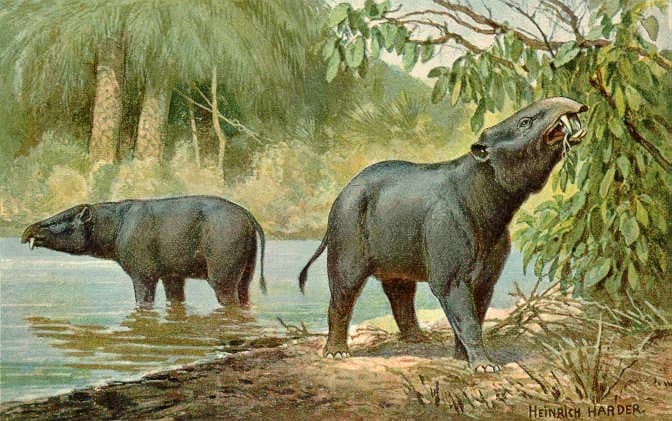
Moeritherium was a modestly-sized animal compared to its elephant descendants, standing approximately 70 centimeters tall at the shoulder with a total length of about 3 meters. Its weight was estimated between 200 and 250 kilograms, comparable to a large domestic pig or a modern tapir. Its stocky, elongated silhouette resembled a dwarf hippopotamus more than an elephant, with a low-slung body and a relatively flat, elongated skull. Its limbs were short and robust, ending in five toes equipped with small hooves, a morphology perfectly adapted for walking in the muddy, marshy environments it frequented.
Moeritherium was an aquatic and semi-aquatic herbivore whose diet consisted primarily of soft marsh vegetation. Isotopic analysis of its teeth and bones indicates a diet rich in freshwater plants, including rushes, reeds, water lilies, and other aquatic plants from the tropical swamps of the Eocene. Its slightly protruding incisors, considered precursors to elephant tusks, were likely used to tear aquatic plants from mud and uproot vegetation along riverbanks. The shape of its molars, with low, rounded crests, was adapted for grinding soft, juicy plant material rather than chewing tough foliage.
Moeritherium inhabited the warm, humid coastal and estuarine environments of Eocene North Africa, primarily in Egypt's Fayum region and in sites in present-day Senegal and Libya. It lived in coastal lagoons, swamps, and estuaries bordered by mangroves and dense tropical forests, a landscape radically different from today's Saharan desert. Its semi-aquatic lifestyle is evidenced by the elevated position of its nostrils on the skull and the high density of its bones, convergent adaptations shared with modern hippopotamuses. It likely spent much of its day submerged in the shallow waters of swamps.
The anatomy of Moeritherium presents a notable mix of primitive characters and early hints of traits that would later define elephants. Its elongated, low skull featured nostrils positioned slightly rearward, a tentative first step toward trunk formation, although Moeritherium itself probably did not possess one. Its second upper and lower incisors were slightly enlarged and protruding, constituting the very first precursors of the characteristic tusks of proboscideans. Its long bones were exceptionally dense, a trait common to aquatic mammals that serves as ballast to remain submerged. The structure of its inner ear already resembled that of modern elephants.
Moeritherium's behavior can be inferred by comparison with modern semi-aquatic mammals like hippopotamuses and tapirs. It likely led a semi-aquatic life, spending its days submerged in the shallow waters of lagoons and swamps to feed on aquatic vegetation and escape the tropical heat. At night or during cooler hours, it ventured onto the banks to graze on terrestrial vegetation. The density of its bones suggests it walked along the bottom rather than swimming, similar to modern hippopotamuses. Its elevated nostrils allowed it to breathe while keeping most of its body submerged.
The first fossils of Moeritherium were discovered in Egypt's Fayum region by British paleontologist Charles William Andrews in 1901, who formally described it in 1906. The Fayum Depression, once a lush tropical swamp, has yielded some of the oldest and most complete proboscidean fossils in the world. Several species have been described, including M. lyonsi and M. trigodon, although the taxonomic status of some remains debated. Skulls, mandibles, and remarkably well-preserved postcranial elements have allowed a detailed reconstruction of this animal. Fossils have also been found in Senegal, Libya, and Mali, considerably expanding the known range of this primitive proboscidean.
| Period | Éocène supérieur / Late Eocene |
| Era | Cénozoïque / Cenozoic |
| Age | 37–35 millions d'années / 37–35 million years ago |
| Location | Afrique du Nord (Égypte, Sénégal, Libye) / North Africa (Egypt, Senegal, Libya) |
| Length | ~3 m |
| Height | ~70 cm au garrot / ~70 cm at shoulder |
| Weight | 200–250 kg |
| Diet | Herbivore |
| Discovery | 1901 |
Moeritherium lyonsi is one of the earliest known representatives of the Proboscideans — the group that includes modern elephants — despite resembling a dwarf hippopotamus. Its slightly protruding incisors foreshadow elephant tusks, its rearward nostril position announces trunk evolution, and its inner ear structure already resembles that of elephants. Described in 1906 by Charles William Andrews, it lived 37 to 35 million years ago.
Moeritherium lyonsi measured about 3 meters long with a shoulder height of 70 centimeters and a weight of 200 to 250 kilograms — comparable to a tapir. Its exceptionally dense long bones served as ballast for walking along swamp bottoms, like modern hippos. Its elevated nostrils allowed breathing while keeping most of the body submerged in the Eocene coastal lagoons of what is now the Fayum region of Egypt.
The first Moeritherium fossils were discovered in Egypt's Fayum Depression in 1901 by Charles William Andrews. This site — once a lush tropical swamp — is one of the world's richest deposits of primitive proboscideans. Fossils have also been found in Senegal, Libya, and Mali. The Fayum Depression has yielded remarkably well-preserved skulls, mandibles, and postcranial elements of M. lyonsi and M. trigodon.
Artistic reconstruction of Moeritherium, a primitive ancestor of elephants
Wikimedia Commons
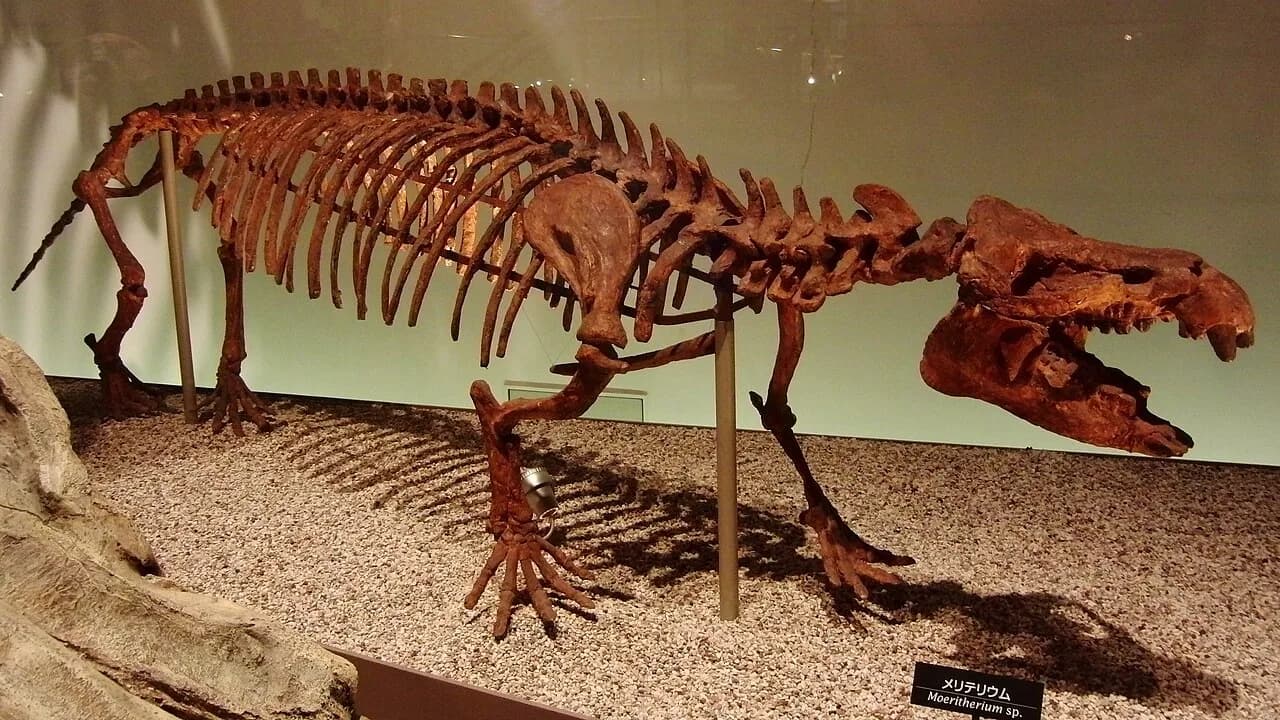
Reconstruction of Moeritherium in its Eocene swamp habitat
Wikimedia Commons