Moa géant
Dinornis robustus, the giant moa, reached 3.6 metres tall and 230 kilograms in females: the largest bird of recent history. Endemic to New Zealand's South Island, it disappeared around 1440, hunted out in under two centuries. It is also the only known bird group with no trace of a wing at all, not even a bony vestige.
The giant moa (Dinornis robustus) lived in New Zealand from at least the Pleistocene until its extinction in the 15th century, only about 600 years ago. Moas were a group of giant ratite birds (related to ostriches and kiwis) endemic to New Zealand, which had evolved in the complete absence of terrestrial mammalian predators. Nine moa species are recognized, ranging from turkey-sized to Dinornis robustus, the largest known bird in recent history. The arrival of Polynesians (Maori) in New Zealand around 1280 AD marked the beginning of the end for moas: in less than 200 years, hunting and habitat destruction led to the complete extinction of all nine species.
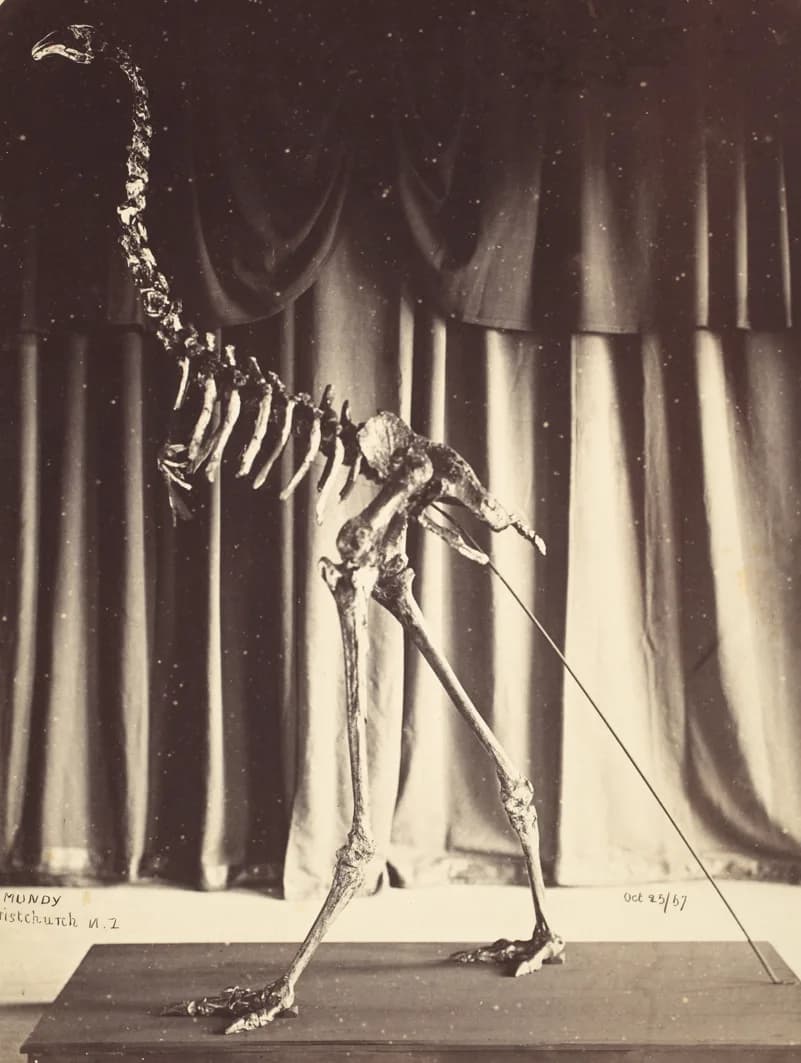
Dinornis robustus, the South Island giant moa, was the largest of all moas and probably the tallest bird in recent history. Females (larger than males) could reach about 3.6 meters in height with neck extended and weigh up to 230 kg. Remarkably, moas are the only known birds to have completely lost their wings — even the vestiges of wing bones disappeared during evolution. Their body was massive and rounded, carried on powerful three-toed legs with thick claws. Their long, flexible neck ended in a small head with a short, wide beak adapted for browsing. Sexual dimorphism was extreme: females weighed up to three times more than males.
Moas were strict herbivores, feeding on leaves, twigs, fruits, and seeds of the New Zealand temperate forest. Analysis of coprolites (fossilized droppings) and intestinal contents of mummified specimens revealed a diet composed mainly of leaves from small trees and shrubs, stems, seeds, and fruits. Their short, wide beak was adapted for plucking leaves and young shoots. Moas filled a crucial ecological role as the main herbivores of New Zealand — in the absence of browsing mammals, they shaped vegetation as deer and bison do on other continents. Their extinction profoundly altered New Zealand's forest ecosystems.
Moas inhabited all of New Zealand, from coastal forests to subalpine grasslands, with different species occupying different habitats. Dinornis robustus lived primarily in the temperate and subalpine forests of the South Island, in environments dominated by southern beeches (Nothofagus), podocarps, and evergreen shrubs. New Zealand was a unique ecosystem, isolated for 80 million years, without terrestrial mammalian predators — the only natural predator of adult moas was Haast's eagle (Hieraaetus moorei), the largest known eagle, with a 3-meter wingspan and talons capable of crushing moa bones.
Moa anatomy was unique among birds. They are the only known birds to have completely lost all trace of their wings — even vestigial bones (scapula, coracoid) had regressed or disappeared. Their sternum was flat, without a keel, confirming the total impossibility of flight. Their massive legs bore three robust toes with thick claws. Their long, flexible neck had numerous cervical vertebrae. Mummified specimens discovered in dry New Zealand caves have preserved skin, feathers (brown filamentous feathers without structured barbules), and even soft tissues. Ancient DNA extracted from these specimens revealed that moas are more closely related to South American tinamous than to New Zealand kiwis.
Moas were relatively slow, placid forest birds, browsing low vegetation and tree foliage. Without mammalian predators, they had not developed sophisticated anti-predator behaviors — making them extremely vulnerable to human hunting. They were probably solitary or lived in small family groups. Reproduction was slow, with probably only one egg laid per season — a key factor in their inability to recover from Maori hunting pressure. Genetic studies suggest moa populations were already relatively small before human arrival, making them even more vulnerable to extinction. Haast's eagle, their only natural predator, went extinct shortly after the moas, deprived of its main prey.
The first moa fossils were described in 1839 by Richard Owen, who correctly identified a bone fragment as belonging to a gigantic bird — a remarkable feat from a single bone. The name Dinornis means 'terrible bird' (Greek: deinos 'terrible' + ornis 'bird'). Moa fossils are extraordinarily abundant in New Zealand: thousands of complete skeletons, feathers, mummified skin, eggs (some 24 cm long), coprolites, and even ancient DNA have been preserved. Radiocarbon dating of moa bones and Maori archaeological sites has precisely traced the chronology of their extinction: the last moas probably disappeared around 1440-1500 AD, less than 200 years after the first Maori arrived. It is one of the clearest and best-documented examples of human-caused extinction.
| Period | Pléistocène à Holocène / Pleistocene to Holocene |
| Era | Cénozoïque / Cenozoic |
| Age | ~600 ans / years (extinction ~1440 AD) |
| Location | Nouvelle-Zélande (île du Sud) / New Zealand (South Island) |
| Height | 3.6 m (femelles) |
| Weight | 230 kg (femelles) |
| Diet | Herbivore |
| Discovery | 1839 |
No, Dinornis robustus was not a dinosaur but a bird — a giant ratite related to ostriches, kiwis, and emus. Birds are technically avian dinosaurs, but the giant moa is a bird that appeared long after the extinction of non-avian dinosaurs (66 Ma ago). It survived until the 15th century and was hunted to extinction by the Maori in fewer than 200 years.
Female Dinornis robustus reached 3.6 meters tall and 230 kilograms, making it the tallest bird in recent history. Sexual dimorphism was extreme: females weighed up to three times more than males. The complete absence of mammalian predators in New Zealand (isolated for 80 Ma) enabled this insular gigantism. The only natural predator of adults was Haast's eagle, a raptor with a 3-meter wingspan.
Radiocarbon dating of moa bones and Maori archaeological sites has precisely traced the extinction: all nine species disappeared between approximately 1440 and 1500 AD, fewer than 200 years after the first Polynesians (Maori) arrived around 1280. Coprolites (fossilized droppings), feathers, and ancient DNA preserved in dry caves complete this portrait of the best-documented human-caused extinction.
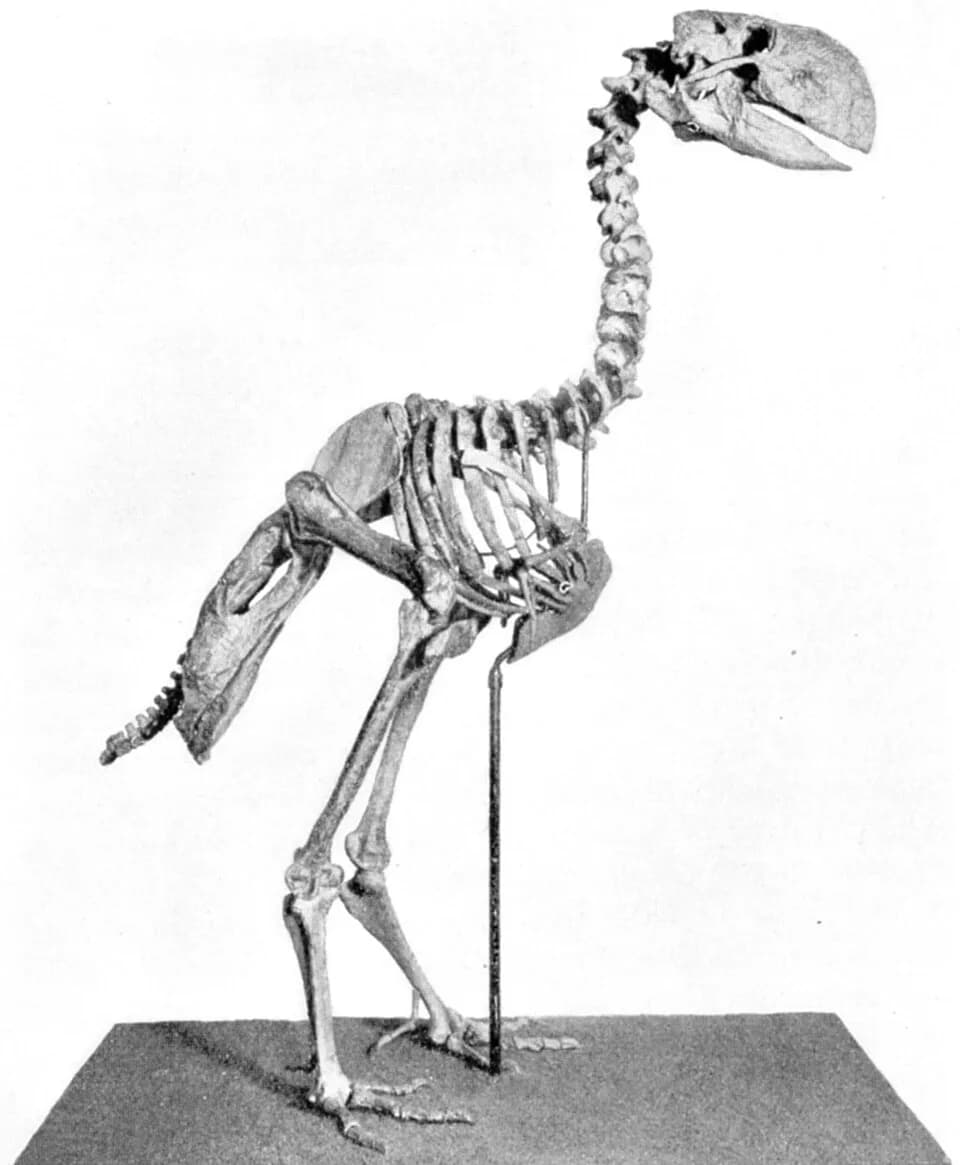
Dinornis robustus skeleton, the South Island giant moa
Wikipedia Commons
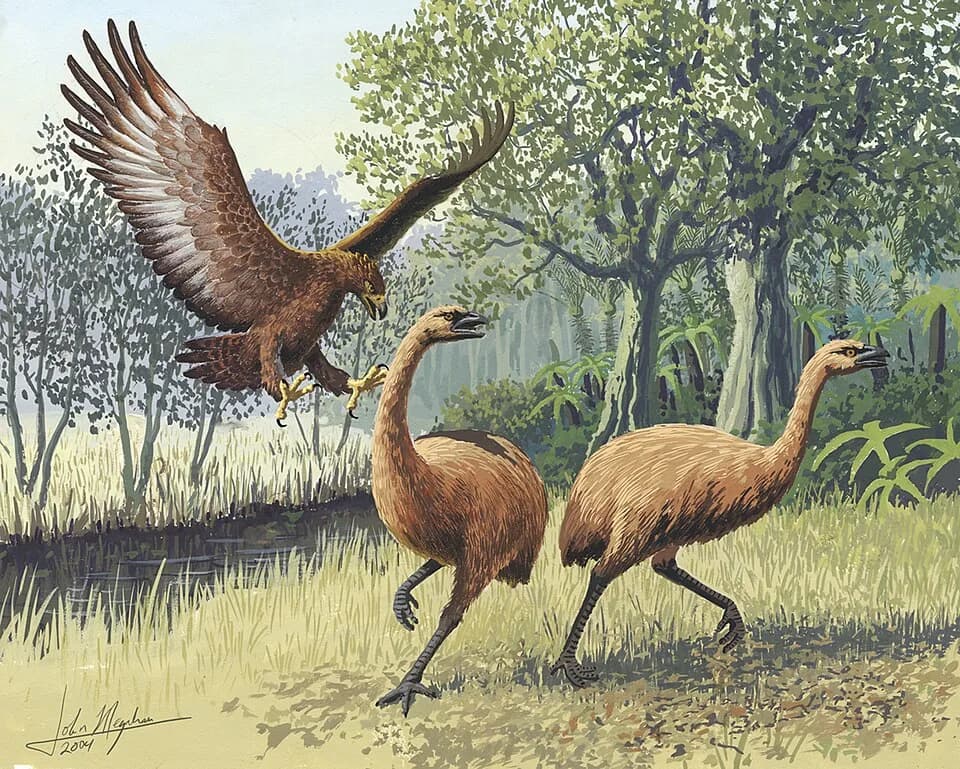
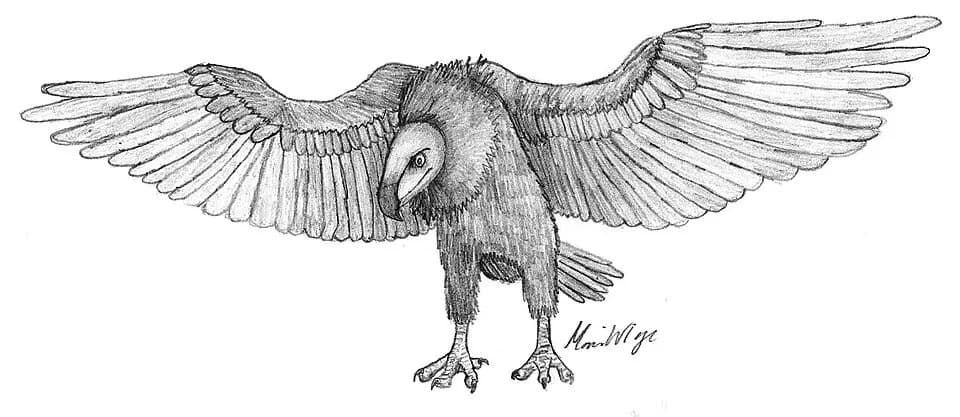
Moa reconstruction being attacked by Haast's eagle, its only natural predator
John Megahan, Wikipedia Commons