Dodo
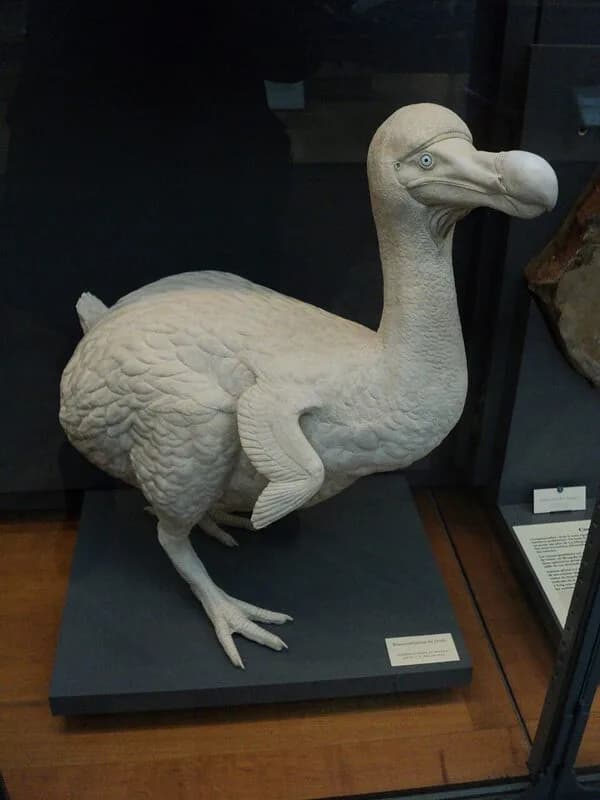
Raphus cucullatus, the dodo, was a ground bird 0.7 to 1 metre tall and 10 to 21 kilograms, endemic to Mauritius and reported by sailors from 1598. Contrary to the image of a fat, clumsy bird, recent reconstructions describe it as agile and well suited to its island. Now the symbol of human-driven extinction, it appears on the Mauritian coat of arms.
The dodo lived exclusively on the island of Mauritius in the Indian Ocean from the late Pleistocene until its tragic and definitive disappearance at the end of the 17th century. This emblematic bird of human-caused extinction evolved and developed in an isolated island environment for hundreds of thousands of years, completely sheltered from any terrestrial predator. The arrival of Portuguese and then Dutch sailors in the 16th century marked the beginning of its rapid and irreversible decline, ultimately leading to its complete extinction around 1681.
The dodo stood approximately one meter tall and weighed between 10 and 21 kilograms according to the most recent estimates, which are based on detailed analysis of complete fossil skeletons recovered from Mauritius. Historical depictions showing it as excessively obese are now considered largely exaggerated by modern scientists who have studied the actual skeletal proportions. Its size was comparable to a large turkey but with a distinctly more robust build and thick, sturdy legs specifically adapted for terrestrial walking across forest floors. Sexual dimorphism was moderate, with males being slightly larger and heavier than females.
The dodo was a frugivorous bird that primarily fed on fallen fruits, nuts, seeds, and roots found on the floor of the tropical forests of Mauritius. Its powerful and distinctively hooked beak allowed it to crack open the hard shells of nuts and thick-skinned fruits with relative ease. Isotopic analyses of its fossilized bones suggest a varied diet that also included bulbs, succulent plants, and occasionally coastal crustaceans found along the shoreline. It played a crucial ecological role in the dispersal of seeds for several endemic tree species on the island, a function that was lost entirely following its extinction.
The dodo inhabited the dry and coastal tropical forests of Mauritius, a rich but extremely fragile island ecosystem in the Mascarene archipelago of the Indian Ocean. It primarily occupied lowland areas and forest edges where ground-level food sources were particularly abundant and easily accessible. The complete absence of terrestrial mammalian predators on the island had allowed the dodo to gradually and progressively lose its ability to fly without suffering any negative selective pressure whatsoever. The marshy areas of Mare aux Songes constitute the principal known deposit of dodo fossils discovered to date.
The dodo's anatomy demonstrates a complete and irreversible adaptation to terrestrial island life without any natural predators. Its wings were vestigial, reduced to small stumps covered with fine feathers that were completely incapable of flight or any form of aerial sustentation. Its legs were robust and muscular, ending in four clawed toes firmly adapted for walking across the tropical forest floors of its island habitat. Its massive and highly distinctive beak, measuring approximately 23 centimeters in length, featured a characteristic hooked tip that served effectively for manipulating and cracking open hard foods such as nuts and tough-skinned fruits.
The dodo was a placid terrestrial bird that had developed absolutely no fear of predators, a trait which greatly facilitated its capture by humans and the various animals they introduced to the island. It probably nested directly on the ground, laying a single egg per clutch in a rudimentary nest constructed from leaves and twigs. Historical accounts from Dutch sailors who visited Mauritius describe a curious bird that approached humans without any suspicion or hesitation. Its remarkably slow reproduction rate, producing only one chick per year at most, made the entire population extremely vulnerable to any significant disturbance of its island environment.
Fossil remains of the dodo are extremely rare and precious, with most specimens having been lost or destroyed over the centuries since the species' extinction in the late 17th century. The Mare aux Songes site, discovered in 1865 on the island of Mauritius, constitutes the richest deposit of dodo bones ever found anywhere in the world. Modern excavations conducted at this site since 2005 have successfully recovered hundreds of individual bones as well as valuable DNA material allowing detailed genetic analyses and phylogenetic studies. The only surviving mounted specimen is housed in the Natural History Museum at the University of Oxford, though it is severely degraded.
| Period | Pléistocène-Holocène / Pleistocene-Holocene |
| Era | Cénozoïque / Cenozoic |
| Age | 0.5-0.0003 Ma |
| Location | Île Maurice / Mauritius |
| Length | 0.7-1 m |
| Height | 1 m |
| Weight | 10-21 kg |
| Diet | Herbivore |
| Discovery | 1598 |
Raphus cucullatus stood about one meter tall and weighed between 10 and 21 kilograms, based on fossil skeleton analysis from Mauritius. Historical depictions showing it as obese and clumsy are now considered exaggerated: it was likely agile in its forest environment, with a robust build adapted for walking on the ground rather than for excessive fatness.
Raphus cucullatus evolved without terrestrial predators on Mauritius for hundreds of thousands of years, losing all fear of intruders. It nested on the ground and laid only one egg per clutch. The arrival of sailors from 1598 onward brought rats, dogs, and pigs that destroyed nests, while deforestation and direct hunting wiped out the entire population within less than a century, around 1681.
Raphus cucullatus belonged to the family Columbidae — pigeons and doves — making it a close relative of these familiar birds despite its radically different morphology. Its nearest island relative, the Rodrigues solitaire (Pezophaps solitaria), lived on a neighboring Mascarene island and also went extinct in the 18th century.
Historical illustration of the Mauritius dodo
Wikimedia Commons, Public Domain
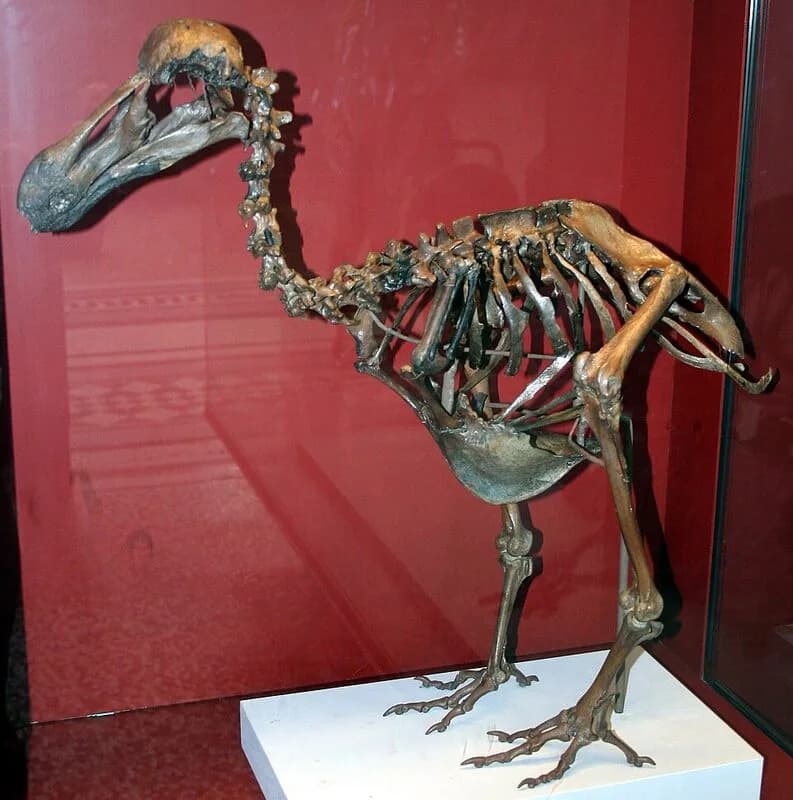
Reconstructed dodo skeleton in museum
Wikimedia Commons, CC BY-SA