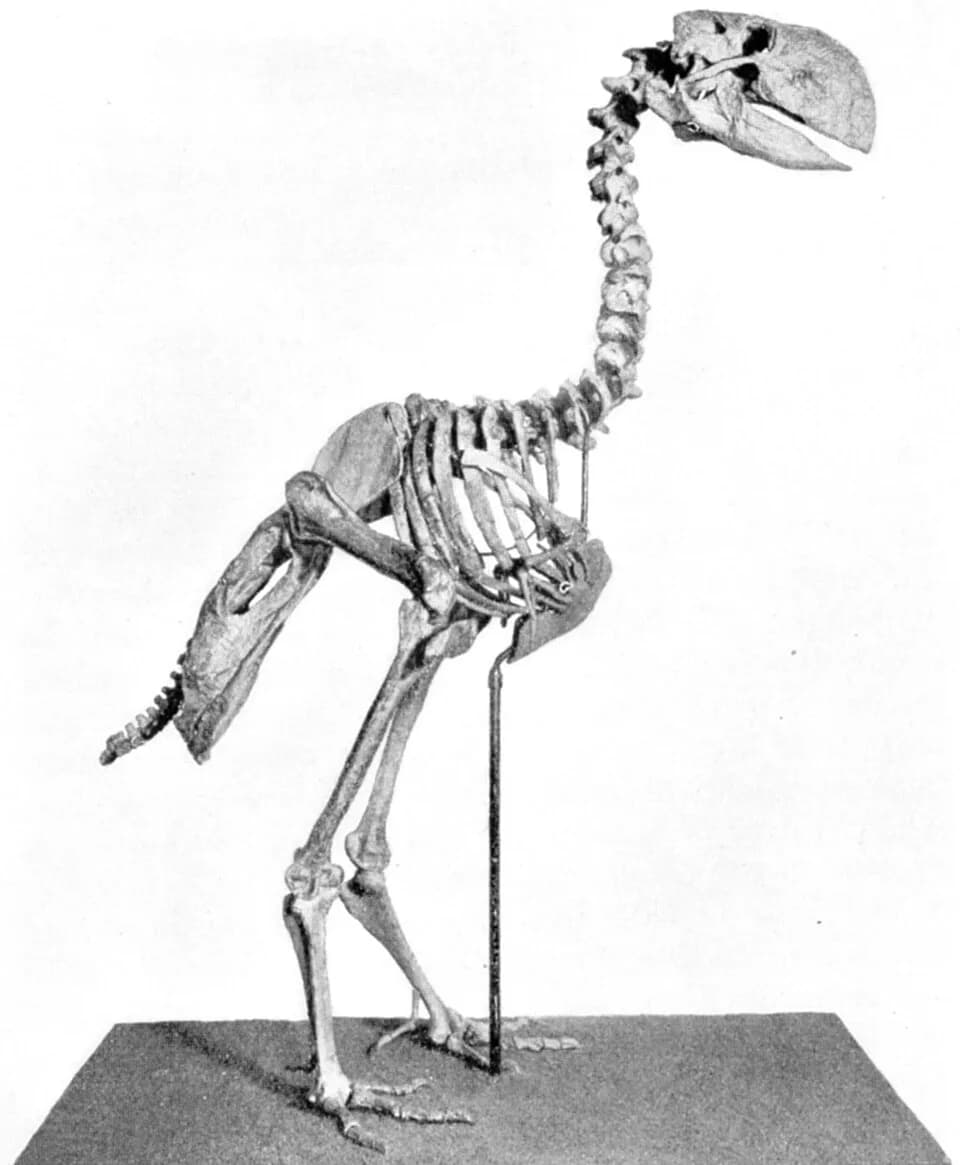
Gastornis
Gastornis gigantea long passed for the predator that took over from the dinosaurs. An isotope analysis published in 2014 overturned that reading: its massive beak served to crush seeds and nuts, not to kill. This flightless bird weighed 100 to 175 kilograms and ranged Europe, North America and China 56 to 45 million years ago.
Gastornis lived from the Late Paleocene to the Middle Eocene, approximately 56 to 45 million years ago. It was one of the first large terrestrial creatures to thrive after the extinction of non-avian dinosaurs 66 million years ago. Gastornis belonged to a group of giant flightless birds that dominated Northern Hemisphere terrestrial ecosystems for over 10 million years. Long confused with the North American genus Diatryma, recent phylogenetic studies have established that Diatryma is a junior synonym of Gastornis. Fossils have been found in Europe (France, Germany, Belgium), North America, and Asia (China), showing a near-worldwide distribution in Eocene tropical forests.
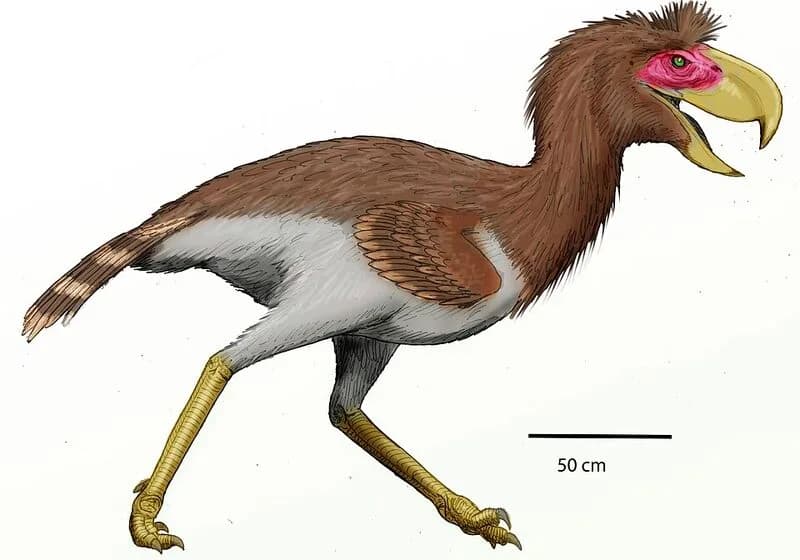
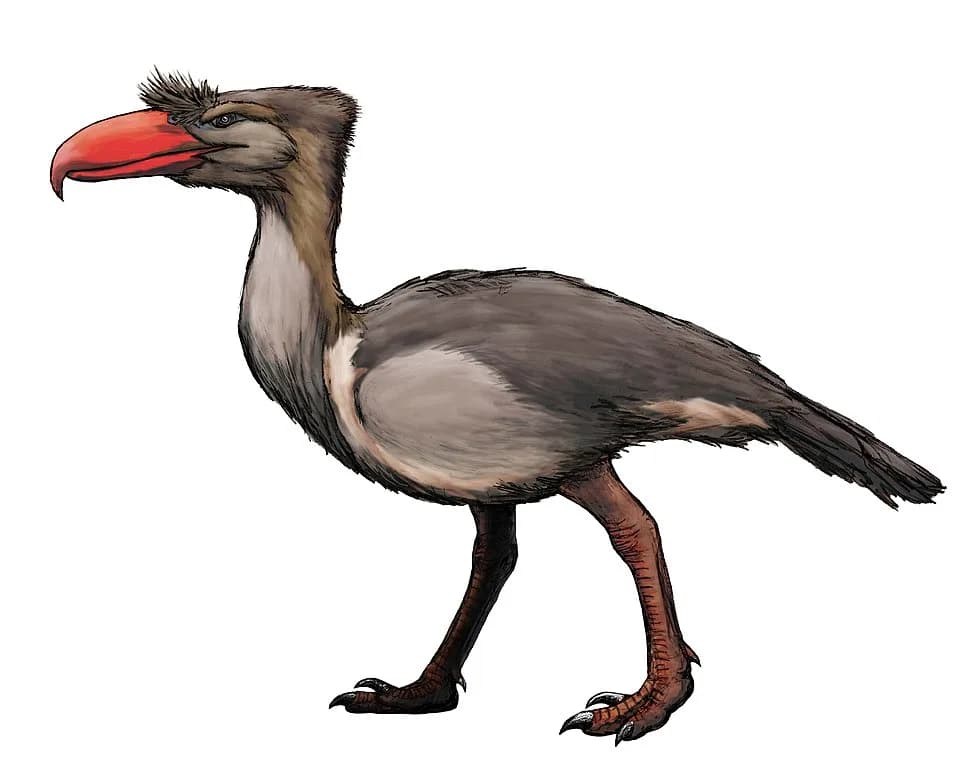
Gastornis was a colossal bird, standing about 1.75 to 2 meters tall — as tall as an adult human. Its weight is estimated between 100 and 175 kg, making it one of the largest terrestrial birds of all time. Its massive skull measured up to 46 centimeters in length, dominated by an enormous, powerful beak that represented nearly half the skull's length. Its legs were short but extremely robust, with bones three times thicker than those of a comparable-sized modern ostrich. Its wings were vestigial and completely useless for flight. Its short, muscular neck supported the massive head with its formidable beak.
Gastornis' diet is the subject of intense scientific debate. Long considered an apex predator (replacing theropod dinosaurs), recent studies have challenged this hypothesis. Calcium isotope analysis in its bones (2014) suggests a herbivorous diet, similar to large terrestrial herbivores. Its massive beak, rather than serving to tear meat, would have been adapted for crushing hard seeds, nuts, and tough fruits from Eocene tropical forests. The absence of sharp foot claws and the beak structure (no predatory hook) support the herbivore hypothesis. Gastornis was therefore probably the 'gorilla' of the Eocene rather than its 'lion.'
Gastornis lived in the dense tropical and subtropical forests that covered Europe and North America during the Late Paleocene and Eocene. These warm, humid forests harbored lush flora of palms, figs, tree ferns, and flowering plants. The Eocene climate was considerably warmer than today — tropical forests extended beyond the Arctic Circle! Gastornis shared these ecosystems with the first modern mammals in full diversification: primitive primates, early horses (Eohippus/Hyracotherium), crocodilians, and giant tortoises. Gastornis' disappearance in the Middle Eocene coincides with global cooling and the rise of mammalian carnivores.
Gastornis' anatomy was that of a massive, powerful terrestrial bird. Its 46 cm skull was dominated by an enormous beak, deep and laterally compressed, with sharp edges but without the hook characteristic of predatory birds. Its jaw musculature was extraordinarily developed, giving it an estimated bite force superior to any living bird. Its cervical vertebrae were short and massive, indicating a powerful neck capable of sudden movements. Its legs, though short for a bird of its size, were incredibly robust with bones three times thicker than an ostrich's. Its feet bore three forward-facing toes with short, rounded nails — more adapted for walking than for prey capture.
Gastornis was probably a solitary animal or one living in small family groups in the understory of Eocene tropical forests. If the herbivore hypothesis is correct, it fed by roaming the forest floor in search of fallen fruits, seeds, and nuts, using its massive beak to crack the hardest shells. Its large size and strength protected it from most predators of the time — mammalian carnivores were still relatively small in the early Eocene. Gastornis was probably territorial and defended food-rich zones against conspecifics. Unable to fly, it compensated with physical power and its formidable beak to deter threats.
Gastornis was first described in 1855 by French paleontologist Edmond Hébert, who named the animal in honor of Gaston Planté, the physicist who had discovered the first fossil in the Eocene limestones of Meudon, near Paris. The North American genus Diatryma, described in 1876 by Edward Drinker Cope, is now considered a synonym of Gastornis. The most complete fossils come from the Willwood Formation (Early Eocene) in Wyoming, the Messel deposits in Germany (an exceptional UNESCO site), and several French and Belgian localities. In 2014, a study published in Naturwissenschaften using calcium isotopes revolutionized our understanding of Gastornis by suggesting a herbivorous rather than carnivorous diet, challenging decades of depicting this bird as a fierce predator.
| Period | Paléocène sup. à Éocène moyen / Late Paleocene to Middle Eocene |
| Era | Cénozoïque / Cenozoic |
| Age | 56-45 Ma |
| Location | Europe, Amérique du Nord, Chine / Europe, North America, China |
| Height | 1.75-2 m |
| Weight | 100-175 kg |
| Diet | Herbivore |
| Discovery | 1855 |
Long depicted as an apex predator replacing dinosaurs, Gastornis gigantea is now considered probably herbivorous by the majority of researchers. A 2014 study published in Naturwissenschaften analyzed calcium isotopes in its bones and concluded a plant-based diet. Its beak lacking a predatory hook and the absence of sharp claws reinforce the hypothesis of a seed and nut crusher rather than a hunter.
Gastornis gigantea stood 1.75 to 2 meters tall and weighed 100 to 175 kg. Its skull reached 46 centimeters long, dominated by a deep, laterally compressed beak with sharp edges. Its extraordinarily developed jaw musculature gave it an estimated bite force more powerful than any known bird, sufficient to crush the hard nuts and seeds of Eocene tropical forests.
No. Gastornis gigantea was a bird — and modern birds are indeed the direct descendants of theropod dinosaurs, but Gastornis itself is a giant flightless bird from the Paleocene and Eocene (56-45 Ma), well after the extinction of non-avian dinosaurs. It belongs to the family Gastornithidae and is not related to giant carnivorous dinosaurs like Tyrannosaurus.
Mounted Gastornis skeleton showing its impressive size
Wikipedia Commons
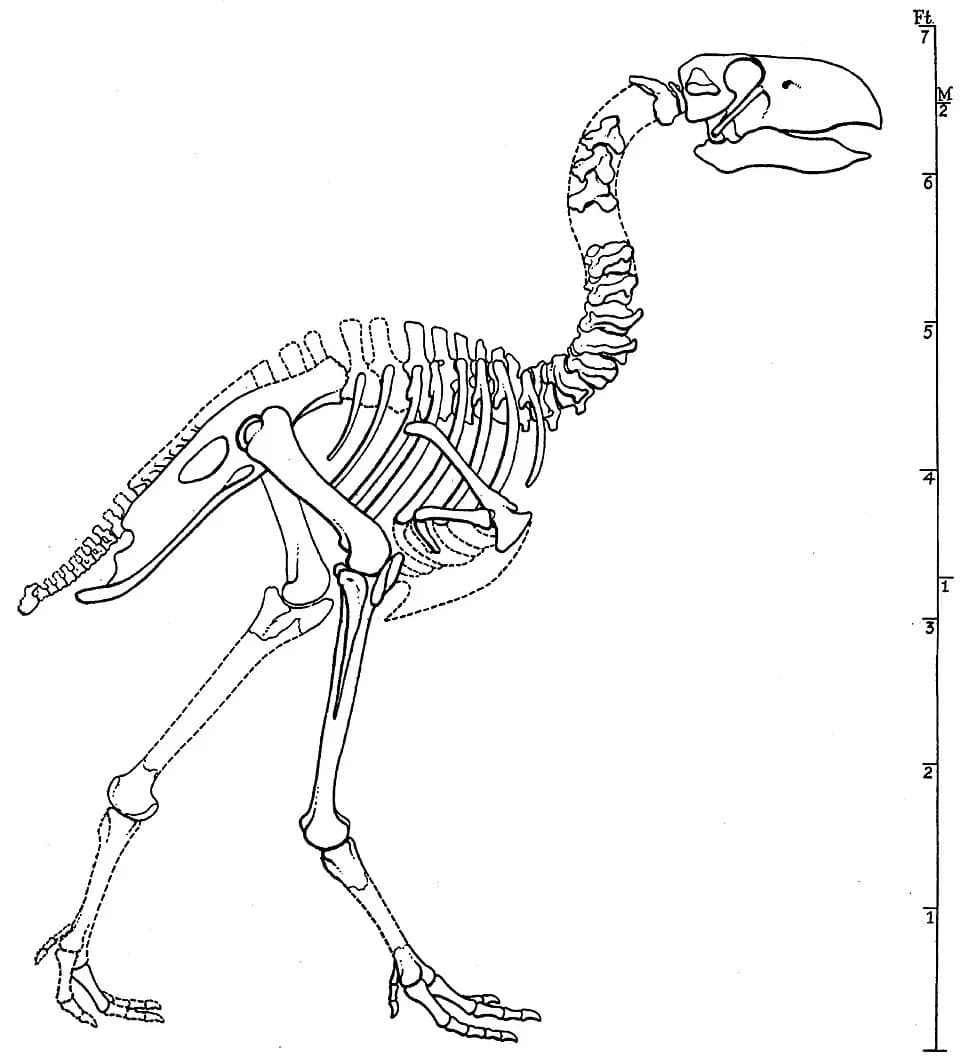
Gastornis reconstruction in its Eocene forest environment
Wikipedia Commons