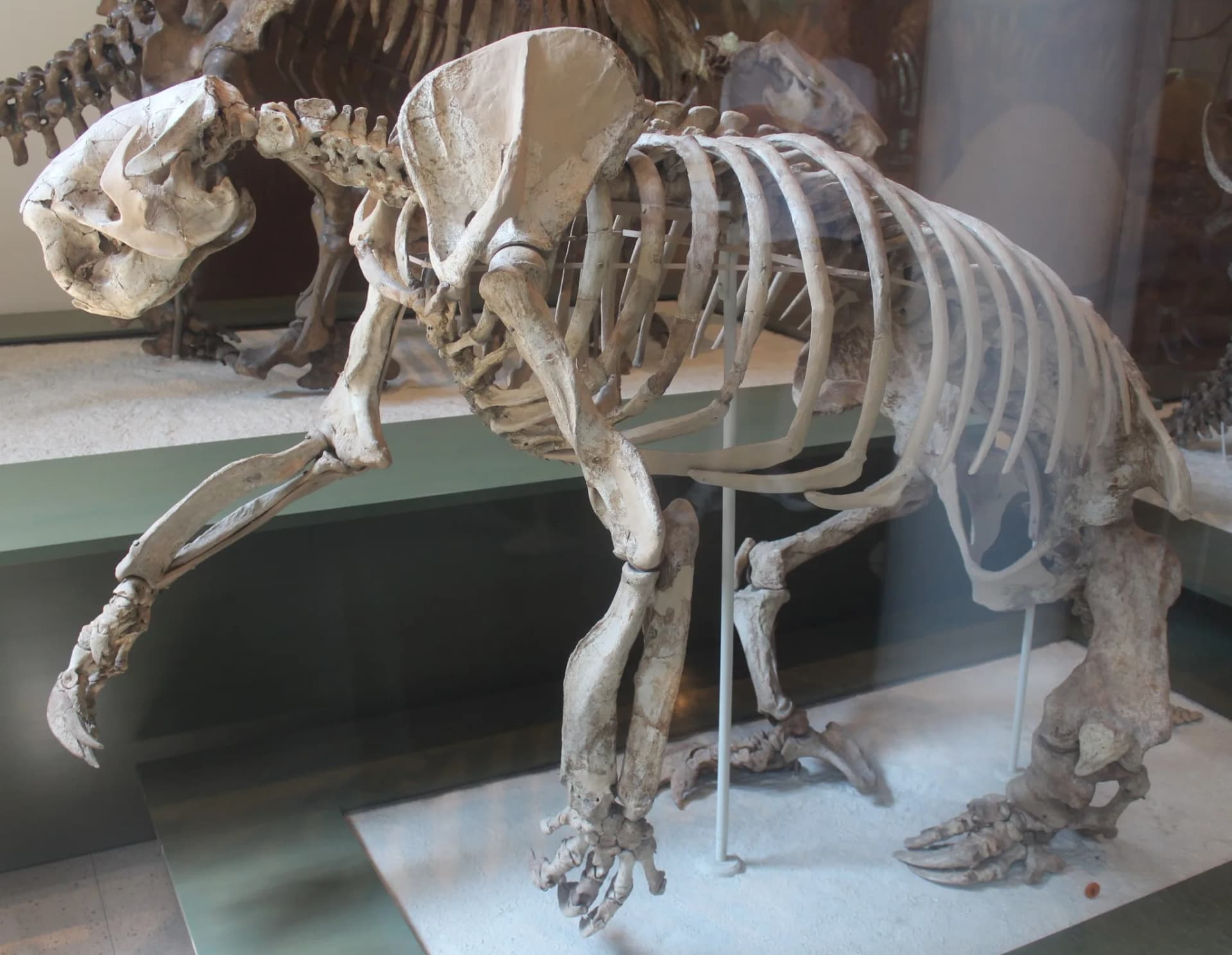
Paresseux géant de Jefferson
Megalonyx jeffersonii owes its name to Thomas Jefferson, who presented the fossil's claws to the American Philosophical Society in 1797, convinced of having found a giant cat. It was in fact a ground sloth 3 metres tall and 800 to 1,000 kilograms, present in North America between 2 million and 11,000 years ago. It is the official fossil of West Virginia.
Megalonyx jeffersonii lived during the Pleistocene, approximately 2 million to 11,000 years ago, making it one of the last giant ground sloths of North America. This massive mammal appeared at the beginning of the Pleistocene and spread across most of the North American continent, from temperate regions of Canada to the southern United States. Its name was assigned by Thomas Jefferson in 1799, then the third President of the United States, who initially believed he had discovered a gigantic clawed lion. It was only later that naturalist Caspar Wistar correctly identified the animal as a giant ground sloth. Megalonyx disappeared around 11,000 years ago, during the great Pleistocene megafaunal extinction that decimated the large mammals of North America.
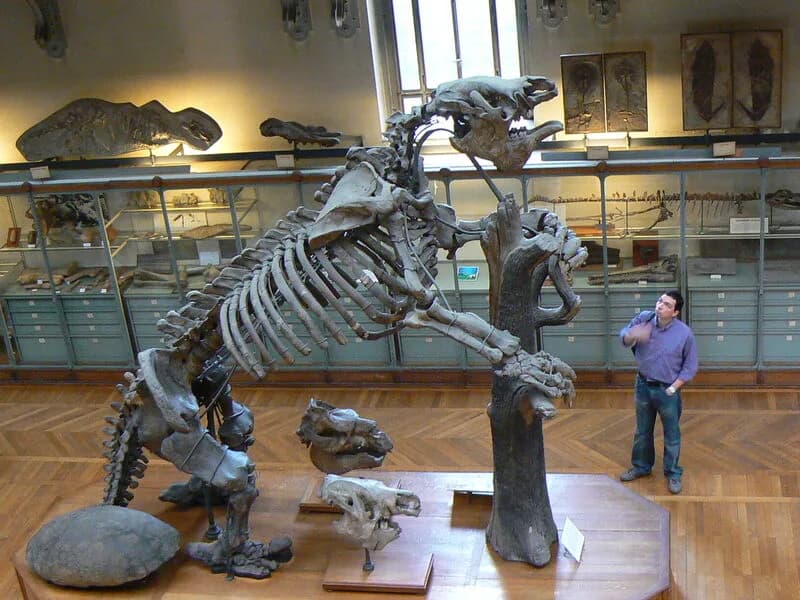
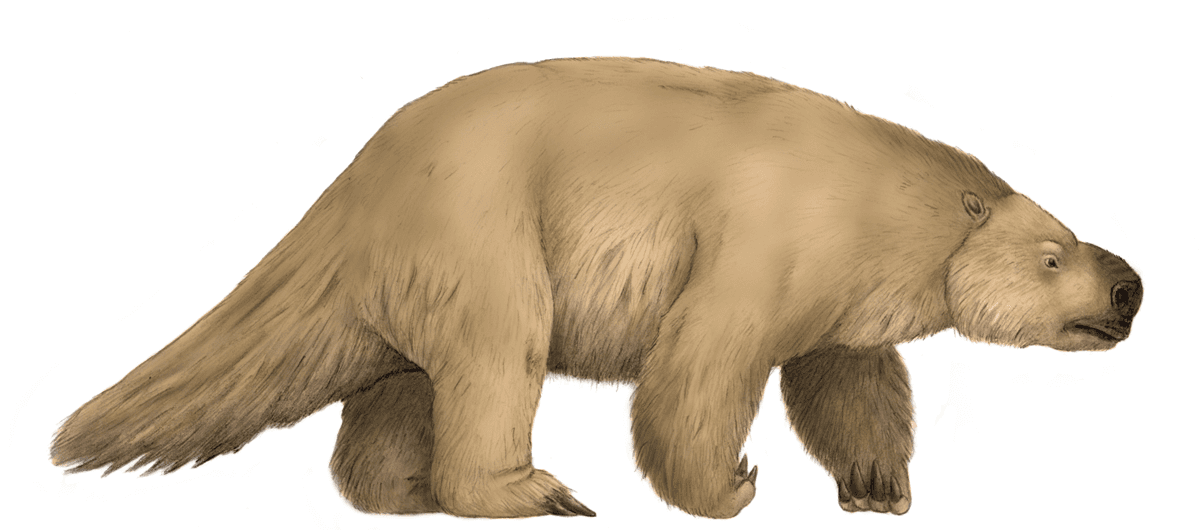
Megalonyx jeffersonii measured approximately 3 meters in length and could reach 1.8 meters in height when standing on its hind legs. Its estimated weight ranged between 800 and 1,000 kilograms, making it one of the largest ground sloths in North America, though considerably smaller than its South American cousin Megatherium. Its build was massive and stocky, with robust limbs and a thick tail that served as a third support point when it stood upright. Its bones were remarkably dense and solid, a characteristic common to giant ground sloths. Compared to modern arboreal sloths weighing only 4 to 8 kg, Megalonyx represented a striking contrast in both size and power, being over a hundred times heavier than its tree-dwelling relatives.
Megalonyx jeffersonii was a strict herbivore that fed primarily on leaves, twigs, fruits, and bark from various trees and shrubs. Thanks to its massive claws and powerful forelimbs, it could reach and pull down branches from the tallest trees to access foliage unavailable to other herbivores. Its masticatory apparatus, equipped with prismatic teeth lacking external enamel, was perfectly adapted for grinding tough plant material. Isotopic analysis of its fossilized teeth reveals a diet composed mainly of C3 plants, including leaves from deciduous trees and conifers. Unlike modern arboreal sloths with extremely slow metabolisms, Megalonyx had to consume large quantities of vegetation daily to maintain its considerable body mass and fuel its terrestrial lifestyle.
Megalonyx jeffersonii occupied an impressive diversity of habitats across North America, from dense temperate forests to open grasslands bordered by wooded areas. Its geographic range extended from Alaska and the Yukon in the north to Florida and Texas in the south, across the Great Plains and the Atlantic coast. It preferred forested environments or forest edges, where abundant arboreal vegetation provided its primary food source. Fossils have been discovered in caves, alluvial deposits, and marshy sites across more than thirty American states and several Canadian provinces. Its climatic tolerance was remarkable, allowing it to survive in conditions ranging from cold boreal forests to the warm temperate zones of the American Southeast.
The anatomy of Megalonyx jeffersonii was specialized for an unusual terrestrial lifestyle among sloths. Its claws, measuring up to 20 centimeters, were powerfully curved, forming formidable hooks capable of tearing bark and pulling branches with considerable force. These claws were not offensive weapons but perfected feeding tools. Its skull was relatively small compared to the body, with a robust lower jaw and cylindrical teeth lacking external enamel, continuously regenerating through wear. Its caudal vertebrae and massive pelvic bones allowed it to sit in a tripod position, using its tail as stable support to reach vegetation above. Its inward-turned feet forced it to walk on the outer edges of its feet.
Megalonyx jeffersonii was probably a solitary animal or one living in small family groups, moving slowly through the forests of North America in search of food. Its metabolism, though faster than that of modern arboreal sloths, remained relatively slow for a mammal of its size. It spent much of its day feeding, using its massive claws to draw branches within reach. Despite its clumsy appearance, Megalonyx possessed formidable defensive strength thanks to its sharp claws and powerful musculature, discouraging most predators of the era. Young individuals were more vulnerable to attacks from Smilodon or packs of dire wolves. Fossil evidence suggests this animal sometimes used natural caves as shelters.
The first Megalonyx fossils were discovered in 1796 in a cave in West Virginia and sent to Thomas Jefferson, who presented his description before the American Philosophical Society in 1797. Jefferson initially believed he had found a giant lion with monstrous claws, hence the name Megalonyx meaning 'great claws' in Greek. Georges Cuvier and Caspar Wistar correctly identified the animal as a giant ground sloth. The species was officially named Megalonyx jeffersonii in 1822 by Desmarest, in tribute to the naturalist president. Fossils have since been found at over 150 sites across North America. The most complete specimen was discovered in 1905 at Big Bone Lick in Kentucky.
| Period | Pléistocène / Pleistocene |
| Era | Cénozoïque / Cenozoic |
| Age | 2 Ma - 11 000 ans |
| Location | Amérique du Nord / North America |
| Length | 3 m |
| Height | 1.8 m (debout / standing) |
| Weight | 800-1000 kg |
| Diet | Herbivore |
| Discovery | 1799 |
No. Megalonyx jeffersonii was a xenarthran mammal of the family Megalonychidae — a giant ground sloth from Pleistocene North America (2 Ma – 11,000 years ago). Thomas Jefferson, who discovered the first fossils in 1797, initially mistook it for a giant clawed lion. It was Caspar Wistar who correctly identified this animal as a giant sloth related to modern arboreal sloths, though about 200 times heavier.
Megalonyx jeffersonii measured approximately 3 meters in length and stood 1.8 meters tall when rearing on its hind legs, with an estimated weight between 800 and 1,000 kilograms. Its front claws, measuring up to 20 centimeters, were not weapons but feeding tools: the animal used them to pull tree branches within reach and access foliage unavailable to other herbivores of its time.
The first Megalonyx jeffersonii fossils were discovered in 1796 in a cave in West Virginia (present-day Big Bone Lick region) and sent to Thomas Jefferson, future U.S. President. He presented his description before the American Philosophical Society in 1797. The species was officially named Megalonyx jeffersonii in 1822 by Desmarest, in tribute to the naturalist president. Since then, fossils have been found at over 150 sites from Alaska to Florida.
Mounted Megalonyx jeffersonii skeleton at the American Museum of Natural History (AMNH)
Wikipedia Commons
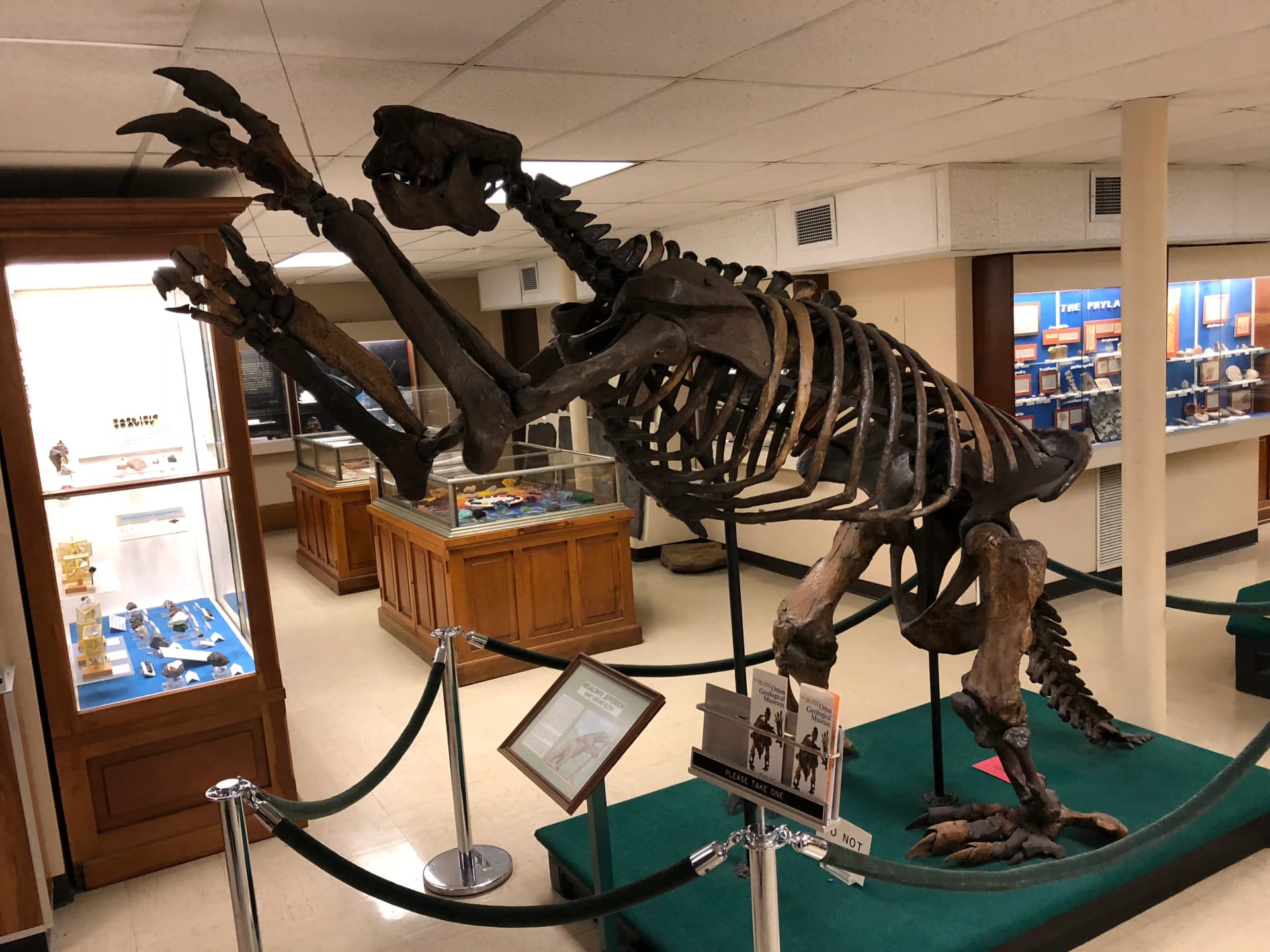
Reconstruction of Megalonyx jeffersonii rearing up to reach foliage
Wikipedia Commons