Mégalania
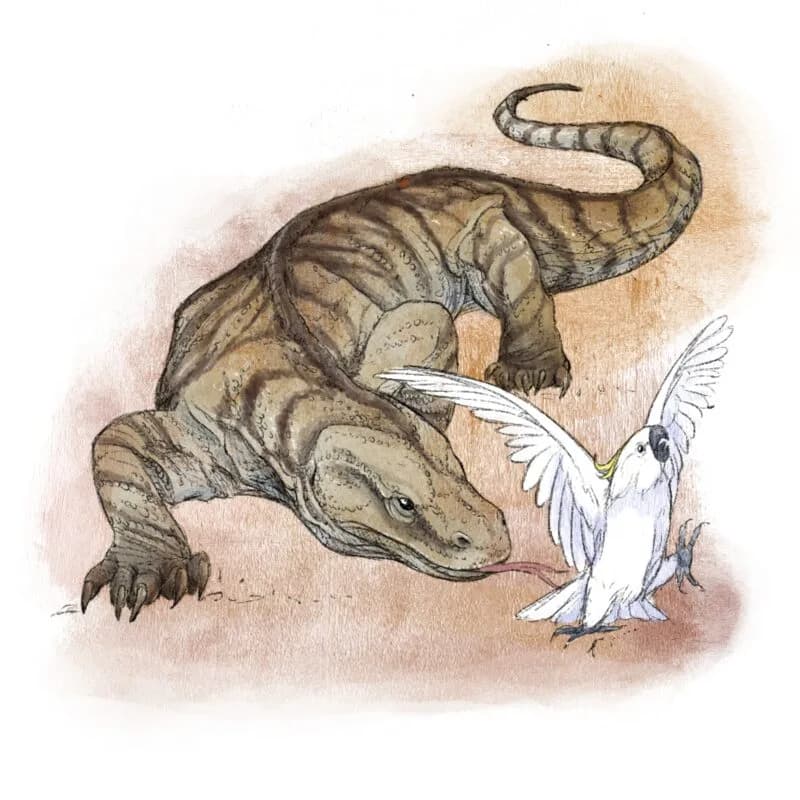
Varanus priscus, or Megalania, is the largest land lizard of all time: 4.5 to 5.5 metres and 300 to 600 kilograms, roughly twice the length and five times the mass of a Komodo dragon. It ranged Australia between 2.5 million and 40,000 years ago. Like its Komodo cousin, it most likely carried venom glands.
Playable in Path of Titans
See Varanus priscus's stats, abilities and role on our survival server.
Megalania lived during the Pleistocene, approximately 2.5 million to 40,000 years ago, in Australia. This colossal monitor lizard appeared when the continent hosted extraordinary megafauna including giant marsupials, flightless birds, and immense reptiles. The climate oscillated between glacial and interglacial periods, but Australia retained vast semi-arid zones favorable to large ectotherms. Megalania likely disappeared at the end of the Pleistocene, coinciding with the arrival of the first humans on the continent approximately 50,000 to 40,000 years ago and associated climatic upheavals.
Varanus priscus is the largest terrestrial lizard that ever existed. Size estimates vary depending on methods employed. The most conservative analyses by Ralph Molnar in 2004 suggest a total length of 4.5 to 5.5 meters for the largest individuals, while earlier estimates proposed up to 7 meters. Its body mass is estimated between 300 and 600 kilograms. For comparison, the modern Komodo dragon rarely reaches 3 meters and 70 kilograms, making Megalania at least twice as long and five times heavier than its closest living relative.
Megalania was an apex carnivorous predator dominating the terrestrial ecosystems of Pleistocene Australia without any serious competition. Its diet likely included large herbivorous marsupials such as Diprotodon optatum, the largest known marsupial weighing up to 2,800 kilograms, as well as giant kangaroos of the genus Procoptodon and massive giant wombats. Like the modern Komodo dragon, Megalania most likely hunted by ambush from concealed positions, inflicting devastating bites to unsuspecting prey. Recent scientific studies strongly suggest it possessed functional venom glands similar to those found in the Komodo dragon, significantly amplifying the effects of its bites through hemorrhaging, tissue destruction, and systemic shock.
Megalania inhabited open woodlands, wooded savannas, and semi-arid zones of eastern and southern Australia throughout the Pleistocene epoch. Fossils have been discovered primarily in Queensland, New South Wales, and South Australia, indicating a broad geographic distribution across the eastern half of the continent. Its preferred habitat was likely grassland plains dotted with scattered trees near permanent water sources where the herbivorous megafauna congregated in large numbers. The subtropical to warm temperate climate of Pleistocene Australia provided favorable thermal conditions for this gigantic ectotherm, which depended entirely on ambient heat and solar radiation to regulate its body temperature and maintain activity levels.
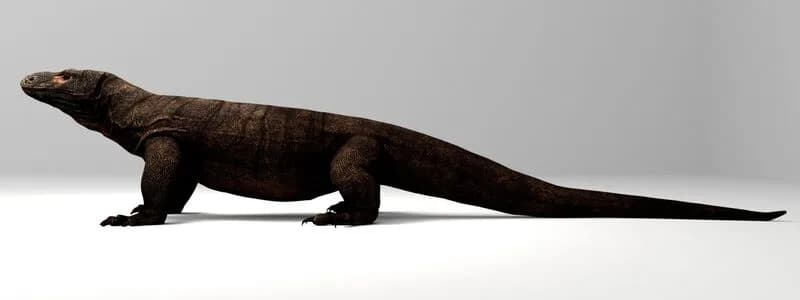
Megalania's anatomy is reconstructed from cranial fragments, vertebrae, and limb bones recovered from various Australian Pleistocene deposits across the eastern states. Its overall morphology closely resembled a considerably enlarged Komodo dragon: a massive, robust skull armed with laterally compressed and finely serrated teeth ideal for slicing through flesh and hide. Its powerful sprawling limbs supported a stocky, heavily muscled body built for delivering devastating attacks. Its tail comprised approximately half its total length and likely served as both a counterbalance during locomotion and a formidable defensive weapon when threatened. Phylogenetic analyses firmly confirm that Megalania belongs to the genus Varanus, closely related to the modern Komodo dragon.
Megalania most likely adopted solitary territorial predator behavior, very similar to that observed in the modern Komodo dragon. It hunted primarily by ambush, concealed in dense vegetation or behind terrain features, lunging explosively at unwary herbivores passing within striking distance. Its venomous bite combined with razor-sharp serrated teeth caused massive hemorrhagic wounds in prey animals, which it could then track patiently over long distances using its highly sensitive Jacobson's organ to detect chemical traces left in the air and on the ground. Like large modern monitor lizards, it could probably detect carrion from several kilometers away and readily supplemented its diet with opportunistic scavenging.
The first Megalania fossils were described in 1859 by the renowned British paleontologist Sir Richard Owen, who named the species Megalania prisca from fragmentary vertebrae discovered in Queensland, Australia. The generic name means 'great roamer' in Greek, alluding to its probable wide-ranging predatory lifestyle. Fragmentary remains have been unearthed at several sites across Queensland, New South Wales, and South Australia, though complete specimens remain elusive. In 2004, Ralph Molnar formally reclassified the species as Varanus priscus, confirming its membership in the same genus as the Komodo dragon and other living monitor lizards. The fossils remain relatively rare and fragmentary, significantly complicating precise size estimates and detailed anatomical reconstructions.
| Period | Pléistocène / Pleistocene |
| Era | Cénozoïque / Cenozoic |
| Age | 2.5 Ma - 40 ka |
| Location | Australie / Australia |
| Length | 4.5-5.5 m |
| Height | 0.6-0.7 m |
| Weight | 300-600 kg |
| Diet | Carnivore |
| Discovery | 1859 |
No. Varanus priscus, known as Megalania, was a monitor lizard (family Varanidae), not a dinosaur. Reclassified in 2004 into the genus Varanus by Ralph Molnar, it belongs to the same group as the modern Komodo dragon. This giant ectotherm lived in Pleistocene Australia, approximately 2.5 million to 40,000 years ago, reaching 4.5 to 5.5 meters in length.
Varanus priscus reached 4.5 to 5.5 meters in length (some earlier estimates suggested up to 7 m) and weighed between 300 and 600 kilograms. The Komodo dragon (Varanus komodoensis) rarely exceeds 3 meters and 70 kg. Megalania was therefore at least twice as long and up to five times heavier than its closest living relative.
Recent studies suggest that Varanus priscus possessed venom glands similar to the Komodo dragon, causing hemorrhaging and shock in prey. Its main targets included Diprotodon optatum (the largest known marsupial, around 2,800 kg), giant kangaroos of the genus Procoptodon, and giant wombats. Its strategy relied on hemorrhagic bites followed by tracking prey through chemical detection via the Jacobson's organ.
Artistic reconstruction of Megalania in its Pleistocene Australian environment
Wikimedia Commons
Size comparison between Megalania and a modern Komodo dragon
Wikimedia Commons