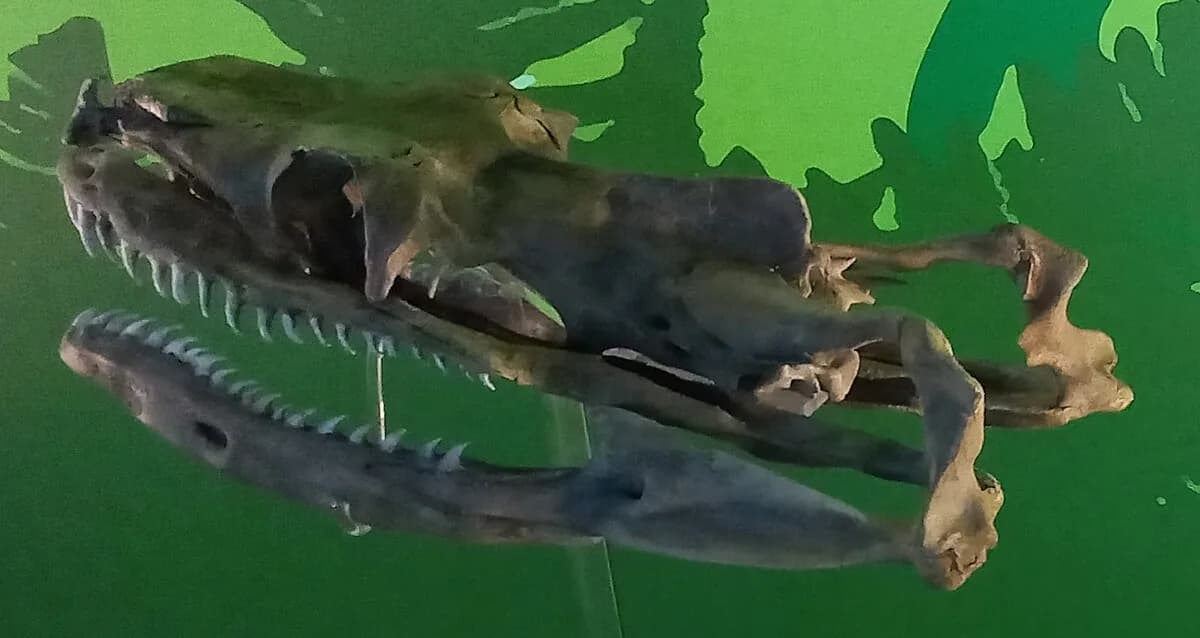
Madtsoia
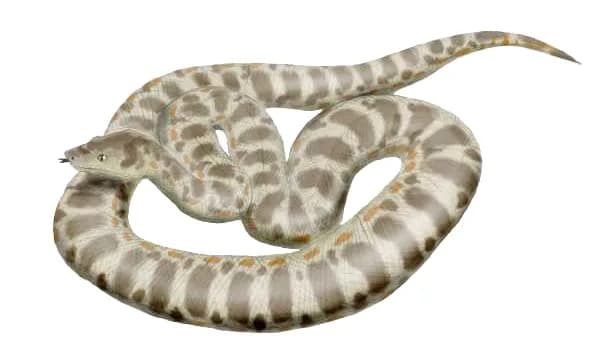
Madtsoia bai is a snake 5 to 9 metres long and 50 to 150 kilograms, described in 1933 and present in Argentina, India, Madagascar and Africa. It crossed the end-Cretaceous extinction and held on until 40 million years ago. A close relative, Sanajeh, was fossilised coiled around a dinosaur nest: direct evidence of such a diet.
Madtsoia lived from the Late Cretaceous to the Eocene, approximately 90 to 40 million years ago. This giant snake belongs to the extinct family Madtsoiidae, an archaic group of Gondwanan snakes representing one of the oldest lineages of large constricting snakes. Madtsoiids were a cosmopolitan family across Gondwanan continents — South America, Africa, India, Madagascar, and Australia — before being supplanted by modern boids and pythonids. Madtsoia survived the Cretaceous-Paleogene mass extinction that eliminated the dinosaurs, persisting until the Eocene before finally disappearing.
Madtsoia bai, the type and largest species, is estimated at approximately 5 to 7 meters in length, making it one of the largest snakes of the dinosaur era and early Cenozoic. Some fossil vertebrae suggest the largest individuals may have approached 9 meters. Its maximum body diameter was approximately 20 to 30 centimeters. Although smaller than the famous Titanoboa (13 meters) which lived a few million years later, Madtsoia was nonetheless a formidably-sized snake, comparable to the largest modern pythons and anacondas.
Madtsoia was a large constricting snake that killed prey by constriction — wrapping its muscular coils around victims until asphyxiation. Its diet probably included primitive mammals, small dinosaurs (during the Cretaceous), birds, lizards, and other reptiles. A spectacular discovery in India revealed a fossil of Sanajeh indicus, a closely related madtsoiid, coiled around titanosaur eggs and a baby sauropod — proving these snakes actually fed on baby dinosaurs. After the dinosaurs' disappearance, Madtsoia probably turned to the rapidly diversifying mammals of the Eocene.
Madtsoia inhabited various terrestrial environments across the Gondwanan continents during the Late Cretaceous and into the early Cenozoic. The type species M. bai was described from Argentina, but related species or forms have been identified in India (M. pisdurensis), Madagascar, North Africa, and Australia, demonstrating a remarkably wide Gondwanan distribution. During the Cretaceous period, these continents were still relatively close to each other, allowing the dispersal of the family across connected or nearby landmasses. Depositional environments include tropical forests, alluvial plains, and coastal zones. In Argentina, fossils come from Cretaceous and Eocene formations of Patagonia, representing temperate to subtropical forest environments with abundant prey resources.
Madtsoia anatomy is known primarily from vertebrae and some cranial elements, as fossil snakes rarely fossilize in complete articulation. Its vertebrae are characteristic of madtsoiids: wide, robust, with a distinct dorsal depression (zygosphene-zygantrum) and well-developed articular surfaces. Like all madtsoiids, Madtsoia possessed a tooth-bearing premaxillary bone — a primitive trait lost in modern snakes, which have an edentulous premaxilla. This feature, combined with other basal traits, places madtsoiids among the most primitive known snakes. Its body was cylindrical and muscular, adapted for constriction.
Madtsoia was probably a terrestrial constrictor, hunting by ambush in the undergrowth of Gondwanan forests. Like large modern pythons and boas, it probably waited concealed in vegetation or near water sources for prey to pass nearby, before striking rapidly and wrapping its coils around the victim. The discovery of the madtsoiid Sanajeh coiled around a titanosaur nest suggests these snakes frequented dinosaur nesting sites to feed on hatchlings — a nest predation behavior similar to modern pythons targeting crocodile and bird nests.
Madtsoia was described in 1933 by Argentine paleontologist George Gaylord Simpson from fossil vertebrae discovered in Patagonia, Argentina. The name honors an Argentine fossil locality. The type species is M. bai, but several other species have been described: M. pisdurensis (India), M. laurasiae (Spain), and other fragmentary forms from Africa and Australia. The family Madtsoiidae, to which it belongs, is one of the oldest known snake families, with representatives from the Middle Cretaceous to the Eocene, and even the Pleistocene in Australia (Wonambi). The 2010 discovery of Sanajeh indicus, found coiled around dinosaur eggs in India, spectacularly illustrated this family's ecology.
| Period | Crétacé sup. – Éocène / Late Cretaceous – Eocene |
| Era | Mésozoïque-Cénozoïque / Mesozoic-Cenozoic |
| Age | 90-40 Ma |
| Location | Argentine, Inde, Madagascar, Afrique / Argentina, India, Madagascar, Africa |
| Length | 5-9 m |
| Height | 30 cm |
| Weight | 50-150 kg |
| Diet | Carnivore |
| Discovery | 1933 |
No. Madtsoia bai was a constricting snake belonging to the extinct family Madtsoiidae. Described in 1933 by George Gaylord Simpson from Patagonian vertebrae, it represents one of the oldest known lineages of large snakes. It lived from the Late Cretaceous to the Eocene (90 to 40 million years ago) and survived the dinosaur extinction, persisting across Gondwanan continents.
In 2010, researchers described a Sanajeh indicus fossil — an Indian madtsoiid closely related to Madtsoia — found coiled around titanosaur eggs and a baby sauropod skeleton in Gujarat (India, Late Cretaceous). This is direct evidence that these snakes frequented dinosaur nesting sites to hunt hatchlings, exactly like modern pythons target crocodile nests.
Madtsoia bai, the type species, is estimated at 5 to 7 meters, with the largest fossil vertebrae suggesting individuals approaching 9 meters. Related species or forms have been identified in Argentina (type species), India (M. pisdurensis), Madagascar, Spain (M. laurasiae), and Australia (Wonambi, surviving into the Pleistocene, 50,000 years ago). This distribution reflects the former Gondwana supercontinent.
Madtsoia fossil remains at Museo Paleontológico Egidio Feruglio
Wikipedia Commons
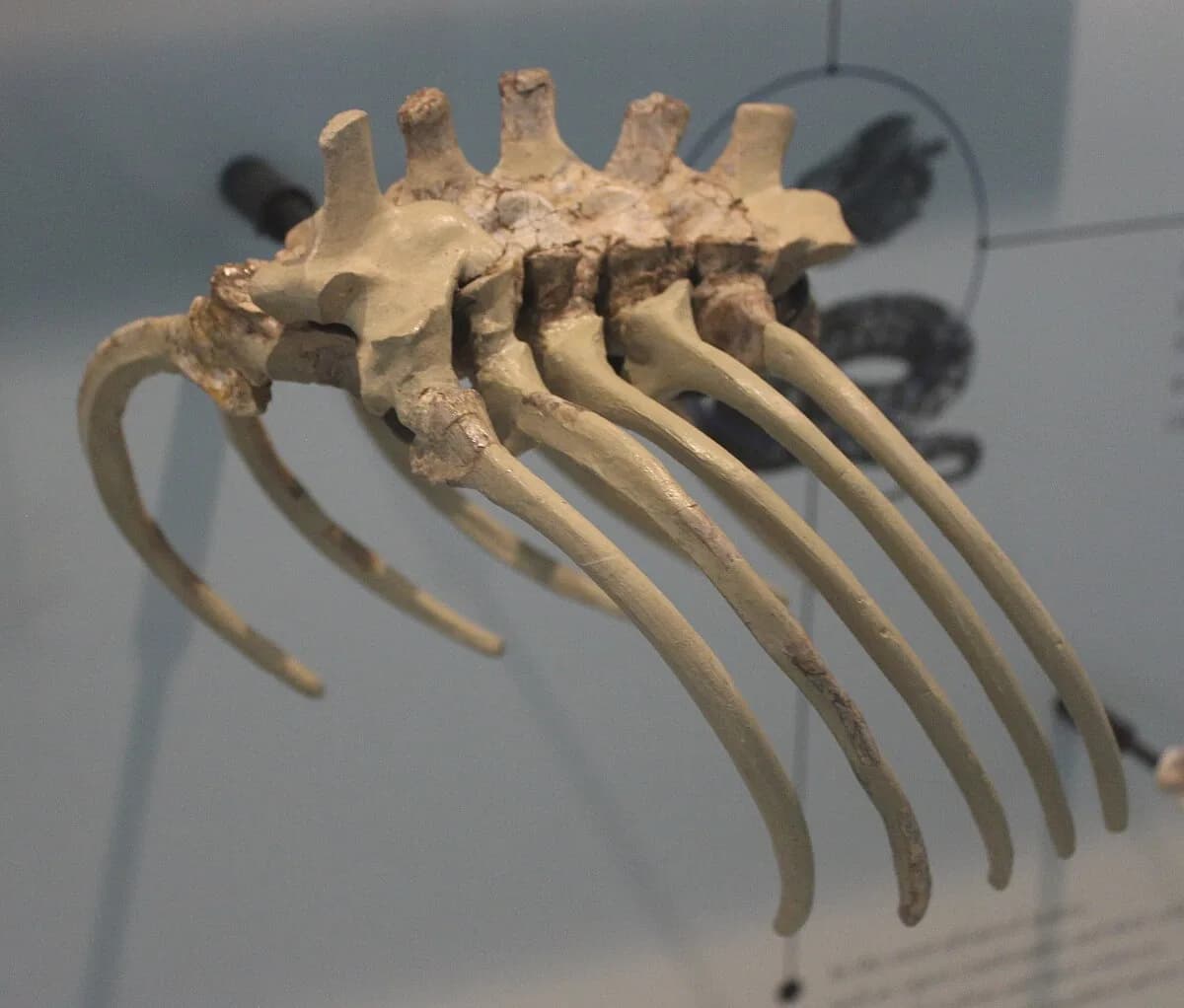
Madtsoia holotype at the American Museum of Natural History
Wikipedia Commons