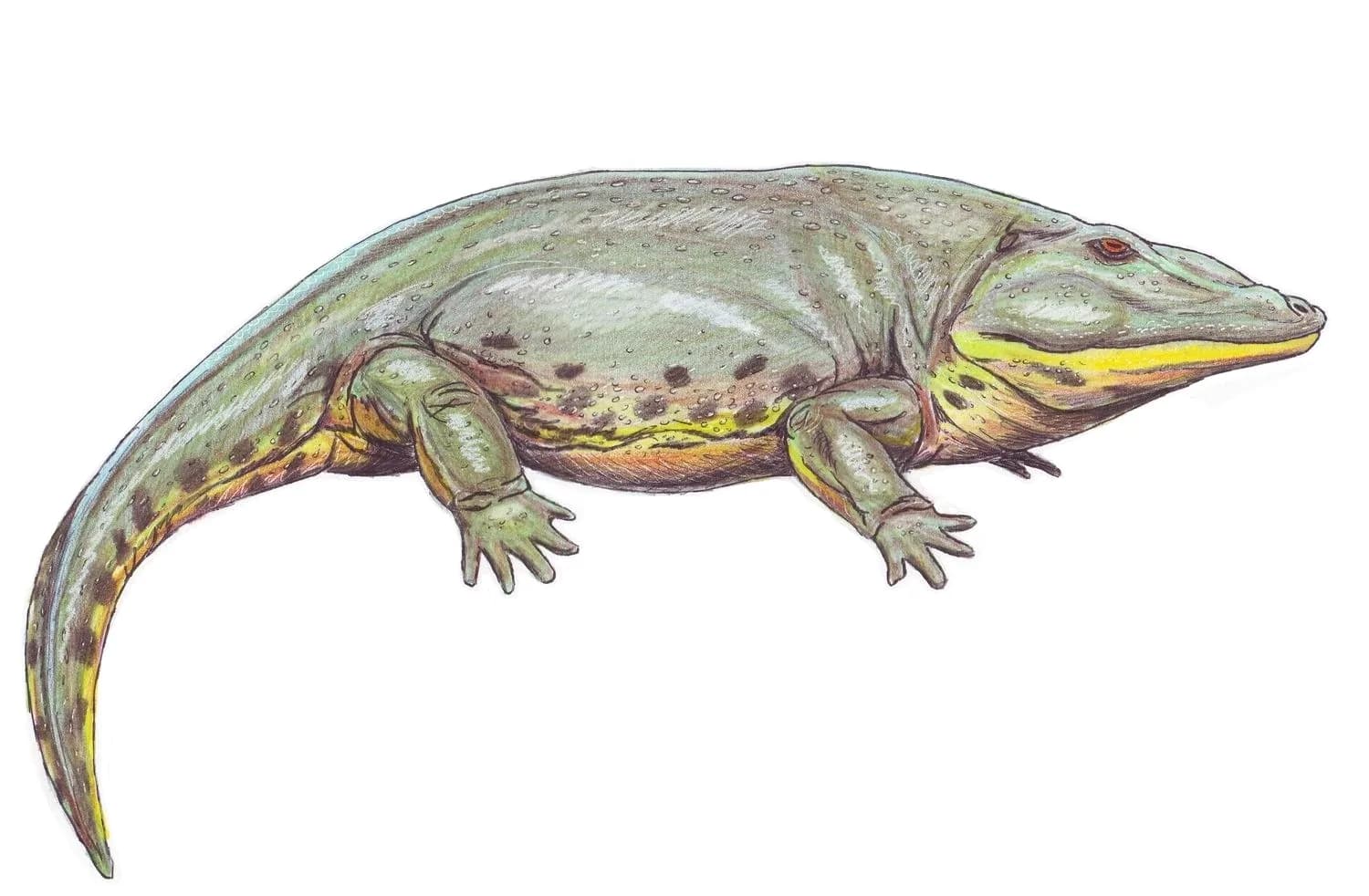
Eryops
Eryops megacephalus is an amphibian 1.5 to 2 metres long and 60 to 90 kilograms, described in 1877 and dated to 295 to 272 million years ago. Its species name means « big head »: the skull takes up nearly a third of its total length. It is among the most abundant Permian amphibians, with dozens of complete skeletons pulled from Texan ground.
Eryops lived during the Early Permian, approximately 295 to 272 million years ago (Sakmarian to Kungurian). This large primitive amphibian belongs to the order Temnospondyli, the largest group of fossil amphibians that ever existed. Temnospondyls dominated freshwater and semi-terrestrial ecosystems of the Late Paleozoic and Early Mesozoic, with Eryops as one of their most iconic representatives. It evolved in the swampy and fluvial environments of the present-day southern United States, at a time when these regions were covered by tropical rainforests on the supercontinent Pangaea.
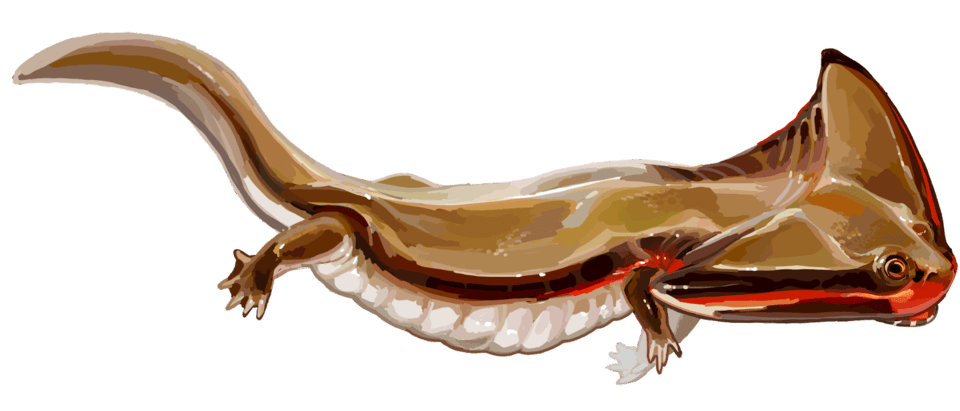
Eryops is one of the largest Permian temnospondyls, reaching approximately 1.5 to 2 meters in total length with an estimated weight between 60 and 90 kilograms, making it a formidable predator of its era. Its massive, broad, and flattened skull measured approximately 60 centimeters long — hence its species name megacephalus, meaning 'big head' in Greek. It was a stocky, powerfully built, robust animal with short but extremely strong limbs, a broad ribcage providing ample room for large lungs, and a relatively short tail. Its muscular, squat morphology resembled a modern crocodile far more than present-day salamanders, clearly reflecting its semi-aquatic predatory lifestyle.
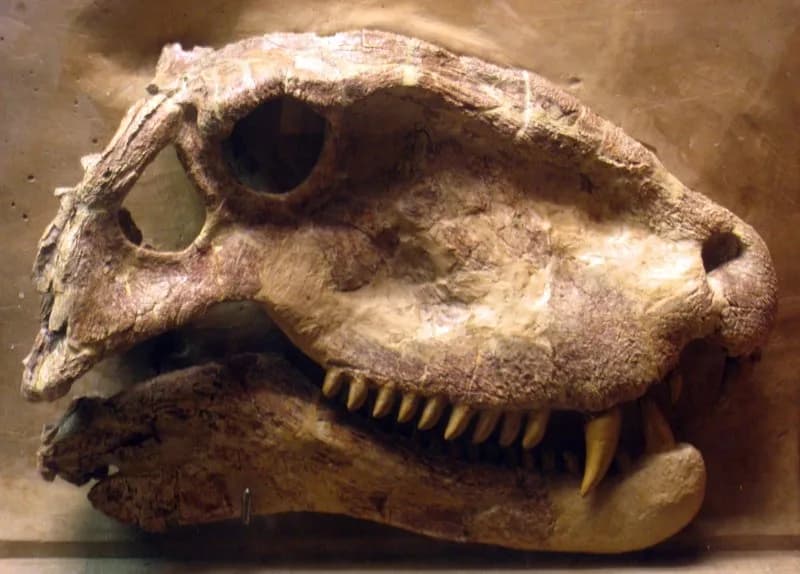
Eryops was a dominant carnivorous predator in its ecosystem. Its wide mouth lined with sharp conical teeth allowed it to capture fish, small amphibians, primitive reptiles, and aquatic invertebrates. Its teeth were set in deep sockets — an unusual trait for amphibians — and some bore labyrinthine enamel folds characteristic of labyrinthodonts. Its hunting technique probably combined aquatic ambush, like modern crocodiles, and active hunting on riverbanks. Jaw analyses suggest it could bite with considerable force, sufficient to crush the carapaces of small terrestrial arthropods.
Eryops inhabited the swampy, fluvial, and lacustrine environments of southern Pangaea, in what is now Texas, Oklahoma, New Mexico, and other southern US states. The Admiral Formation in Texas and the Wichita Formation are the most productive deposits. These environments represent tropical floodplains and meandering river systems bordered by tree fern forests and primitive conifers. The climate was warm and humid with marked seasons — ideal conditions for a large amphibian requiring regular access to water to maintain skin hydration.
Eryops anatomy reflects its semi-aquatic lifestyle. Its wide, flattened skull bore dorsal eyes allowing vision above the water surface. Its conical teeth were arranged in rows on the maxilla, premaxilla, and palate — including large fang-like palatal teeth. Its rhachitomous vertebrae (composed of several distinct elements) are characteristic of primitive temnospondyls. Its robust limbs with short, squat digits indicate good terrestrial locomotion capability, while its laterally compressed tail served for aquatic propulsion. Its skin was probably smooth and permeable, like modern amphibians, requiring a humid environment.
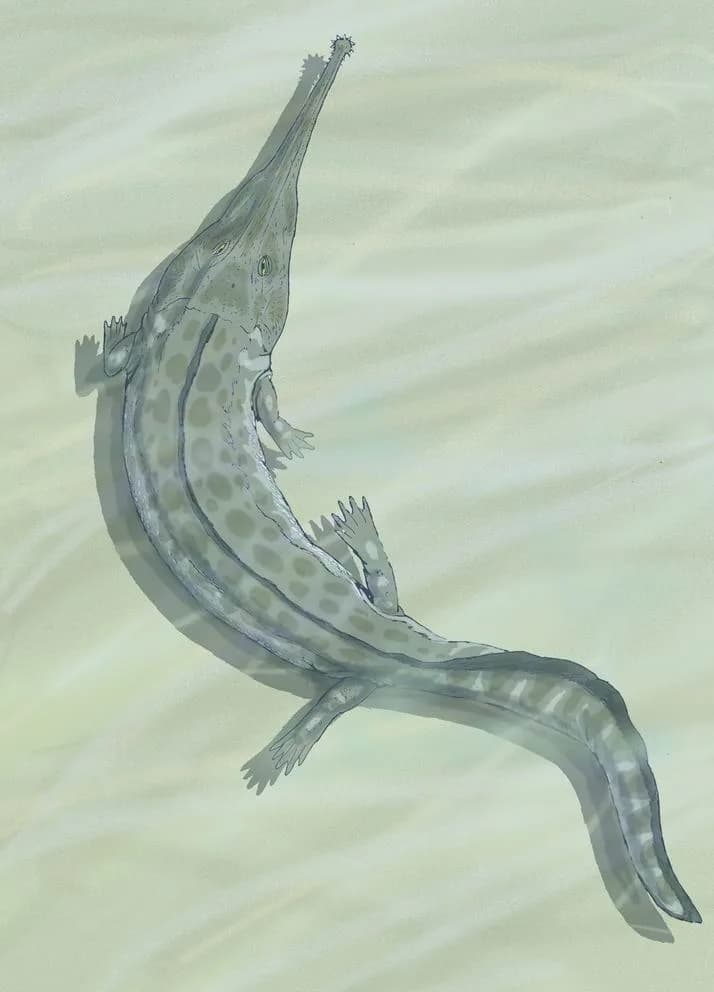
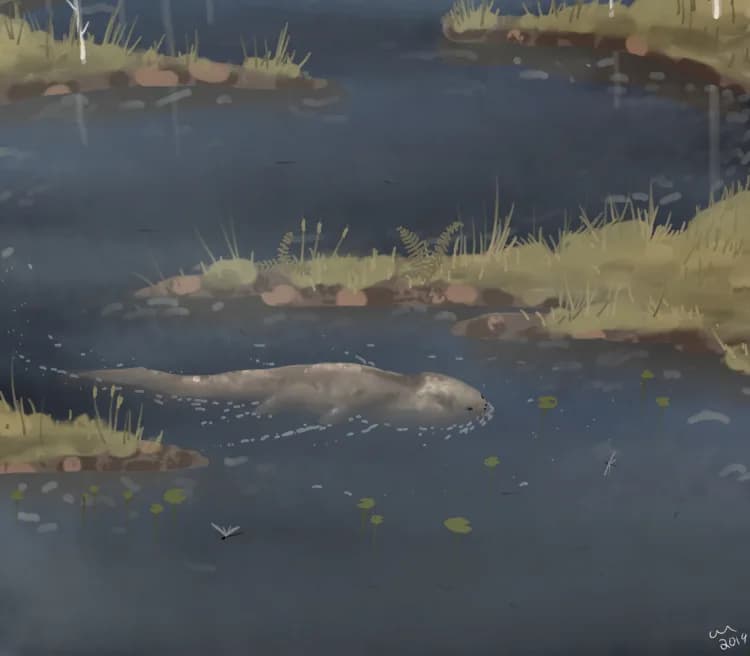
Eryops was probably an opportunistic semi-aquatic predator, dividing its time between water bodies and shorelines. Like modern crocodiles, it likely stalked prey from the water with only its eyes and nostrils emerging above the surface. On land, its robust limbs allowed surprisingly agile movement for its size, though its gait was probably that of a sprawling animal. Like all amphibians, it had to return to water to reproduce, probably laying eggs in aquatic environments. Its large size protected it from most terrestrial predators of its era.
Eryops was first described by American paleontologist Edward Drinker Cope in 1877. The name means 'drawn-out face' (from Greek eryein 'to draw' + ops 'face'), referring to the elongated shape of its skull. It is one of the most abundantly represented fossil amphibians of the North American Permian, with numerous complete or near-complete skeletons discovered in Texas and Oklahoma. The American Museum of Natural History and Chicago's Field Museum possess particularly impressive mounted specimens. Its abundant preservation makes it a reference taxon for studying temnospondyl biology and ecology.
| Period | Permien inférieur / Early Permian |
| Era | Paléozoïque / Paleozoic |
| Age | 295-272 Ma |
| Location | États-Unis (Texas, Oklahoma, Nouveau-Mexique) / USA (Texas, Oklahoma, New Mexico) |
| Length | 1.5-2 m |
| Height | 40 cm |
| Weight | 60-90 kg |
| Diet | Piscivore |
| Discovery | 1877 |
Eryops megacephalus measured between 1.5 and 2 meters long, weighing an estimated 60 to 90 kilograms. It lived in the Early Permian, approximately 295 to 272 million years ago, in what is now Texas, Oklahoma, and New Mexico. It was one of the largest terrestrial tetrapods of its era.
Eryops megacephalus was broadly amphibious: capable of hunting in Permian waterways and swamps as well as on land. Its robust limbs and reinforced ribs allowed it to support its weight out of water — a major advance over its ancestors. Its skin likely needed to stay moist, still tying it to aquatic environments for reproduction.
Eryops megacephalus was a piscivore and opportunistic predator. Its massive skull — about 60 cm long, disproportionate to its body — was armed with long, pointed conical teeth. It likely ambushed prey in shallow water, snapping up fish, amphibians, and small reptiles with a rapid skull lunge, much like a modern crocodile.
Eryops megacephalus life reconstruction
Dmitry Bogdanov, CC BY 3.0
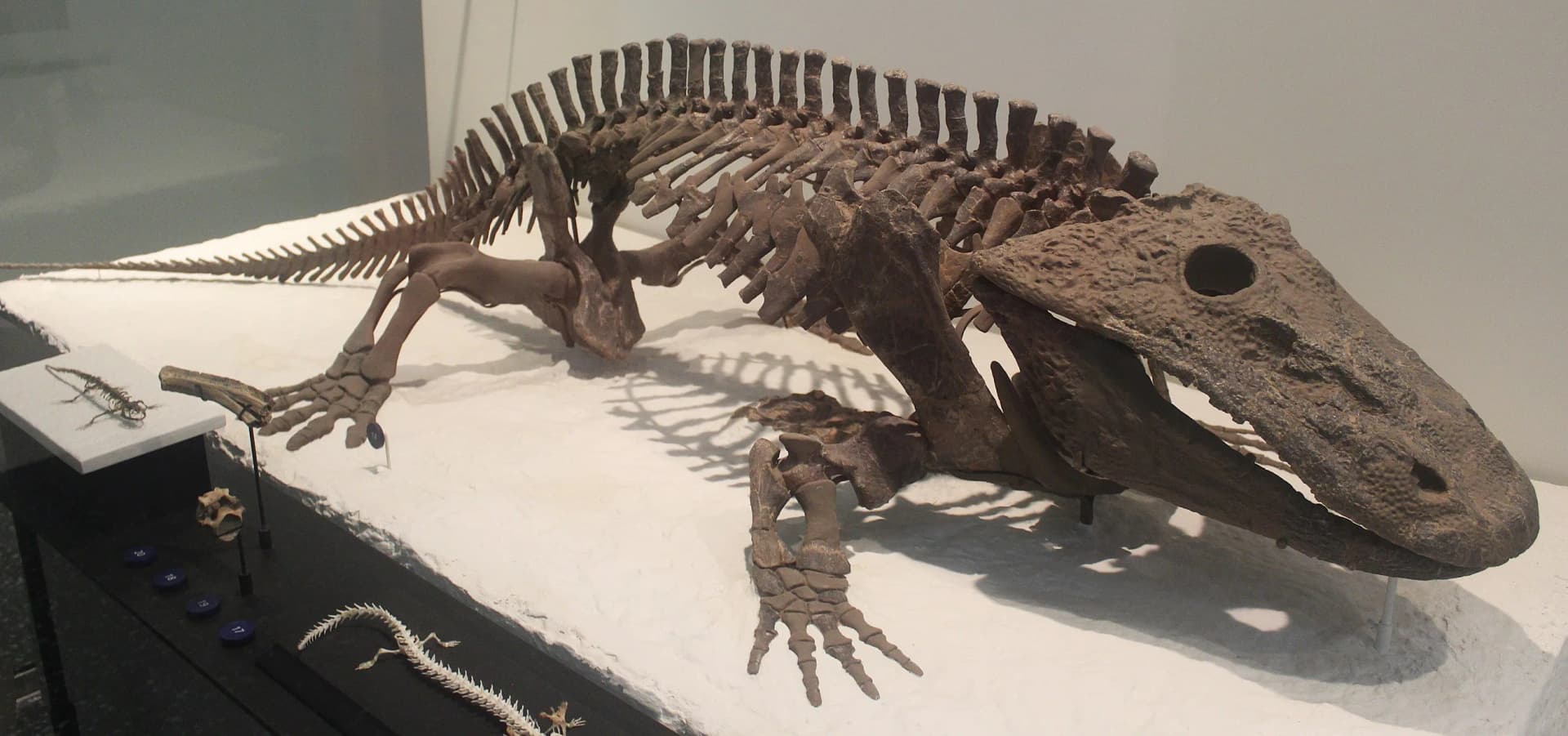
Eryops skeleton at the American Museum of Natural History
Wikipedia Commons