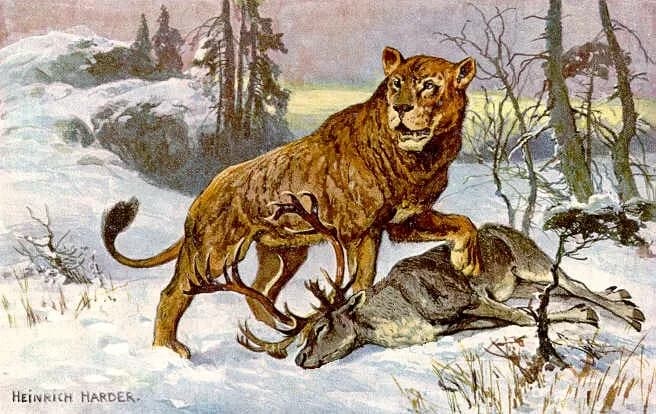
Lion des cavernes
Panthera spelaea, the cave lion, measured about 2.4 metres in body length and 200 to 350 kilograms, ranging across Europe and northern Asia between 700,000 and 13,000 years ago. The paintings in Chauvet Cave, 36,000 years old, give the earliest known depictions of it, detailed enough to show that it had no mane.
The cave lion (Panthera spelaea) appeared during the Middle Pleistocene, approximately 700,000 years ago, and dominated the ecosystems of Europe and northern Asia until its extinction around 13,000 years ago. Sometimes classified as a subspecies of the modern lion (P. leo spelaea), it is now generally recognized as a distinct species based on genetic analyses. First described by naturalist Georg August Goldfuss in 1810, from fossils discovered in German caves, this large felid thrived during the glacial cycles of the Pleistocene. It coexisted with Neanderthals and then Homo sapiens, who depicted it magnificently in the cave art of Chauvet Cave 36,000 years ago — paintings now designated a UNESCO World Heritage Site. The cave lion disappeared during the great megafaunal extinction at the end of the Pleistocene, likely a victim of postglacial climate warming that radically transformed its open steppe habitats into dense forests, combined with increasing pressure from modern human populations.
The cave lion ranked among the largest cats that ever lived. It exceeded the modern African lion by 10 to 25 percent in body dimensions, reaching a body length of approximately 2.4 meters (excluding the tail) and a shoulder height of about 1.2 meters. Its estimated weight ranged between 200 and 350 kilograms for adult males, with some specimens potentially exceeding this range. Females were smaller but still impressively large. Its build was robust and muscular, adapted for hunting large herbivores across the open environments of the glacial steppe. Compared to modern lions, it possessed proportionally longer limbs and a slightly more elongated skull, features that gave it both a powerful and streamlined appearance. Morphometric analyses of long bones confirm considerable muscle mass, particularly in the shoulders and forelimbs.
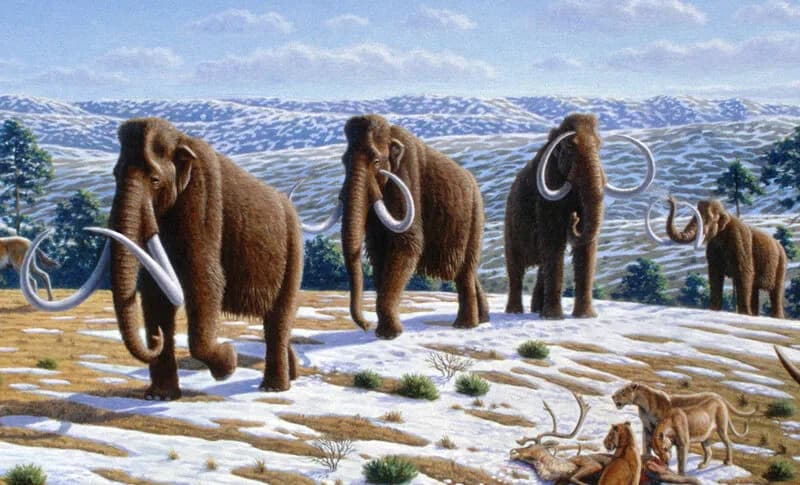
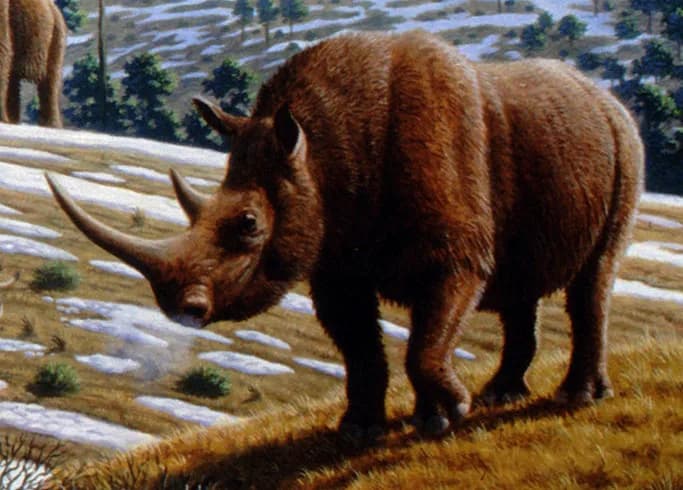
The cave lion was an apex predator sitting atop the food chain of glacial Europe. Its diet, reconstructed through isotopic analysis of bone collagen and dental enamel, primarily included steppe bison, cervids (reindeer, giant deer Megaloceros), wild horses, and bovids. Some populations specialized in specific prey depending on the region: Siberian Arctic cave lions hunted more reindeer and bison, while those in western Europe also attacked young woolly rhinoceroses and possibly young mammoths separated from their herds. Like modern lions, they likely hunted in groups to bring down large prey, using encirclement and ambush tactics. Characteristic bite marks on bison and horse bones found at European sites testify to their predatory power.
The cave lion occupied a vast territory stretching from the Iberian Peninsula and the British Isles eastward to eastern Siberia, and even beyond the Bering Strait into Alaska and the Yukon (where the American subspecies, Panthera spelaea atrox, sometimes considered a separate species, lived). Its preferred habitat was the open steppe-tundra and mammoth grasslands that covered vast expanses of Eurasia during glacial periods. Despite its name, the cave lion did not actually live in caves — the nickname comes from the fact that most of its fossils were discovered in karst cavities where carcasses were naturally preserved. It preferred open terrain offering good visibility for hunting, avoiding dense forests that limited its ability to pursue prey. During interglacial periods, forest expansion reduced its habitat and fragmented its populations.
The cave lion's anatomy reveals a felid superbly adapted to the rigorous conditions of the Ice Age. Its skull, longer and narrower than that of the African lion, housed a powerful jaw with imposing canines capable of piercing the thick hides of large Pleistocene herbivores. Its limbs were proportionally longer than those of modern lions, suggesting a longer stride and potentially greater running endurance. One of its most remarkable features, revealed by cave paintings at Chauvet and Trois-Frères, is the apparent absence of a mane in males, or at most a very reduced one — a striking contrast with the modern African lion. This lack of a mane may have been an adaptation to the cold climate, as a thick mane could accumulate snow and ice. Its fur was likely denser and thicker than that of modern lions for thermal insulation. The tail ended in a dark tuft, clearly visible in cave art depictions.
The behavior of the cave lion can be reconstructed from fossil evidence, cave paintings, and by analogy with modern lions. The Chauvet Cave depictions, dating to 36,000 years ago, show groups of lions hunting together, strongly suggesting a social lifestyle similar to that of modern lions. Males and females likely hunted in coordinated prides to bring down the large herbivores of the glacial steppe. The Chauvet paintings even portray collective hunting scenes where several lions converge on a herd of bison, attesting to a complex social organization. Unlike the African lion, the absence of a mane suggests sexual dimorphism was less pronounced, which could indicate slightly different social structures. Fossils show individuals that survived serious injuries, suggesting they received assistance from group members. The cubs discovered in Siberian permafrost indicate that females used sheltered dens for giving birth.
The cave lion was first described by Georg August Goldfuss in 1810, from fossils extracted from caves in Franconia (Bavaria, Germany). Since then, thousands of specimens have been discovered across Europe and Asia, at sites as diverse as the Arcy-sur-Cure caves in France, Zoolithen Cave in Germany, and Siberian permafrost deposits. The most spectacular discoveries are those of mummified lion cubs from Siberian permafrost: in 2015, two cubs named Uyan and Dina were unearthed in the Abyisky district of Yakutia, followed in 2017 by a third specimen named Spartak. These baby lions, over 25,000 years old, are so remarkably preserved that their fur, internal organs, and even facial expressions remain intact — an extraordinary window into the biology of this extinct species. Cave art also constitutes a unique fossil record: the paintings of Chauvet Cave (Ardèche, France), 36,000 years old and a UNESCO World Heritage Site, offer the most detailed and oldest depictions of this majestic animal.
| Period | Pléistocène / Pleistocene |
| Era | Cénozoïque / Cenozoic |
| Age | 700 000 – 13 000 ans / 700,000 – 13,000 years |
| Location | Europe et Asie du Nord / Europe and Northern Asia |
| Length | ~2.4 m (corps / body) |
| Height | ~1.2 m (épaule / at shoulder) |
| Weight | 200–350 kg |
| Diet | Carnivore |
| Discovery | 1810 |
Panthera spelaea owes its name to the fact that nearly all its fossils were discovered in karst cavities — caves where carcasses decomposed and mineralized naturally. In reality it preferred the open steppes and mammoth grasslands of the Eurasian glacial tundra, where its vision and speed gave it a hunting advantage. The nickname stuck despite being inaccurate.
Panthera spelaea exceeded the modern African lion by 10 to 25 percent in body dimensions. Adult males reached about 2.4 meters long (body without tail) and 1.2 meters at the shoulder, weighing 200 to 350 kg. It was one of the largest cats that ever existed. Unlike the African lion, cave paintings at Chauvet Cave (36,000 years ago) show it had no or very little mane.
Panthera spelaea went extinct approximately 13,000 years ago, at the end of the Pleistocene. Its disappearance coincides with postglacial climate warming that transformed its open steppes into dense forests, drastically reducing its habitat and prey (bison, horses, reindeer). Growing pressure from Homo sapiens populations likely accelerated its decline, combining prey reduction and direct hunting.
Reconstruction of the European cave lion
Heinrich Harder, Public domain, via Wikimedia Commons
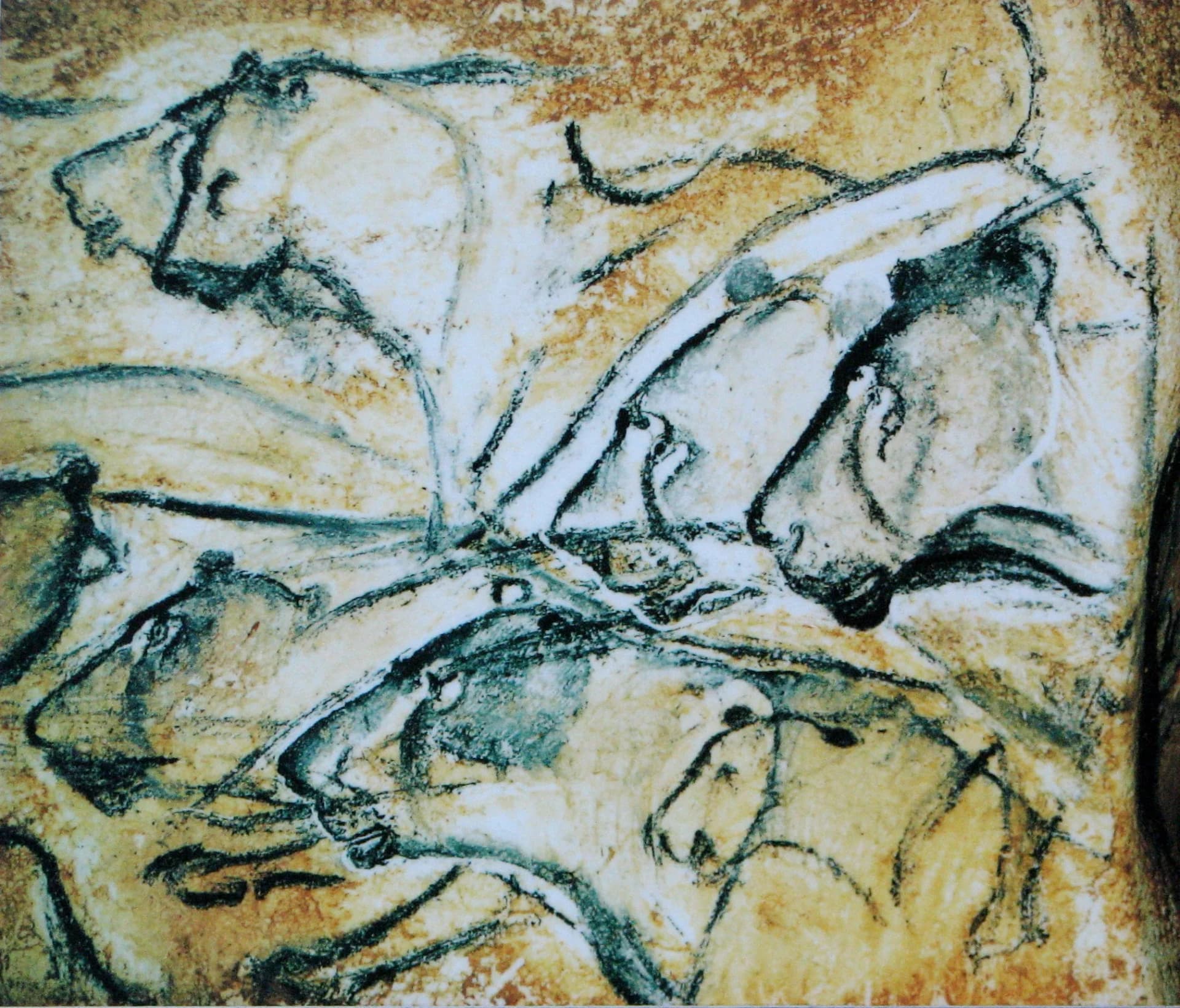
Cave lion painting, Chauvet Cave (museum replica)
HTO, Public domain, via Wikimedia Commons