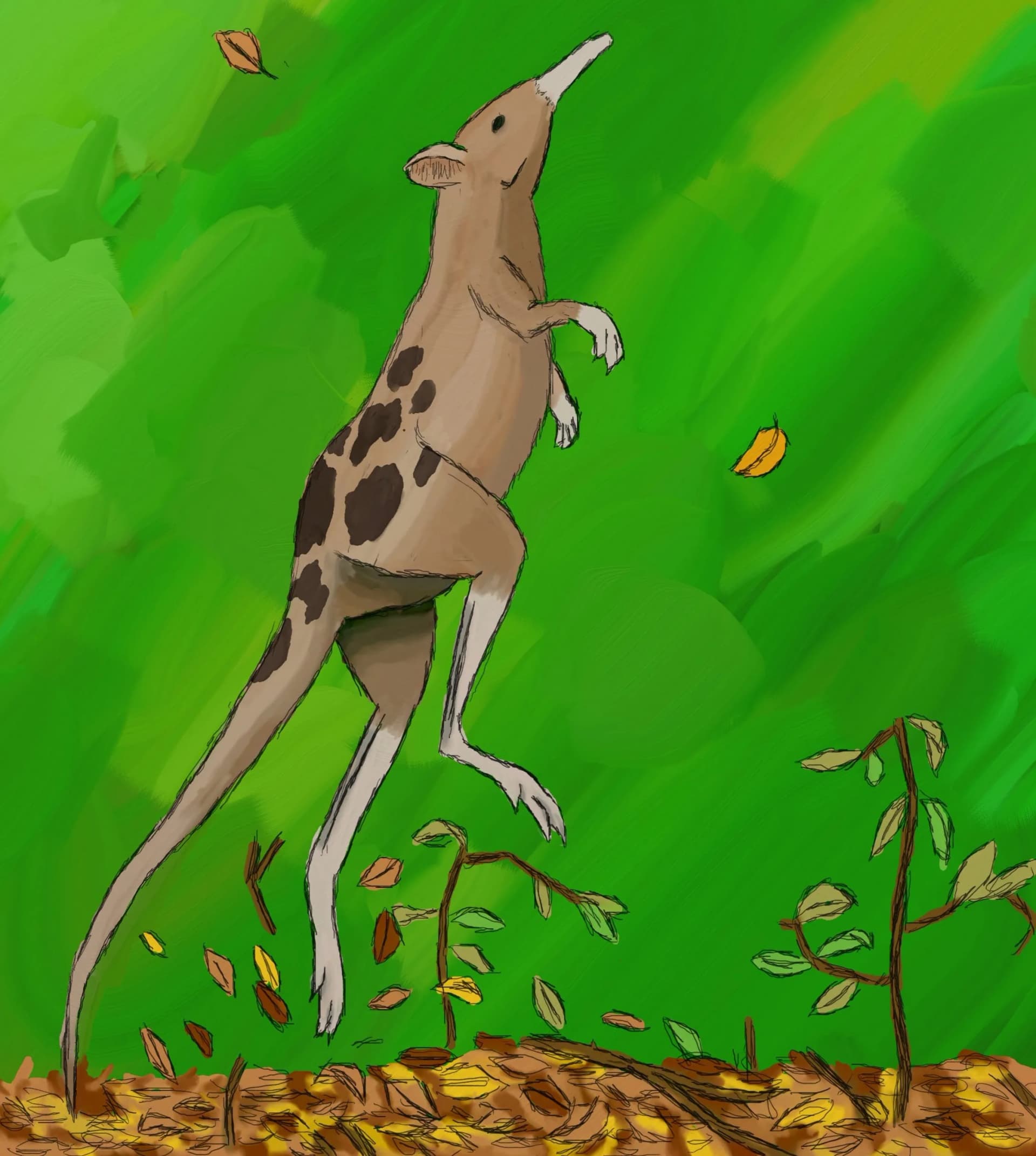
Leptictidium
Leptictidium tobieni was a small mammal from Germany, described in 1929 and dated to 47 million years ago. Between 60 and 90 centimetres including the tail, and 1 to 3 kilograms, it moved by hopping on its hind legs. It owes its fame to the BBC series Walking with Beasts (2001), where it leads the first episode.
Leptictidium lived during the Middle Eocene, approximately 47 million years ago, in a tropical Europe vastly different from the one we know today. This period of the Cenozoic era was characterized by an exceptionally warm and humid climate, with dense forests covering most of the European continent. The Middle Eocene represented a key moment in mammalian evolution, as mammals rapidly diversified their forms and lifestyles after the extinction of non-avian dinosaurs 66 million years ago. Leptictidium belonged to the order Leptictida, a group of archaic mammals with no living descendants, which went permanently extinct at the end of the Eocene without leaving any successor lineage.
Leptictidium was a small mammal measuring between 60 and 90 centimeters in total length, tail included, with a modest weight of 1 to 3 kilograms. Its remarkably long tail accounted for approximately half its body length and played a crucial role in balance during bipedal locomotion. Its body was compact and streamlined, with hind limbs significantly longer and more powerful than the forelimbs, a characteristic adaptation for hopping locomotion. Its size was comparable to that of a large rat or small rabbit, but its slender silhouette and unusual proportions made it immediately recognizable among the European Eocene fauna.
Leptictidium was an opportunistic insectivore with a marked omnivorous tendency, feeding on a wide range of small prey and plant material. The extraordinarily preserved stomach contents in Messel fossils revealed a diet composed of insects, small lizards, and plant fragments. Its long, mobile proboscis allowed it to probe forest litter and soil crevices to flush out invertebrate prey. It probably hunted actively, using its keen eyesight and agility to capture insects in motion. This dietary flexibility allowed it to efficiently exploit the abundant resources of Eocene tropical forests, adapting to seasonal variations in the availability of different food sources.
Leptictidium inhabited the humid tropical forests of Middle Eocene Europe, in an environment radically different from the continent's current temperate climate. The Messel site, near Darmstadt in Germany, now a UNESCO World Heritage Site, is the main deposit for Leptictidium fossils. This exceptional site was at the time a volcanic maar lake, surrounded by a lush tropical forest comparable to present-day jungles of Southeast Asia. The deep, oxygen-poor waters of the lake enabled exceptional fossilization, preserving even stomach contents and body outlines. Leptictidium lived in the dense undergrowth of these forests, hopping between roots and low vegetation in search of food.
The anatomy of Leptictidium reveals a mammal highly specialized for bipedal hopping locomotion, a unique adaptation among Eocene mammals. Its hind limbs, considerably longer than the forelimbs, possessed elongated metatarsal bones similar to those of modern kangaroos or jerboas. Its long, rigid tail served as a counterbalance during jumps, maintaining equilibrium and enabling rapid directional changes. The skull bore a long, pointed snout topped by a short, mobile proboscis, comparable to that of modern elephant shrews, equipped with sensory whiskers for detecting prey. Its large eyes suggest partially nocturnal or crepuscular activity. The teeth displayed a primitive mix of pointed incisors and tribosphenic molars adapted to an insectivorous diet.
Leptictidium moved through the undergrowth of Eocene tropical forests in rapid bipedal hops, a locomotion remarkably similar to that of modern African elephant shrews. This method of movement allowed it to reach surprising speeds for its size, giving it an advantage both in capturing prey and escaping predators. Its long proboscis, constantly in motion, probed the ground and forest litter in search of insects and small invertebrates. Probably solitary and territorial, Leptictidium occupied a home range in the dense undergrowth where it found both food and shelter. Its activity was likely concentrated at dawn and dusk, optimal periods for insect hunting in the tropical forest environment.
Leptictidium fossils come primarily from the famous Messel deposit in Germany, an ancient volcanic maar lake dating from the Middle Eocene, approximately 47 million years ago. This site, inscribed as a UNESCO World Heritage Site in 1995, is renowned for the exceptional quality of its fossils, often preserving body outlines, fur, and even the stomach contents of animals. The type species, Leptictidium auderiense, was first described in 1929 by paleontologist Tobien. Three species are currently recognized: L. auderiense, L. tobieni, and L. nasutum. The Messel specimens rank among the best-preserved fossil mammals in the world, offering a remarkable glimpse into the biology and ecology of this extinct animal. This deposit made Leptictidium famous to the general public through the BBC documentary series 'Walking with Beasts' in 2001.
| Period | Éocène moyen / Middle Eocene |
| Era | Cénozoïque / Cenozoic |
| Age | 47 Ma |
| Location | Europe (Allemagne) / Europe (Germany) |
| Length | 60-90 cm (queue incluse / tail included) |
| Height | 20 cm |
| Weight | 1-3 kg |
| Diet | Omnivore |
| Discovery | 1929 |
Leptictidium tobieni moved in rapid bipedal hops, like a small kangaroo, thanks to hind limbs far longer than the forelimbs and a long balancing tail. This locomotion is unique among Eocene mammals and represents a case of convergent evolution with modern African elephant shrews.
Stomach contents preserved in fossils from the Messel deposit (Middle Eocene, ~47 Ma, Germany) reveal that Leptictidium tobieni consumed insects, small lizards, and plant fragments. This exceptional preservation is due to the oxygen-poor waters of the Messel maar lake, a UNESCO World Heritage Site.
No. Leptictidium belonged to the order Leptictida, a group of archaic mammals that went completely extinct at the end of the Eocene without leaving any successor lineage. Despite a striking resemblance to African elephant shrews, it is not their ancestor — the similarity is due to convergent evolution.
Artistic reconstruction of Leptictidium in bipedal posture in its forest habitat
Nobu Tamura, CC BY 3.0, via Wikimedia Commons
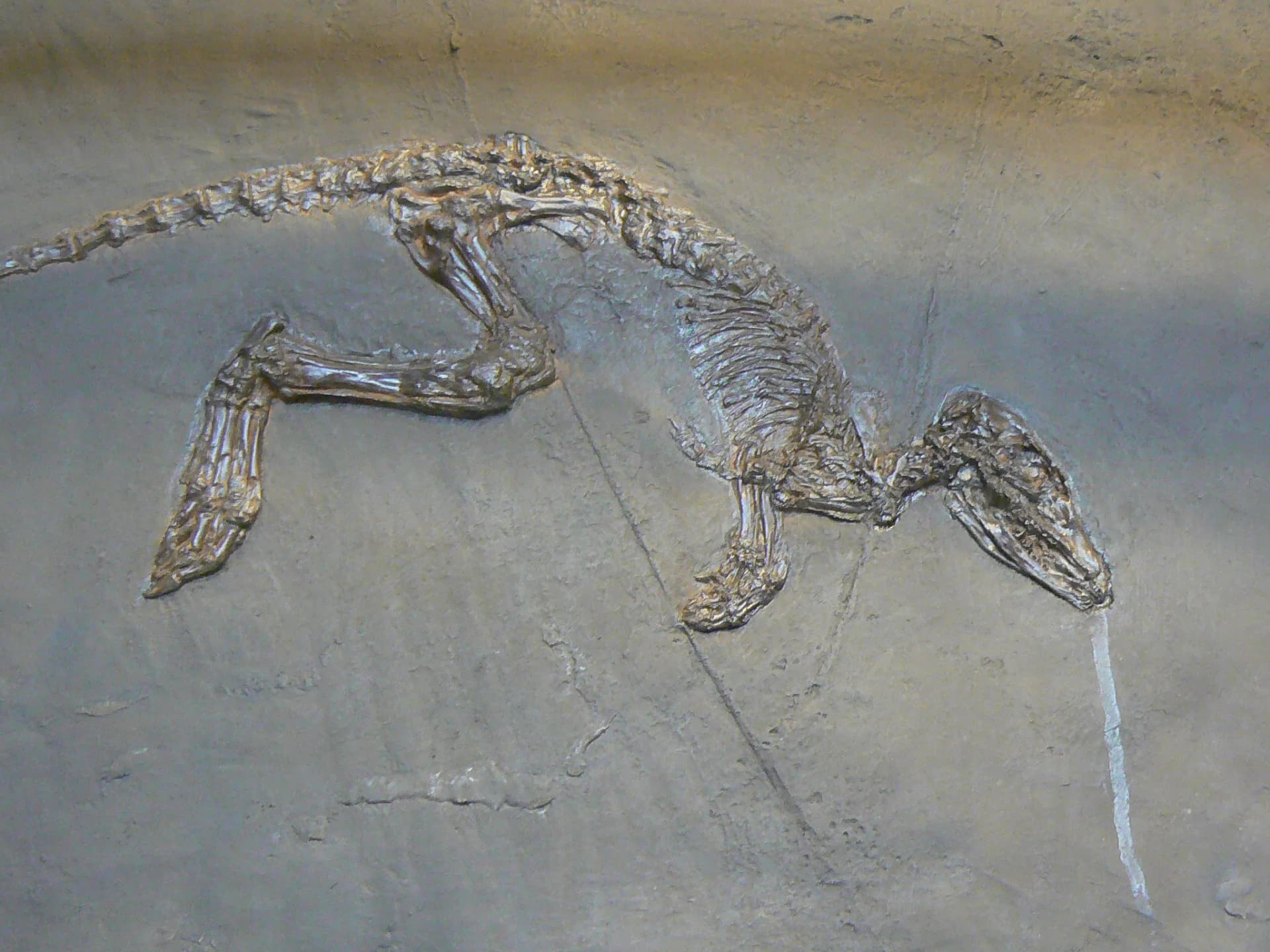
Fossil skeleton of Leptictidium auderiense from the Messel deposit, Germany
Ghedoghedo, CC BY-SA 3.0, via Wikimedia Commons