Ambulocetus
Ambulocetus natans was an early cetacean from northern Pakistan, dated to 49 to 48 million years ago. At 3 metres and around 300 kilograms, it had fully functional legs while belonging to the lineage leading to modern whales. Its name means the walking whale: it could move on land as well as swim at sea.
Ambulocetus natans lived during the early Eocene, approximately 49 to 48 million years ago, in what is now northern Pakistan. This period corresponds to a critical phase in cetacean evolution, when the terrestrial ancestors of whales were beginning to conquer the aquatic environment. The Eocene was an era of intense global warmth, with average temperatures well above today's levels and high sea levels. The Tethys Sea, a vast tropical ocean that separated India from the rest of Asia, bordered the coasts where Ambulocetus lived, offering warm and shallow waters ideal for a semi-aquatic predator. This evolutionary transition between land and sea, documented by a remarkable series of fossils found in Pakistan and India, represents one of the most spectacular transformations in the history of mammals.
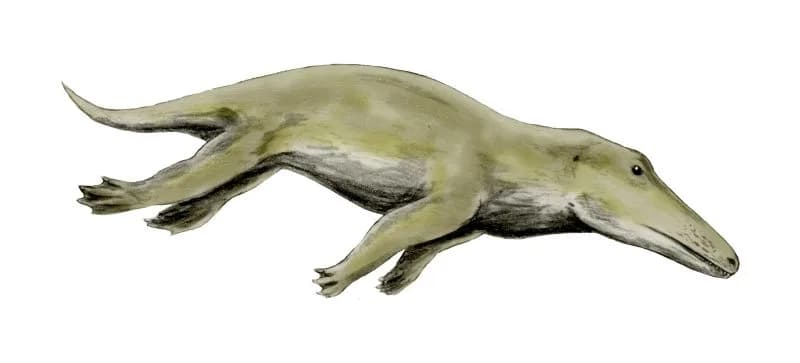
Ambulocetus measured approximately 3 meters in total length with an estimated weight of 300 kilograms, making it roughly the size of a modern saltwater crocodile. Its body was massive and elongated, with a proportionally large skull measuring nearly 60 centimeters long. Its forelimbs were relatively short but robust, equipped with webbed feet that likely served both for walking on soft ground and for swimming. Its hindlimbs were significantly larger and more powerful, with enormous feet that served as its primary aquatic propulsion organs. The tail was long and muscular, though probably not yet flattened into a fluke like modern cetaceans. Its overall silhouette resembled a cross between a crocodile and a giant otter, perfectly adapted for an amphibious lifestyle.
Ambulocetus was a formidable carnivorous predator that hunted by ambush, lurking in the shallow waters of estuaries and coastal lagoons, much like a modern crocodile. Its diet included fish, terrestrial mammals coming to drink at the water's edge, and likely other aquatic vertebrates. Its elongated and flattened skull, equipped with powerful jaws lined with conical, sharp teeth, was perfectly designed for seizing and holding slippery prey. Oxygen isotope analysis of its tooth enamel indicates that it consumed both freshwater and saltwater prey, confirming its lifestyle in transitional environments between land and sea. Its hunting technique likely involved remaining motionless below the surface, then propelling itself explosively to snap up prey with a devastating bite.
Ambulocetus inhabited the coastal and estuarine environments that bordered the Tethys Sea, in the region corresponding to present-day northern Pakistan, specifically in the Kuldana geological formation. These environments included shallow lagoons, mangrove estuaries, river mouths, and tropical intertidal zones. The waters were warm and nutrient-rich, harboring a diverse fauna of fish and invertebrates. India, then colliding with the Eurasian plate, created coastal sedimentary basins perfect for fossil preservation and for the life of a semi-aquatic predator. Ambulocetus shared its habitat with other primitive cetaceans such as Pakicetus, though the latter was more terrestrial. The presence of Ambulocetus in these transitional environments perfectly illustrates the intermediate stage of the marine conquest by whale ancestors.
The anatomy of Ambulocetus represents a noteworthy intermediate between terrestrial mammals and modern aquatic cetaceans. It possessed four functional limbs capable of supporting its weight on land, while also being adapted for swimming. Its feet were large and probably webbed, functioning as paddles in the water. Its skull exhibited typically cetacean characteristics: eyes positioned on top of the head, like a crocodile, and most importantly a thickened tympanic bulla partially isolated from the skull, an acoustic adaptation enabling underwater hearing through bone conduction via the lower jaw — exactly the same mechanism used by modern whales. Its spine was flexible and powerful, allowing vertical undulations for aquatic propulsion. Its nostrils were still located at the front of the snout, unlike the dorsal blowhole of modern cetaceans, showing that this migration had not yet occurred at this evolutionary stage.
Ambulocetus, whose name literally means 'the walking whale,' led a dual life between land and water, much like modern crocodilians. On land, it probably moved with a slow and awkward gait, dragging its massive body on its four relatively short legs. In the water, however, it became an agile and formidable predator, using its powerful hindlimbs and muscular tail to propel itself with vertical body undulations. Its primary hunting strategy consisted of aquatic ambush: motionless and partially submerged in the murky waters of estuaries, it would watch for prey passing nearby before launching an explosive attack. Like modern crocodiles, it could detect vibrations transmitted through water thanks to its specialized auditory system, sensing the movements of its prey long before seeing them. It probably spent most of its time in the water, only returning to land to rest or reproduce.
The fossils of Ambulocetus natans were discovered between 1992 and 1994 by a team led by Dutch-American paleontologist Johannes G. M. Thewissen, in the layers of the Kuldana Formation in northern Pakistan, dated to approximately 49 million years ago. The holotype specimen comprises a remarkably complete skeleton including the skull, most of the vertebral column, the pelvis, and all four limbs with their feet — an exceptional rarity for such an ancient cetacean. The scientific description was published in 1994 in the journal Science, sending shockwaves through the paleontological community because this fossil masterfully filled the gap between the most primitive cetaceans (such as Pakicetus, essentially terrestrial) and more aquatic forms (such as Rodhocetus). The species name natans means 'swimming' in Latin, emphasizing its amphibious capability. This fossil constitutes one of the most eloquent pieces of evidence for the evolutionary transition of cetaceans from their terrestrial artiodactyl ancestors to a fully aquatic life.
| Period | Éocène / Eocene |
| Era | Cénozoïque / Cenozoic |
| Age | 49-48 Ma |
| Location | Nord du Pakistan / Northern Pakistan |
| Length | 3 m |
| Height | 0.6 m |
| Weight | 300 kg |
| Diet | Piscivore |
Ambulocetus natans (literally 'the swimming whale'), discovered in 1992-1994 by Thewissen in Pakistan's Kuldana Formation (~49 Ma), had four functional limbs capable of supporting its 300 kg on land. In water, its large webbed feet and muscular tail propelled its 3-meter body through vertical undulations — exactly the mechanism of modern whales. Its 1994 description in Science filled a major gap in cetacean evolution.
Ambulocetus natans had a thickened tympanic bulla partially isolated from the skull — the same underwater hearing mechanism through bone conduction via the lower jaw used by modern whales. This acoustic adaptation, visible on its 60 cm skull, confirms it could detect vibrations in water long before the evolution of the dorsal blowhole characteristic of modern cetaceans.
Ambulocetus natans hunted by ambush like a modern crocodile: motionless and partially submerged in the murky estuarine waters of the Tethys Sea (Pakistan, ~49 Ma), it waited for prey — fish, mammals coming to drink — before launching explosive attacks. Oxygen isotope analysis of its teeth proves it consumed both freshwater and saltwater prey, confirming its life in transitional environments.
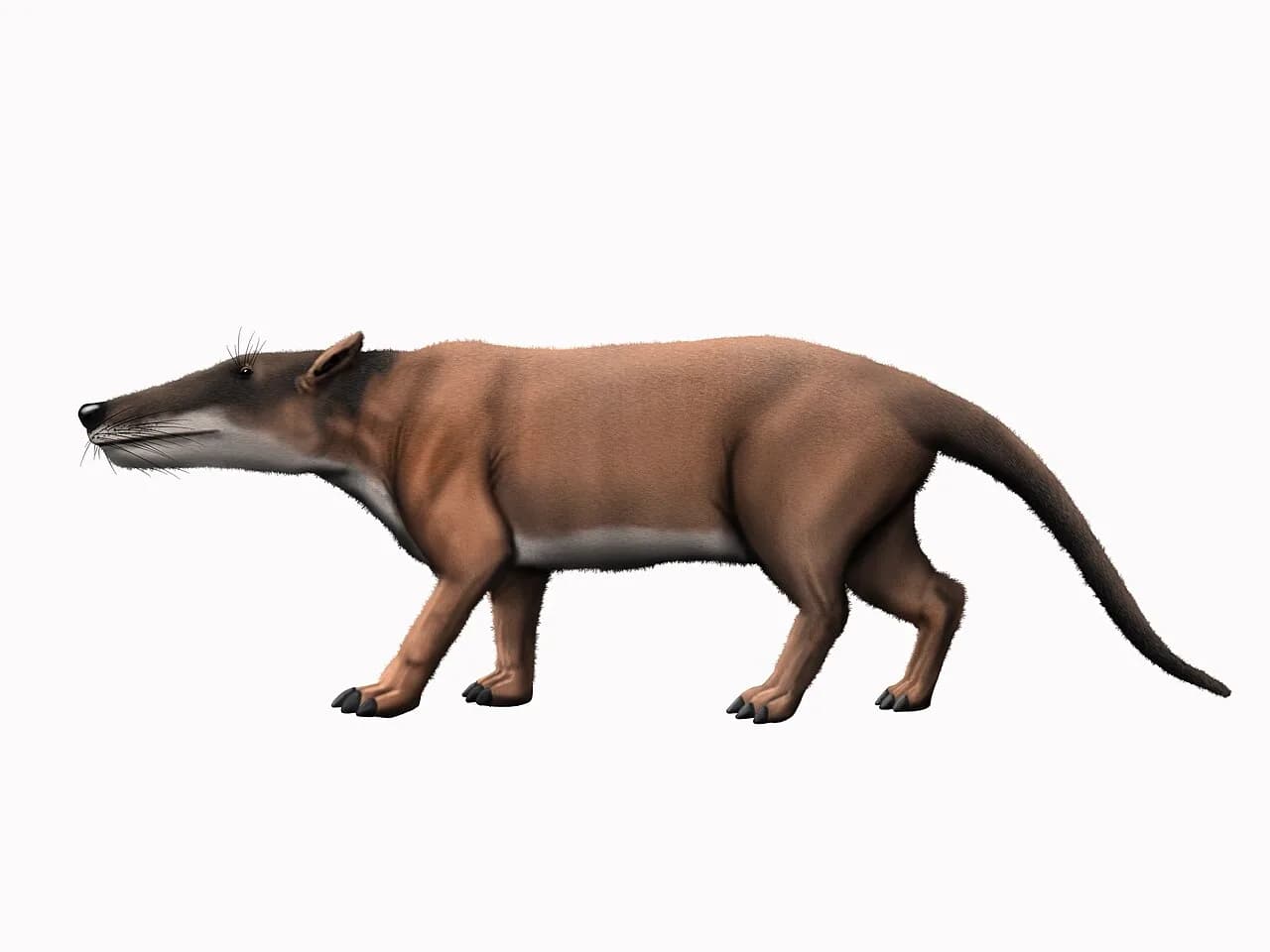
Ambulocetus natans illustration
Nobu Tamura, Wikimedia Commons
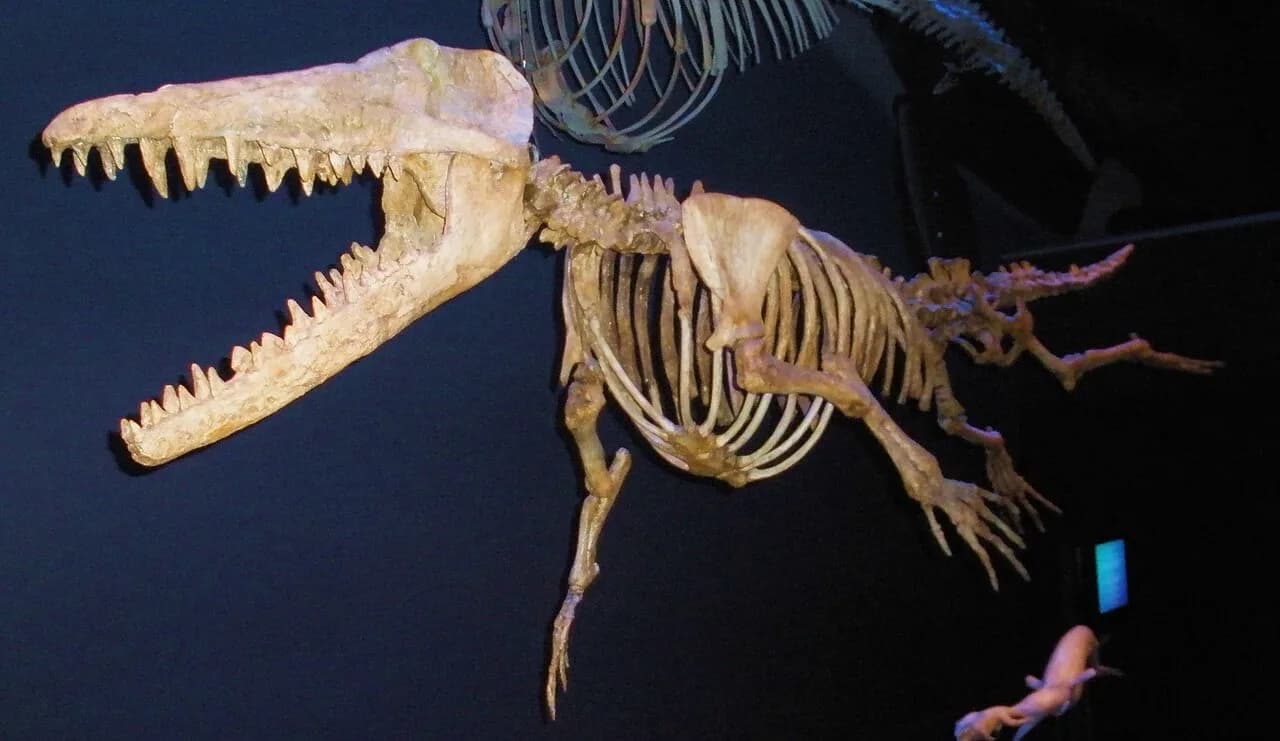
Ambulocetus natans skeleton
Wikimedia Commons