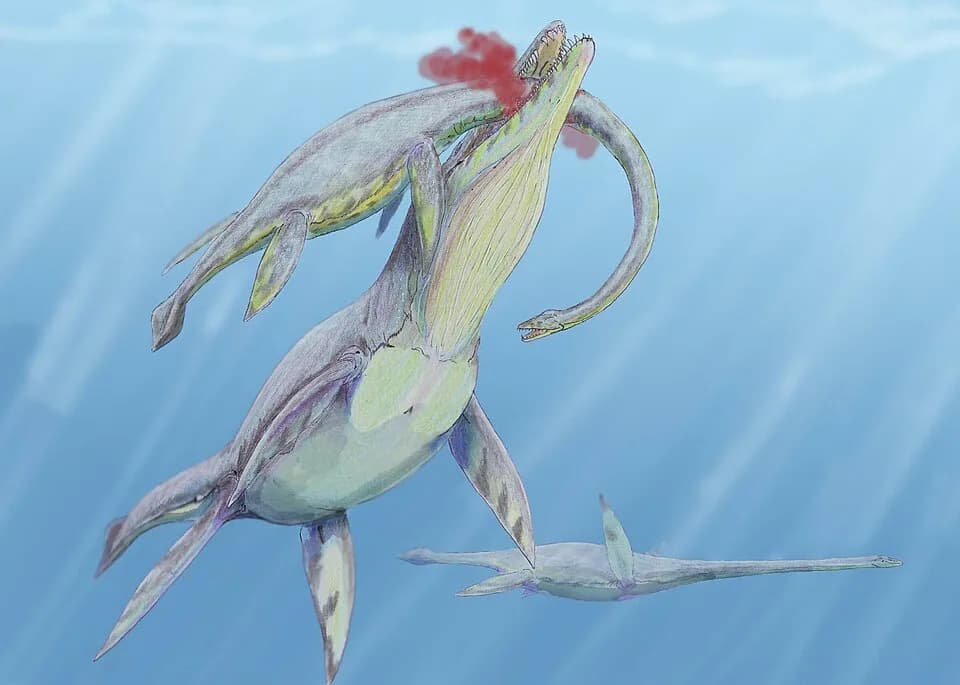
Kronosaure
Kronosaurus queenslandicus is a pliosaur 9 to 11 metres long and 10 to 12 tonnes, described in 1924 in Queensland. Its bite reached around 30,000 newtons, twice that of a living saltwater crocodile, enough to crush a sea turtle's shell. The skeleton mounted at Harvard's Museum of Comparative Zoology was artificially lengthened, with extra vertebrae added.
Kronosaurus lived during the Early Cretaceous, approximately 125 to 100 million years ago (Aptian to Albian stages). This gigantic short-necked pliosaur belonged to the order Plesiosauria and the family Pliosauridae, those marine predators characterized by a massive skull, short neck, and enormous jaws that made them the apex predators of Mesozoic seas. It thrived in the Eromanga Sea, a vast epicontinental ocean that covered much of interior Australia during the Cretaceous, when global temperatures were considerably warmer than today and sea levels flooded continental basins across the world. The Mesozoic era was at its peak, with giant marine reptiles dominating oceanic ecosystems worldwide, long before the mosasaurs that would succeed them in the Late Cretaceous.
Kronosaurus queenslandicus is one of the largest known pliosaurs and among the most formidable marine predators of the Early Cretaceous. Modern estimates place its total length between 9 and 11 meters, although the famous mounted skeleton at the Harvard Museum of Comparative Zoology was artificially elongated to 12.8 meters using plaster, earning it the unflattering nickname 'Plasterosaurus.' Its weight is estimated between 10.6 and 12.1 tonnes. Its skull reached 2.2 meters in length, with a mandible up to 2.7 meters — representing approximately 25% of total body length, an exceptional proportion among marine reptiles that underscores the overwhelming importance of its jaws in its predatory lifestyle. Its largest teeth measured up to 30 centimeters in total length, with 12-centimeter crowns, conical and smooth, lacking the serrations characteristic of terrestrial theropod dinosaurs.
Kronosaurus was the undisputed apex predator of the Early Cretaceous Australian seas, sitting at the very top of the marine food chain. Fossilized stomach contents reveal an extraordinarily diverse diet including elasmosaurs (long-necked plesiosaurs), sea turtles, sharks, and cephalopods — essentially anything that swam in the Eromanga Sea was potential prey. Its bite force, estimated at approximately 30,000 newtons, was roughly twice that of a large modern saltwater crocodile, enabling it to crush even the most resistant shells and bones. Its massive conical teeth, though lacking serrations, were extremely robust and perfectly adapted for seizing and holding powerful, slippery prey. It likely hunted through ambush tactics, similar to modern crocodilians, explosively accelerating from depth to surprise prey at or near the surface.
Kronosaurus inhabited the Eromanga Sea, a vast shallow and warm epicontinental ocean that covered much of interior Australia during the Early Cretaceous period. This inland sea extended thousands of kilometers, connecting the Gulf of Carpentaria to southern Australia, creating an exceptionally productive marine environment rich in biodiversity and teeming with potential prey. The global climate, far warmer than today with no polar ice caps, maintained tropical to subtropical waters conducive to a dense and diverse marine food chain. Kronosaurus shared this habitat with elasmosaurs, ichthyosaurs, giant sea turtles, sharks, and an abundance of bony fish and cephalopods that constituted the base of its food web. Fossils are concentrated in northeastern Queensland, primarily in the Toolebuc Formation near the towns of Hughenden and Richmond, which have become internationally renowned paleontological sites.
Kronosaurus possessed the characteristic morphology of pliosaurs: a fusiform, hydrodynamic body, a short and powerful neck composed of only 13 cervical vertebrae, and a disproportionately large head relative to the rest of the body. Its four limbs were transformed into powerful paddle-shaped flippers, with the front flippers being significantly larger than the rear ones, which reached approximately 2 meters in span. Unlike long-necked plesiosaurs, Kronosaurus propulsion relied on the simultaneous beating of all four flippers, a technique comparable to the 'underwater flight' of modern sea turtles rather than the lateral body undulation of mosasaurs. Its teeth displayed marked anisodontia — teeth of unequal sizes along the jaw — with the largest concentrated at the front for prey capture and the smaller ones at the rear for gripping and manipulating prey during swallowing.
Kronosaurus was most likely a solitary and territorial predator occupying the absolute apex of the food chain in its marine ecosystem, with no natural predators of its own. Bite marks discovered on bones of sub-adult specimens suggest cannibalism or intraspecific aggression, a behavior commonly observed in many large modern predators including crocodiles, great white sharks, and large monitor lizards. Its hunting strategy probably combined ambush and short pursuit tactics, utilizing its powerful musculature and four flippers for explosive accelerations that could catch even the fastest prey off guard. The enormous size of its skull and its massively armed jaw made it a predator capable of attacking virtually any marine animal of its time, including elasmosaurs that could reach 10 meters in length. Its likely territorial behavior would explain the frequent traces of intraspecific combat observed on fossils across multiple collection sites.
The first Kronosaurus fossils were discovered in 1899 by Andrew Crombie near Hughenden, Queensland, Australia, in the rich marine deposits of the Toolebuc Formation. Heber Longman, director of the Queensland Museum, formally described the genus in 1924 from jaw fragments that immediately revealed the enormous size of this animal. The most famous expedition was conducted in 1931-1932 by the Harvard Museum of Comparative Zoology, led by William Schevill, which recovered a partial but substantial skeleton that would become the centerpiece of the museum's marine reptile collection. Preparation of this specimen took an astonishing 25 years, and the mounted skeleton, supplemented with plaster, reached 12.8 meters — a length now considered exaggerated, with modern estimates placing the true size between 9 and 11 meters. In 1978, a specimen was discovered at Toronto Park in Queensland, and in 2014, exceptionally well-preserved mandibles were unearthed at Euraba. A Colombian species, K. boyacensis, described from Villa de Leyva, was reclassified in 2021 into a separate genus, Monquirasaurus. Kronosaurus is therefore now considered monotypic, with only a single valid species.
| Period | Crétacé inférieur / Early Cretaceous |
| Era | Mésozoïque / Mesozoic |
| Age | 125-100 Ma |
| Location | Australie (Queensland) / Australia (Queensland) |
| Length | 9-11 m |
| Height | ~2 m |
| Weight | 10-12 tonnes |
| Diet | Carnivore |
| Discovery | 1924 |
Kronosaurus queenslandicus measured between 9 and 11 meters long, with an estimated weight of 10 to 12 tonnes. The famous Harvard Museum of Comparative Zoology skeleton was artificially lengthened to 12.8 meters using plaster, earning it the nickname 'Plasterosaurus.' Modern estimates, based on allometric comparisons with other pliosaurs, confirm the more modest but still colossal size of 9 to 11 meters.
Kronosaurus queenslandicus inhabited the Eromanga Sea, a vast shallow and warm epicontinental ocean covering much of interior Australia during the Early Cretaceous, 125 to 100 million years ago. Fossils come primarily from the Toolebuc Formation in northeastern Queensland, first discovered in 1899 by Andrew Crombie near Hughenden.
Yes, Kronosaurus queenslandicus was significantly larger than Liopleurodon ferox. Kronosaurus reached 9 to 11 meters and weighed 10 to 12 tonnes, with a skull 2.2 meters long representing 25% of its total length. Liopleurodon measured only 5 to 7 meters for 1 to 2 tonnes. Both were pliosaur apex predators, but separated by approximately 40 million years of evolution.
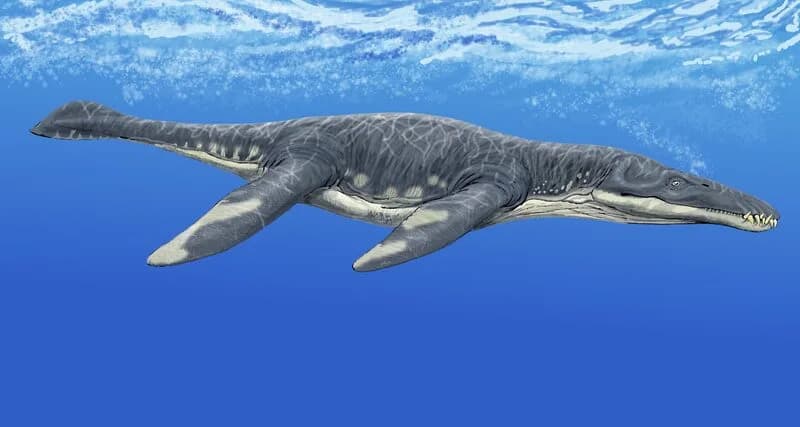
Life reconstruction of Kronosaurus queenslandicus hunting
Dmitry Bogdanov / Wikimedia Commons
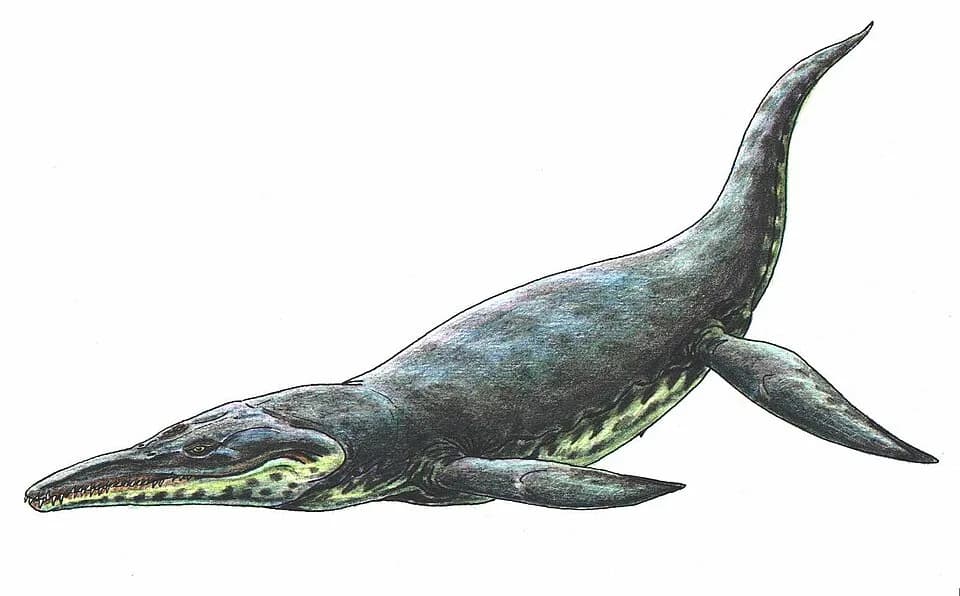
Mounted skeleton of Kronosaurus at the Harvard Museum of Comparative Zoology
Wikimedia Commons
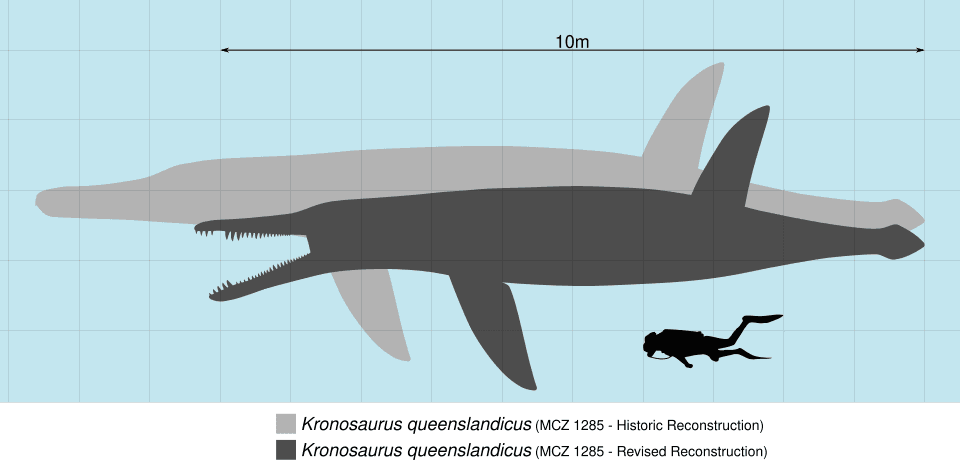
Size comparison between Kronosaurus queenslandicus and a human
Wikimedia Commons