Kosmocératops
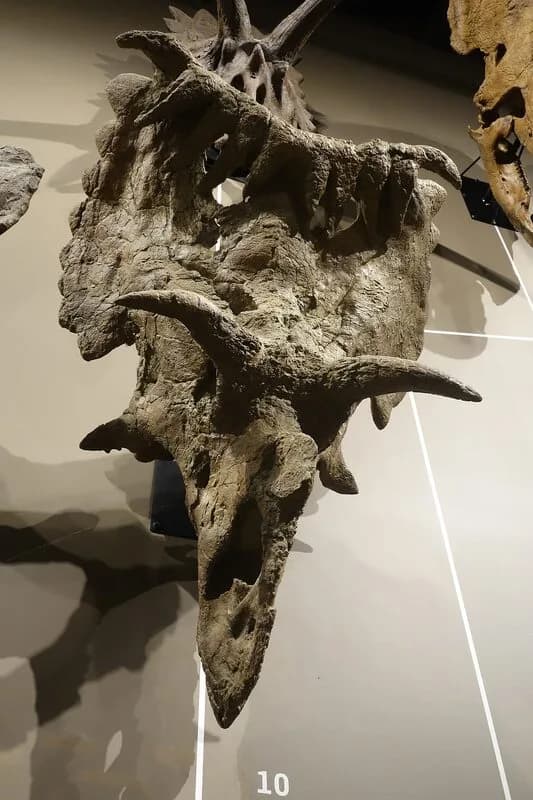
Kosmoceratops richardsoni holds the record for the most ornamented skull in the dinosaur world: fifteen horns and bony structures, against three for Triceratops. At 4.5 metres and 1.2 tonnes, described in 2010 in North America, it lived 76 to 75 million years ago. That profusion most likely served display rather than combat.
Kosmoceratops lived approximately 76 to 75.9 million years ago, during the late Campanian stage of the Late Cretaceous period. This interval represents the peak of ceratopsian diversity in North America. At this time, the North American continent was bisected by the Western Interior Seaway, creating an island continent known as Laramidia to the west. It was on this restricted landmass that Kosmoceratops evolved, in a context of well-documented dinosaur provincialism that promoted the development of distinct endemic species in the northern and southern regions of Laramidia.
Kosmoceratops was a medium-sized ceratopsian, reaching approximately 4.5 meters in length, an estimated shoulder height of 1.5 meters, and a body weight of around 1.2 metric tonnes. Although smaller than some of its relatives such as Triceratops, it more than compensated with the extraordinary ornamentation of its skull. Its robust, quadrupedal body, typical of ceratopsids, featured a heavily built skeleton suited to its terrestrial lifestyle. Its forelimbs were slightly shorter than the hindlimbs, giving it the characteristic posture common to horned dinosaurs.
A strict herbivore like all ceratopsians, Kosmoceratops fed primarily on low-growing vegetation and varied foliage available in its subtropical environment. Its toothless keratinous beak allowed it to efficiently clip tough stems and resistant leaves with precision. Behind this beak were long tooth rows forming complex dental batteries comprising hundreds of continuously replacing teeth throughout the animal lifetime, perfectly adapted for shearing and grinding fibrous plant material such as palms, ferns, cycads, and the diverse flowering angiosperms that were thriving and rapidly diversifying in the warm, humid subtropical environment of the Kaiparowits Formation.
Kosmoceratops inhabited the warm, humid coastal and swampy environments of the Kaiparowits Formation, in what is now southern Utah within the present-day Grand Staircase-Escalante National Monument. Its natural environment was characterized by dense forests of towering conifers, tree ferns, and diverse flowering plants, laced with numerous rivers and extensive wetland areas that provided abundant water resources. The warm, humid subtropical climate prevailing at that latitude during the Late Cretaceous supported exceptional biodiversity and high plant productivity. This rich biotope was situated approximately 100 kilometers from the shore of the Western Interior Seaway, creating a diverse and varied coastal ecosystem teeming with dinosaurs and other wildlife.
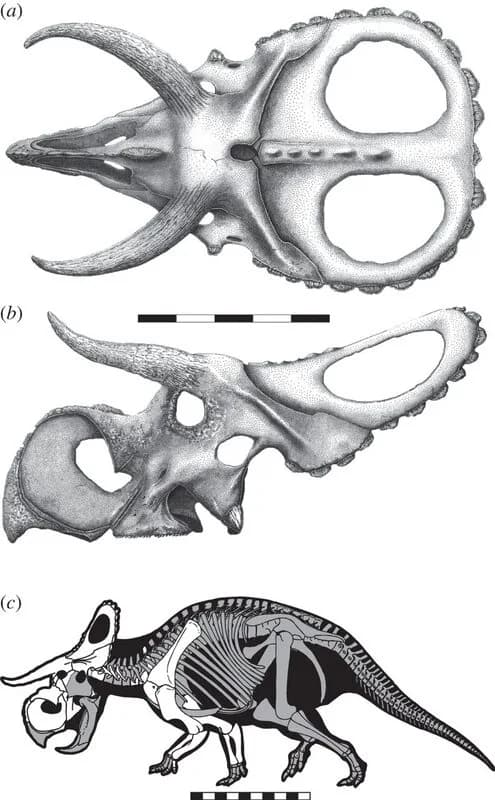
The most spectacular anatomical feature of Kosmoceratops is undoubtedly its skull, which holds the absolute record for the greatest number of bony ornaments among all known dinosaurs. It possessed a total of 15 horns and horn-like structures distributed across the head: a blade-like nasal horn, two large brow horns above the eyes oriented unusually outward and to the sides — atypical for a chasmosaurine — one horn at the tip of each cheekbone, and ten well-developed hooks or spurs along the rear margin of its short and broad frill. This cranial shield, the frill, was comparatively shorter and wider than those of its relatives.
The behavior of Kosmoceratops was most likely heavily influenced by its extravagant cranial ornamentation. Paleontologists believe that the majority of these bony structures would not have been effective as defensive weapons against large predators, but played a dominant role in intraspecific signaling: intimidating rival males, performing dominance displays during ritualized combat, and attracting mates during the breeding season. This type of intense sexual selection, comparable to that observed in modern deer or birds, would have gradually driven the elaboration of these ornaments over successive generations in this isolated island population of Laramidia.
Kosmoceratops fossils were discovered in 2006 and 2007 in the Kaiparowits Formation within the Grand Staircase-Escalante National Monument in Kane County, Utah. The specimens include a nearly complete adult skull with associated postcranial remains, as well as fragments from juvenile individuals. The species was formally described and named in 2010 by paleontologist Scott D. Sampson and colleagues in a paper published in the journal PLOS ONE. The generic name Kosmoceratops means 'ornate horned face', referencing its spectacular skull, while the specific epithet richardsoni honors Scott Richardson, the fossil preparator who discovered the specimens.
| Period | Crétacé supérieur / Late Cretaceous |
| Era | Mésozoïque / Mesozoic |
| Age | 76-75 Ma |
| Location | Amérique du Nord / North America |
| Length | 4.5 m |
| Height | 1.5 m |
| Weight | 1.2 tonnes |
| Diet | Herbivore |
| Discovery | 2010 |
Kosmoceratops richardsoni had 15 horns and bony structures on its head: one nasal horn, two large brow horns, two cheekbone horns, and ten bony hooks around its frill margin. This is the absolute record among all known dinosaurs, far above the 3 horns of Triceratops.
Kosmoceratops richardsoni lived 76 to 75.9 million years ago (Campanian) in the humid coastal environments of the Kaiparowits Formation in present-day Utah (Grand Staircase-Escalante). It inhabited Laramidia, an island continent formed by the division of North America by the Western Interior Seaway.
Palaeontologists believe the 15 bony structures of Kosmoceratops richardsoni were not effective as defensive weapons. They primarily served for intraspecific communication: intimidating rivals, ritualised combat, and courtship — sexual selection comparable to that seen in modern deer or birds.
Fossil skull of Kosmoceratops richardsoni on display at the Natural History Museum of Utah, revealing its 15 horns and bony ornamental structures.
Wikimedia Commons, CC BY-SA
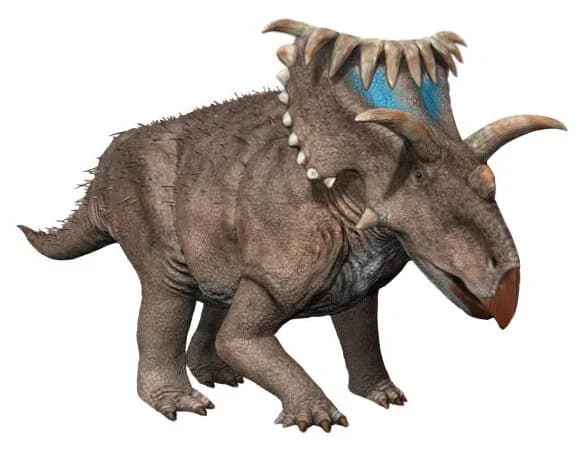
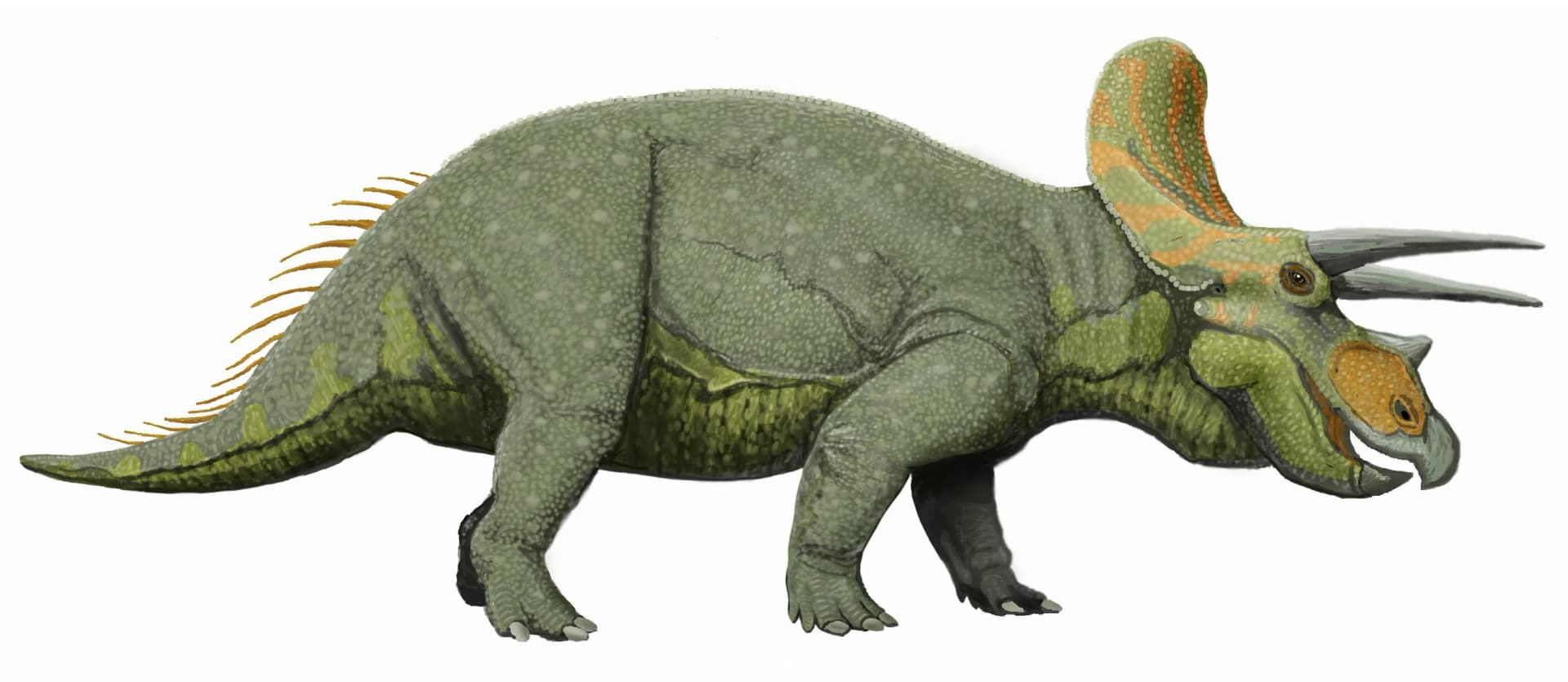
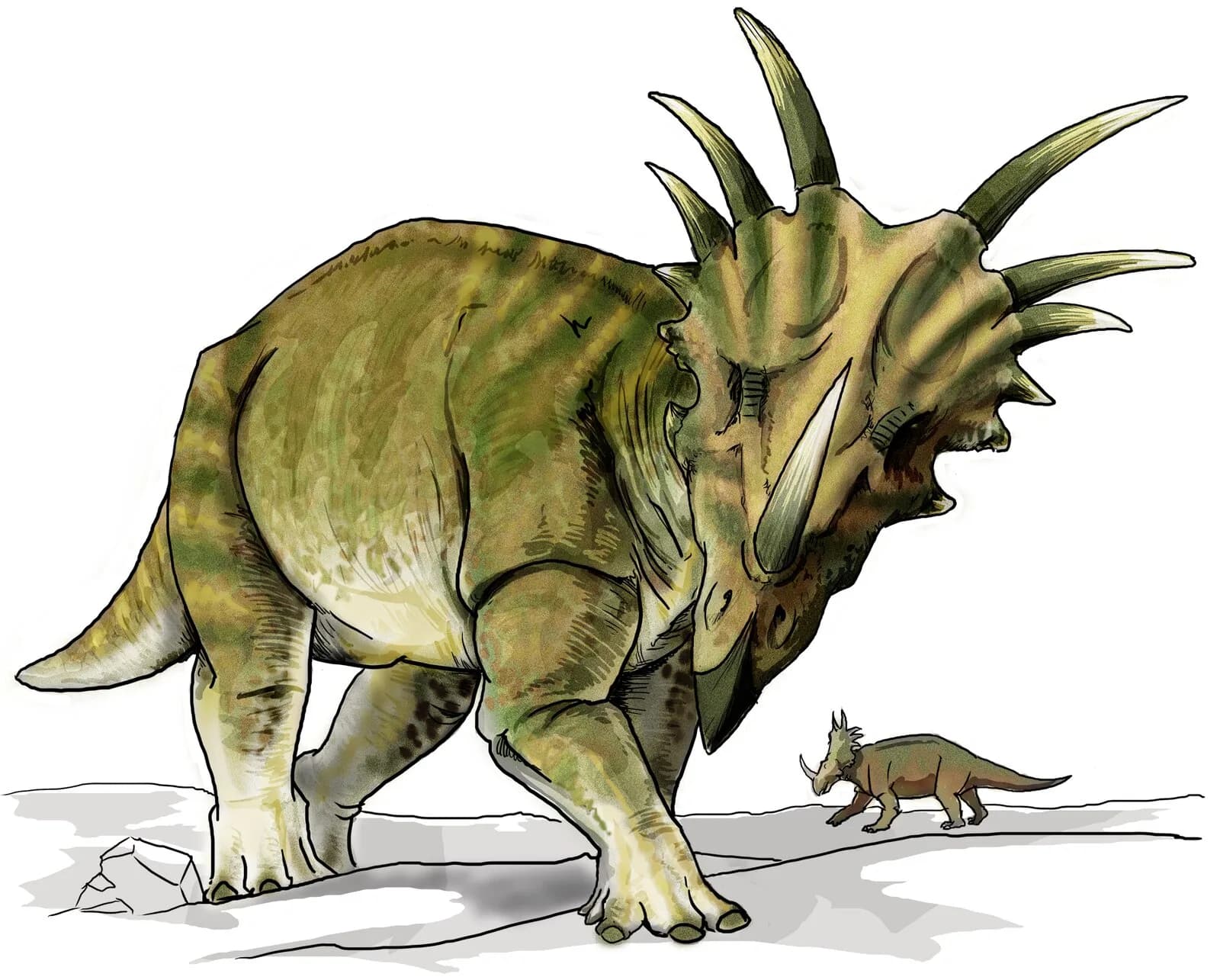
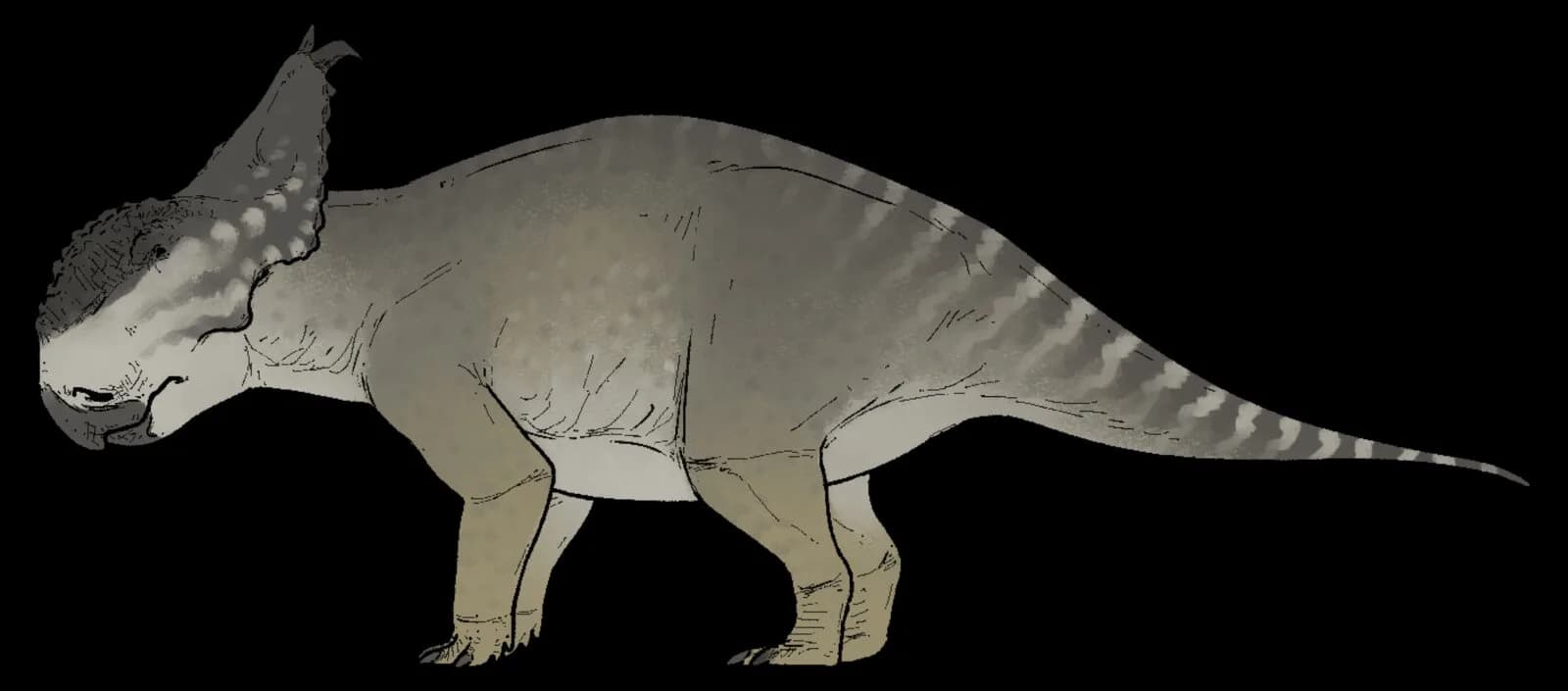
Artistic reconstruction of Kosmoceratops richardsoni in its swampy Late Cretaceous environment on the island continent of Laramidia.
Wikimedia Commons, CC BY-SA