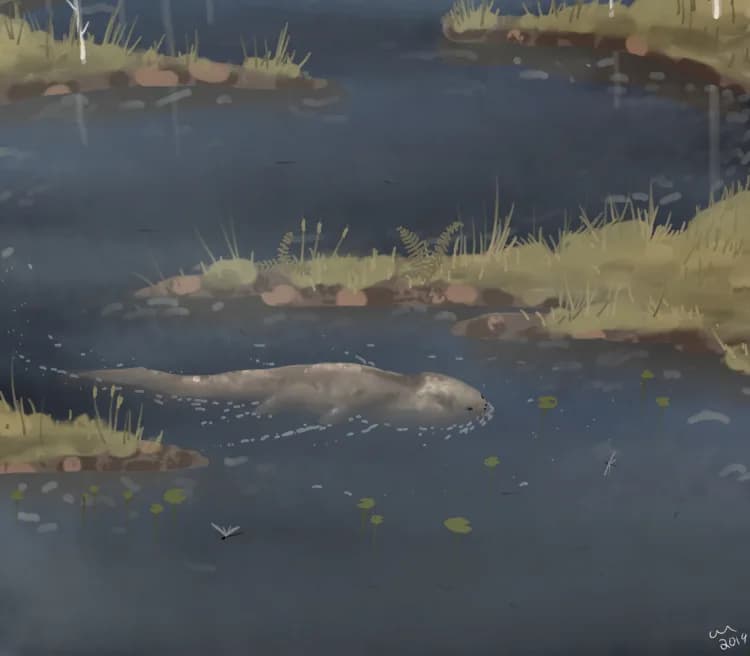
Koolasuchus
Koolasuchus cleelandi is among the last known temnospondyls, a group of amphibians thought extinct since the end of the Triassic, some 80 million years earlier. Four to 5 metres long and 250 to 500 kilograms, described in 1997 in Victoria, it held on until 112 million years ago in waters near the South Pole, too cold for crocodilians.
Koolasuchus lived during the Early Cretaceous, approximately 125 to 112 million years ago (Aptian). This is remarkable because temnospondyls were thought to have disappeared by the end of the Triassic, approximately 80 million years earlier. Koolasuchus thus represents a 'living fossil' of its time — one of the very last surviving temnospondyls, persisting in the cold environments of the Australian rift while elsewhere this group had been replaced by crocodilians. Its prolonged survival in southeastern Australia is explained by temperatures too cold for ectothermic crocodilians of the time, which could not colonize these high latitudes.
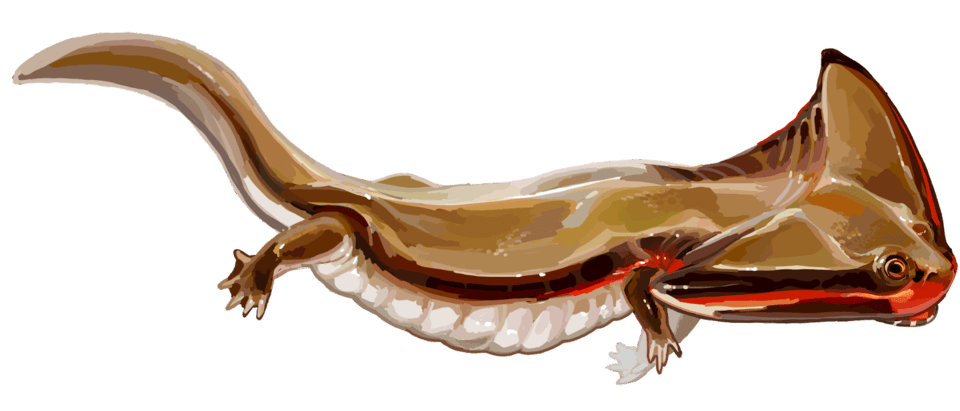
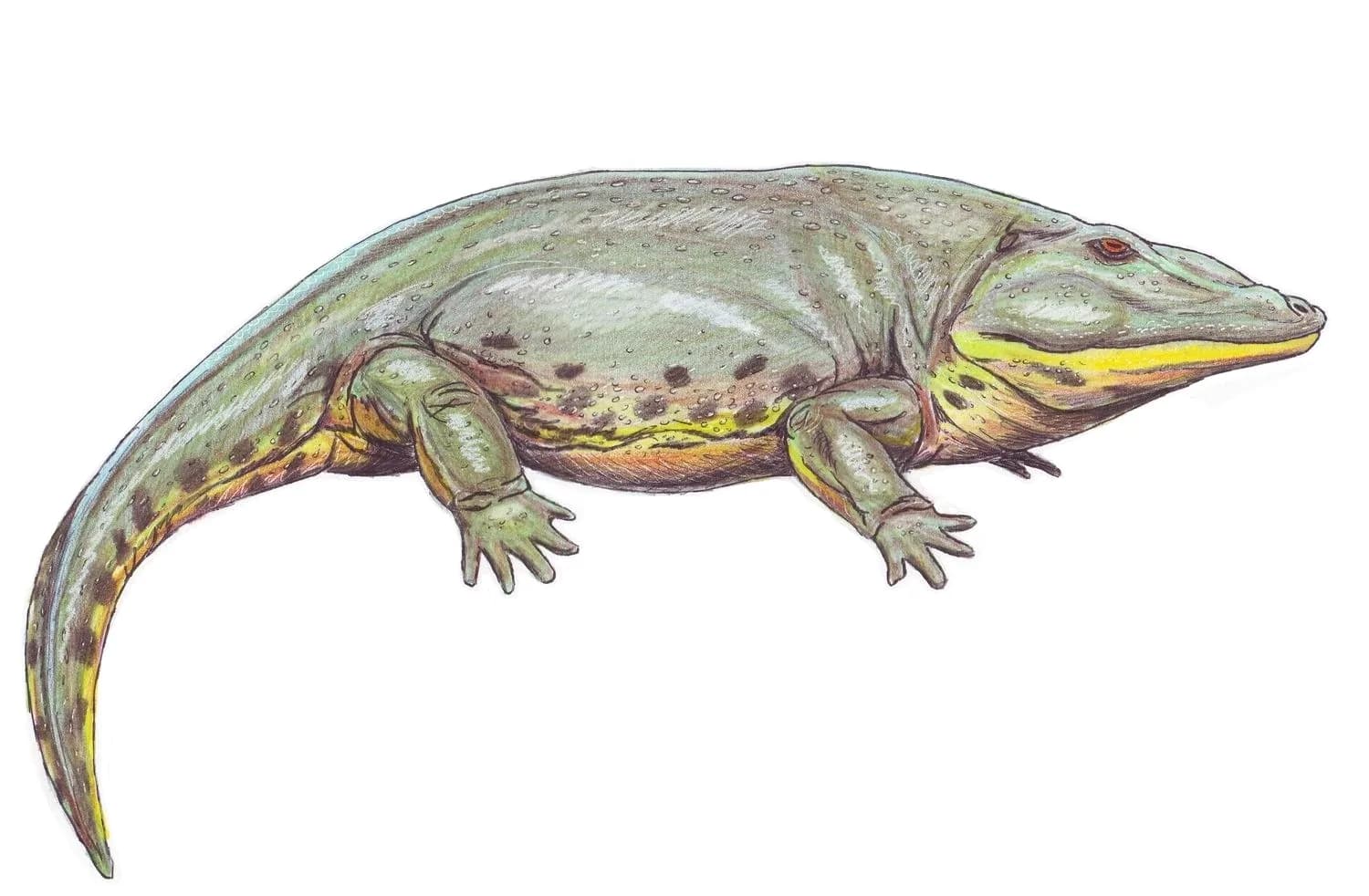
Koolasuchus was a large temnospondyl, reaching an estimated length of approximately 4 to 5 meters — making it one of the largest Cretaceous amphibians and one of the largest temnospondyls to survive beyond the Triassic. Its weight is estimated between 250 and 500 kilograms. Its wide, flattened skull measured approximately 65 centimeters long. Its general morphology was similar to a giant salamander but with much more massive proportions, a stocky body, and a disproportionately wide head relative to its body.
Koolasuchus was an ambush predator of the cold streams and lakes of the Australian rift. It probably fed on fish, freshwater crustaceans, small dinosaurs coming to drink, and other aquatic vertebrates. Its wide mouth equipped with conical teeth and large palatal fangs allowed it to capture significant prey with a rapid, powerful jaw snap. Like modern giant salamanders of Japan and China, it probably hunted by ambush, lurking in riverbeds or under overhanging banks, waiting for prey to pass within reach before snapping its jaws shut.
Koolasuchus inhabited the cold freshwater rivers and lakes of the Australo-Antarctic rift, a tectonic rift valley progressively separating Australia from Antarctica during the Early Cretaceous. This rift was located at approximately 70° south latitude — well beyond the polar circle — and experienced winters with several months of near-total darkness and temperatures near freezing. Fossils come from the Strzelecki Formation in southeastern Victoria State, Australia. These cold polar conditions allowed Koolasuchus survival by excluding crocodilians, which cannot tolerate low temperatures.
The skull of Koolasuchus is wide, flattened, and tabular — typical of chigutisaurid temnospondyls. It bears large temporal fenestrae and dorsally positioned orbits. Its conical teeth are complemented by large palatal fang teeth on the palate, forming an effective trap for slippery prey. Its body was probably elongated and dorso-ventrally flattened, with smooth, permeable skin like modern amphibians. Its limbs were proportionally short relative to its massive body. Its tail, probably laterally compressed, served as an aquatic propulsor. Its lateral lines — a sensory system detecting vibrations in water — were well-developed on the skull.
Koolasuchus was an aquatic ambush predator, spending most of its life in the cold rivers and lakes of the polar rift. Its survival during Antarctic winters, with months of darkness and freezing temperatures, suggests an ability to enter winter torpor — a state of metabolic lethargy similar to hibernation in modern giant salamanders. Its well-developed lateral lines allowed it to detect prey in dark, turbid waters even without light. It occupied the ecological niche normally held by crocodilians in warmer ecosystems, taking advantage of the absence of these competitors in polar environments.
Koolasuchus was described in 1997 by Australian paleontologists Anne Warren, Rich, and Vickers-Rich. The generic name honors Lesley Kool, the fossil preparator who freed the first specimens, while the specific name honors Mike Cleeland, the fossil discoverer. Remains come from the Strzelecki Formation in southeastern Victoria State, Australia, dating to the Aptian (Early Cretaceous). The material primarily comprises jaw and skull fragments. Its description as a Cretaceous temnospondyl caused a sensation in the paleontological community, pushing back the supposed extinction date of this group in Australia by 80 million years.
| Period | Crétacé inférieur (Aptien) / Early Cretaceous (Aptian) |
| Era | Mésozoïque / Mesozoic |
| Age | 125-112 Ma |
| Location | Australie (Victoria) / Australia (Victoria) |
| Length | 4-5 m |
| Height | 60 cm |
| Weight | 250-500 kg |
| Diet | Piscivore |
| Discovery | 1997 |
Koolasuchus cleelandi lived at roughly 70° south latitude, in waters too cold for the ectothermic crocodilians that had replaced temnospondyls elsewhere. This polar niche allowed it to survive until 125–112 million years ago, around 80 million years after the supposed extinction of its group at the end of the Triassic.
Koolasuchus cleelandi reached 4 to 5 metres in length, with an estimated weight of 250 to 500 kilograms. Its broad, flattened skull measured approximately 65 centimetres. A chigutisaurid temnospondyl amphibian, it resembled a giant salamander with lateral-line organs on the skull to detect vibrations in water.
Koolasuchus cleelandi hunted by ambush in the cold, dark streams of the Australo-Antarctic rift. Its well-developed lateral lines allowed it to detect prey (fish, crustaceans, small dinosaurs coming to drink) without light. Like modern giant salamanders of Japan, it could enter torpor during polar winters.
Koolasuchus reconstruction in a polar stream
Wikipedia Commons
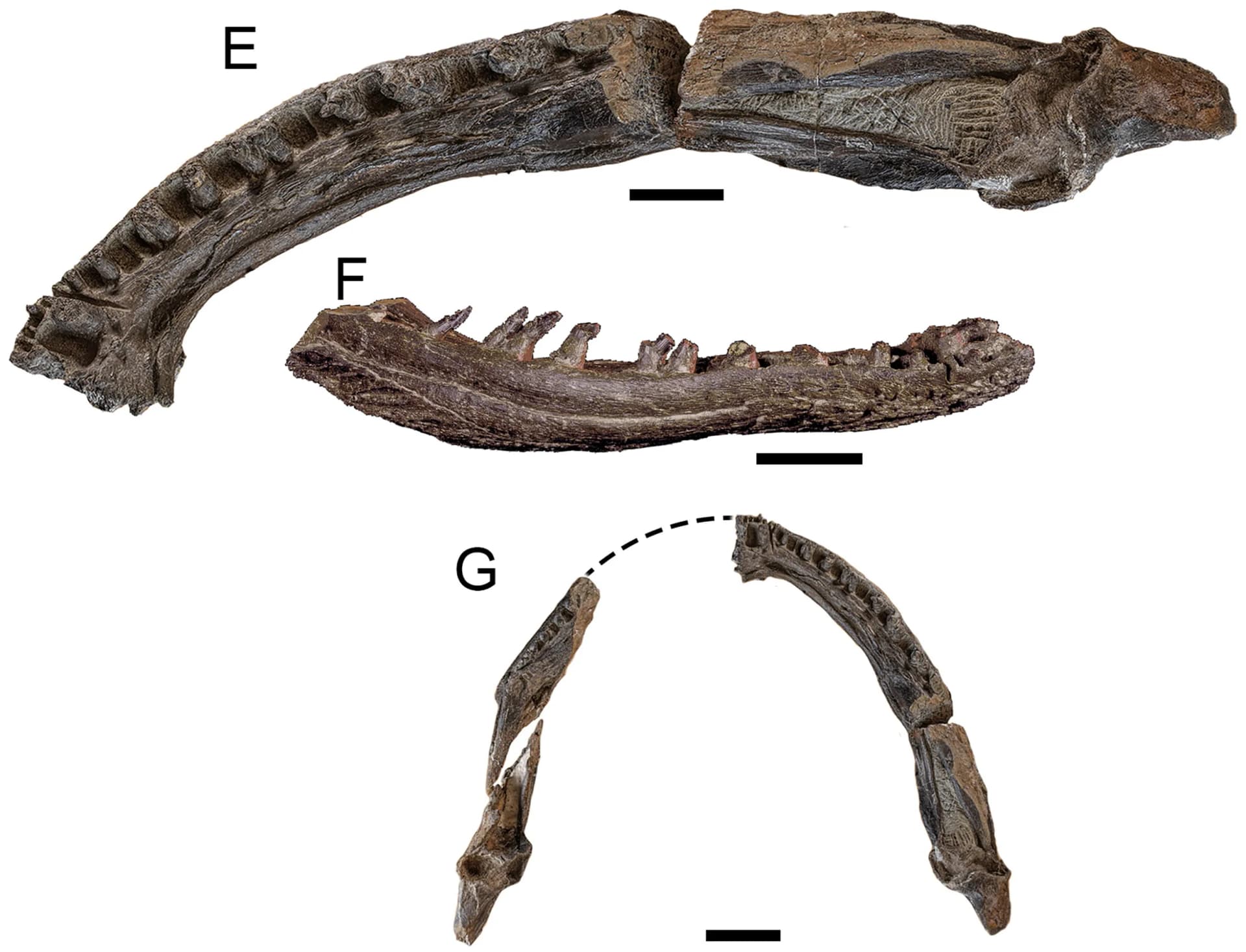
Koolasuchus cleelandi fossil mandibles
Wikipedia Commons