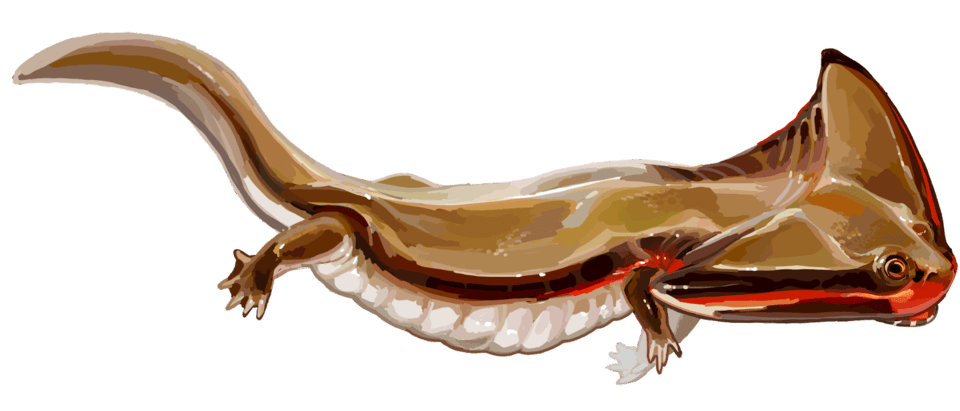
Diplocaulus
Diplocaulus magnicornis is an amphibian about a metre long with a boomerang-shaped skull, described in 1877 and dated to 307 to 257 million years ago. In 1980 researchers carved a full-size replica of its head from balsa wood and tested it in a wind tunnel: the horns behaved like a wing, generating lift that pushed it upward through the water.
Diplocaulus lived from the Late Carboniferous (Pennsylvanian) through the Late Permian, approximately 307 to 257 million years ago — a remarkable existence spanning 50 million years. This bizarre and striking aquatic amphibian belonged to the order Nectridea, a group of lepospondyls (primitive amphibians) now entirely extinct. Diplocaulus is the largest and most famous of all lepospondyls, and its extraordinary boomerang-shaped silhouette makes it one of the most recognizable prehistoric animals. Its name means 'double stem' in Greek (diplos = double, kaulos = stem), referring to the structure of its vertebrae. Several species are recognized, including D. magnicornis (the largest and best documented) and D. salamandroides (the type species, much smaller).
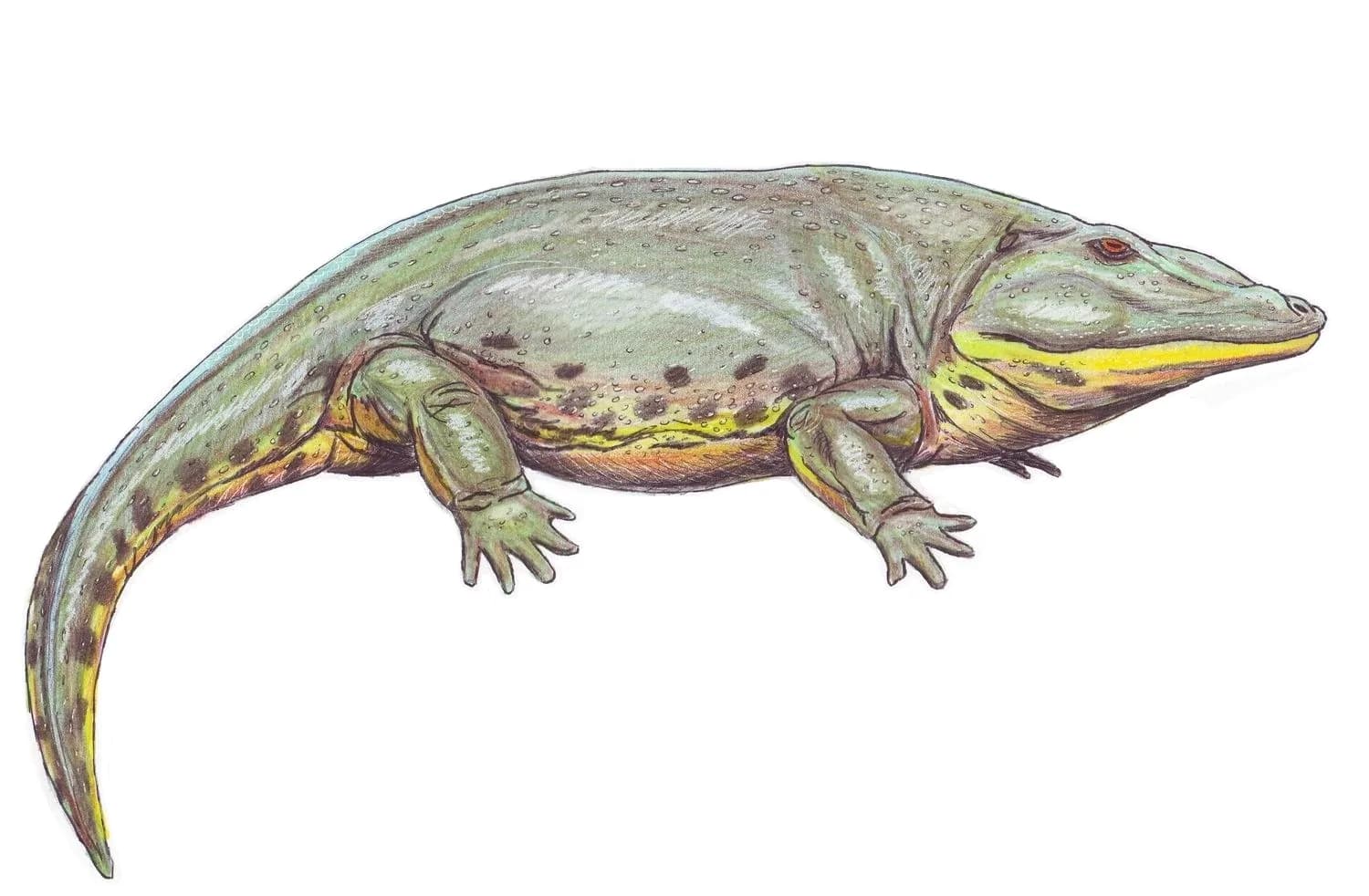
Diplocaulus magnicornis could reach one meter in length as an adult, making it a giant among lepospondyls — a group of primitive amphibians whose most representatives barely exceeded a few centimeters. D. salamandroides, the type species, was much smaller, about one-fifth to one-sixth the size of D. magnicornis. The estimated weight of a one-meter adult ranged between 2 and 8 kilograms. The stocky, elongated body resembled that of a large salamander, but it is of course its spectacular boomerang-shaped head, with two long bony protuberances (tabular horns) extending from each side, that made it immediately recognizable.
Diplocaulus was an aquatic carnivore that fed primarily on small fish and various invertebrates living in the same freshwater environments. A highly effective bottom-dwelling ambush predator, it remained completely motionless on the water bottom and then used the remarkable hydrodynamic shape of its boomerang-like head (creating a hydrofoil effect) to propel itself rapidly upward to capture unsuspecting prey swimming above. Wind tunnel studies have demonstrated that the abrupt upward tilting of its broad head generated significant hydrodynamic lift, propelling the animal toward the surface in a flash. At rest, the head was naturally angled approximately 1.5 degrees below horizontal, minimizing both lift and drag for energy-efficient waiting.
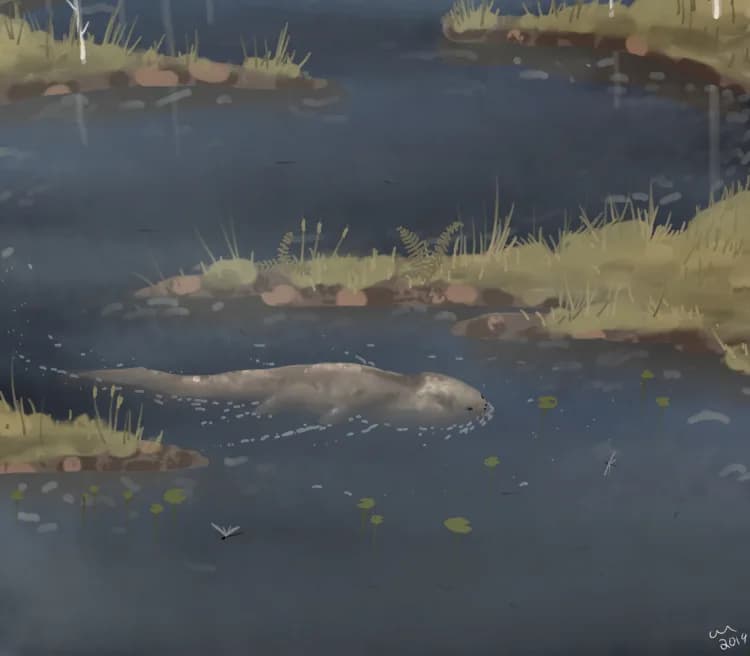
Diplocaulus inhabited freshwater environments of the vast tropical floodplains of the supercontinent Pangaea during the Late Carboniferous and Permian periods. The majority of fossils come from the famous 'red beds' of Texas and Oklahoma in the United States, with hundreds of well-preserved D. magnicornis specimens recovered from the Clear Fork, Arroyo, and Chickasha geological formations. Additional fossils have also been discovered in Illinois and Pennsylvania (Late Carboniferous), New Mexico, and Morocco (Late Permian) — the latter being the most recent occurrence of a lepospondyl amphibian known anywhere in the entire world, extending the group's temporal range significantly.
Diplocaulus's most iconic feature is its boomerang or arrow-shaped skull, formed by two long bony protuberances (tabular horns) extending from each side of the back of the skull. These horns are primarily composed of the tabular bone, assisted by the squamosal and postparietal bones. Their function was scientifically tested in 1980 by Cruickshank and Skews, who built a full-size balsa wood model and placed it in a wind tunnel: the result showed the horns functioned like an airplane wing, generating significant lift in water. Other hypotheses include anti-predator defense (a head too wide to swallow) and counterbalancing. Locomotion was probably anguilliform, using a long thin caudal whip.
Diplocaulus was a semi-benthic animal that spent most of its time at the bottom of streams and pools. Exceptional fossils revealed dormancy behavior in burrows (estivation): groups of juveniles gathered underground during droughts. One famous case shows that the predator Dimetrodon broke into one of these estivation burrows to devour the occupants, leaving fatal bite marks on the skull of one Diplocaulus. This gregarious behavior in juveniles and vulnerability to terrestrial predators underscore the strictly aquatic nature of the animal.
Diplocaulus was first described in 1877 by the famous American paleontologist Edward Drinker Cope, from a few vertebrae found near Danville, Illinois. In 1882, Cope described D. magnicornis ('large horns'), the first species whose bizarre, horned skull nature was understood. In 1917, Herman Douthitt published an exhaustive anatomical monograph that remains a foundational reference. In 1980, Cruickshank and Skews performed the famous wind tunnel tests demonstrating the hydrodynamic function of the horns. The last species described, D. minimus from Morocco (1988), is the most recent occurrence of any lepospondyl group.
| Period | Carbonifère supérieur au Permien supérieur / Late Carboniferous to Late Permian |
| Era | Paléozoïque / Paleozoic |
| Age | 307-257 Ma |
| Location | États-Unis (Texas, Oklahoma, Illinois, Pennsylvanie, Nouveau-Mexique), Maroc / USA (Texas, Oklahoma, Illinois, Pennsylvania, New Mexico), Morocco |
| Length | ~1 m |
| Height | 15 cm |
| Weight | 2-8 kg (estimé / estimated) |
| Diet | Piscivore |
| Discovery | 1877 |
In 1980, Cruickshank and Skews built a full-size balsa wood model of Diplocaulus magnicornis and wind tunnel-tested it: the tabular horns functioned like an airplane wing in water, generating hydrodynamic lift. This mechanism allowed the amphibian to rapidly propel itself upward to capture prey. Other hypotheses include anti-predator defense (a head too wide to swallow).
Diplocaulus existed for approximately 50 million years, from the Late Carboniferous (307 Ma) to the Late Permian (257 Ma). Most D. magnicornis fossils come from the Clear Fork and Arroyo formations of Texas and Oklahoma. A Moroccan species (D. minimus, 1988) represents the most recent known occurrence of any lepospondyl anywhere in the world.
Exceptional fossils show that Dimetrodon, the large Permian synapsid predator, attacked Diplocaulus magnicornis in their estivation burrows. Fatal Dimetrodon bite marks have been identified on Diplocaulus skulls, proving these amphibians gathered underground during droughts and that Dimetrodon broke into these shelters to devour the occupants.
Artistic reconstruction of Diplocaulus magnicornis
Wikimedia Commons, CC BY-SA
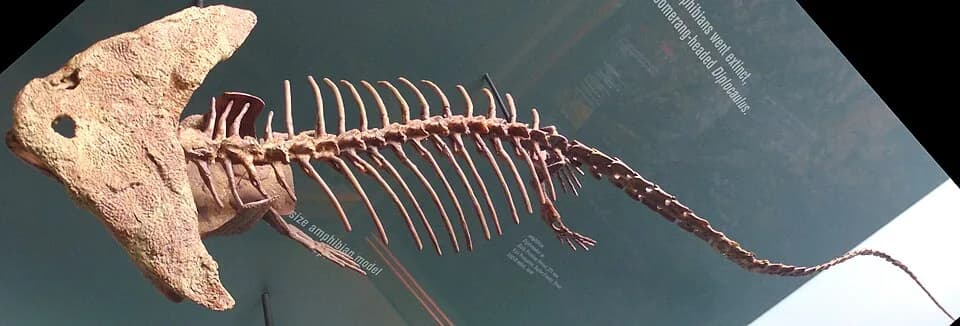
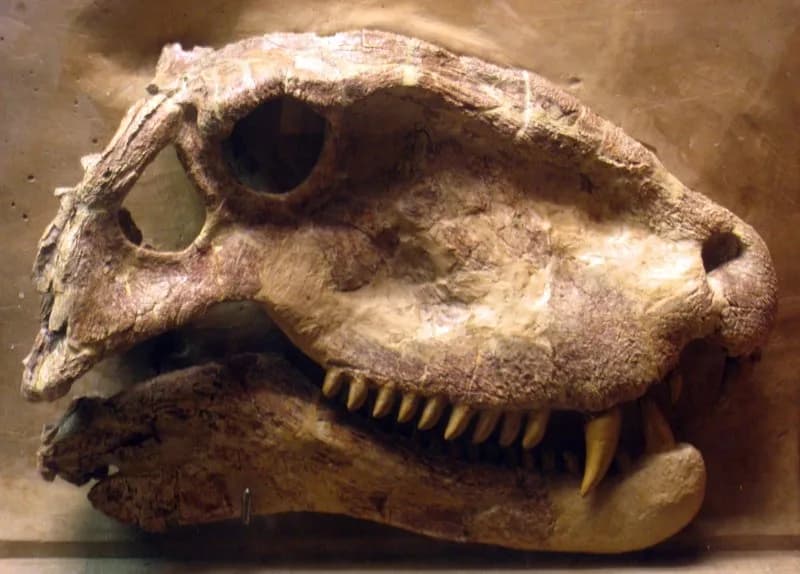
Skeleton and reconstructed model at Denver Museum
Wikimedia Commons, CC BY-SA
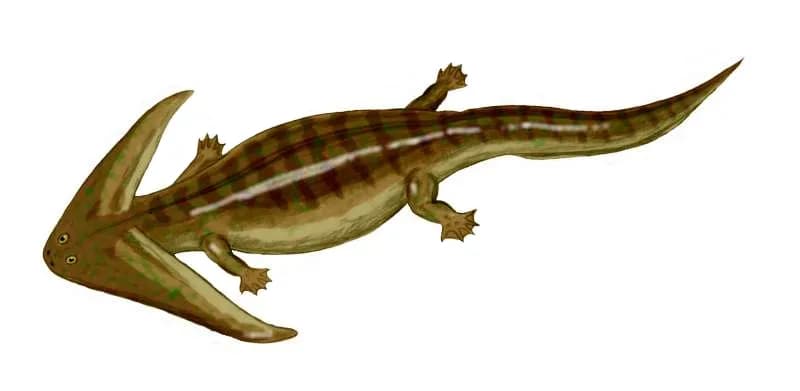
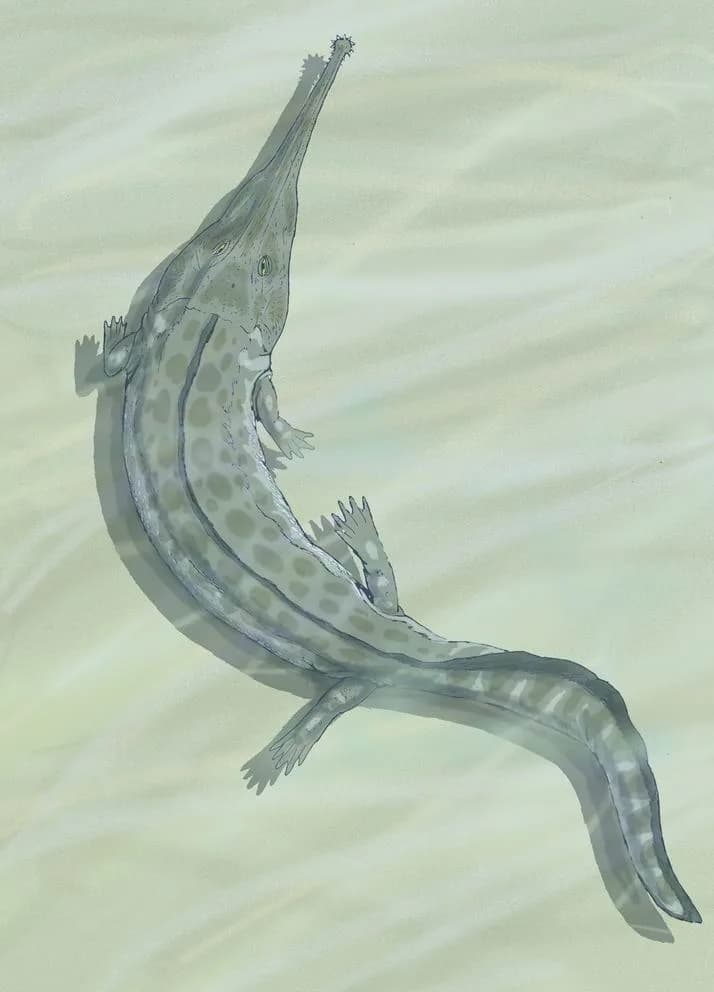
Classic scientific illustration of Diplocaulus, lateral view
Nobu Tamura, CC BY-SA 3.0