Kaiwhekea
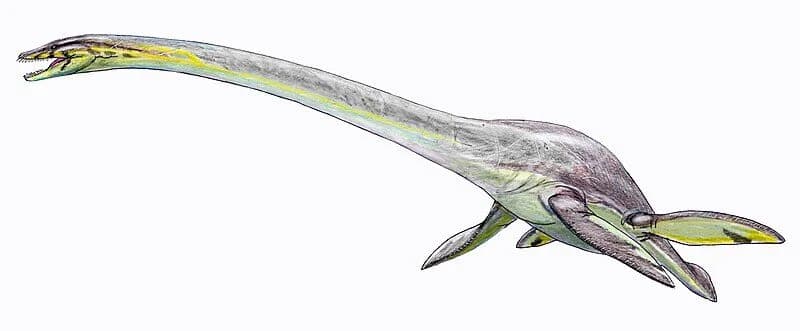
Kaiwhekea katiki takes its name from Māori: kai, « to eat », and wheke, « squid ». This 7-metre plesiosaur, described in 2002 from the Katiki Formation in New Zealand, lived around 70 million years ago. It is an aristonectine, with a shorter neck and larger head than the elasmosaurs. Its large eyes suggest hunting at depth, in low light.
Playable in Path of Titans
See Kaiwhekea katiki's stats, abilities and role on our survival server.
Kaiwhekea lived at the very end of the Late Cretaceous, during the Maastrichtian, about 70 million years ago. Its fossils come from what is now New Zealand, then part of the submerged continent of Zealandia, in the southern seas near Antarctica. These temperate-to-cold waters, at high southern latitudes, held a distinctive marine fauna, different from that of the warm seas of the northern hemisphere. It was in this southern ocean, shortly before the great end-Cretaceous extinction, that this plesiosaur hunted, ranking among the last great marine reptiles of the age of dinosaurs.
Kaiwhekea was described in 2002 by palaeontologists Arthur Cruickshank and Ewan Fordyce, from a nearly complete skeleton found in the Katiki Formation near Shag Point, in the Otago region of New Zealand. The name comes from the Māori language: kai ("food, eat") and wheke ("squid, octopus"), meaning "squid eater", while the epithet katiki refers to the geological formation that yielded it. This name, rooted in local culture, reflects both the animal's presumed diet and its link to the land where it was found. The genus is monotypic, containing only the type species, K. katiki.
Kaiwhekea was a medium-sized plesiosaur, estimated at about 7 metres long. Compared with the most spectacular elasmosaurs, whose enormous necks could make up half the total length, Kaiwhekea had more balanced proportions, with a relatively large head for a member of this family. Its stocky body, propelled by four broad flippers, was built for manoeuvrable swimming rather than pure speed. This respectable size made it a sizeable predator in the southern seas of the latest Cretaceous, without rivalling the largest marine reptiles of the time, such as the giant mosasaurs that reigned elsewhere.
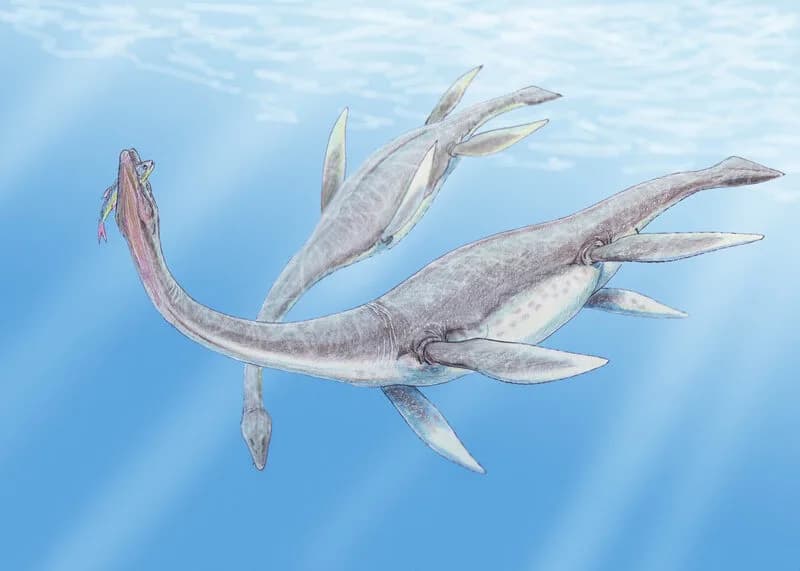
Kaiwhekea likely fed on small, soft prey, especially cephalopods such as squid and their relatives, along with small fish. Its jaw held many fine, pointed, needle-like teeth, poorly suited to slicing large prey but ideal for trapping and holding slippery animals. This dentition, combined with a large head, suggests a feeding style based on suction or rapid capture of prey schools, rather than predation on large game. Its Māori name, "squid eater", neatly sums up the picture scientists have of its diet: a hunter specialised in the abundant but elusive prey of deeper waters. Its many fine, slightly curved teeth probably interlocked to form a kind of cage that held the small prey sucked in with the water. This suction-capture mechanism, suspected in several aristonectines, would suit a hunter of squid and small schooling fish perfectly.
Kaiwhekea inhabited the temperate-to-cold seas fringing Zealandia, at high southern latitudes, not far from the Antarctica of the time. This southern environment, less studied than the warm northern seas, held a marine fauna adapted to cooler and sometimes darker waters. Kaiwhekea's presence there reflects a late radiation of plesiosaurs in this part of the world, at the very end of the Cretaceous. It shared the ocean with other marine reptiles, fish and abundant cephalopods, which probably made up most of its menu. This southern distribution makes it a valuable witness to the marine life of the far south on the eve of the extinction. This high-latitude setting, where light and temperature varied strongly with the seasons, likely shaped Kaiwhekea's adaptations, starting with its large eyes.
Kaiwhekea belongs to the Aristonectinae, a group of elasmosaurid plesiosaurs with an atypical build: their neck is shorter and their head larger than in classic, long-necked elasmosaurs. Its rounded, hydrodynamic head held large eyes, suggesting it could hunt in dim light, at depth or by night. Like all plesiosaurs, it moved using four paddle-shaped flippers powered by strong muscles, in a swimming style often compared to "underwater flight". Its tail was short and did not provide propulsion, instead acting as a rudder to adjust direction. Together, these features outline an agile, precise swimmer. Like many plesiosaurs, Kaiwhekea probably swallowed stones, gastroliths, which could act as ballast to control buoyancy or help grind food in the stomach. Its flippers, supported by many elongated, packed finger bones, formed stiff, efficient paddles, anchored on a broad, solid girdle that supported the muscles of this underwater flight.
Kaiwhekea's anatomy suggests a manoeuvrable predator rather than a sprinter, able to make tight turns to chase lively prey. Its large eyes point to activity in dimly lit waters, perhaps during deep dives in search of squid. Like other plesiosaurs, it was a fully marine reptile that breathed air at the surface and, based on the evidence available for this group, probably gave birth to live young in the water, never returning to land. Its four-flipper swimming gave it great stability. Far from the image of a sea monster charging at large prey, Kaiwhekea evokes a patient, precise hunter exploiting abundant but hard-to-catch resources. The large size of its eye sockets is a strong clue: in marine animals, large eyes often go with hunting in dark waters, whether at depth or during the long nights of high southern latitudes. Kaiwhekea could thus have exploited prey out of reach of other predators. There is no sign, however, of any specific social behaviour: as for most plesiosaurs, its lifestyle is reconstructed from its anatomy rather than direct observation.
Kaiwhekea is placed in the family Elasmosauridae, within the order Plesiosauria, and more precisely in the clade Aristonectinae. These aristonectines form a distinctive branch of elasmosaurs, marked by a shortened neck and a large head with many small teeth — a clear departure from the long-necked model that made elasmosaurs famous. This position makes Kaiwhekea an interesting case for understanding plesiosaur diversity at the end of the Cretaceous, and the existence of a southern radiation of these marine reptiles. Its discovery in New Zealand reinforced the idea that the southern hemisphere held, just before the extinction, original and still poorly known plesiosaur communities.
Compared with a typical elasmosaur such as Elasmosaurus, whose immense neck held dozens of vertebrae, Kaiwhekea takes the opposite tack with its short neck and large head. This difference illustrates the evolutionary flexibility of plesiosaurs, able, within one family, to produce both long-necked hunters and more compact forms geared toward other prey. The aristonectines, of which Kaiwhekea is part, recall in some respects filter feeders or small-prey hunters, a little like some modern seals that feed on krill or squid. This distant parallel highlights the diversity of strategies marine life explored, long before the rise of marine mammals. At the end of the Cretaceous, while mosasaurs dominated many seas, plesiosaurs like Kaiwhekea still occupied specialised niches: proof that these two great groups of marine reptiles coexisted by sharing resources.
Kaiwhekea is known from a nearly complete skeleton, which is valuable for a plesiosaur and has allowed its features to be firmly established. This fossil comes from the Katiki Formation in New Zealand, a site that has yielded several latest-Cretaceous marine reptiles and sheds light on the life of the southern ocean at that time. The quality of preservation helped scientists recognise the distinctive traits of the aristonectines and place Kaiwhekea in the plesiosaur tree. As is often the case for southern-hemisphere marine reptiles, finds remain fewer than in the north, which makes every well-preserved specimen all the more valuable.
Kaiwhekea remains a name little known to the general public, but it holds a special place for those interested in southern-hemisphere marine reptiles and New Zealand's palaeontological heritage. It has also gained visibility through video games: it features among the playable creatures of Path of Titans, where it was one of the first fully aquatic creatures added. One important distinction should be recalled, however: Kaiwhekea was not a dinosaur, but a plesiosaur, a marine reptile of a separate lineage that never walked on land. Its Māori name, rooted in local culture, also makes it a fine example of the meeting between science and tradition around fossils. For many players, it is also a chance to learn that a four-flippered "sea monster" was neither a fish nor a dinosaur, but a reptile in its own right, perfectly adapted to life at sea.
| Period | Crétacé supérieur / Late Cretaceous (Maastrichtien) |
| Era | Mésozoïque / Mesozoic |
| Age | ~70 Ma |
| Location | Nouvelle-Zélande / New Zealand (Formation de Katiki) |
| Length | ~7 m |
| Height | — |
| Weight | — |
| Diet | Carnivore (calmars, poissons) |
| Discovery | 2002 |
Kaiwhekea katiki measured approximately 7 metres in length. Unlike classic elasmosaurs whose neck accounts for half the body length, Kaiwhekea belonged to the aristonectines, a group with a shorter neck and a relatively large head, propelled by four paddle-shaped flippers.
Kaiwhekea likely fed on squid and small fish. Its many fine, needle-like teeth formed an effective cage for trapping slippery prey by suction. Its Māori name in fact means "squid eater".
Kaiwhekea lived approximately 70 million years ago, during the Maastrichtian (Late Cretaceous), in the cold seas of Zealandia near Antarctica. Its fossils were described in 2002 from the Katiki Formation near Shag Point, in the Otago region of New Zealand.
Information on this page is based on peer-reviewed scientific publications.
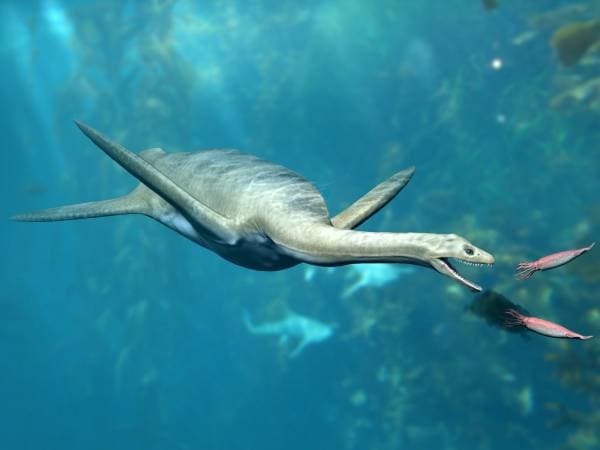
Life reconstruction of Kaiwhekea katiki, an aristonectine plesiosaur from the Late Cretaceous of New Zealand.
Nobu Tamura, CC BY-SA 4.0, via Wikimedia Commons
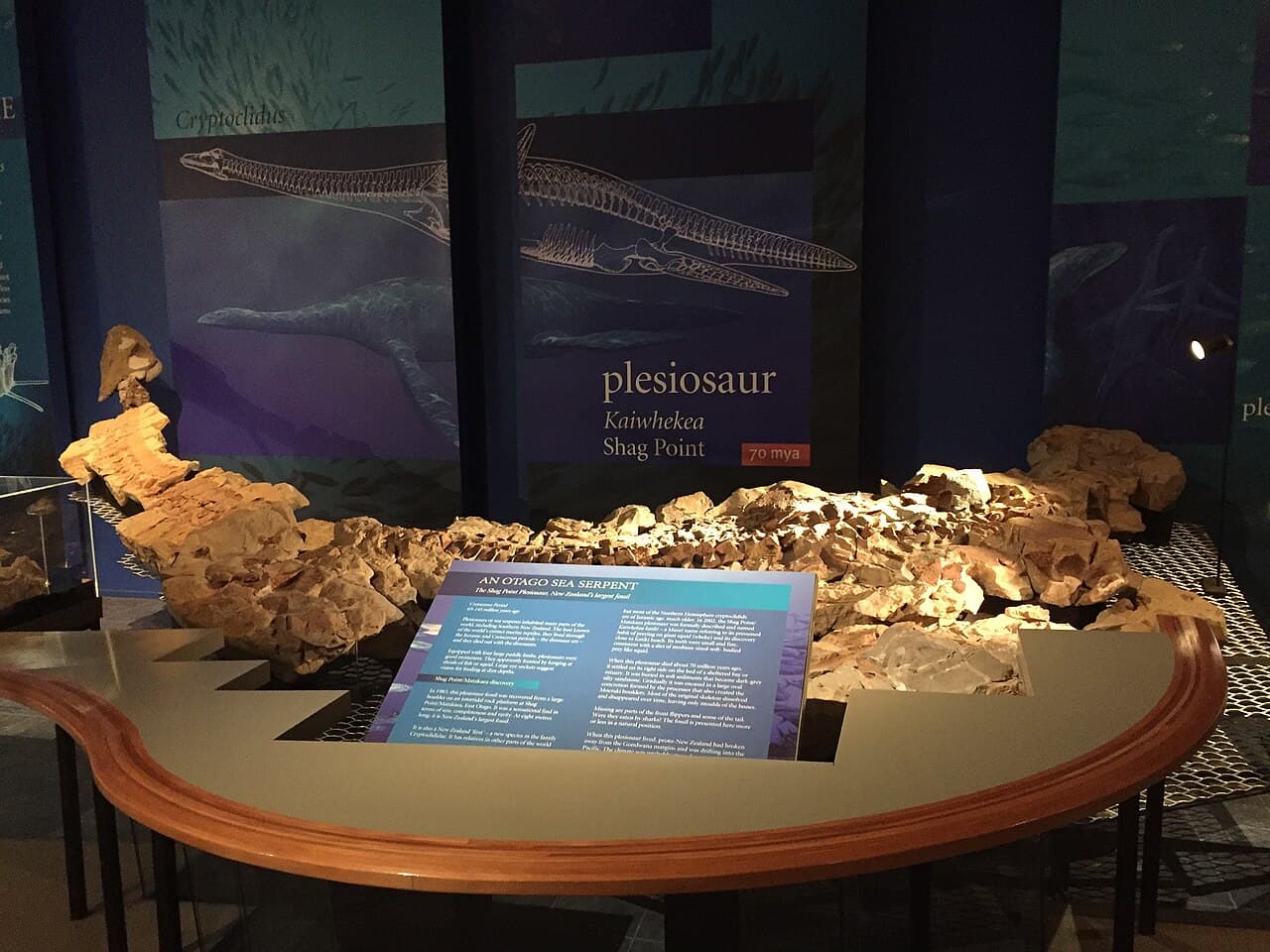
Mounted skeleton of Kaiwhekea katiki, showing the relatively short neck and large head of the aristonectines.
Merytat3n, CC BY-SA 4.0, via Wikimedia Commons