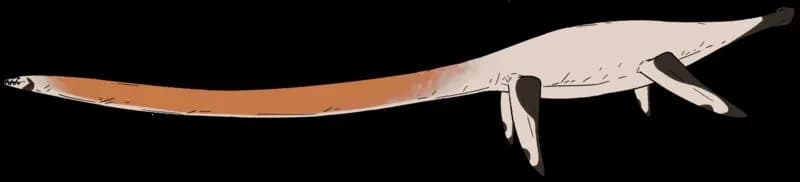
Albertonectes
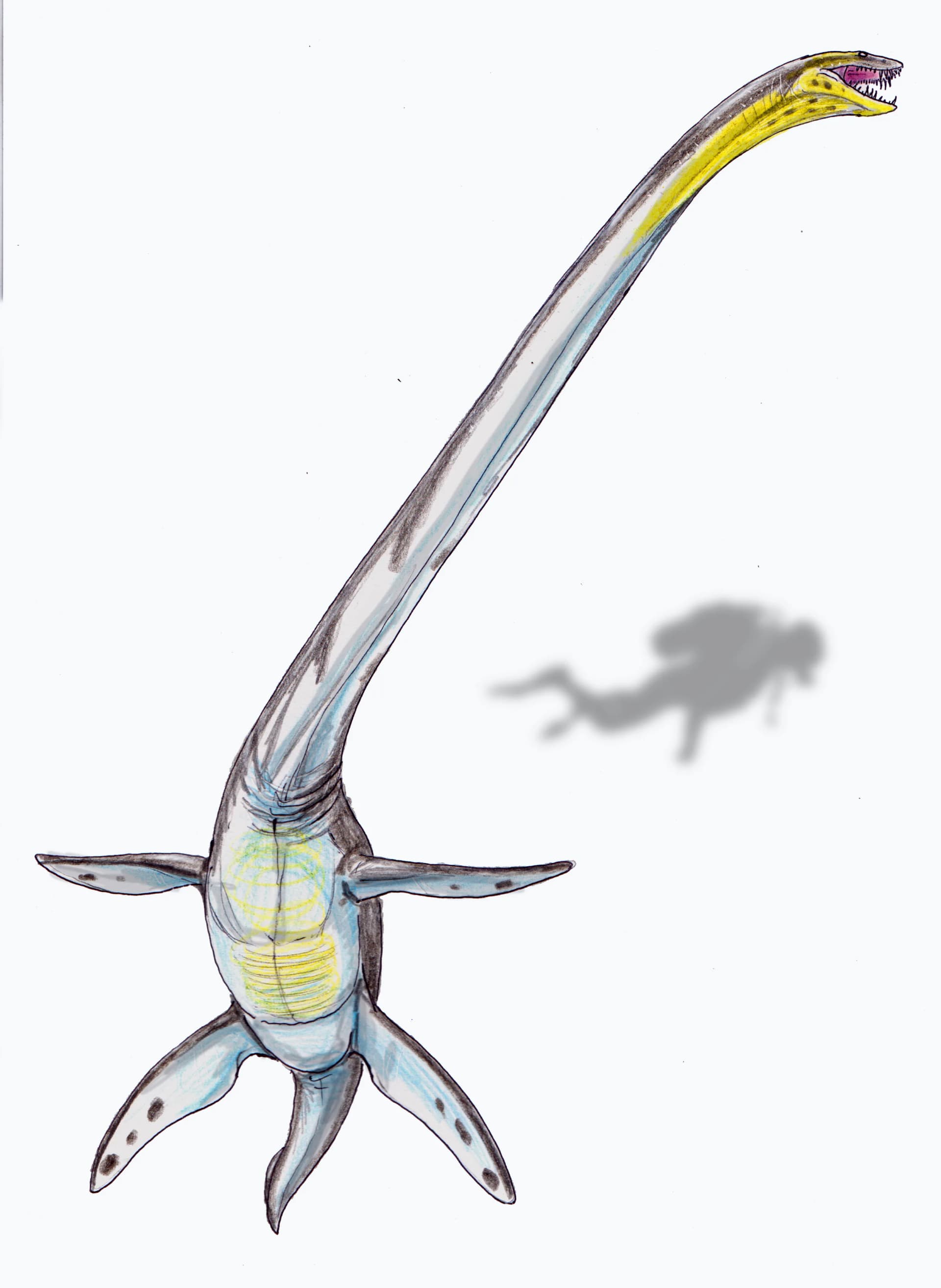
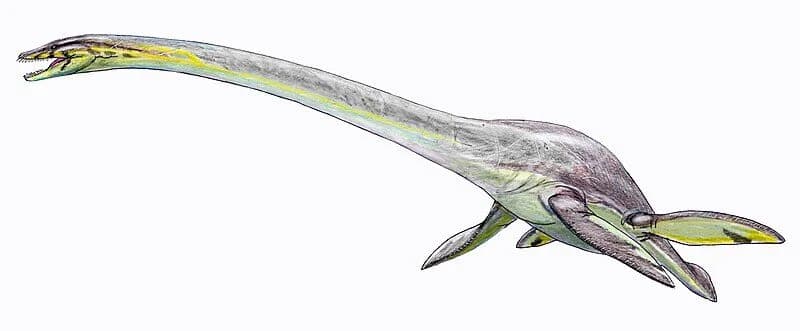
Albertonectes vanderveldei was a plesiosaur from Alberta, described in 2012 and dated to 76 to 72 million years ago. At 11 metres and 2 to 3 tonnes, it holds the outright record for the longest neck of any vertebrate: 76 cervical vertebrae, where a giraffe has seven. Its 7-metre neck made up nearly two thirds of its total length.
Albertonectes lived during the Late Cretaceous, approximately 76 to 72 million years ago (Campanian), in the waters of the Western Interior Seaway that then covered much of North America. This shallow, warm sea extended from the Gulf of Mexico to the Arctic Ocean, dividing the continent into two distinct landmasses. Albertonectes is an elasmosaurid, a group of plesiosaurs characterized by extraordinarily long necks and massive bodies. Its discovery in Alberta, Canada, pushed the boundaries of what paleontologists believed possible in terms of cervical length in marine reptiles.
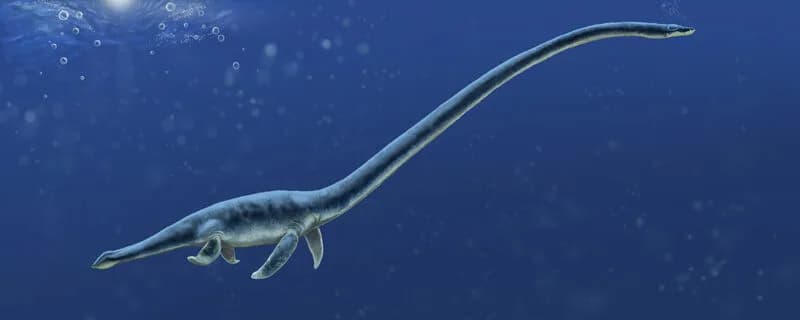
Albertonectes vanderveldei is one of the largest known elasmosaurids, measuring approximately 11 meters in total length. Its spectacular neck, composed of 76 cervical vertebrae — an absolute record among all known vertebrates — represented over 7 meters alone, nearly two-thirds of the animal's entire length. Its weight is estimated between 2 and 3 tonnes, a substantial mass supported by four large paddle-shaped flippers. Its skull, proportionally tiny relative to the body, measured about 30 centimeters. This extreme head-to-neck ratio represents one of the most spectacular anatomical proportions in the animal kingdom.
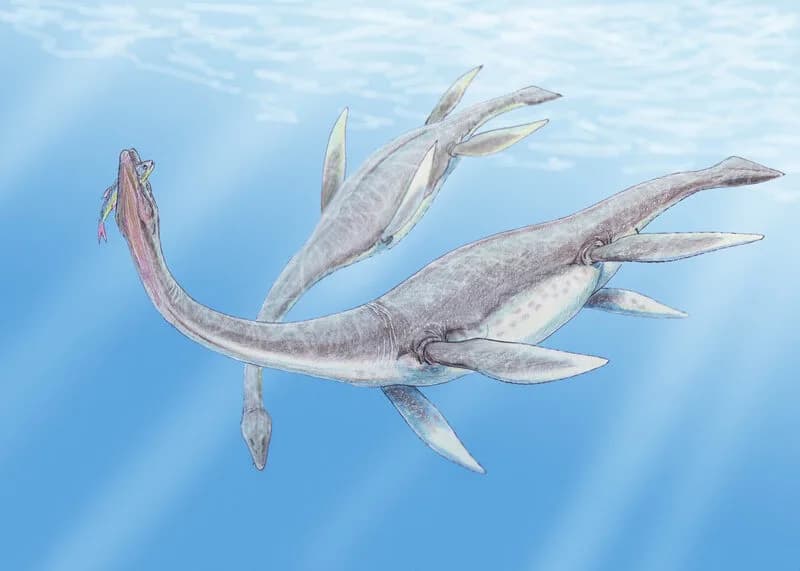
Albertonectes was a specialized piscivore, feeding on small to medium-sized fish and cephalopods (squid and ammonites) in the Western Interior Seaway. Its long, flexible neck allowed it to hunt stealthily, approaching prey without its massive body being detected. Its teeth, long and thin like needles, were perfectly adapted for grasping slippery fish. It likely hunted by swimming slowly then projecting its small head forward with lightning speed to capture fish by surprise. Gastroliths (stomach stones) found with the specimen suggest a role in digestion or ballast control.
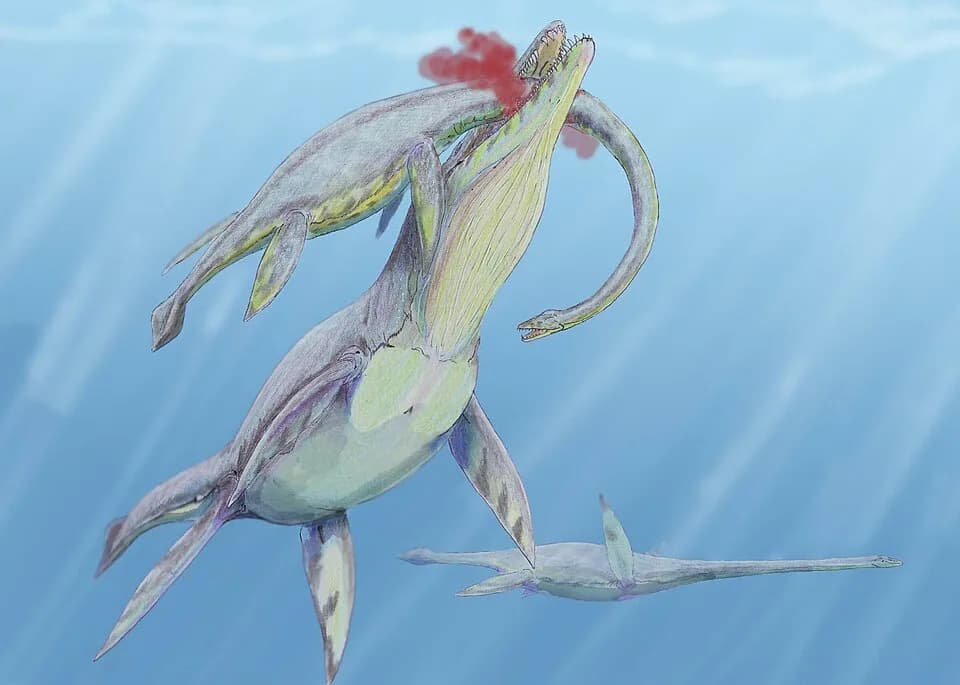
Albertonectes inhabited the shallow to moderately deep waters of the Western Interior Seaway, in the region corresponding to modern-day Alberta, Canada. This interior sea was an extremely productive marine ecosystem, warmed by tropical currents and harboring a diverse fauna of fish, ammonites, sharks, and marine reptiles. The sediments of the Bearpaw Formation, where Albertonectes was discovered, indicate an open marine environment with moderate water depth. It coexisted with mosasaurs, other plesiosaurs, giant sea turtles, and a variety of bony and cartilaginous fish.
Albertonectes anatomy is dominated by its phenomenal neck of 76 cervical vertebrae — the highest number of cervical vertebrae ever recorded in any animal. For comparison, giraffes have only 7 and typical elasmosaurids between 60 and 72. Each cervical vertebra was relatively short and compressed, allowing remarkable lateral flexibility while limiting vertical movements. Its four powerful flippers, transformed into hydrodynamic paddles, provided efficient propulsion through simultaneous movements resembling the 'underwater flying' of sea turtles. Its stocky, compact body contrasted sharply with the elegance of its seemingly endless neck.
Albertonectes was a relatively slow but enduring swimmer, cruising the waters of the Western Interior Seaway in search of fish schools. Its hunting strategy relied on long-range ambush: its massive body remained motionless or drifted slowly while its 7-meter neck silently swept a vast hunting zone, surprising fish before they detected the danger. Gastroliths found in its abdominal cavity likely served as ballast to control buoyancy and maintain a stable position at depth. Like all plesiosaurs, it had to regularly return to the surface to breathe, being a lung-breathing reptile rather than a gill-breathing animal.
Albertonectes was described in 2012 by paleontologist Tai Kubo and colleagues, from a remarkably complete specimen discovered in the Bearpaw Formation near Lethbridge, in southern Alberta, Canada. The genus name means 'Alberta swimmer,' while the species vanderveldei honors Ren Vandervelde, a member of the excavation team. The holotype includes most of the postcranial skeleton, including all 76 complete cervical vertebrae, which is exceptional for an elasmosaurid. The specimen is housed at the Royal Tyrrell Museum of Palaeontology in Drumheller, Alberta. This discovery established a new record for the highest number of cervical vertebrae in any known vertebrate.
| Period | Crétacé supérieur / Late Cretaceous |
| Era | Mésozoïque / Mesozoic |
| Age | 76-72 Ma |
| Location | Alberta, Canada |
| Length | 11 m |
| Height | 1.5 m |
| Weight | 2-3 tonnes |
| Diet | Piscivore |
| Discovery | 2012 |
Albertonectes vanderveldei had 76 cervical vertebrae — the highest number ever recorded in any vertebrate. Its 7-meter neck represented nearly two-thirds of its 11-meter total length. For comparison, giraffes have only 7 cervical vertebrae, and typical elasmosaurids between 60 and 72. This Campanian plesiosaur (76-72 Ma) from Alberta, described in 2012 by Kubo, set a still-unbeaten record.
Albertonectes vanderveldei used its exceptional neck as an ambush weapon: its massive 2-3 tonne body remained still or drifted slowly while the neck silently swept a wide zone. Its needle-like teeth seized fish by surprise in the Western Interior Seaway. Gastroliths found with the specimen suggest it also swallowed stones to control buoyancy.
Albertonectes vanderveldei was described in 2012 by Tai Kubo and colleagues, from a remarkably complete specimen — including all 76 cervical vertebrae — discovered in the Bearpaw Formation near Lethbridge, Alberta, Canada. The specimen is housed at the Royal Tyrrell Museum of Palaeontology in Drumheller. The species honors Ren Vandervelde, a member of the excavation team.
Reconstruction of Albertonectes vanderveldei showing its exceptionally long neck
Nobu Tamura, CC BY-SA 3.0, via Wikimedia Commons
Fossil of Albertonectes vanderveldei with visible gastroliths
Wikimedia Commons