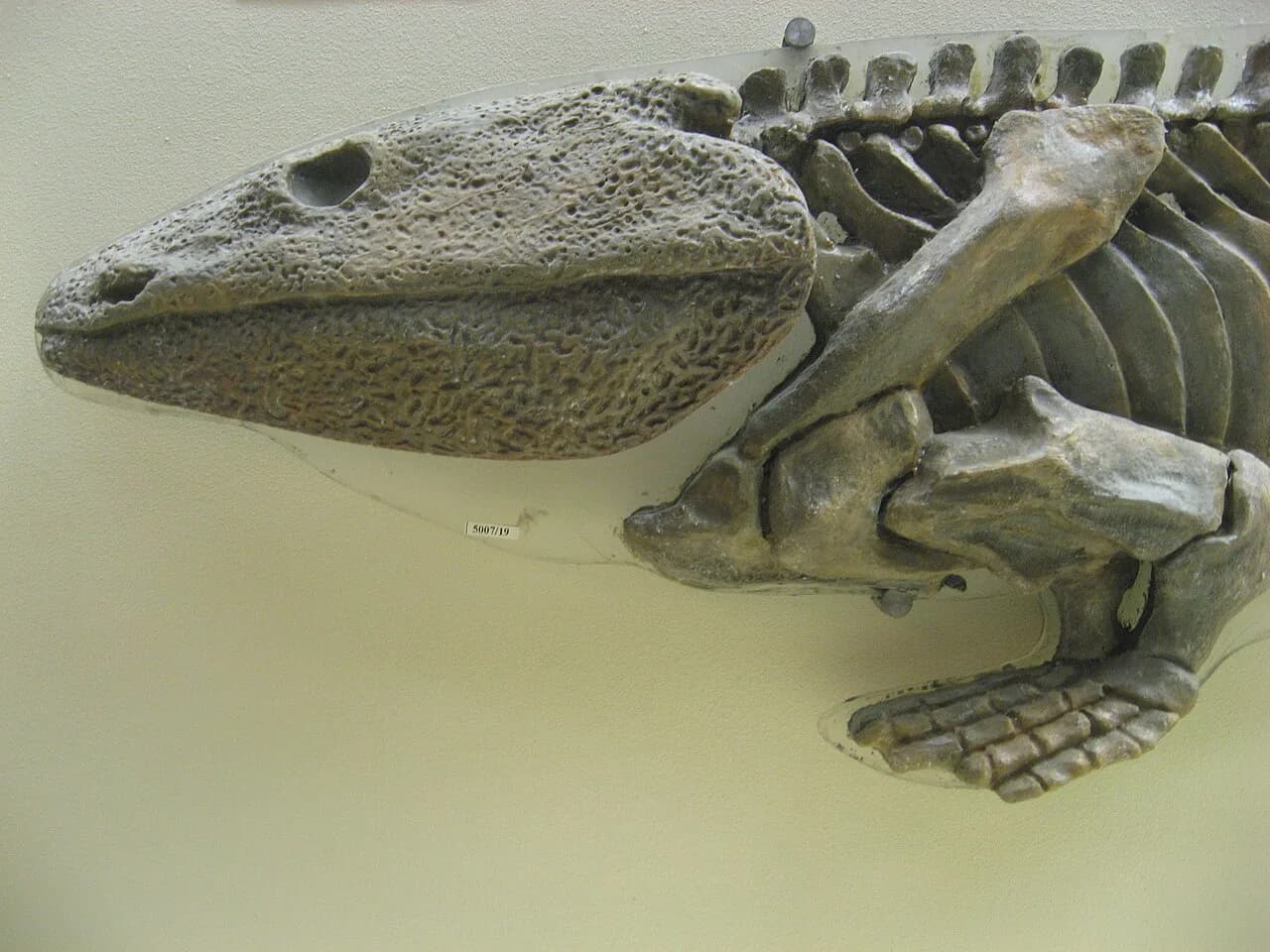
Ichthyostega
Ichthyostega stensioei carried seven toes on each hind foot. That discovery showed the five-digit tetrapod plan was not the original template but a simplification that came later. About 1.5 metres long and 10 to 20 kilograms, described in 1932 in eastern Greenland, it lived 365 million years ago, at the very start of the move onto land.
Ichthyostega lived during the Late Devonian, approximately 365 million years ago, at a pivotal moment in the history of life on Earth: the transition of vertebrates from water to land. This notable animal is one of the very first known tetrapods, meaning one of the first vertebrates to possess limbs with digits rather than fins. It belongs to the stegocephalian group, those primitive amphibians that represent the evolutionary bridge between lobe-finned fishes (sarcopterygians) and terrestrial vertebrates. Ichthyostega lived in the shallow coastal waters and swamps of eastern Greenland, which at that time was located in the tropics, bathed in a warm and humid climate. Its existence bears witness to one of the most spectacular ecological transitions in evolution: the conquest of dry land by vertebrates.
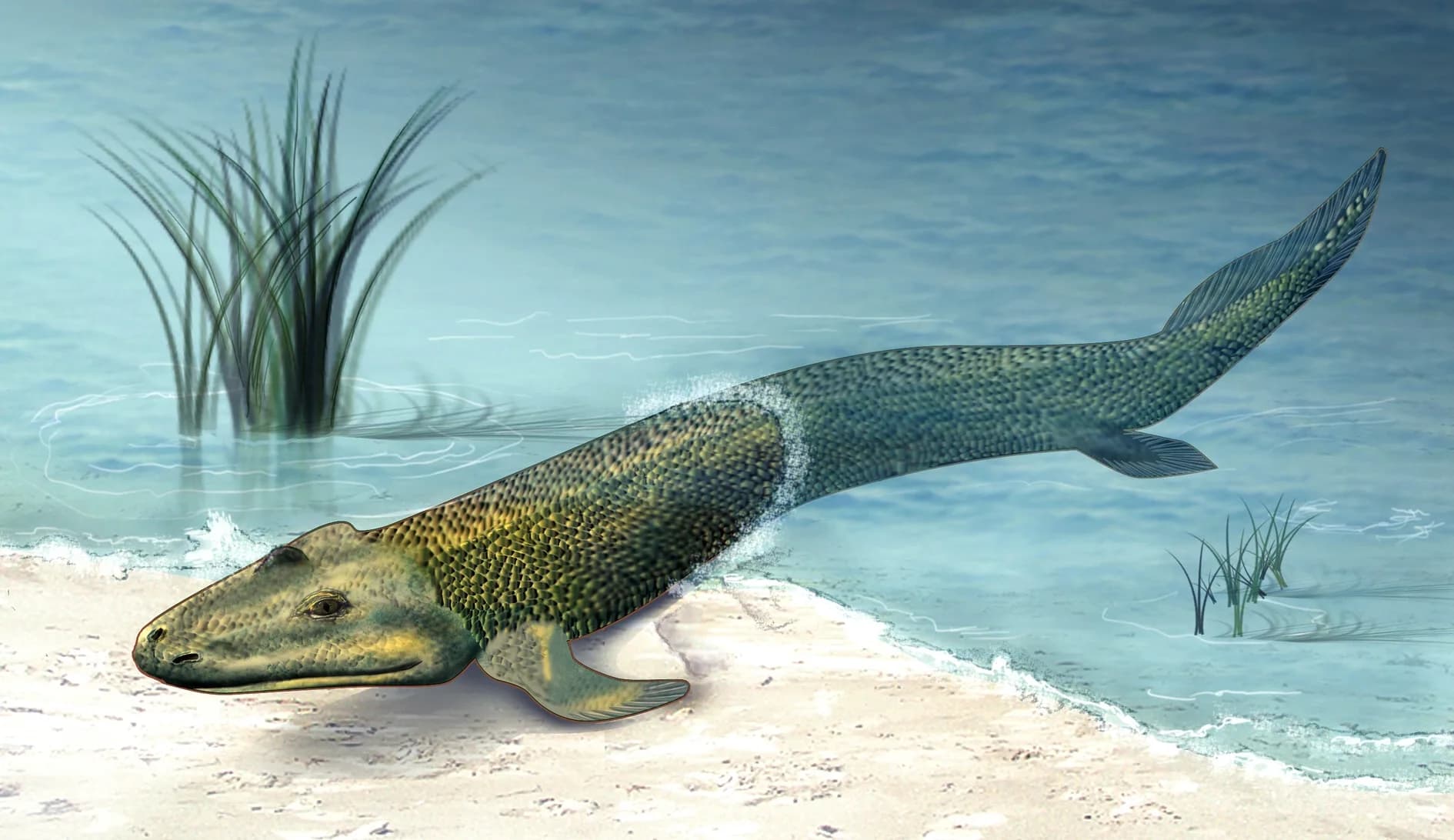
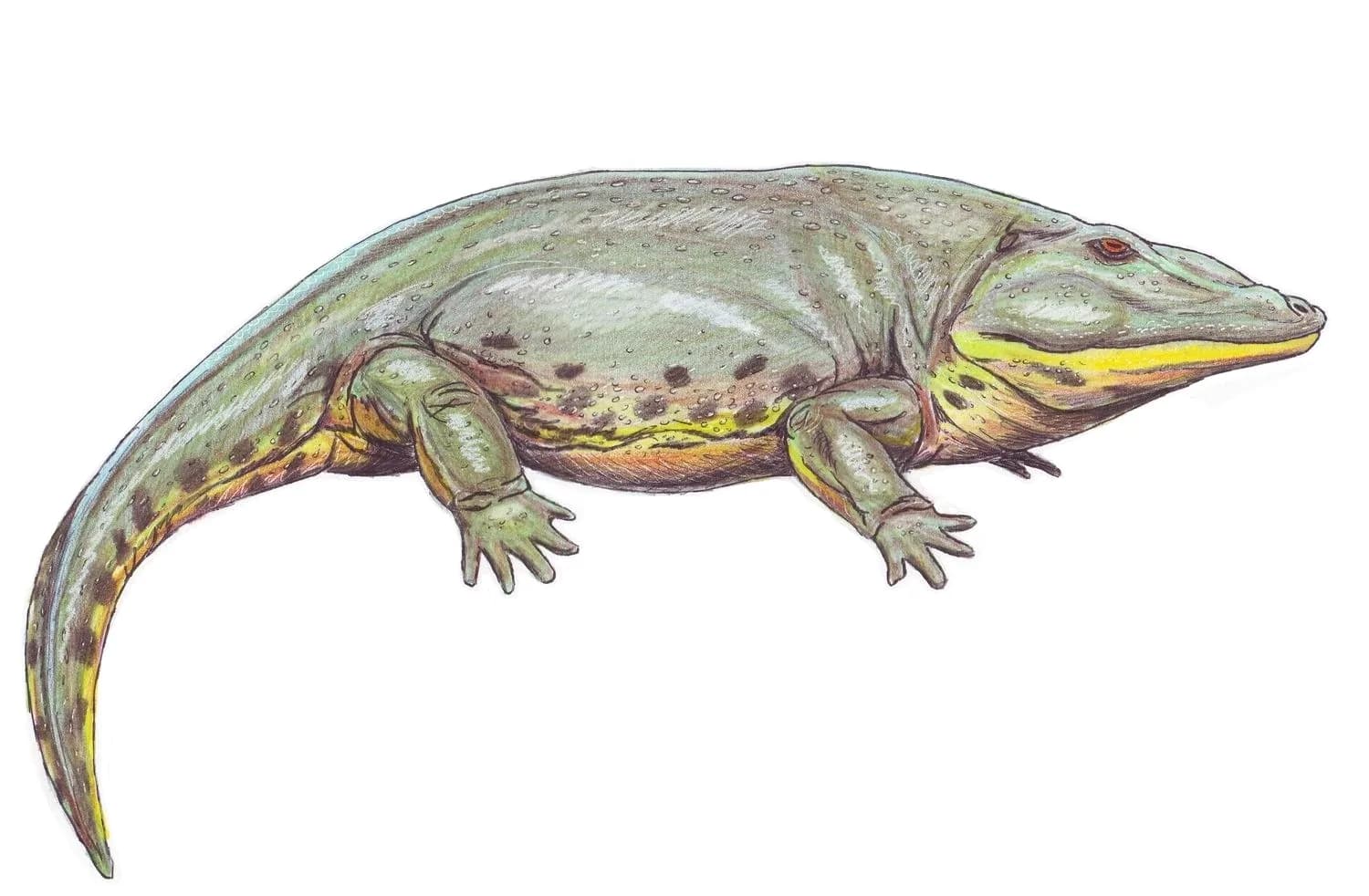
Ichthyostega measured approximately 1.5 meters in total length, making it one of the largest primitive tetrapods of its time — significantly more imposing than its contemporary Acanthostega, which barely exceeded 60 centimeters. Its massive, robust body was supported by powerful limbs, particularly the forelimbs which were well-developed and adapted to support its weight out of water. Its hind limbs, however, were shorter and paddle-shaped, better suited for swimming than terrestrial walking. The estimated weight of the animal ranged between 10 and 20 kilograms, a considerable mass for a primitive amphibian. Its silhouette resembled that of a giant salamander equipped with a fish tail, an extraordinary mix of aquatic and terrestrial characteristics.
Ichthyostega was a carnivore that fed primarily on fish and other aquatic prey in the shallow waters of the Late Devonian. Its wide mouth was lined with pointed conical teeth, typical of ambush predators that capture prey through suction and rapid biting. The arrangement of teeth on the jaws and palate suggests it practiced a feeding style similar to modern crocodilians, snapping up fish that ventured too close. Analyses of cranial morphology indicate that its jaw could exert significant bite force, sufficient to capture and retain slippery prey such as the armored fishes of the Devonian. It probably hunted by ambush in shallow waters, using its dorsal eyes to spot prey at the surface.
Ichthyostega inhabited the coastal swampy environments and shallow waters of eastern Greenland during the Late Devonian, approximately 365 million years ago. At that time, Greenland bore no resemblance to today's frozen desert: it was located in the tropics, near the equator, and enjoyed a warm, humid climate with average temperatures well above current conditions. The environment consisted of coastal lagoons, winding rivers, floodplains, and swamps bordered by primitive vegetation including giant ferns and arborescent lycopsids. These habitats offered an abundance of food in the form of fish and aquatic invertebrates, while providing transition zones between aquatic and terrestrial environments ideal for an animal in the process of conquering dry land.
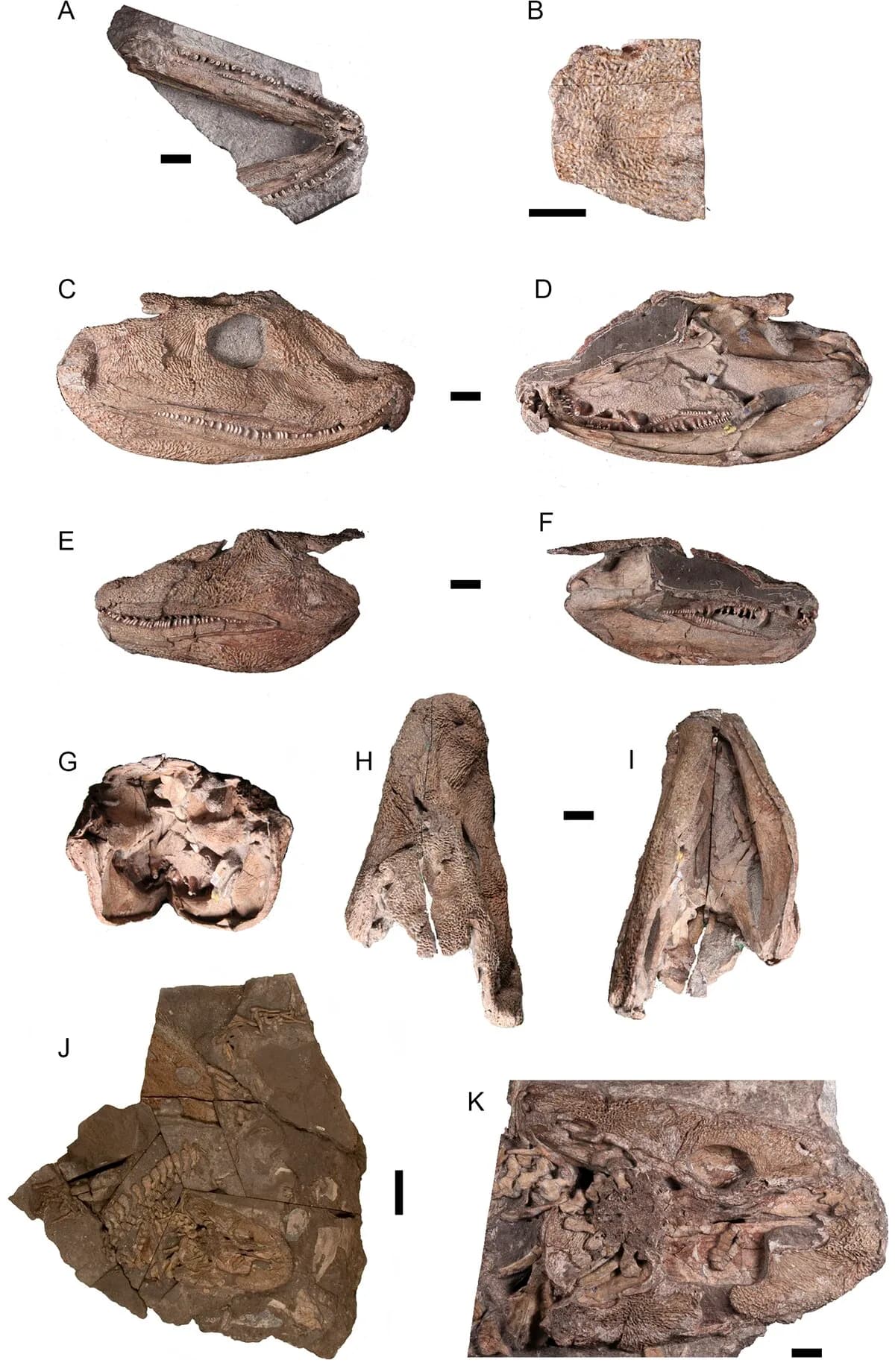
The anatomy of Ichthyostega presents a remarkable mixture of aquatic and terrestrial features that makes it a true 'transitional fossil.' One of its most surprising peculiarities is the presence of seven digits on each hind foot — not five as in most modern tetrapods, which revolutionized our understanding of limb evolution. Its forelimbs were robust and well-articulated, capable of supporting its weight on dry land, while its hind limbs, shorter and paddle-shaped, were better adapted for aquatic propulsion. Its tail retained dermal fin rays (lepidotrichia) identical to those of fish fins, a clearly piscine vestige. Its ribs were exceptionally broad and overlapped one another, forming a sort of 'bony corset' that supported its body out of water and protected its internal organs from being crushed by gravity.
Ichthyostega could crawl on dry land in a manner reminiscent of a modern seal, primarily using its powerful forelimbs to haul itself out of the water and drag itself along shorelines. Detailed biomechanical analyses performed using CT scanning revealed that its gait did not resemble that of a walking salamander, but rather that of a seal propelling itself on its belly. It is considered one of the very first animals to have left aquatic environments to venture onto dry land, although its lifestyle remained primarily aquatic. It probably spent the majority of its time in the water, only emerging onto shore to rest, escape aquatic predators, or exploit new terrestrial food resources. Its ability to breathe atmospheric air, combined with its probably permeable skin, allowed brief but significant excursions out of the water.
The first fossils of Ichthyostega were discovered in eastern Greenland and described in 1932 by Swedish paleontologist Gunnar Säve-Söderbergh, making it one of the first primitive tetrapods ever identified by science. The animal quickly became an icon of paleontology, often presented as 'the first land animal' in textbooks and documentaries. However, modern studies using computed tomography (CT scanning) have considerably nuanced this image. In 2005, the work of Per Ahlberg and Jennifer Clack revealed the presence of seven digits on the hind feet, challenging the idea that five digits was the ancestral number for tetrapods. CT scans also demonstrated that Ichthyostega did not walk at all as previously imagined: its overlapping ribs and vertebral structure indicated locomotion closer to a seal than a salamander. These major revisions show how a fossil famous for nearly a century can still hold surprises.
| Period | Dévonien supérieur / Late Devonian |
| Era | Paléozoïque / Paleozoic |
| Age | 365 Ma |
| Location | Est du Groenland / East Greenland |
| Length | ~1,5 m |
| Height | 25 cm |
| Weight | 10-20 kg (estimé / estimated) |
| Diet | Piscivore |
| Discovery | 1932 |
Ichthyostega stensioei was neither a dinosaur nor a fish. It was one of the earliest known tetrapods, a stegocephalian from the Late Devonian (about 365 million years ago), representing an evolutionary intermediate between lobe-finned fishes (sarcopterygians) and terrestrial vertebrates. It predates dinosaurs by 165 million years.
Ichthyostega stensioei had seven toes on each hind foot, according to CT-scan analyses published in 2005 by Per Ahlberg and Jennifer Clack. This discovery overturned the idea that five digits was the ancestral tetrapod plan — it was in fact a later evolutionary simplification in vertebrate history.
Ichthyostega stensioei did not walk like a salamander. Biomechanical CT-scan analyses showed that its overlapping ribs and vertebral structure imposed locomotion similar to a modern seal — a belly-dragging motion powered by the forelimbs. Its paddle-shaped hind limbs, better suited for swimming, played a secondary role in terrestrial locomotion.
Ichthyostega illustration
Nobu Tamura, Wikimedia Commons
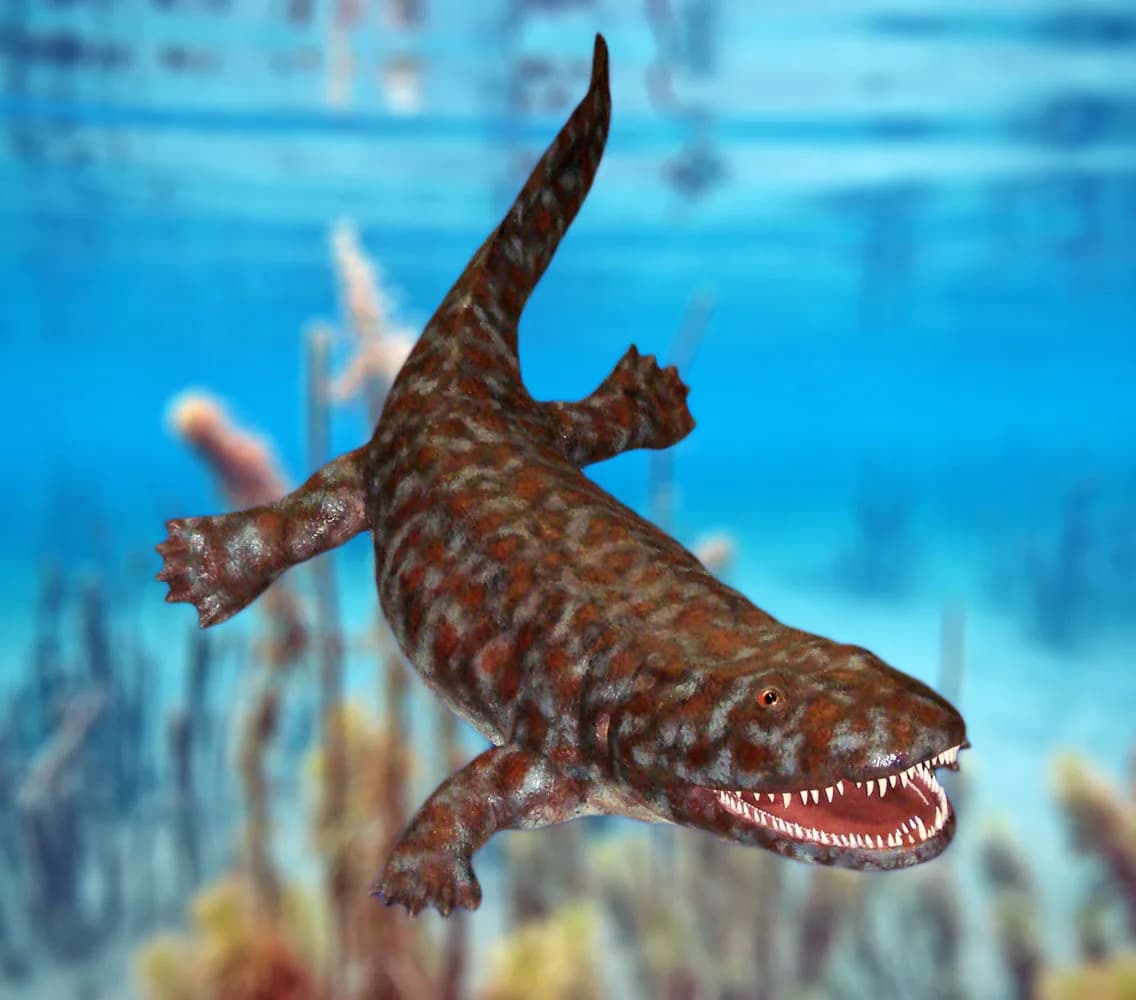
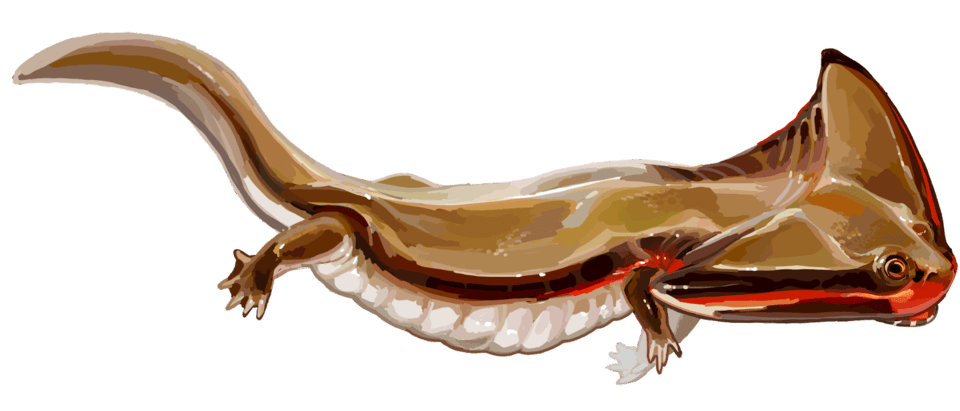
Ichthyostega model
Wikimedia Commons