Acanthostega
Acanthostega gunnari was an early tetrapod from East Greenland, described in 1933 and dated to 365 million years ago. Around 60 centimetres long and 1 to 2 kilograms, it carried eight digits on each hand — evidence that five is not an original plan but a later reduction. Despite its limbs, it kept functional internal gills.
Acanthostega lived during the Late Devonian, approximately 365 million years ago (Famennian), at a pivotal period in the history of life on Earth when vertebrates were just beginning their transition from aquatic environments to dry land. This era is often called the 'Age of Fishes,' as oceans, lakes, and rivers teemed with an extraordinary diversity of lobe-finned and ray-finned fishes. The Late Devonian was marked by major extinction events, notably the Frasnian-Famennian extinction, which disrupted marine and freshwater ecosystems. It was in this context of profound environmental and ecological changes that Acanthostega evolved, representing one of nature's earliest attempts to develop limbs with digits in vertebrates.
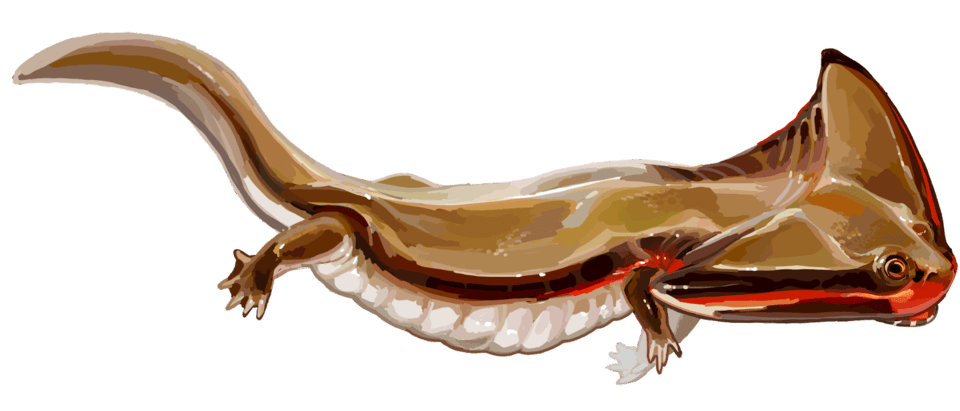
Acanthostega measured approximately 60 centimeters in total length, making it a relatively small animal compared to some of its contemporaries such as Ichthyostega, which could reach one meter. Despite its modest size, Acanthostega is one of the most important animals in the entire evolutionary history of vertebrates. Its elongated, fusiform body presented a noteworthy mixture of aquatic and terrestrial features: a laterally flattened tail equipped with fin rays like a fish, limbs bearing true digits, and a relatively wide, flattened skull typical of early tetrapods. Its weight is estimated at approximately one to two kilograms, similar to that of a large modern salamander.
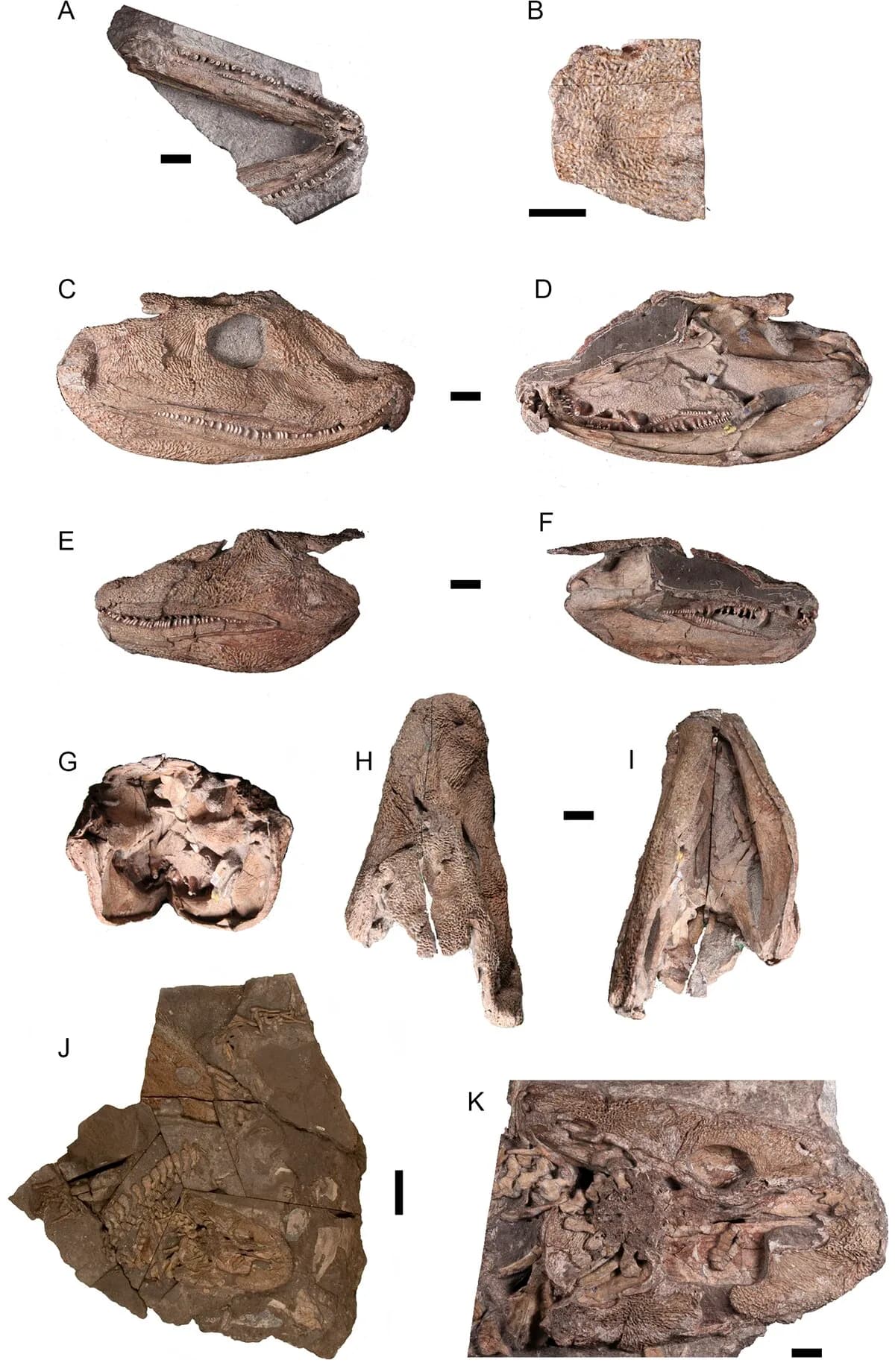
Acanthostega was an aquatic carnivore that fed primarily on small fish and invertebrates inhabiting the freshwaters of the Late Devonian. Its dentition, composed of small pointed conical teeth arranged in rows on the jaws and palate, was perfectly adapted for capturing slippery prey in water. The shape of its skull, wide and slightly flattened, with relatively short but powerful jaws, suggests a hunting technique involving suction and rapid biting, similar to that of modern aquatic salamanders. Devonian waters teemed with potential prey, including primitive fish, crustaceans, worms, and various aquatic arthropods.
Acanthostega inhabited shallow freshwater environments of the Late Devonian, in what is now eastern Greenland. At that time, Greenland was located much farther south than today, in a tropical to subtropical zone, and harbored lush freshwater ecosystems composed of meandering rivers, swamps, and shallow lakes bordered by dense vegetation of primitive plants. These aquatic environments were warm, shallow, and clogged with submerged vegetation, providing an ideal habitat for an ambush predator like Acanthostega. The sediments in which its fossils were found indicate low-energy fluvial environments with seasonal floodplains.
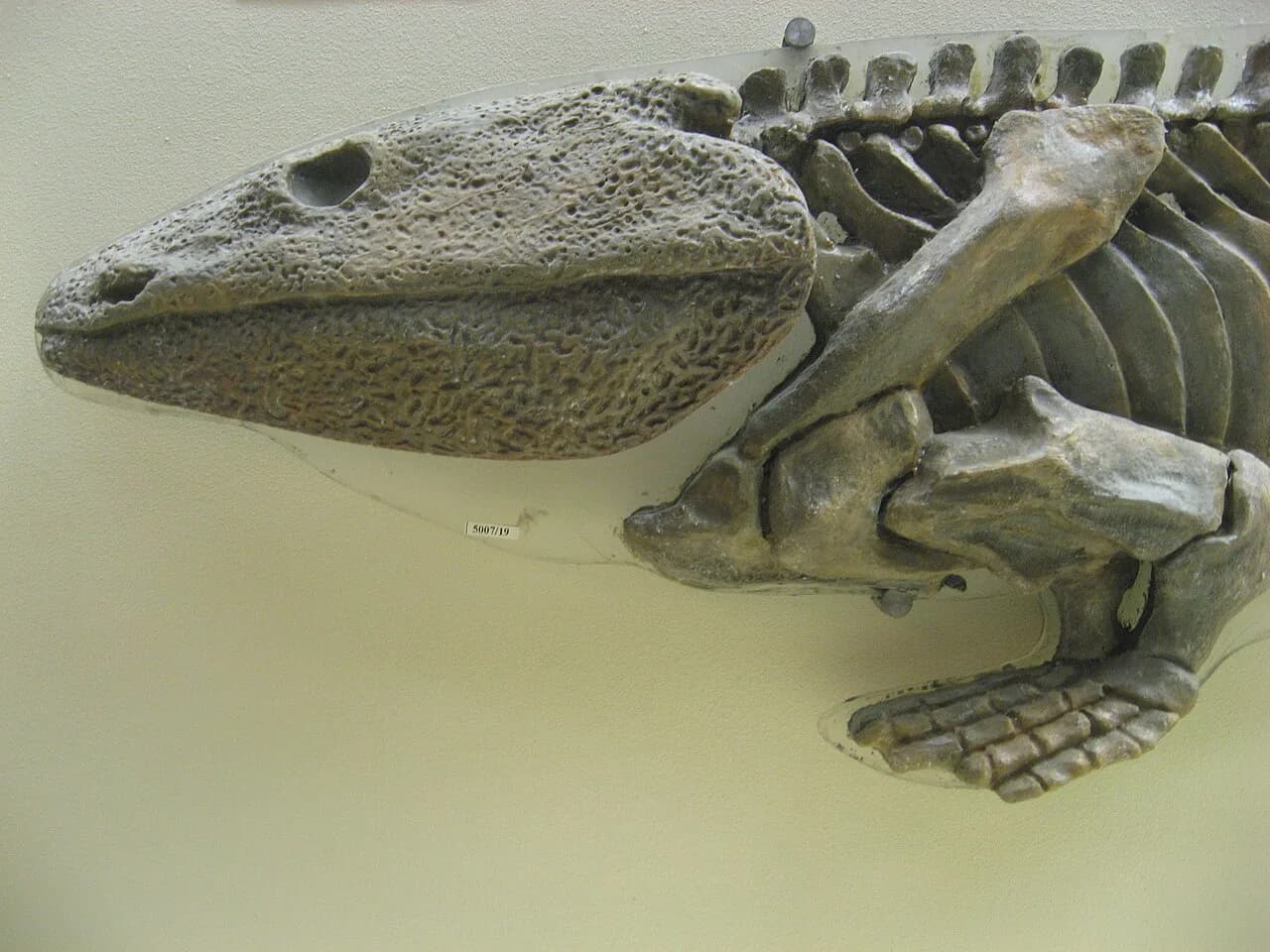
The anatomy of Acanthostega is absolutely extraordinary and revolutionized our understanding of tetrapod evolution. Its most famous feature is the presence of eight digits on each forelimb — not five like most modern tetrapods. This stunning discovery demonstrated that the five-fingered body plan (pentadactyly), long considered ancestral, was in reality only a secondary reduction from a higher initial number of digits. Acanthostega also retained functional internal gills, visible through the presence of branchial grooves on the skull bones, proving it could still breathe underwater despite the presence of primitive lungs. Its tail bore dermal fin rays (lepidotrichia) like that of a fish, forming a laterally flattened caudal fin. Its limbs, though equipped with digits, were not robust enough to support its weight out of water.
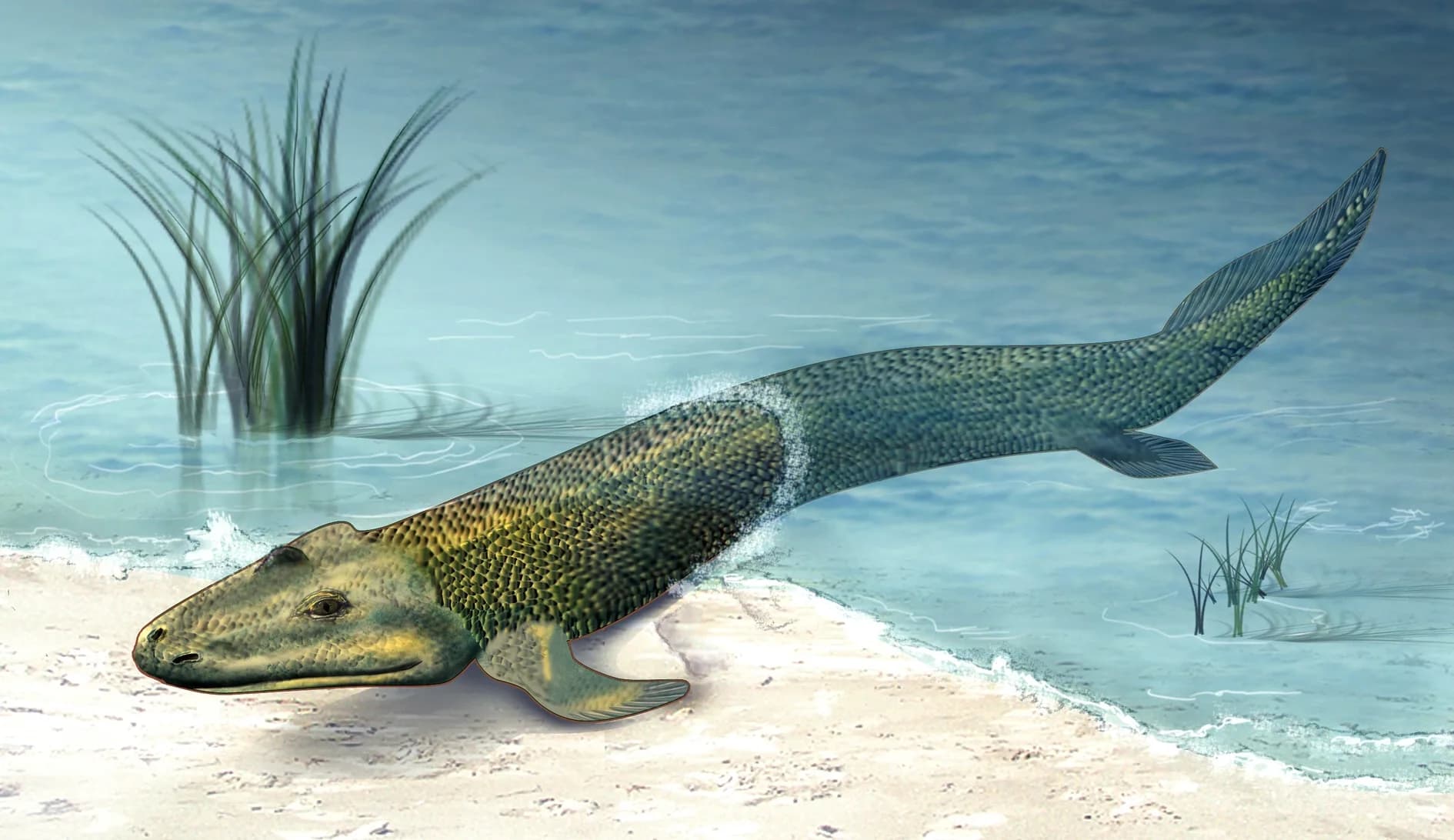
Despite having four limbs equipped with digits, Acanthostega was an essentially aquatic animal that spent virtually its entire life in water. Its limbs were not designed for terrestrial walking: the wrist and ankle joints were not strong enough to support body weight out of water, and the ribcage lacked the robustness necessary to prevent the lungs from collapsing under terrestrial gravity. Acanthostega probably used its eight-fingered limbs to navigate through the dense aquatic vegetation of Devonian swamps, gripping submerged stems and roots to propel and stabilize itself in currents. This lifestyle reveals that tetrapod limbs evolved for aquatic locomotion, not for terrestrial walking as was previously believed.
Acanthostega fossils were first discovered in eastern Greenland in 1933 by Danish geologists Gunnar Säve-Söderbergh and Erik Jarvik, but it was not until 1987 that British paleontologist Jennifer Clack led a revolutionary expedition that collected much more complete specimens. Clack's work on Acanthostega radically transformed our understanding of the fish-to-tetrapod transition. Her detailed description of the eight-fingered limbs, published in 1990, sent shockwaves through the paleontological world: it proved that digits had evolved in water, not on dry land, overturning a dogma over a century old. Jennifer Clack devoted much of her career to the study of Acanthostega and early tetrapods, becoming one of the most influential paleontologists of the twentieth century.
| Period | Dévonien supérieur / Late Devonian |
| Era | Paléozoïque / Paleozoic |
| Age | 365 Ma |
| Location | Est du Groenland / East Greenland |
| Length | ~60 cm |
| Height | 10 cm |
| Weight | 1-2 kg (estimé / estimated) |
| Diet | Piscivore |
| Discovery | 1933 |
Acanthostega gunnari had eight digits on each forelimb — not five. This discovery, published by Jennifer Clack in 1990, proved that pentadactyly (five fingers) is not an ancestral plan but a secondary reduction. Digits therefore evolved in water before being adapted for terrestrial walking, overturning a century-old scientific dogma.
No: despite its four-limbed body, Acanthostega gunnari was essentially aquatic. Its wrist and ankle joints were not robust enough to support its weight (1-2 kg) out of water. It used its limbs to navigate submerged vegetation in Devonian swamps of Greenland, where its fossils were found approximately 365 million years ago.
Acanthostega gunnari could do both: it retained functional internal gills visible through branchial grooves on skull bones, while also possessing primitive lungs. This dual respiratory capacity confirms its status as a transitional form between lobe-finned fish and the first terrestrial tetrapods, during the Famennian age (Late Devonian).
Acanthostega gunnari illustration
Nobu Tamura, Wikimedia Commons
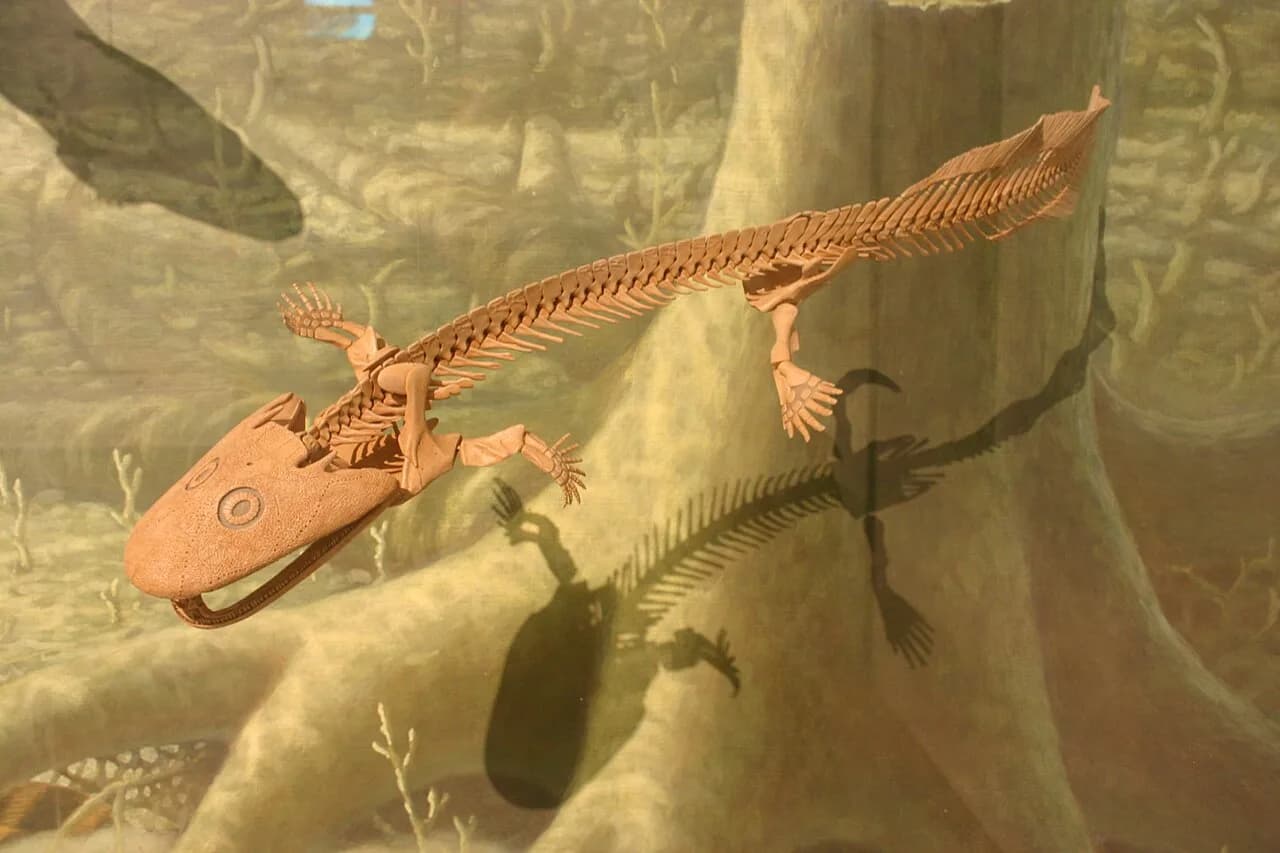
Acanthostega gunnari reconstruction
Wikimedia Commons