Entélodonte
Entelodon magnus was an entelodont from Europe and Asia, described in 1848 and present 37 to 28 million years ago. At 2.5 metres and 400 to 500 kilograms, it was only a distant cousin of modern pigs, despite the hell pig nickname. Its skulls carry fight scars so deep they look like weapon strikes.
Entelodon lived during the late Eocene and Oligocene, approximately 37 to 28 million years ago, in Eurasia. This ungulate mammal belongs to the family Entelodontidae, nicknamed 'hell pigs' or 'terminator pigs' due to their terrifying appearance, although they are only distant relatives of modern pigs. Entelodonts represent one of the most singular mammalian groups of the Paleogene, combining traits of active predator, scavenger, and omnivore in a massive and powerful body. The genus Entelodon was the first described in this family, named in 1848 by French naturalist Aymard from fossils discovered in France. The Oligocene, a period of global climatic cooling, saw entelodonts thrive in the open forests and emerging grasslands of Europe and Asia, before their decline and replacement by true carnivores in the Miocene.
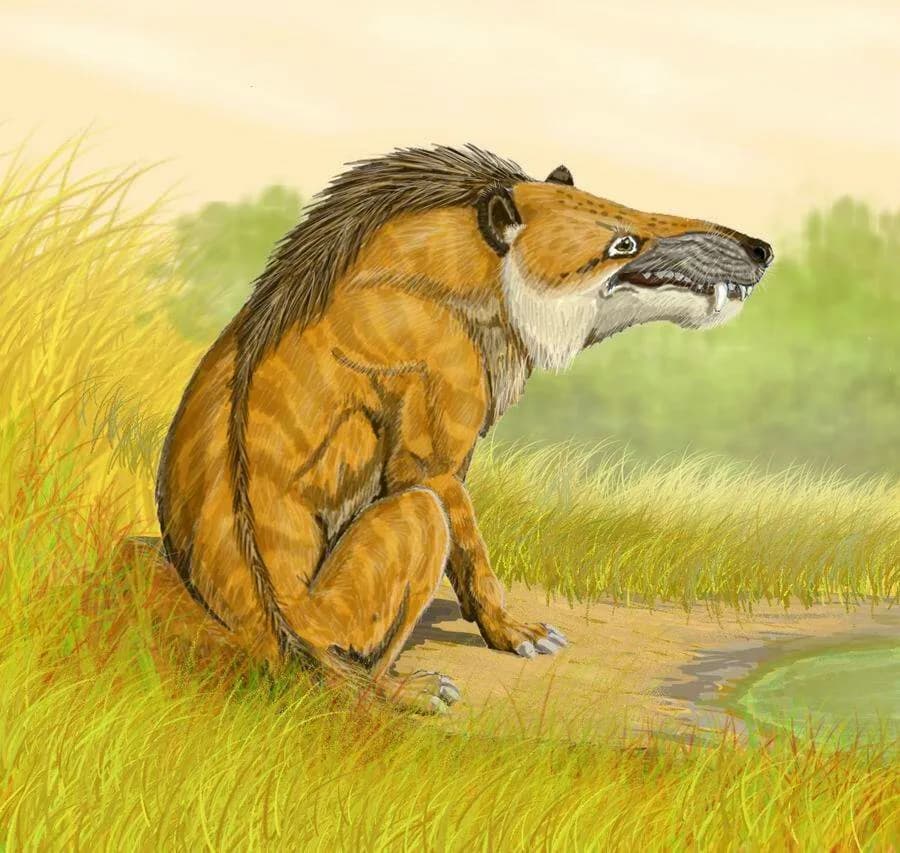
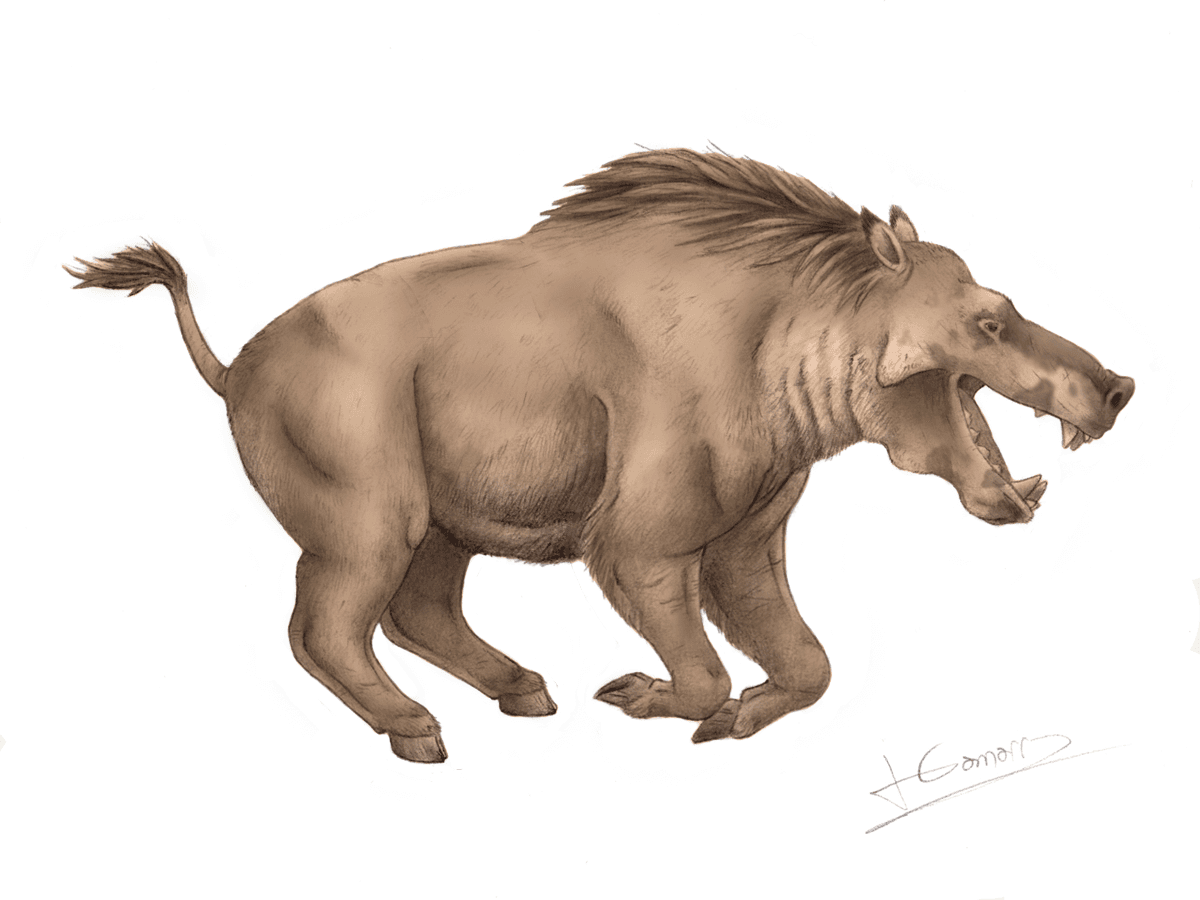
Entelodon magnus, the type species, was an imposing animal the size of a modern bison. It measured approximately 2.5 meters long and reached 1.3 meters at shoulder height, with an estimated weight between 400 and 500 kilograms. Its skull was disproportionately enormous relative to its body, measuring up to 65 centimeters long, equipped with characteristic lateral bony protuberances below the eyes and on the lower jaw. These growths gave its head a particularly frightening and unique appearance among mammals. Its North American relative Daeodon (formerly Dinohyus) was even larger, reaching 1.8 meters at the shoulder and weighing up to 900 kilograms. Entelodon's legs were surprisingly long and slender for such a massive animal, ending in two functional toes like modern deer.
Entelodon was an opportunistic omnivore with strong carnivorous and scavenging tendencies. Its dentition reveals a remarkable mix: massive incisors and canines capable of tearing flesh and crushing bones, combined with grinding molars adapted for vegetation. Stable isotope studies of entelodont teeth reveal a mixed diet including meat, plants, roots, and likely carrion. Tooth marks found on fossil bones of other Oligocene mammals, notably primitive rhinoceroses and camels, match Entelodon's dental profile, confirming its role as an active predator or scavenger. Some paleontologists compare its feeding lifestyle to that of the modern brown bear: a powerful omnivore capable of active hunting but often preferring the most easily accessible resources, including stealing prey from other predators (kleptoparasitism).
Entelodon occupied open forests, grasslands, and wetlands across Europe and Asia during the Oligocene. The main fossil sites are found in France (notably in the Quercy phosphorites and sedimentary basins of the Massif Central), Germany, Spain, and Central Asia. During the Oligocene, Europe was an archipelago of islands and peninsulas with a temperate to subtropical climate, dotted with lakes, rivers, and sparse forests — an ideal environment for a large opportunistic omnivore. The transition from dense Eocene forests to the more open Oligocene habitats favored entelodonts, whose long legs were adapted for rapid movement in open terrain. Wetlands and riverbanks, rich in vegetation and small animals, likely constituted preferred habitats.
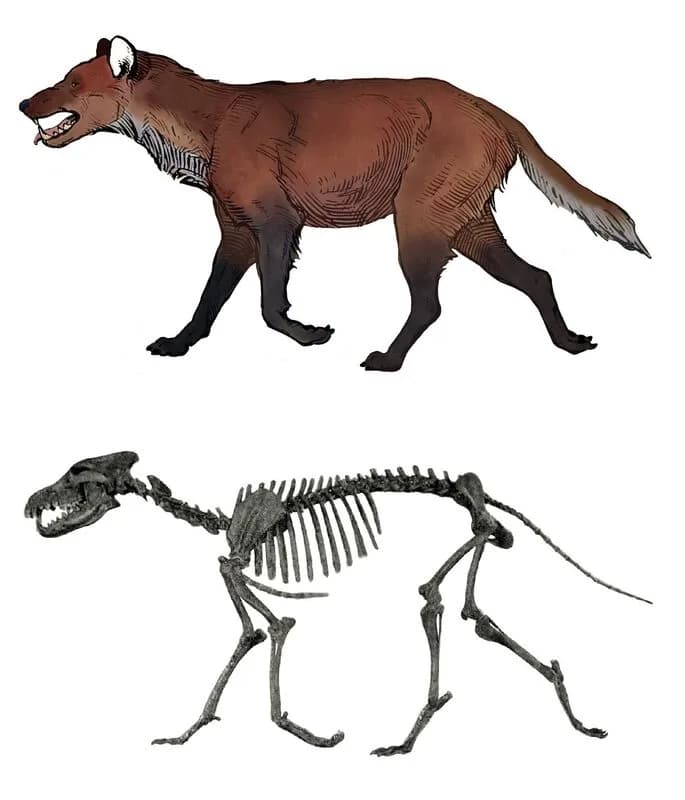
Entelodon's anatomy presented a unique mix of predatory and herbivorous characteristics. Its massive skull, the genus's most distinctive trait, bore prominent bony bumps (jugal and mandibular processes) whose function remains debated: sexual signals, intraspecific combat, or anchorage for hypertrophied jaw muscles. Its canines were enormous and pointed, while its premolars featured cutting edges capable of slicing meat, and its molars were more blunted for plant grinding. Its jaw musculature, anchored on a developed sagittal crest and widened zygomatic processes, gave it bite force comparable to that of a large cat. Its body was carried on relatively long and gracile limbs for its mass, each ending in two main toes (didactyl), an adaptation for running in open terrain. Its robust spine supported a muscular back and a powerful neck capable of violently shaking prey.
Entelodon's behavior is reconstructed from several striking lines of fossil evidence. Skulls showing healed injuries — bites, perforations, and fractures — testify to violent intraspecific fights, likely between males for territory or female access. These injuries, primarily located on the bony bumps of the skull and jaw, suggest these structures served as 'bumpers' during head-to-head confrontations. Bone accumulation sites, called 'bone caches,' have been found in burrows associated with entelodont remains, indicating food-caching behavior similar to modern hyenas. Entelodon likely practiced kleptoparasitism, using its imposing size to intimidate and drive other predators from their kills. Its running speed, estimated at 40-50 km/h thanks to its long legs, made it a surprisingly agile predator for its mass.
The first Entelodon fossils were discovered in France in the 1840s and described by naturalist Aymard in 1848. The name Entelodon means 'perfect tooth' (Greek: enteles 'complete, perfect' + odous 'tooth'), referring to its complete and unspecialized dentition. The Quercy phosphorites in southwestern France have yielded numerous remarkably preserved specimens, including complete skulls with bony pathologies documenting intraspecific combat. In Germany, Oligocene deposits in Thuringia and Saxony have produced partial skeletons allowing reconstruction of the animal's posture and locomotion. Other entelodont species have been found in North America (Archaeotherium, Daeodon) and Asia (Paraentelodon), demonstrating this family's worldwide distribution. The discovery of 'bone caches' — deliberate bone accumulations in burrows — associated with entelodont teeth constitutes some of the oldest evidence of food-caching behavior in mammals.
| Period | Éocène supérieur — Oligocène / Late Eocene — Oligocene |
| Era | Cénozoïque / Cenozoic |
| Age | 37 - 28 Ma |
| Location | Europe et Asie (France, Allemagne, Asie centrale) / Europe and Asia (France, Germany, Central Asia) |
| Length | 2.5 m |
| Height | 1.3 m (au garrot / at shoulder) |
| Weight | 400 - 500 kg |
| Diet | Omnivore |
| Discovery | 1848 |
Entelodon magnus measured about 2.5 meters long and weighed 400 to 500 kilograms, standing 1.3 meters at the shoulder — comparable to a modern bison. Its disproportionately large skull reached 65 centimeters in length, adorned with characteristic lateral bony protuberances below the eyes. Its North American relative Daeodon was even more massive, weighing up to 900 kg.
Entelodon magnus was an opportunistic omnivore with strong carnivorous tendencies. Its tooth marks have been found on bones of primitive rhinoceroses and Oligocene camels, confirming an active role as predator or scavenger. Its lifestyle resembled the modern brown bear: able to hunt actively, but also to steal prey from other predators (kleptoparasitism), and to cache food in burrows.
Entelodon magnus lived from approximately 37 to 28 million years ago (Late Eocene to Oligocene) across Europe and Asia. The most significant fossils come from the Quercy phosphorites in France and Oligocene deposits in Germany. The genus was described in 1848 by naturalist Aymard based on material discovered in France.
Reconstruction of Entelodon magnus, the 'hell pig' of the European Oligocene
Concavenator, CC BY-SA 4.0
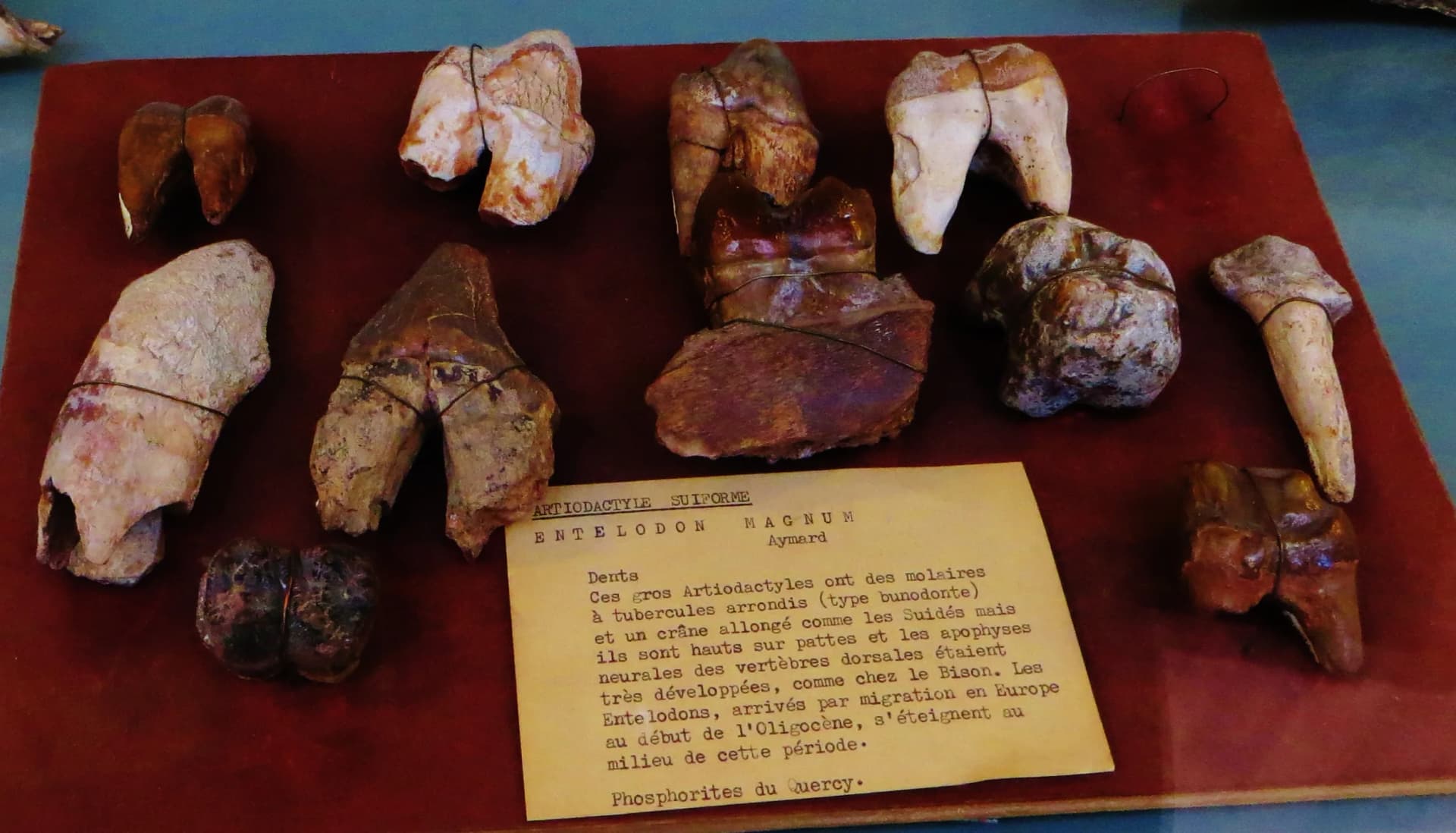
Fossil skull of Entelodon magnum showing the characteristic bony protuberances
Ghedoghedo, CC BY-SA 3.0