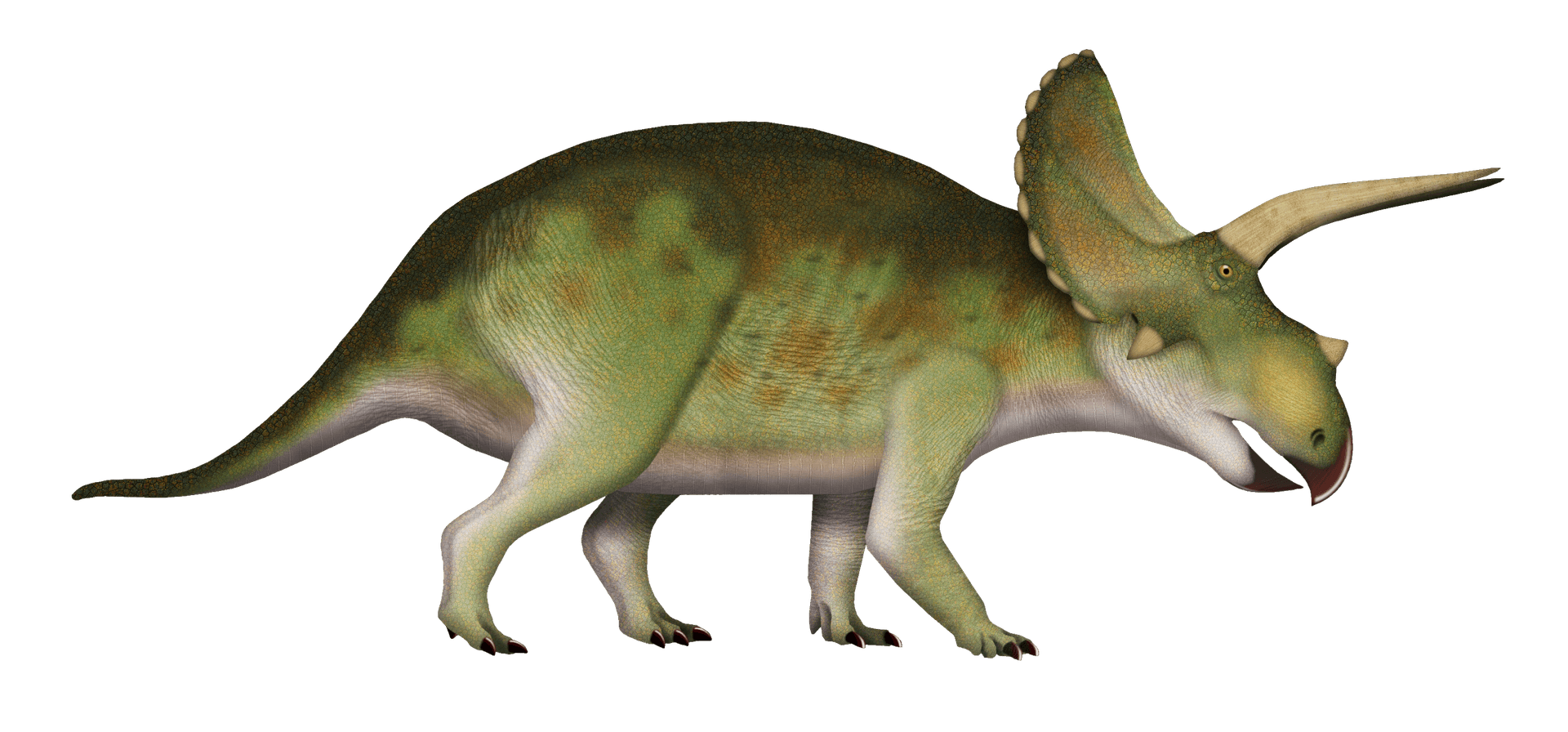
Éotriceratops
Eotriceratops xerinsularis is a ceratopsian 8.5 to 9 metres long and 9 to 10 tonnes, described in 2007 in Alberta and dated to around 67.6 million years ago. Its name means « dawn three-horned face »: it precedes Triceratops by a few hundred thousand years. Its skull is proportionally larger, which at first led to overestimates of its total size.
Playable in Path of Titans
See Eotriceratops xerinsularis's stats, abilities and role on our survival server.
Eotriceratops xerinsularis lived in the Late Cretaceous, during the early Maastrichtian, approximately 67.6 million years ago. At that time, North America formed an island-continent known as Laramidia, separated from Appalachia by the Bearpaw Seaway. Present-day Alberta was then a vast deltaic lowland bordering this inland sea, with a warm, humid subtropical climate. Eotriceratops shared its environment with herbivores such as Edmontosaurus and formidable predators including the tyrannosaurids characteristic of the Horseshoe Canyon Formation.
The species was formally described in 2007 by Wu Xiao-Chun, Brinkman, Eberth, and Braman, based on a partial skull recovered from the Horseshoe Canyon Formation in Alberta, Canada. The generic name literally means 'dawn three-horned face' — the Greek prefix eos (dawn, aurora) combined with triceratops — underscoring its early phylogenetic position in the lineage leading to Triceratops. The specific epithet xerinsularis refers to the paleogeography of Laramidia. This partial skull constitutes the bulk of described material to date, though additional fragments have been reported from the same formation.
For some time, Eotriceratops was presented as one of the largest known ceratopsids, with some estimates suggesting up to 9 meters in length and 12 tonnes in weight. These figures relied on the raw size of the skull, which is proportionally larger relative to body size than that of Triceratops. More recent revisions accounting for cranial allometry in chasmosaurines place revised estimates at approximately 8.5 to 9 meters in length and around 9 to 10 tonnes. The bony frill extending the skull posteriorly was massive, contributing to the initial impression of gigantism. By comparison, Triceratops horridus reached 8 to 9 meters and 8 to 12 tonnes depending on the individual.
Like all ceratopsids, Eotriceratops was a strict herbivore. Its toothless parrot-like beak efficiently cropped tough vegetation — tree ferns, primitive palms, and low-growing angiosperms. Its rows of cheek teeth, tightly packed into dental batteries, sheared and sliced coarse plant fibers with remarkable efficiency. This dental system, unique to derived ceratopsids, allowed them to process plants unavailable to other herbivores. The low position of the head relative to the ground indicates a preference for understory vegetation, in contrast to sauropods browsing at height.
Eotriceratops is known from the Horseshoe Canyon Formation, a geological unit in south-central Alberta dating to the early Maastrichtian (~68–67 Ma). This environment corresponded to a coastal swampy lowland, crossed by river channels and bordered to the east by the Bearpaw Sea. The dominant vegetation included conifer forests, angiosperms in full evolutionary radiation, and open alluvial plains. Marked seasonal conditions alternated between wet seasons with flooding and drier periods. Eotriceratops shared this space with Edmontosaurus, Anchiceratops, Arrhinoceratops, and the tyrannosaurids that then dominated Laramidian ecosystems.
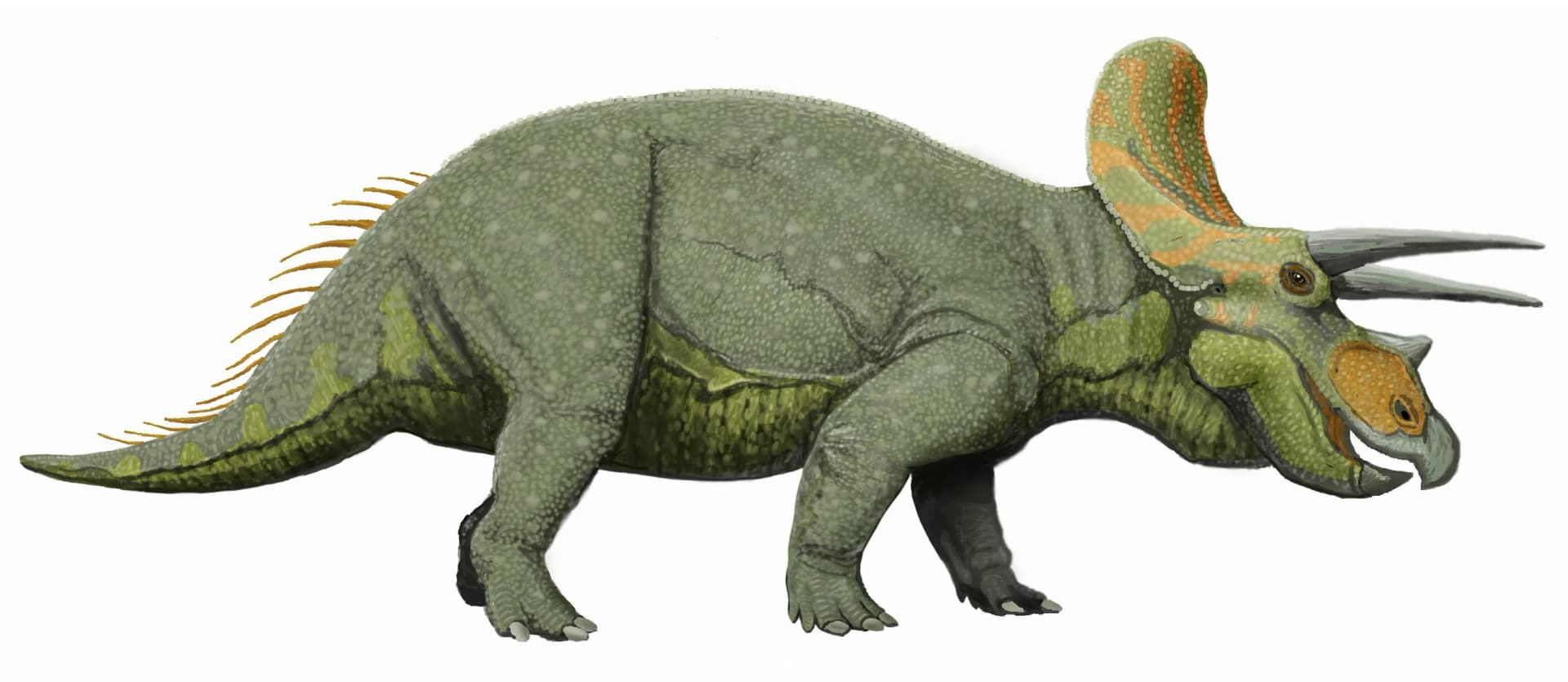
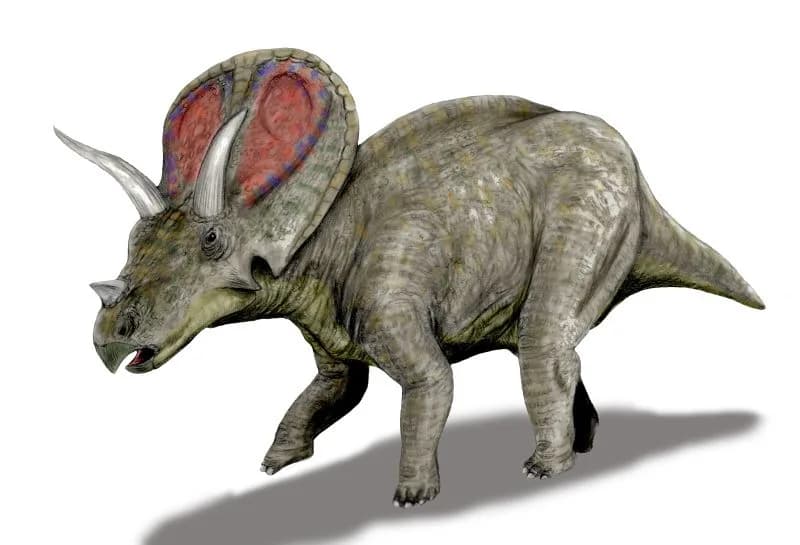
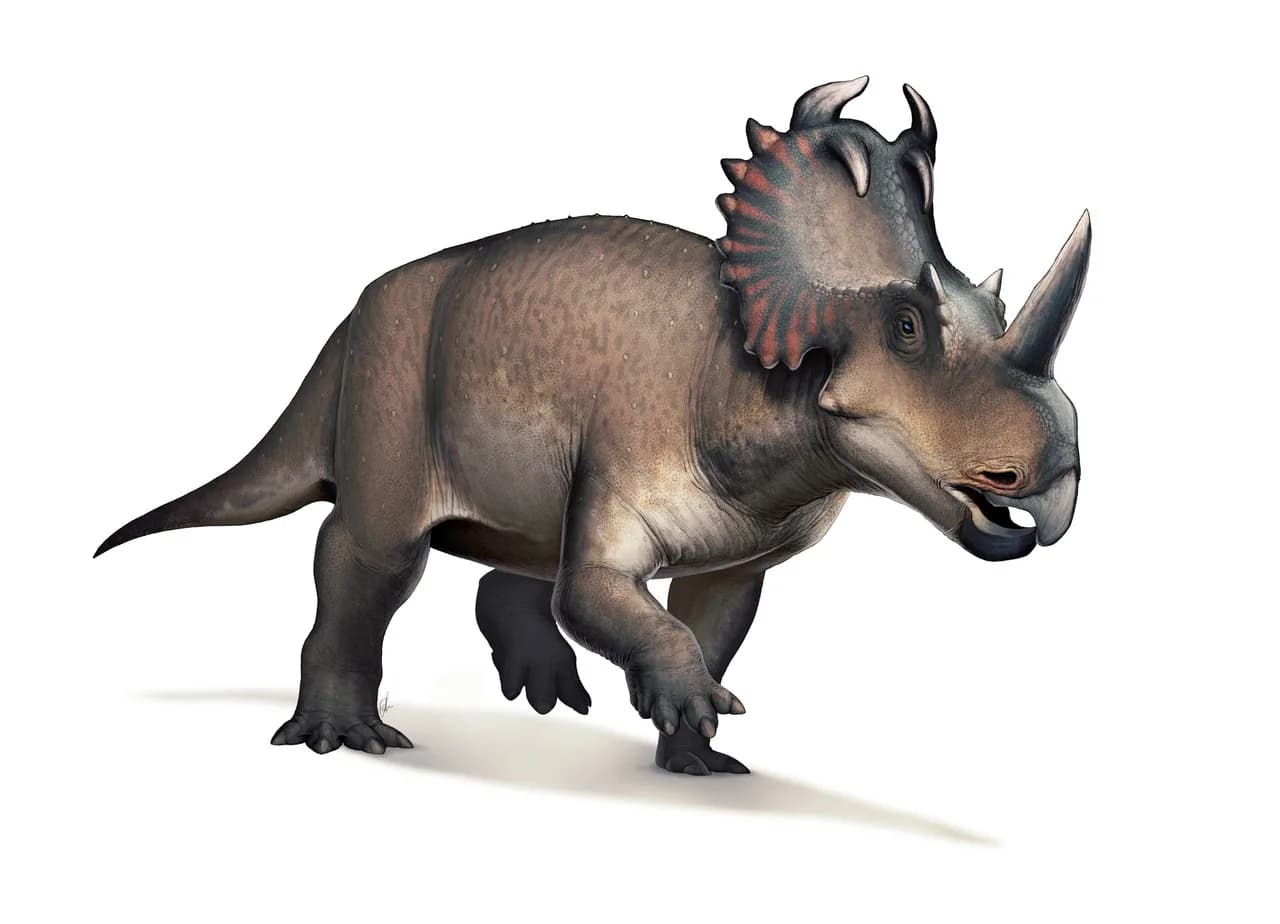
The skull of Eotriceratops bears three major horns: two long, forward-curving frontal (postorbital) horns and a shorter nasal horn. The bony frill, which extends dorsally from the parietals and squamosals, is solid and relatively unfenestrated — a typical feature of the tribe Triceratopsini, to which it belongs, as opposed to the large-fenestrate chasmosaurines such as Chasmosaurus. The overall robustness of the skull, the morphology of the epiparietal bones, and the squamosal-parietal junction distinguish Eotriceratops from its close relatives Triceratops and Torosaurus. The known pectoral girdle and limb elements suggest a massive animal, with a semi-erect posture adapted to bearing a heavy head on a muscular neck.
Ceratopsids of the Triceratopsini lineage are generally interpreted as gregarious animals, moving in groups at least during certain phases of their life cycle. The imposing frill of Eotriceratops, visible from a distance, likely served for intraspecific communication: individual recognition, social status signaling, and displays during reproductive competition. The robust frontal horns could have been used in male-versus-male confrontations for access to females or food resources, analogously to modern deer. Defense against predators relied on body mass, frontal charges, and defensive grouping of individuals. Fossil trackways attributed to ceratopsids in Alberta show gregarious trails, supporting the hypothesis of collective movements.
Eotriceratops xerinsularis is a ceratopsid dinosaur of the subfamily Chasmosaurinae, assigned to the tribe Triceratopsini. This group includes the most derived forms of the clade, characterized by a frill without large fenestrae and prominent frontal horns. Phylogenetic analyses place it as a sister taxon or close relative of the clade grouping Triceratops and Torosaurus, sharing several cranial synapomorphies with them. Its stratigraphic position in the early Maastrichtian (approximately 67.6 Ma) makes it one of the oldest known Triceratopsini, predating Triceratops species typically placed in the late Maastrichtian (~66.5–66 Ma). This early temporal position earns it its evocative name of 'dawn'.
Eotriceratops differs from Triceratops in the detailed morphology of the epiparietal bones, the configuration of the nasal sinuses, and the shape of the squamosal-parietal junction. Compared to Torosaurus, whose frill features large rounded fenestrae, that of Eotriceratops is compact and unfenestrated. Regaliceratops, another Maastrichtian chasmosaurine from Alberta, differs by a much more developed nasal horn and differently ornamented frill. Arrhinoceratops and Anchiceratops, contemporaries in the same formation, belong to more basal chasmosaurine lineages with distinct frill and horn configurations. The cranial size of Eotriceratops exceeds that of average adult Triceratops horridus specimens, though sexual dimorphism and intraspecific variability complicate these comparisons.
The holotype material of Eotriceratops consists of a partial skull (TMP 1997.085.0001) housed at the Royal Tyrrell Museum of Palaeontology in Drumheller, Alberta. This specimen includes portions of the rostral skull, parietal, squamosal, nasal bones, and horn fragments. Preservation quality is good for the recovered elements, but the incompleteness of the material limits precise anatomical reconstructions. The Horseshoe Canyon Formation has yielded other fragments attributed to closely related ceratopsids, but no postcranial skeleton definitively associated with Eotriceratops has been described to date. The Royal Tyrrell Museum remains the only institution holding material referred to this species, which limits direct comparative studies.
Eotriceratops remains less prominent in popular culture than its cousin Triceratops, a global cultural icon of dinosaurs, but it attracts the attention of paleontology enthusiasts for its pivotal position in the evolution of Maastrichtian ceratopsids. Its evocative name as the 'dawn of Triceratops' gives it a particular narrative aura in discussions of the final radiation of ceratopsids before the K-Pg extinction. Reconstruction illustrations have circulated in the paleoart community since its 2007 description, highlighting its resemblance to Triceratops while revealing its subtle morphological differences. Canadian natural history museums, particularly the Royal Tyrrell Museum, regularly feature Eotriceratops in their exhibits on Alberta's Cretaceous fauna.
| Period | Crétacé supérieur / Late Cretaceous |
| Era | Mésozoïque / Mesozoic |
| Age | ~67,6 Ma |
| Location | Amérique du Nord / North America (Alberta, Canada) |
| Length | 8,5–9 m |
| Height | ~2,8 m |
| Weight | 9 000–10 000 kg |
| Diet | Herbivore |
| Discovery | 2007 |
Eotriceratops xerinsularis, described in 2007 by Wu et al. from a partial skull in the Horseshoe Canyon Formation (Alberta), predates Triceratops by over a million years (67.6 Ma vs ~66.5–66 Ma). Its skull is proportionally larger than average adult Triceratops horridus specimens. The detailed morphology of its epiparietal bones, nasal sinus configuration, and squamosal-parietal junction shape distinguish it taxonomically, though both belong to the tribe Triceratopsini.
Early estimates cited up to 9 meters and 12 tonnes for Eotriceratops xerinsularis, based on raw skull size. However, skulls of basal Triceratopsini ceratopsids are proportionally larger relative to body size than in derived forms. Revisions accounting for chasmosaurine cranial allometry corrected these estimates to approximately 8.5–9 meters and 9–10 tonnes — comparable to Triceratops. The imposing frill contributed to the initial impression of gigantism.
Eotriceratops xerinsularis lived in the Horseshoe Canyon Formation, Alberta, a swampy coastal lowland crossed by river channels and bordered to the east by the Bearpaw Sea. The warm, humid subtropical climate favored conifer forests and angiosperms in full evolutionary radiation. North America then formed the island-continent of Laramidia. Eotriceratops shared its space with Edmontosaurus, Anchiceratops, ankylosaurs, and the dominant tyrannosaurids of this Maastrichtian ecosystem.
Information on this page is based on peer-reviewed scientific publications.
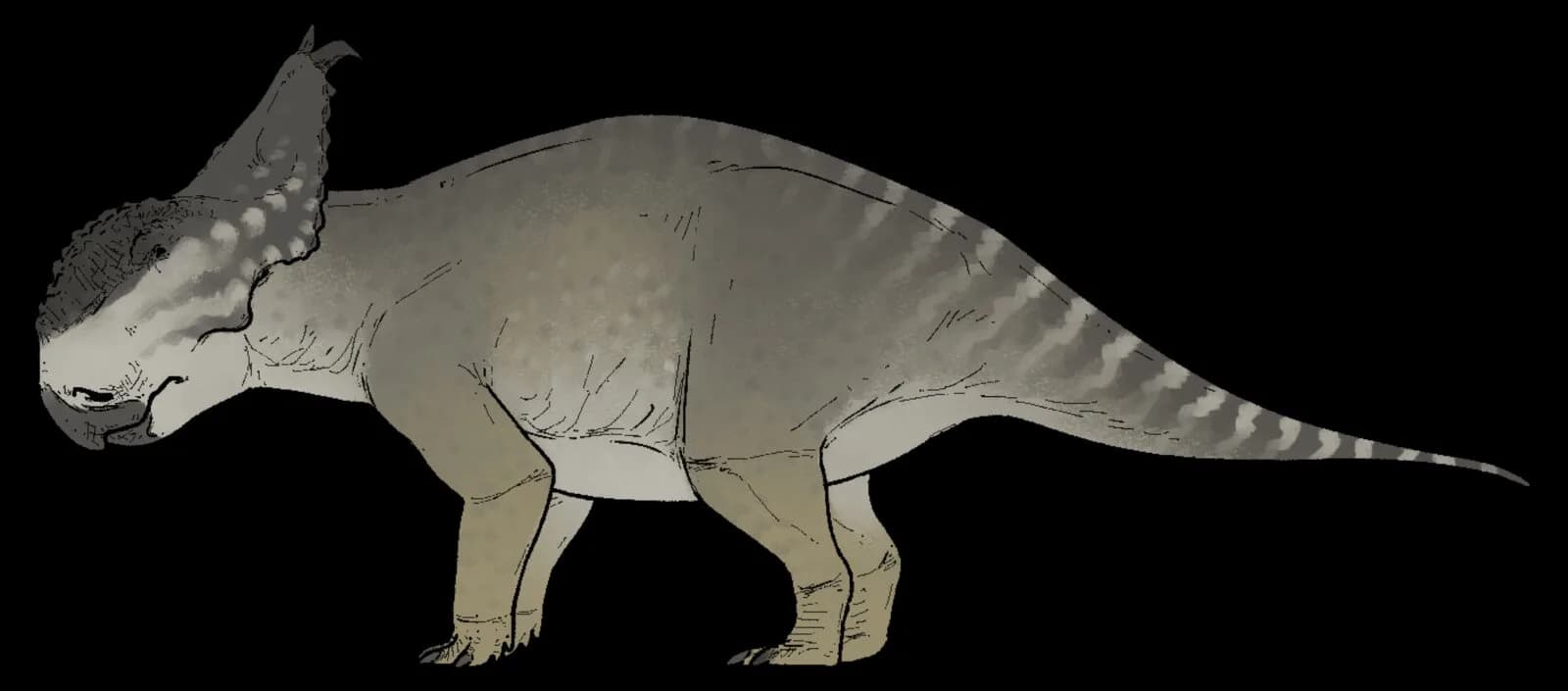
Life reconstruction of Eotriceratops xerinsularis
TotalDino, CC BY 4.0, via Wikimedia Commons
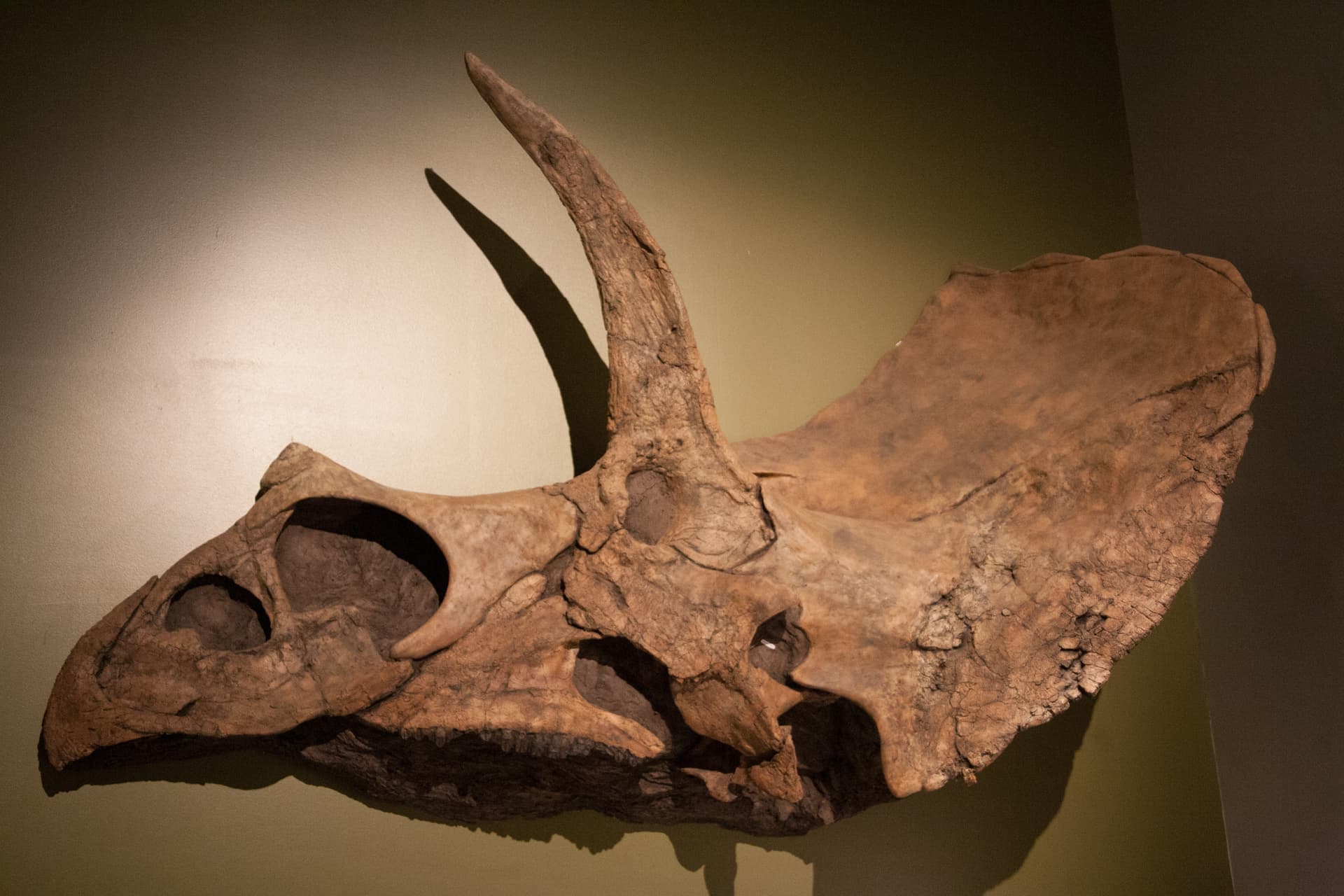
Partial skull of Eotriceratops xerinsularis, Royal Tyrrell Museum, Alberta
Roland Tanglao from Vancouver, Canada, CC BY 2.0, via Wikimedia Commons