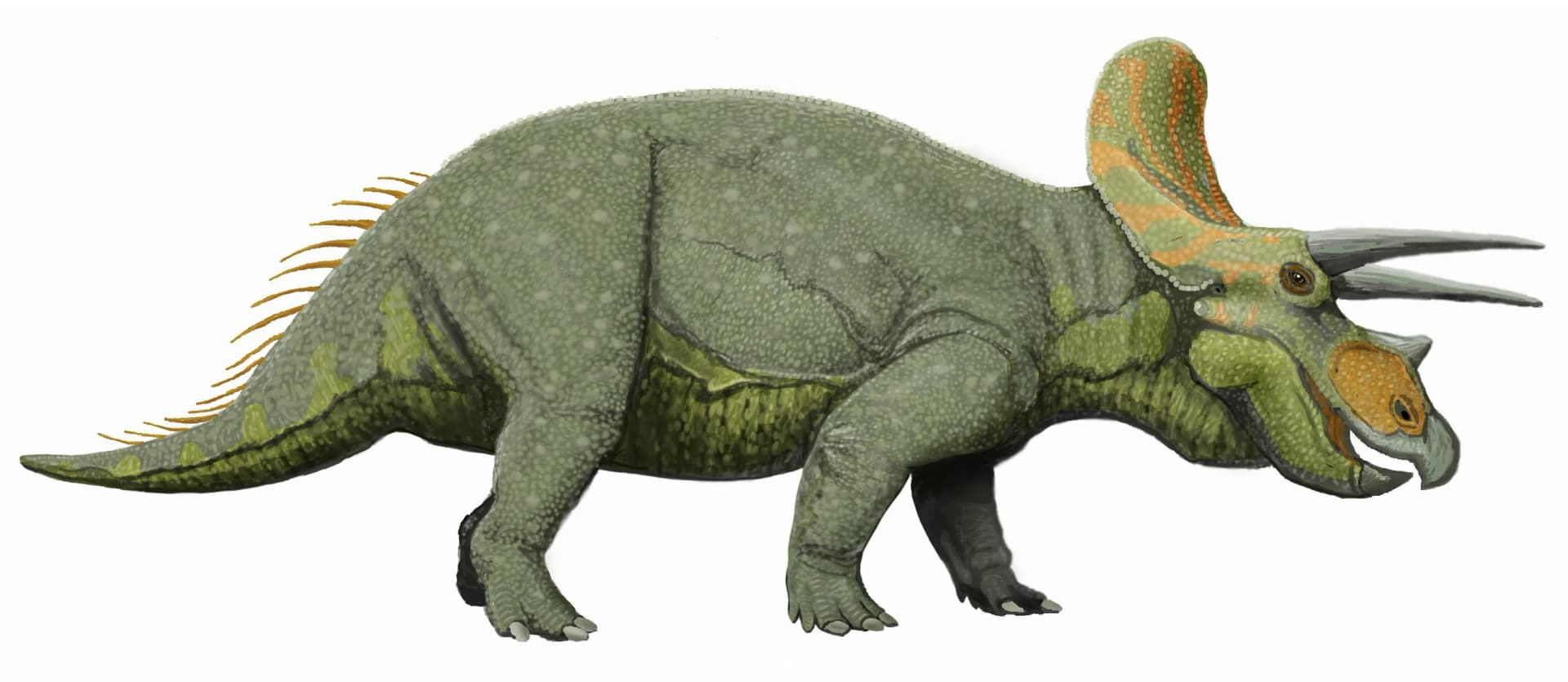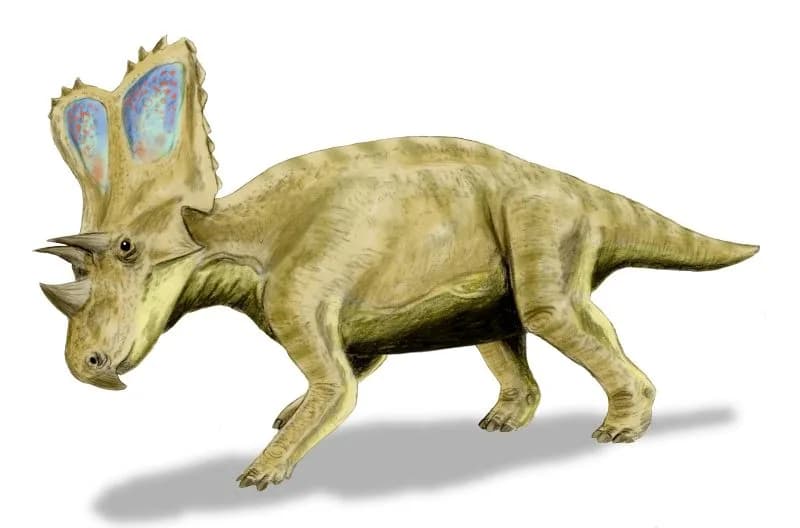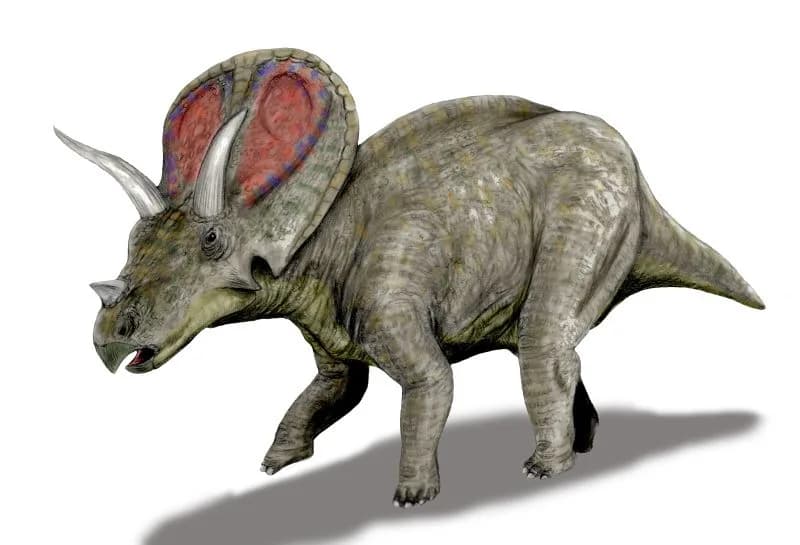
Régalicératops
Regaliceratops peterhewsi was nicknamed « Hellboy » by palaeontologists, for the two bosses above its eyes. About 5 metres long and 1.5 to 2 tonnes, found in Alberta in 2005, it lived 68.5 to 67.5 million years ago. Though a chasmosaurine, its ornaments mimic those of centrosaurines: a clear case of convergent evolution.
Regaliceratops lived in the Late Cretaceous, approximately 68.5 to 67.5 million years ago, during the Maastrichtian stage. This period corresponds to the final millions of years before the Cretaceous-Paleogene mass extinction, making Regaliceratops one of the last ceratopsids to have existed. It belongs to the subfamily Chasmosaurinae, a surprising fact because its cranial ornamentations more closely resemble those of Centrosaurinae, a remarkable phenomenon of convergent evolution. It lived in what is now western Canada, in a region where chasmosaurines dominated the ecosystems of the late Cretaceous. The climate of the time remained warm but was beginning to cool slightly, foreshadowing the climatic changes that would accompany the imminent mass extinction.
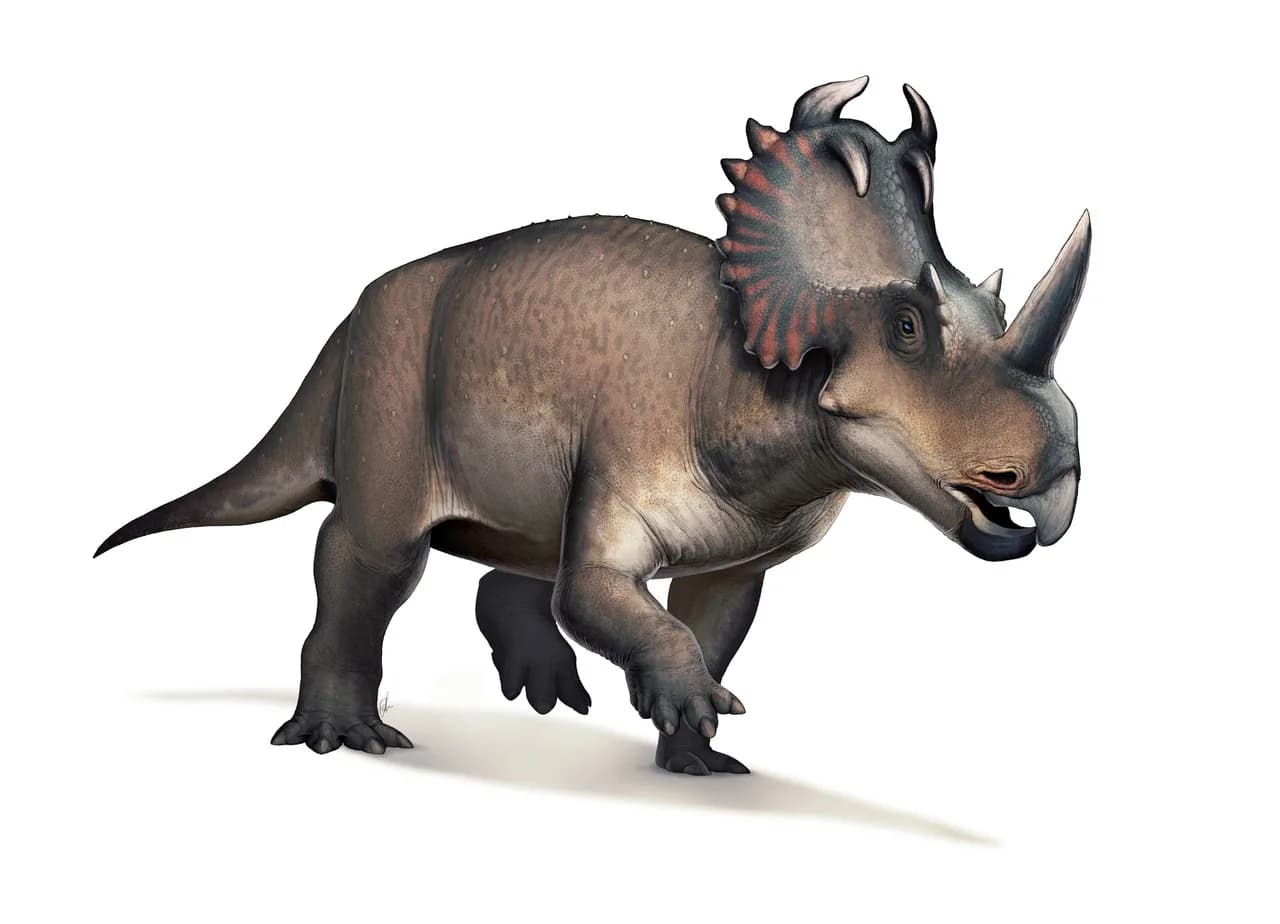
Regaliceratops measured approximately 5 meters in length with an estimated weight between 1.5 and 2 tonnes, making it a medium-sized ceratopsian. Its hip height reached about 1.5 to 1.8 meters. The most striking feature of this animal is its spectacularly ornamented skull. The parietal frill is bordered by large triangular bony plates arranged in a crown, evoking the royal crown that earned it the nickname 'Hellboy.' Above the eyes stand two small forward-curving brow horns, relatively modest compared to those of Triceratops. The nasal horn, in contrast, is prominent and robust, resembling the profile of a centrosaurine more than a chasmosaurine.
A strict herbivore like all ceratopsids, Regaliceratops fed on the low, fibrous vegetation of the Maastrichtian. Its powerful horny beak, sharp and compact, was efficient at cutting the stems and leaves of ferns, cycads, and angiosperms that increasingly dominated terrestrial ecosystems at the end of the Cretaceous. The dental batteries, typical of ceratopsids, comprised hundreds of teeth stacked in vertical columns, continuously replaced throughout life, ensuring efficient grinding of plant fibers through vertical shearing. The rapid diversification of flowering plants during the Maastrichtian probably offered a greater food variety than was available to earlier ceratopsians. Its ecological niche was that of a browser specialized in near-ground vegetation.
Regaliceratops inhabited the coastal plains of what is now western Canada, in the province of Alberta. The Maastrichtian environment in this region was characterized by a warm temperate climate, with mixed forests of conifers and angiosperms, wetlands, and rivers feeding fertile floodplains. The St. Mary River Formation, where the holotype was discovered, represents an ancient fluvial and coastal plain environment. Regaliceratops probably coexisted with other chasmosaurines like Eotriceratops and Triceratops, as well as hadrosaurs, ankylosaurs, and the fearsome Tyrannosaurus rex, which reigned as apex predator in this ecosystem. The diverse vegetation supported a rich herbivore community during this late Cretaceous period.
Regaliceratops anatomy is a remarkable case of convergent evolution. Though phylogenetically a chasmosaurine, its skull presents ornamentations that mimic those of centrosaurines: a dominant prominent nasal horn, reduced brow horns, and a frill adorned with large triangular epiparietals arranged in a crown. This crown of bony spines on the frill is the most distinctive feature, with flat, triangular plates radiating from the edge like the points of a royal crown. The frill is fenestrated, typical of chasmosaurines, which distinguishes it from the solid frills of Triceratops. The body was quadrupedal and robust, with standard body proportions for a medium-sized ceratopsid. The dentition consisted of complex dental batteries adapted for grinding tough vegetation.
Regaliceratops was probably a gregarious animal, although the absence of bone beds makes this hypothesis more speculative than for genera like Centrosaurus. Its spectacularly ornamented frill very likely served as a visual display for species recognition and sexual selection, a particularly important role in an ecosystem where several ceratopsid species coexisted. The horns and prominent nasal horn were used during ritualized combat between males for dominance and mate access. When facing predators like Tyrannosaurus rex, Regaliceratops probably adopted a defensive posture by lowering its head and presenting its horns and frill as a deterrent shield. Its social behavior and defense strategies were presumably similar to those of other large ceratopsids.
Regaliceratops peterhewsi was discovered in 2005 by geologist Peter Hews along the Oldman River in southern Alberta, Canada. The specimen was excavated by the Royal Tyrrell Museum between 2005 and 2011, a lengthy process due to the extreme hardness of the surrounding rock. The official description was published in 2015 by Caleb Brown and Donald Henderson. The genus name means 'royal horned face,' referring to the crown-like arrangement of the frill ornamentations. The species honors Peter Hews, the discoverer. The holotype (TMP 2005.055.0001) is a nearly complete, remarkably well-preserved skull. The specimen quickly received the nickname 'Hellboy' from the preparation team, due to the bumps above the eyes that evoke the comic book character's horns. It is currently the only known specimen of this species.
| Period | Crétacé supérieur / Late Cretaceous |
| Era | Mésozoïque / Mesozoic |
| Age | 68.5-67.5 Ma |
| Location | Canada (Alberta) / Canada (Alberta) |
| Length | ~5 m |
| Height | ~1.8 m |
| Weight | 1.5-2 tonnes |
| Diet | Herbivore |
| Discovery | 2005 |
The Royal Tyrrell Museum preparation team nicknamed the holotype TMP 2005.055.0001 'Hellboy' because of the bumps above the eyes recalling the comic book character's horns. The surrounding rock was extremely hard: it took six years (2005–2011) to extract the nearly complete skull. Caleb Brown and Donald Henderson officially described Regaliceratops peterhewsi in 2015.
Regaliceratops peterhewsi is phylogenetically a chasmosaurine, yet its skull mimics that of centrosaurines: prominent nasal horn, reduced brow horns, and a frill adorned with large crown-like triangular plates. This convergence between two ceratopsid subfamilies is a rare example of independent evolutionary repetition of the same ornamental pattern, probably under similar sexual selection pressure.
Regaliceratops peterhewsi measured approximately 5 meters long weighing 1.5 to 2 tonnes, during the Maastrichtian (68.5–67.5 Ma), among the last ceratopsids to have existed. It lived in Alberta (Canada) in the coastal plains of the St. Mary River Formation, likely alongside Eotriceratops, hadrosaurs, and Tyrannosaurus rex as apex predator.
Regaliceratops peterhewsi life reconstruction
Wikimedia Commons
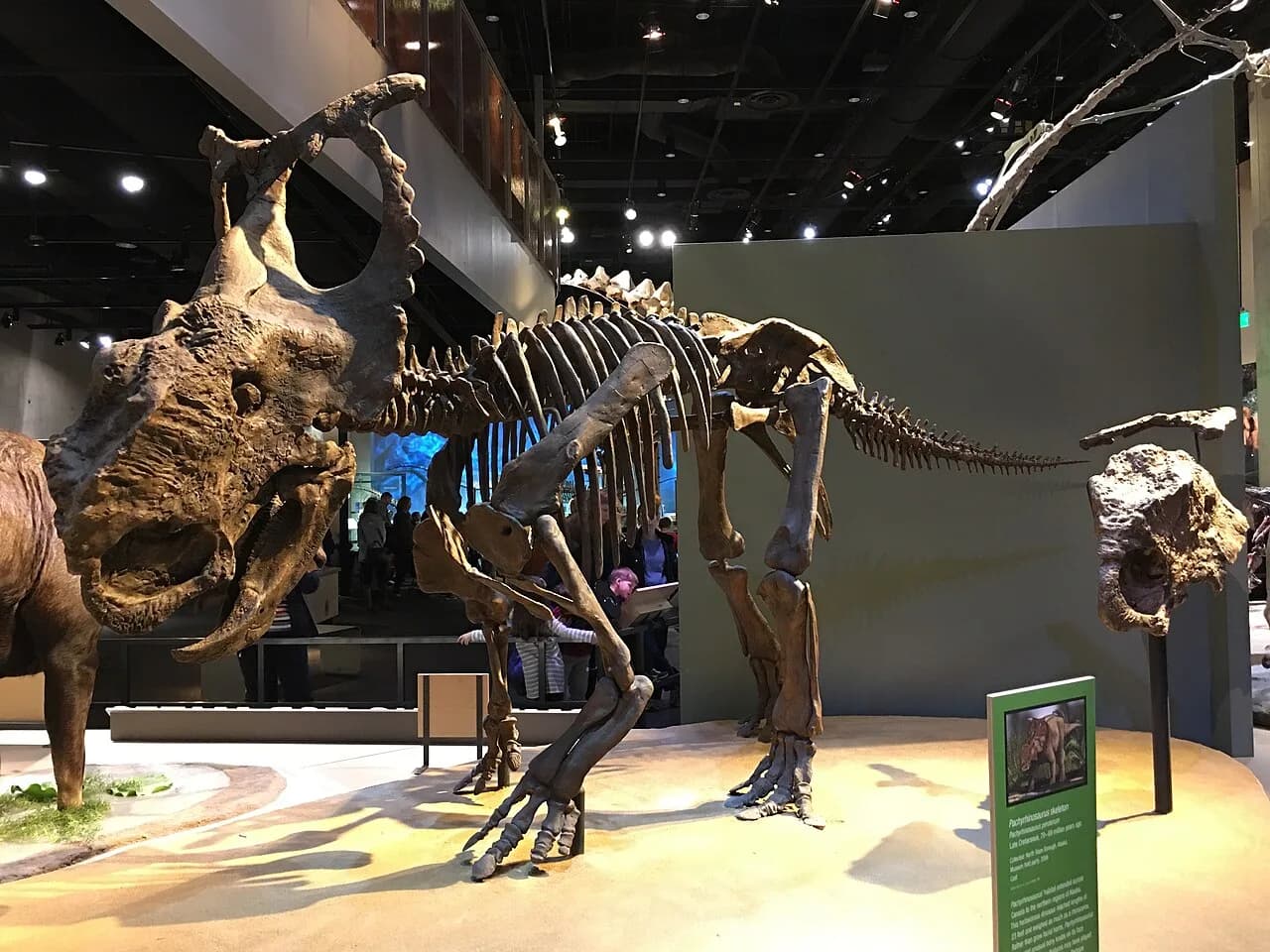
Regaliceratops 'Hellboy' skull at the Royal Tyrrell Museum
Wikimedia Commons