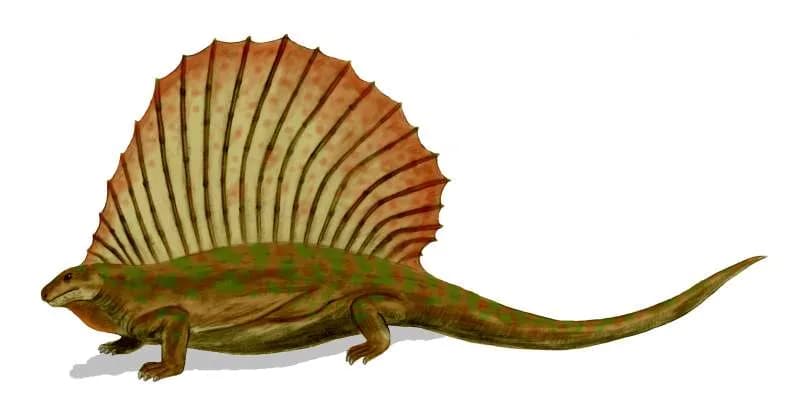
Edaphosaure
Edaphosaurus pogonias ranks among the first large land herbivores, roughly a hundred million years before the plant-eating dinosaurs. At 3 to 3.5 metres and 150 to 300 kilograms, it lived 310 to 280 million years ago. Its dorsal sail carries crossbars on each spine, telling it apart at a glance from the smooth sail of Dimetrodon.
Edaphosaurus lived from the Late Carboniferous to the Early Permian, approximately 310 to 280 million years ago, spanning a period of roughly 30 million years across two geological periods. It is one of the earliest large known terrestrial herbivores in Earth's history, predating herbivorous dinosaurs by over 100 million years. Edaphosaurus belonged to the synapsids (the lineage ultimately leading to mammals), like its predatory contemporary Dimetrodon, with which it shared the spectacular feature of a large dorsal sail. However, Edaphosaurus' sail was clearly distinguished by the presence of 'crossbars' on the neural spines — lateral outgrowths completely absent in Dimetrodon. Edaphosaurus played a crucial ecological role as the first large terrestrial herbivore, paving the way for millions of years of herbivore dominance in terrestrial ecosystems.
Edaphosaurus was a respectably sized animal for its time, measuring about 3 to 3.5 meters in total length with an estimated weight of 150 to 300 kilograms, making it one of the largest herbivores of the Late Carboniferous and Early Permian periods. Its dorsal sail, formed by greatly elongated neural spines rising from the vertebral column, could reach over 1 meter in height and was its most visually striking feature. Its head was remarkably small relative to its massive body — only about 15 centimeters long for a 3-meter body, reflecting a very different cranial proportion compared to predatory synapsids. Its body was stocky and barrel-shaped, with a voluminous belly typical of herbivores that require a large digestive system to ferment plant matter. Its short, sprawling limbs maintained it in a low, stable posture close to the ground.
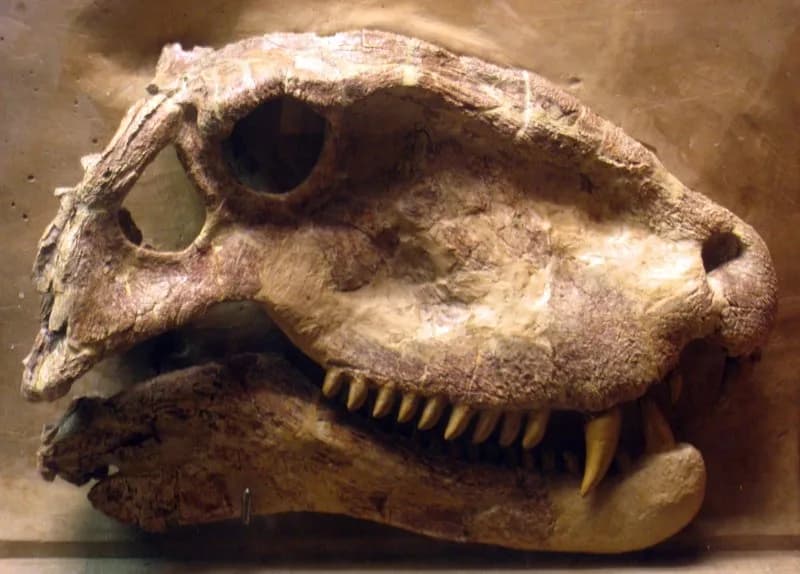
Edaphosaurus is considered one of the first large terrestrial herbivores in the entire history of life on Earth. Its short jaws bore numerous small marginal teeth and distinctive batteries of palatal teeth (located on the palate) that together formed an efficient grinding surface for processing tough vegetation. This unique dental system allowed it to effectively grind leaves, stems, and probably seeds of the plants available during the Carboniferous and Early Permian periods. The available plant food sources included ferns, lycopsids (club mosses), horsetails, and primitive conifers. The evolution of a large terrestrial herbivore was a major ecological event, because it created for the first time an efficient energy transfer pathway between primary producers (plants) and large predators such as Dimetrodon.
Edaphosaurus lived in the tropical floodplains and swamp forests of equatorial Pangaea, in what is now the southern United States and parts of Europe. The famous 'red beds' of Texas and Oklahoma represent alluvial plain environments crossed by meandering rivers, with dense vegetation consisting of tree ferns, giant lycopsids, and primitive conifers providing both food and shelter. The climate was warm and humid with marked seasonal variations. Edaphosaurus shared these diverse ecosystems with the predator Dimetrodon, the giant amphibian Eryops, and numerous other synapsids and reptiles of the Early Permian, forming complex ecological communities.
Edaphosaurus' most distinctive anatomical feature was its dorsal sail adorned with characteristic 'crossbars.' Unlike Dimetrodon's smooth sail with plain neural spines, Edaphosaurus' neural spines bore lateral outgrowths (tubercles) arranged perpendicularly along their length, giving the sail a distinctive 'grid' or 'branching tree' appearance unique among all known synapsids. The function of these crossbars remains actively debated among paleontologists: they may have increased the surface area of the sail for more efficient thermoregulation, served as fat storage sites, or played a role in visual signaling for species recognition or mate attraction. Its remarkably small skull bore a dentition specifically adapted for herbivory, with palatal teeth forming grinding plates — a unique innovation among primitive synapsids.
Edaphosaurus was a slow, placid herbivore that probably spent the vast majority of its time feeding, much like large modern herbivores such as tortoises and iguanas. Its prominent dorsal sail likely served primarily for thermoregulation — by orienting the broad surface toward the morning sun, it could warm up considerably faster than predators like Dimetrodon, giving it a crucial temporal advantage either to flee or to begin feeding earlier in the day. Despite its large size and imposing sail, Edaphosaurus possessed no obvious active defenses against predators other than its considerable body mass. It likely lived in loose groups or herds to benefit from collective vigilance against approaching carnivores.
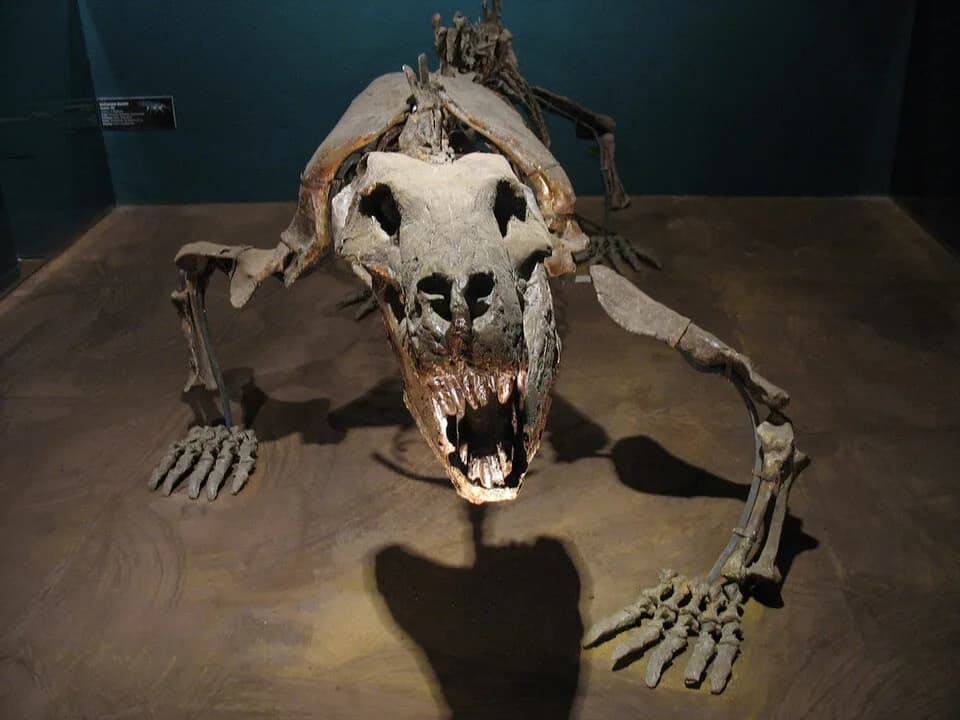
Edaphosaurus was first described in 1882 by Edward Drinker Cope, the famous rival of Othniel Charles Marsh during the Bone Wars era of competitive paleontology in North America. The name means 'pavement lizard' or 'ground lizard' (from Greek edaphos meaning 'ground' and sauros meaning 'lizard'). Fossils come primarily from the Permian red beds of Texas and Oklahoma, the same prolific geological deposits that have produced abundant Dimetrodon specimens. Several species are recognized including E. pogonias and E. cruciger. A remarkable specimen of E. cruciger from New Mexico preserves a nearly complete skeleton with the sail intact. Fossils have also been found in Europe, specifically in the Czech Republic and Germany, demonstrating a global distribution.
| Period | Carbonifère sup. au Permien inf. / Late Carboniferous to Early Permian |
| Era | Paléozoïque / Paleozoic |
| Age | 310-280 Ma |
| Location | Texas, Oklahoma, Nouveau-Mexique (USA), Europe / Texas, Oklahoma, New Mexico (USA), Europe |
| Length | 3-3.5 m |
| Height | 1.8 m |
| Weight | 150-300 kg |
| Diet | Herbivore |
| Discovery | 1882 |
No. Edaphosaurus pogonias was a synapsid, belonging to the evolutionary lineage leading to mammals — and therefore more closely related to us than to any dinosaur. It lived during the Late Carboniferous and Early Permian, 310 to 280 million years ago, over 40 million years before the first dinosaurs appeared. Its dorsal sail and sprawling four limbs are traits of a primitive reptile, not a dinosaur.
The sail of Edaphosaurus pogonias is distinguished by crossbars on the neural spines — perpendicular lateral outgrowths absent in Dimetrodon. Their function remains debated: solar thermoregulation, fat storage, or visual signaling. The sail reached over one meter in height on a body measuring 3 to 3.5 meters long.
Edaphosaurus pogonias is considered one of the earliest large known terrestrial herbivores, predating herbivorous dinosaurs by over 100 million years. By creating an energy transfer between plants and predators like Dimetrodon, it inaugurated the trophic structure of complex terrestrial ecosystems. It was described in 1882 by Edward Drinker Cope from the red beds of Texas and Oklahoma.
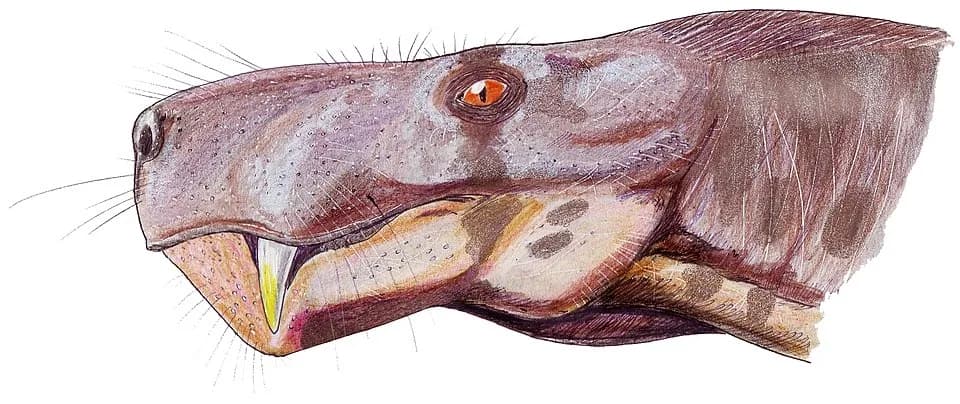
Edaphosaurus reconstruction showing its dorsal sail with crossbars
Nobu Tamura, CC BY-SA 3.0
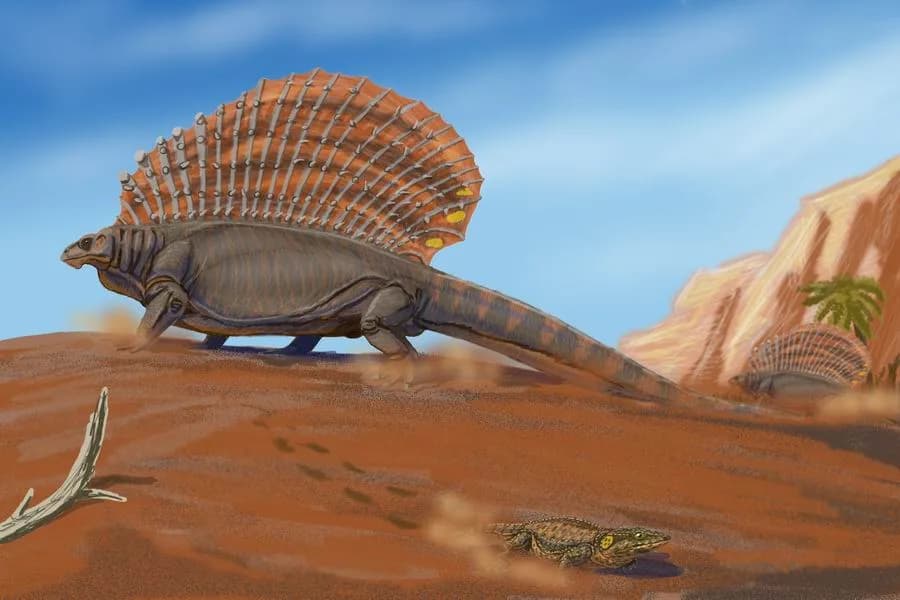
Edaphosaurus pogonias skeleton with preserved sail
Wikipedia Commons