Dsungariptère
Dsungaripterus weii was a pterosaur from China, described in 1964 from fossils in the Junggar Basin and dated to 130 to 120 million years ago. Its body measured one metre and 10 to 15 kilograms. Its upturned beak is unique among pterosaurs: it prised shellfish off rocks, which flat rear teeth then crushed.
Dsungaripterus lived during the Early Cretaceous, approximately 130 to 120 million years ago (Valanginian-Aptian), in the Junggar Basin region of what is now northwestern China (Xinjiang Province). This period corresponds to a major diversification of pterosaurs, during which numerous families developed varied dietary specializations. The Early Cretaceous climate in Central Asia was warm and semi-arid, with interior lakes and coastal areas rich in invertebrate marine life. Dsungaripterus is one of the most distinctive pterosaurs thanks to its unique curved beak, perfectly adapted to a diet specializing in shellfish and crustaceans.
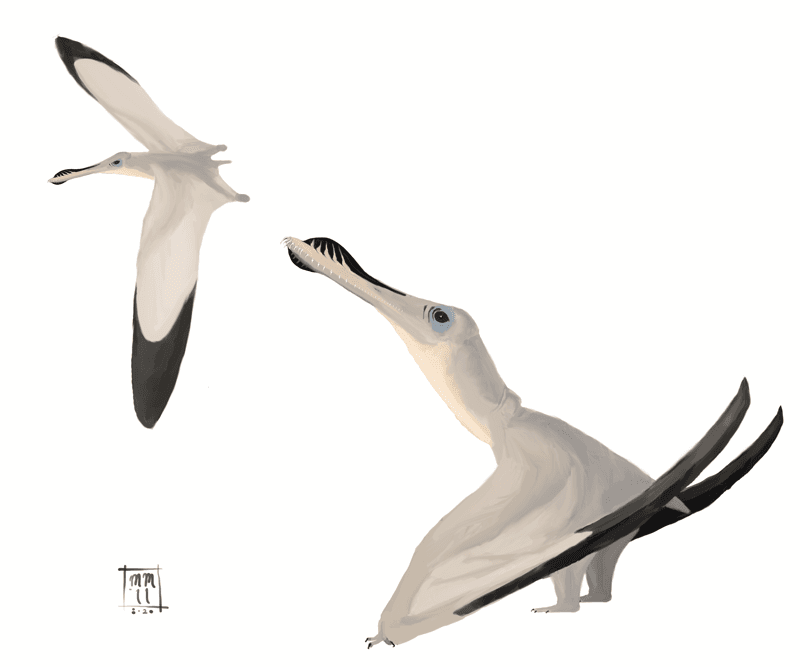
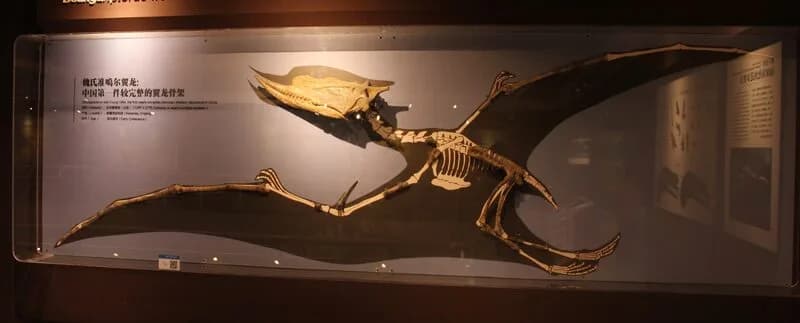
Dsungaripterus weii had a wingspan of approximately 3 to 3.5 meters, making it a medium-sized pterosaur for its time. Its skull measured about 45 centimeters long, dominated by a prominent bony crest that rose from the base of the beak to the back of the skull. Its weight is estimated between 10 and 15 kilograms, a light mass made possible by the hollow, pneumatized bones characteristic of pterosaurs. The beak, the most striking element of its anatomy, was long, narrow, and strongly curved upward at its tip, vaguely resembling the shape of a pair of forceps or a surgical tool.
Dsungaripterus was a specialized piscivore and durophage, feeding primarily on mollusks, crustaceans, and hard-shelled fish. Its upward-curved beak served as a lever to extract shellfish from rocks and shallow seabeds. The posterior part of its jaws was equipped with flat, robust dental surfaces perfectly designed for crushing the hard shells of bivalves, gastropods, and crustaceans. This durophagous adaptation is unique among known pterosaurs and recalls that of certain coral-crushing fish. Wear traces on its posterior teeth confirm this specialized diet.
Dsungaripterus inhabited the lacustrine and coastal environments of the Junggar Basin, a vast geological depression in northwestern China. During the Early Cretaceous, this region included large shallow lakes bordered by wetlands and alluvial plains. The climate was subtropical with marked dry seasons. The shores of these lakes harbored an abundant fauna of mollusks and crustaceans, providing an ideal food source for this specialized pterosaur. Dsungaripterus shared its habitat with other pterosaurs and numerous theropod and sauropod dinosaurs typical of the Early Cretaceous of Asia.
Dsungaripterus anatomy reveals a highly specialized pterosaur. Its sagittal cranial crest, made of thin but rigid bone, rose in a blade from the premaxilla to the parietal bone, likely serving as a visual signal and aerodynamic stabilizer in flight. The upward-curved beak was toothless at the tip but bore low, flattened teeth at the back of the jaws, forming an efficient crushing surface. The skull bones were fenestrated (perforated with large openings) to reduce weight while maintaining structural strength. Its membranous wings were supported by an enlarged fourth finger, as in all pterosaurs.
Dsungaripterus was probably a coastal or lacustrine animal, patrolling shorelines and low-tide zones in search of exposed shellfish. Its foraging technique likely resembled that of modern oystercatchers: walking on rocks and sand, using its curved beak to dislodge and extract mollusks from their substrate. In flight, its cranial crest and wing morphology enabled efficient soaring above bodies of water. Like many pterosaurs, it was probably diurnal and colonial, nesting in groups on cliffs or rocky islets near its favorite fishing grounds.
Dsungaripterus was first described in 1964 by Chinese paleontologist Yang Zhongjian (C.C. Young), from fossils discovered in the Lianmuqin Formation, Junggar Basin, Xinjiang Province, China. The genus name means 'Junggar wing,' referencing the discovery region. Several relatively complete specimens have been unearthed, including well-preserved skulls displayed at the Institute of Vertebrate Paleontology and Paleoanthropology (IVPP) in Beijing. A second species, D. brancai, was described from Tanzanian material, expanding the genus's geographic range. The Chinese fossils are among the best-preserved pterosaurs from Central Asia.
| Period | Crétacé inférieur / Early Cretaceous |
| Era | Mésozoïque / Mesozoic |
| Age | 130-120 Ma |
| Location | Chine (Xinjiang, bassin de Junggar) / China (Xinjiang, Junggar Basin) |
| Length | 1.0 m (corps / body) |
| Height | 0.8 m |
| Weight | 10-15 kg |
| Diet | Piscivore / Durophage |
| Discovery | 1964 |
No. Dsungaripterus weii was a pterosaur, a group of flying reptiles distinct from dinosaurs. Pterosaurs and dinosaurs are both archosaurs, but they form two separate evolutionary lineages. Dsungaripterus is therefore neither a bird nor a dinosaur: it is a flying reptile from the Early Cretaceous, 130 to 120 million years ago, whose membranous wings were supported by a greatly enlarged fourth finger.
Dsungaripterus weii had a wingspan of 3 to 3.5 meters and an estimated weight of 10 to 15 kilograms. Its diet was durophagous: its upward-curved beak allowed it to pry mollusks and crustaceans from rocks, while its flat, robust rear teeth crushed hard shells. This dietary specialization is unique among known pterosaurs.
Dsungaripterus weii was described in 1964 by Chinese paleontologist Yang Zhongjian from fossils in the Lianmuqin Formation of the Junggar Basin, Xinjiang Province, China. The name means 'Junggar wing.' Several relatively complete specimens are housed at the Institute of Vertebrate Paleontology and Paleoanthropology (IVPP) in Beijing.
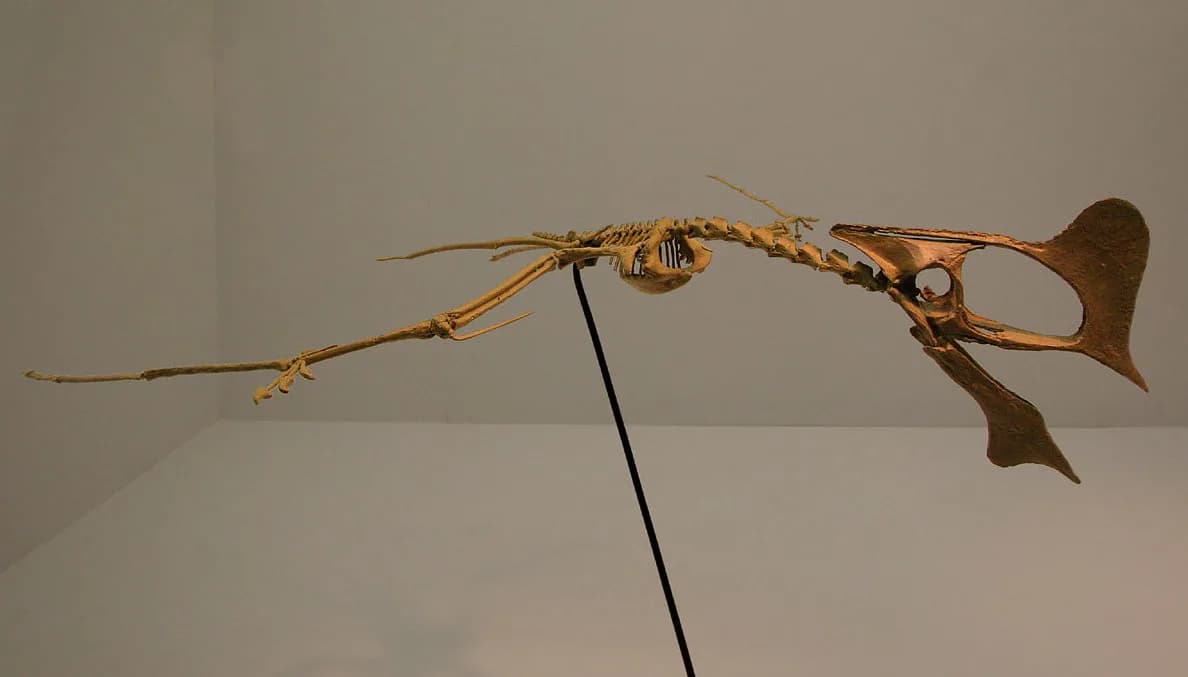
Mounted skeleton of Dsungaripterus weii at the Paleozoological Museum of China
FunkMonk (Michael B.H.), CC BY-SA 3.0, via Wikimedia Commons
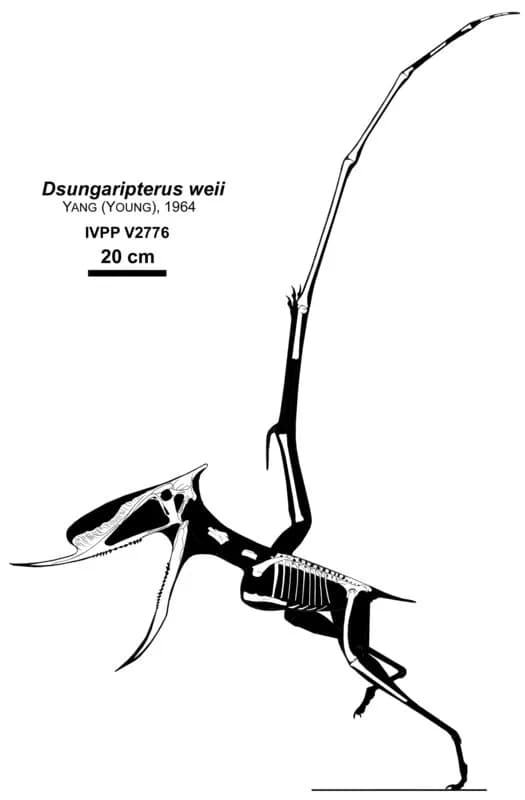
Skeletal reconstruction of Dsungaripterus weii showing the characteristic curved beak
Wikimedia Commons