Anhanguera
Anhanguera blittersdorffi was a pterosaur described in 1985, found in Brazil, England, Australia and Morocco between 112 and 100 million years ago. Its wingspan reached 4.5 metres and it weighed 15 to 25 kilograms. It fished in low flight over the ocean, and its name comes from old Tupi: old devil, a creature of Brazilian mythology.
Anhanguera blittersdorffi lived during the Early Cretaceous, approximately 112 to 100 million years ago, from the Albian to Cenomanian ages. This large Brazilian pterosaur is one of the most important representatives of the anhanguerids, a family of piscivorous pterodactyloids that dominated the skies above Cretaceous seas. Discovered in the Santana Formation of the Araripe Basin in northeastern Brazil, Anhanguera played a central role in understanding the diversity and ecology of Cretaceous pterosaurs. It lived during a major transition: the South Atlantic was opening between South America and Africa, creating new marine environments rich in prey. Anhanguera coexisted with Tropeognathus and Tapejara in the Araripe Basin, illustrating the remarkable ecological diversification of Brazilian pterosaurs. Fossils of related forms have been found in England, Australia, and Morocco, suggesting a near-worldwide distribution.
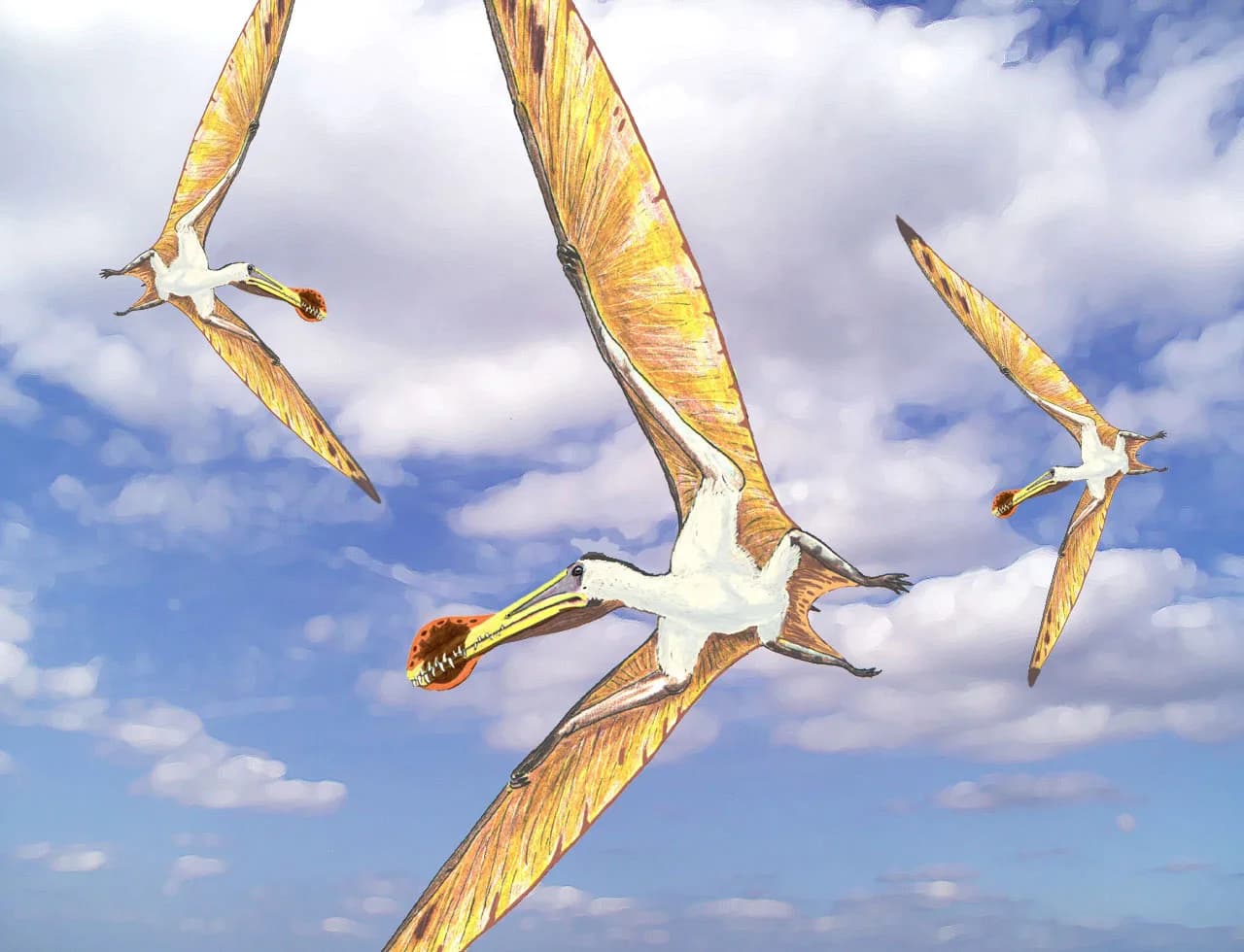
Anhanguera was a large pterosaur with an estimated wingspan between 4 and 5 meters, placing it between small pterosaurs like Tapejara and giants like Tropeognathus. Its elongated skull measured approximately 50 centimeters long, dominated by a rostrum armed with conical teeth. Its estimated weight was between 10 and 15 kg. Anhanguera's cranial crest was less spectacular than Tropeognathus's: a rounded bony crest adorned the top of the premaxilla (upper snout), rising above the beak line like a low fin. Some species also bore a crest on the lower mandible. The body was compact and aerodynamic, with long, narrow wings typical of pelagic fishing pterosaurs. Body proportions suggest a lighter, more agile flyer than its cousin Tropeognathus, potentially capable of tighter maneuvers while fishing.
Anhanguera was a specialized piscivore, as evidenced by its entire cranial anatomy. Its conical, pointed, widely-spaced teeth were ideally arranged for harpooning fish at the water's surface. The anterior teeth were notably larger than the posterior ones, forming an effective capture zone at the snout tip. The premaxillary crest probably played a hydrodynamic role similar to Tropeognathus's, stabilizing the beak during skim-feeding in low flight. Functional morphology analysis of the skull indicates the jaws could close rapidly, a necessity for capturing fast-moving fish. Anhanguera probably hunted in the coastal and pelagic waters of the proto-South Atlantic, targeting small to medium fish near the surface. The diversity of Anhanguera species and close relatives in the Araripe Basin suggests resource partitioning, with each species targeting prey of different sizes or depths.
Anhanguera inhabited the coastal and pelagic marine environments of the Early Cretaceous, primarily in the Araripe Basin region of Brazil, but probably also above the vast expanses of the forming South Atlantic. Santana Formation fossils indicate an environment of coastal lagoons and shallow seas in a tropical climate. The geographic distribution of Anhanguera and close relatives (England, Australia, Morocco) suggests an animal capable of crossing oceans or at least covering very long distances over water, like modern albatrosses and frigatebirds. This worldwide distribution confirms the animal's pelagic lifestyle. Coastal zones served as nesting and resting sites, while pelagic waters constituted the main hunting grounds. The Araripe Basin, with its rich record of pterosaurs, fish, and marine invertebrates, represented a marine biodiversity hotspot in the Early Cretaceous.
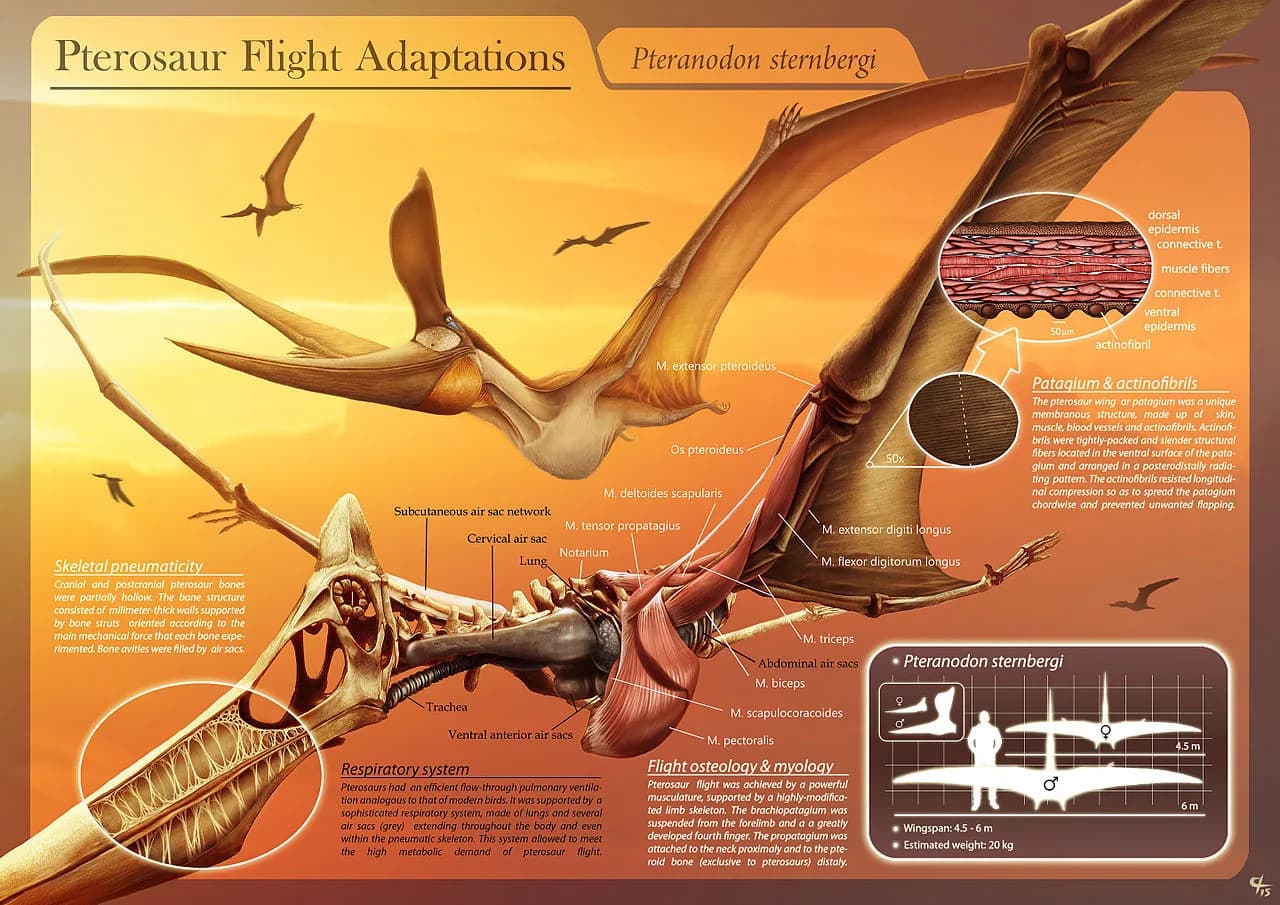
Anhanguera's anatomy was typical of ornithocheirid pterosaurs adapted for pelagic soaring and marine fishing. The elongated, narrow skull featured a rounded bony crest on the premaxilla, less prominent than Tropeognathus's carinae but nonetheless characteristic. The conical, pointed teeth were set in sockets, largest at the front of the snout and progressively decreasing rearward. The wings were long and narrow, with a high aspect ratio optimal for dynamic soaring over the ocean. The humerus bore a well-developed deltopectoral crest for anchoring the powerful pectoral muscles needed for wing-flapping during takeoff and climbing. The notarium (fused dorsal vertebrae) reinforced the torso against aerodynamic stresses. The sternum bore a prominent keel. The feet were small but with functional claws. The entire skeleton was highly pneumatized, with hollow bones connected to the air sac system, considerably reducing weight for an animal of this wingspan.
Anhanguera's behavior reflected that of an aerial predator specialized in open-water marine fishing. Its long, narrow wings were designed for dynamic soaring, a flight technique exploiting differences in wind speed between the water surface and altitude to maintain flight without active wing-flapping. Anhanguera probably fished by flying at low altitude over the marine surface, dipping its jaws into the water to seize fish, a technique similar to skimmers but also comparable to plunge-diving terns. The coexistence of several piscivorous pterosaur species in the Araripe Basin (Anhanguera, Tropeognathus, Brasileodactylus) implies resource sharing, possibly through different target prey sizes or preferred fishing zones. Nesting probably occurred in colonies on coasts or islands, with adults making regular return trips between fishing areas and the nest to feed young. Aerodynamic studies suggest Anhanguera could reach cruising flight speeds of 30 to 50 km/h.
Anhanguera was first described in 1985 by Brazilian paleontologists Diogenes de Almeida Campos and Alexander Kellner from fossils of the Santana Formation in the Araripe Basin. The name Anhanguera comes from Old Tupi meaning 'old devil' or 'evil spirit' (anhanga 'spirit, devil' + era 'old'), a creature from Brazilian indigenous mythology. The type species, A. blittersdorffi, honors Baron von Blittersdorff. The genus has had a turbulent taxonomic history, with numerous species described and then reclassified. Fossils are preserved three-dimensionally in the limestone nodules characteristic of the Araripe Basin, allowing detailed anatomical study. The type specimen includes a remarkably complete skull. Remains attributed to close anhanguerids have been discovered in England (Cambridge Greensand Formation), Australia, and Morocco, suggesting a near-cosmopolitan distribution of the family in the Early Cretaceous. Anhanguera is one of the most studied Brazilian pterosaurs and has significantly contributed to understanding pterodactyloid evolution and ecology.
| Period | Crétacé inférieur / Early Cretaceous |
| Era | Mésozoïque / Mesozoic |
| Age | 112 - 100 Ma |
| Location | Distribution mondiale (Brésil, Angleterre, Australie, Maroc) / Worldwide (Brazil, England, Australia, Morocco) |
| Length | Envergure / Wingspan: 4.5 m |
| Height | ~1 m (debout / standing) |
| Weight | 15-25 kg |
| Diet | Piscivore |
| Discovery | 1985 |
No, Anhanguera blittersdorffi was a pterosaur, a flying reptile distinct from dinosaurs. It lived during the Early Cretaceous, roughly 112 to 100 million years ago, above the coastal seas of the proto-South Atlantic. Pterosaurs form their own group of archosaurian reptiles, separate from dinosaurs since the Triassic.
Anhanguera blittersdorffi reached a wingspan of 4 to 5 meters with an estimated weight of 10 to 15 kg. Its long, narrow wings enabled dynamic soaring at low altitude. It fished by skimming the water surface with its forward-pointing conical teeth, capable of cruising at 30-50 km/h.
The rounded crest on Anhanguera blittersdorffi's premaxilla likely played a hydrodynamic role during skim-fishing, stabilizing the beak at water impact. It may also have served for species recognition or sexual selection, as seen in many modern seabirds that possess cranial ornaments.
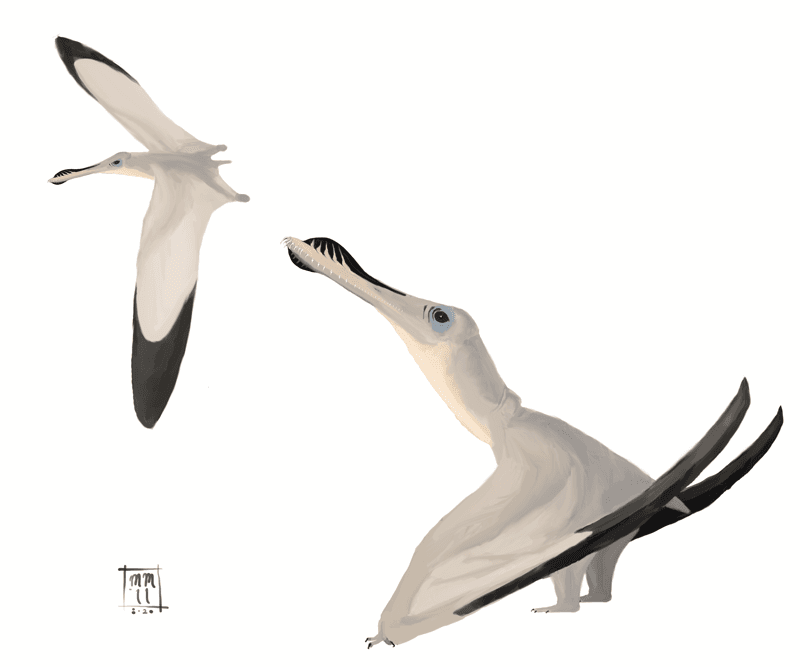
Life restoration of Anhanguera blittersdorffi by Matt Martyniuk
Matt Martyniuk / Wikimedia Commons
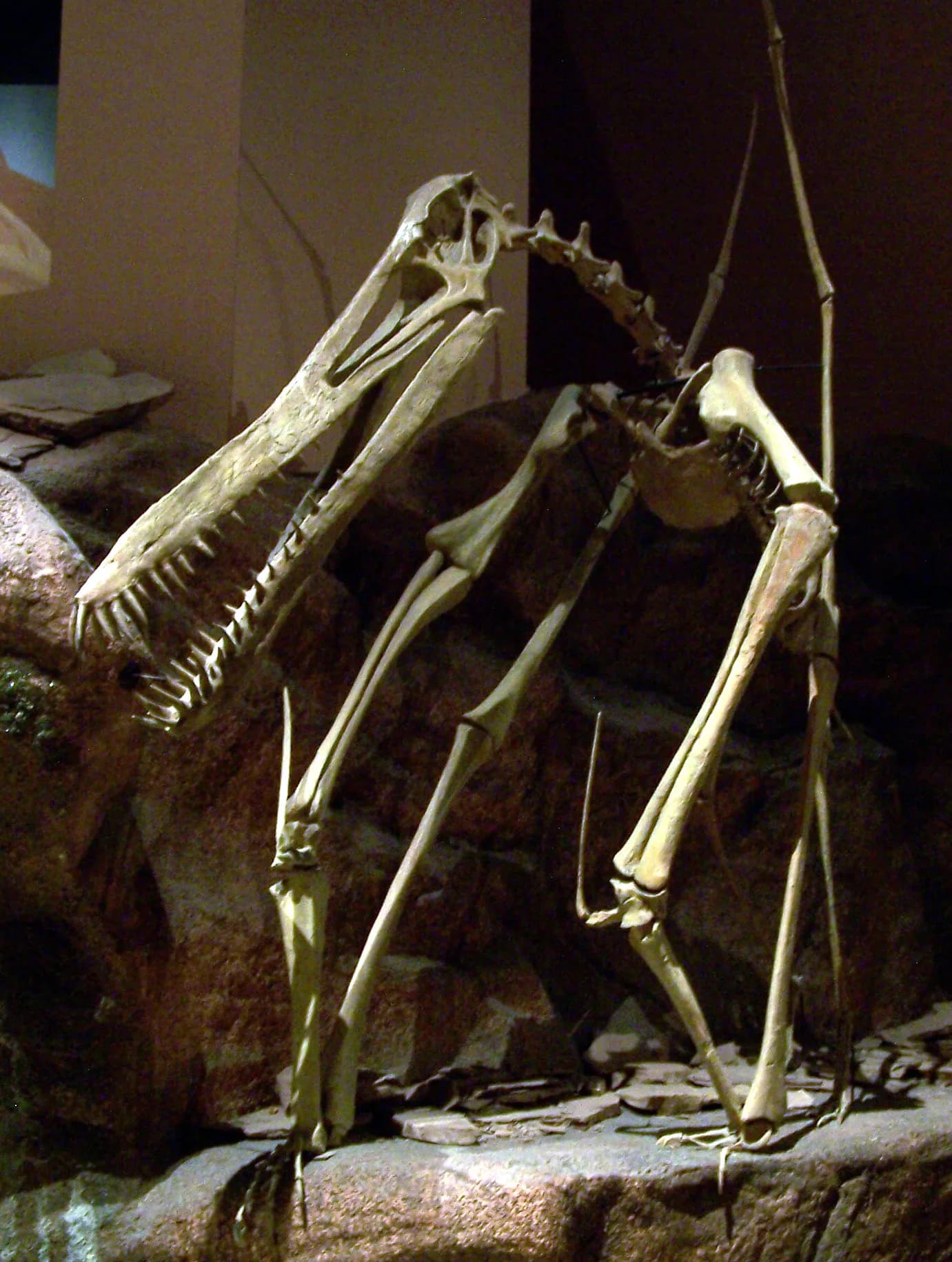
Mounted Anhanguera skeleton at North American Museum of Ancient Life
Wikimedia Commons