Dimorphodon
Dimorphodon macronyx is a pterosaur with a 1.4-metre wingspan weighing 1 to 2 kilograms, which flew 195 to 190 million years ago. Mary Anning, a pioneering figure in palaeontology, uncovered it in 1828 on the Jurassic Coast of Dorset. Its name means « two-form teeth »: the jaw carried two distinct tooth types, unusual among pterosaurs.
Dimorphodon macronyx lived during the Early Jurassic, approximately 195 to 190 million years ago, during the Sinemurian and Pliensbachian ages. This primitive pterosaur was one of the first flying reptiles to be scientifically described, discovered on the coastal cliffs of Dorset in England by the famous paleontologist Mary Anning in 1828. Dimorphodon belongs to the rhamphorhynchoids, the basal group of pterosaurs characterized by a long rigid tail and well-developed teeth. It lived in a very different world: the supercontinent Pangaea was just beginning to break apart, and present-day England was located at tropical latitudes, bordered by the Tethys Sea. Dimorphodon shared its coastal environment with early dinosaurs, ichthyosaurs, and primitive plesiosaurs. Its discovery by Mary Anning significantly contributed to understanding the diversity of Mesozoic reptiles at a time when paleontology was still in its infancy.
Dimorphodon was a modestly-sized pterosaur, with a wingspan of approximately 1.4 meters, comparable to that of a large modern falcon. Its body measured about 1 meter long, a large portion of which was occupied by its rigid tail of approximately 50 centimeters. Its estimated weight ranged between 1 and 2 kg, making it a relatively light animal despite its robust construction. The most striking feature of Dimorphodon was its disproportionately large head relative to its body, measuring approximately 23 centimeters long — nearly a quarter of the total body length. This massive skull resembled that of a modern puffin with its tall, rounded profile. Despite the imposing size of its head, the skull was lightened by large openings (fenestrae) separated by thin bony partitions, a common adaptation in pterosaurs to reduce weight during flight.
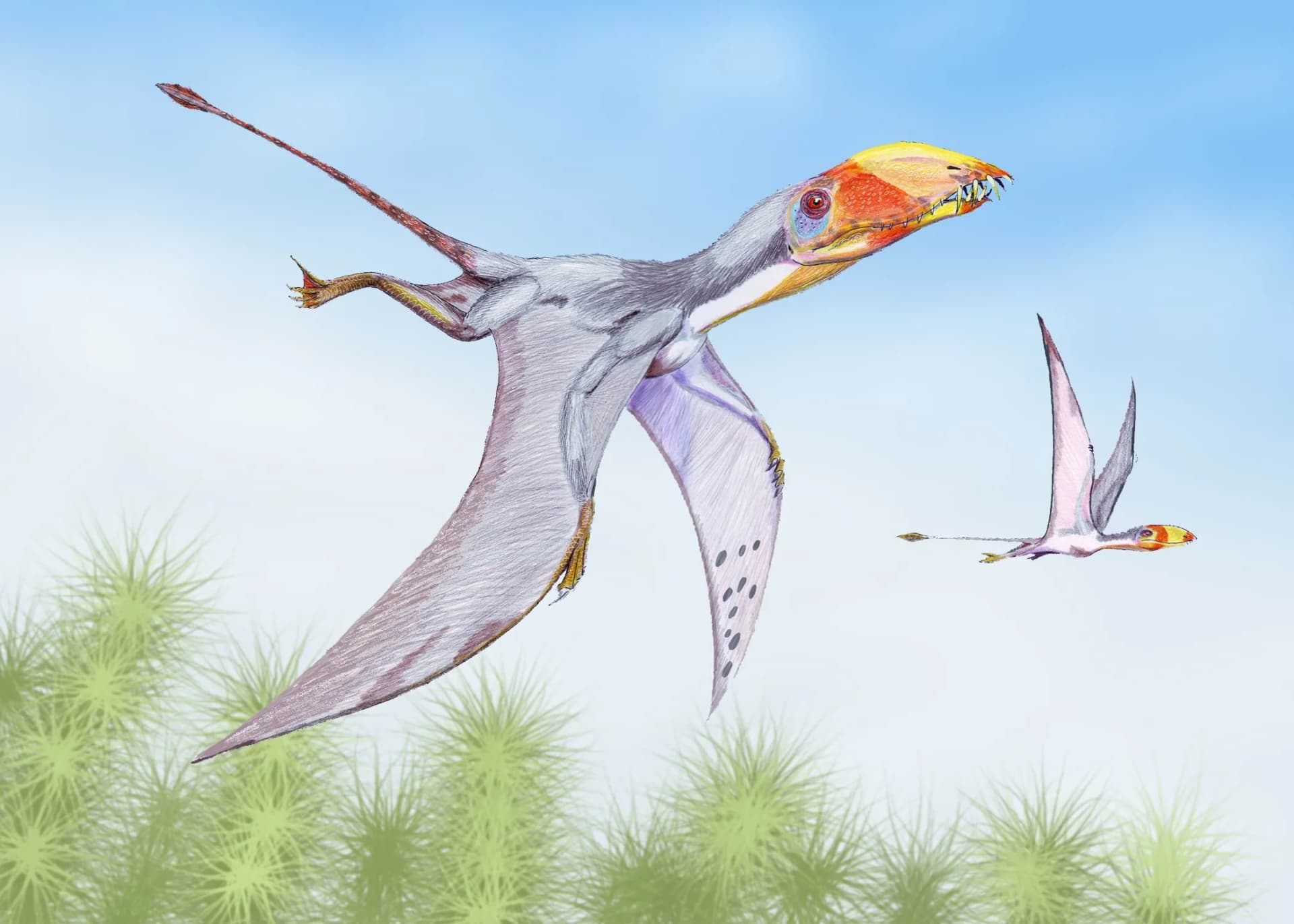
The name Dimorphodon means 'two-form teeth,' a direct reference to its heterodont dentition, unusual for a reptile. Its upper jaw bore four large, pointed, curved teeth at the front, followed by rows of smaller, more numerous teeth toward the back. This unique dental configuration suggests a varied, possibly opportunistic diet. The large anterior teeth were ideal for grasping slippery prey such as fish or squid, while the smaller posterior teeth could process insects and other invertebrates. Some paleontologists have proposed that Dimorphodon was primarily insectivorous, using its large front teeth to catch insects in flight, while others favor the hypothesis of a coastal piscivore catching fish at the water's surface. The jaw morphology allowed rapid closure, adapted for capturing fast and agile prey.
Dimorphodon inhabited the coastal environments of the Early Jurassic, in the region that now corresponds to the coast of Dorset in England, famously known as the 'Jurassic Coast' and a UNESCO World Heritage Site. During the Early Jurassic, this region was located at more southerly latitudes, enjoying a warm, humid tropical climate. The coastal landscape included limestone cliffs, beaches, lagoons, and shallow seas rich in marine life. Dimorphodon probably occupied an ecological niche similar to that of modern seabirds, nesting on coastal cliffs and feeding in littoral waters and adjacent wetlands. The geological formations of Lyme Regis, where the majority of fossils originate, reveal a shallow marine environment with muddy bottoms rich in ammonites, belemnites, and fish, providing an abundant food source for this pterosaur.
Dimorphodon's anatomy combined primitive characters with unique specializations among pterosaurs. Its skull, proportionally one of the largest among pterosaurs, presented a tall, narrow lateral profile, remarkably similar to that of the modern Atlantic puffin. The large cranial fenestrae (antorbital, temporal) considerably lightened this imposing structure, making it compatible with flight. Its wings were supported by a hyper-elongated fourth finger, as in all pterosaurs, with a wing membrane (patagium) extending from the fingertip to the body. Its hindlimbs were robust and well-developed, with five functional toes equipped with claws, suggesting aptitude for terrestrial locomotion and climbing. Its long tail was stiffened by ossified tendons forming elongated rods that kept the tail straight, probably serving as a stabilizer during flight. The sternum bore a modest crest (keel) for flight muscle attachment.
Dimorphodon's behavior is the subject of active debate among paleontologists, particularly regarding its flight capabilities and terrestrial locomotion. The robust structure of its hindlimbs and foot morphology led some researchers, notably Kevin Padian, to propose that Dimorphodon was a competent bipedal walker, capable of running on the ground like certain birds. Other paleontologists favor a more typical quadrupedal pterosaur locomotion, moving on all fours. In flight, Dimorphodon was probably an active flyer but not a long-distance glider like later pterosaurs, its morphology suggesting short, maneuverable flights between coastal cliffs and fishing areas. Its large head and heterodont teeth indicate an opportunistic predator, hunting from elevated perches such as cliffs, branches, or rocks before diving on prey. Nesting likely occurred in colonies on coastal cliffs.
Dimorphodon was discovered in 1828 by Mary Anning, the famous fossil collector of Lyme Regis, Dorset, England. The specimen was initially described by William Buckland that same year as Pterodactylus macronyx. In 1859, Richard Owen created the genus Dimorphodon to distinguish it from true pterodactylids, the name meaning 'two-form teeth' (Greek: di 'two' + morphe 'form' + odous 'tooth'). The holotype specimen, housed at the Natural History Museum in London, is remarkably complete for an Early Jurassic pterosaur. Other specimens have been discovered in the Lower Lias formations of Dorset over the decades. The original discovery by Mary Anning is particularly significant as she was one of the first women to make major contributions to paleontology, though she rarely received scientific credit during her lifetime. Fossils attributed to Dimorphodon or related forms have also been reported from Mexico.
| Period | Jurassique inférieur / Early Jurassic |
| Era | Mésozoïque / Mesozoic |
| Age | 195 - 190 Ma |
| Location | Europe (Angleterre, Dorset) / Europe (England, Dorset) |
| Length | Envergure / Wingspan: 1.4 m |
| Height | ~30 cm |
| Weight | 1-2 kg |
| Diet | Carnivore |
| Discovery | 1828 |
Dimorphodon macronyx ('two-form teeth') had four large, pointed, curved teeth at the front of its upper jaw, followed by rows of smaller teeth toward the back. This heterodont dentition, rare among pterosaurs, suggests an opportunistic diet: the large front teeth served for grasping fish or squid, while the smaller ones processed insects and invertebrates.
Dimorphodon macronyx was discovered in 1828 by Mary Anning on the coastal cliffs of Lyme Regis (Dorset, England). The species was initially described by William Buckland as Pterodactylus macronyx, then placed in its own genus by Richard Owen in 1859. The holotype, housed at the Natural History Museum in London, is one of the most complete known Early Jurassic pterosaurs.
Dimorphodon macronyx had a wingspan of approximately 1.4 meters and weighed 1 to 2 kg. Its terrestrial locomotion is still debated: Kevin Padian proposed bipedal walking, while other paleontologists favor quadrupedal locomotion. Its robust hindlimbs with five clawed toes suggest good climbing ability on the Early Jurassic coastal cliffs of Dorset.
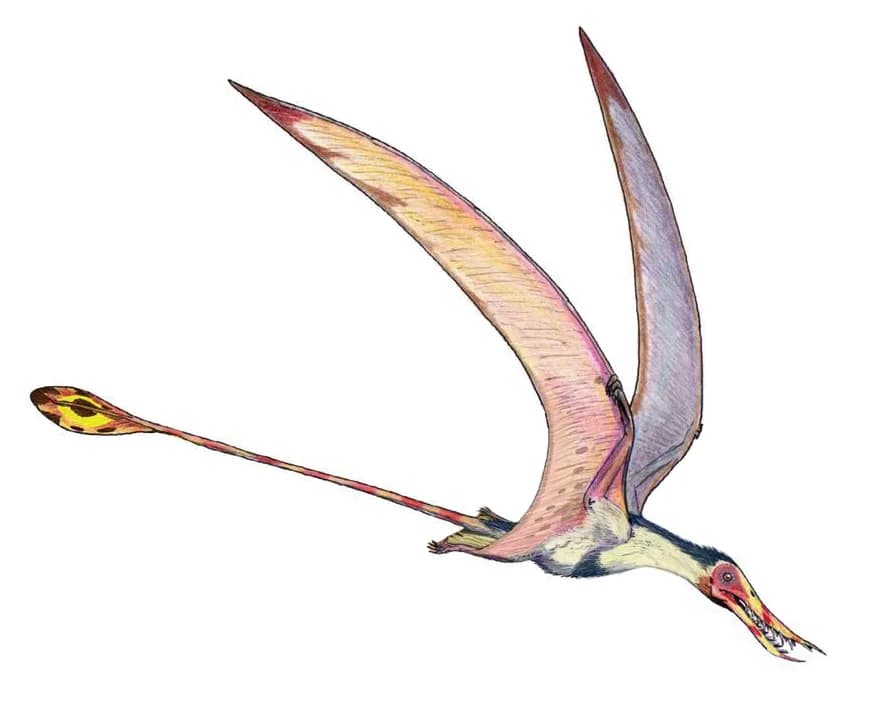
Artistic reconstruction of Dimorphodon by Dmitry Bogdanov
Dmitry Bogdanov / Wikimedia Commons
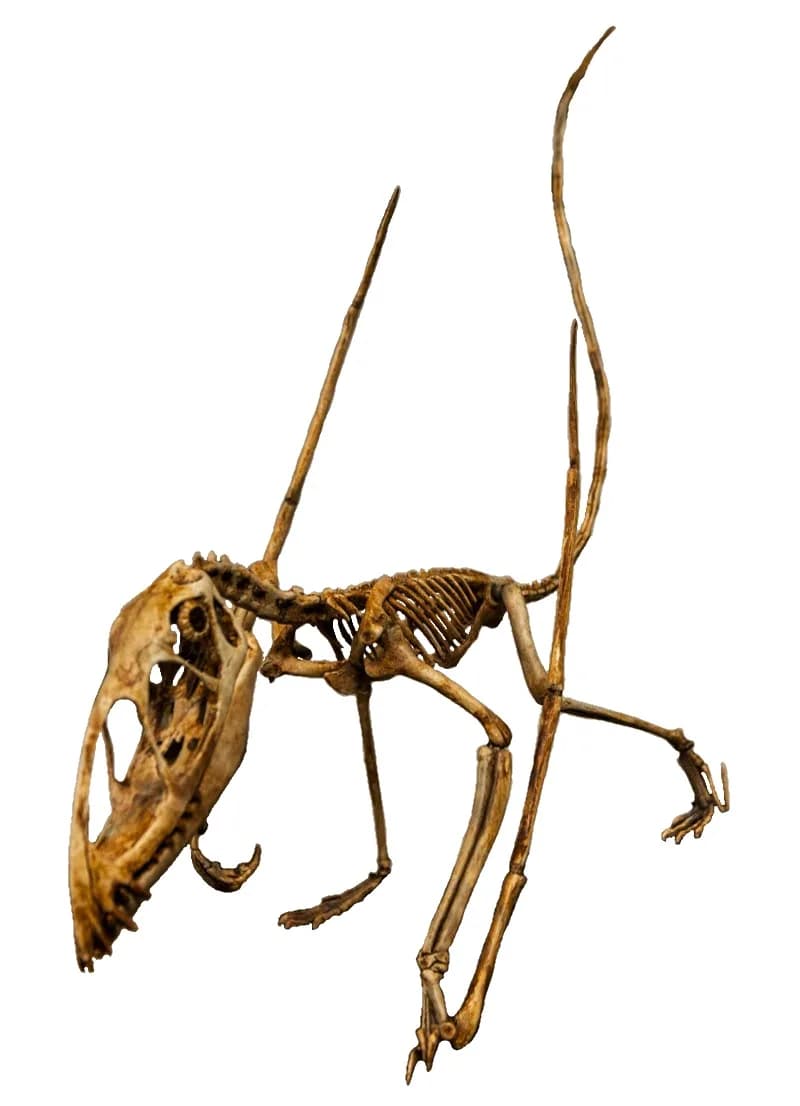
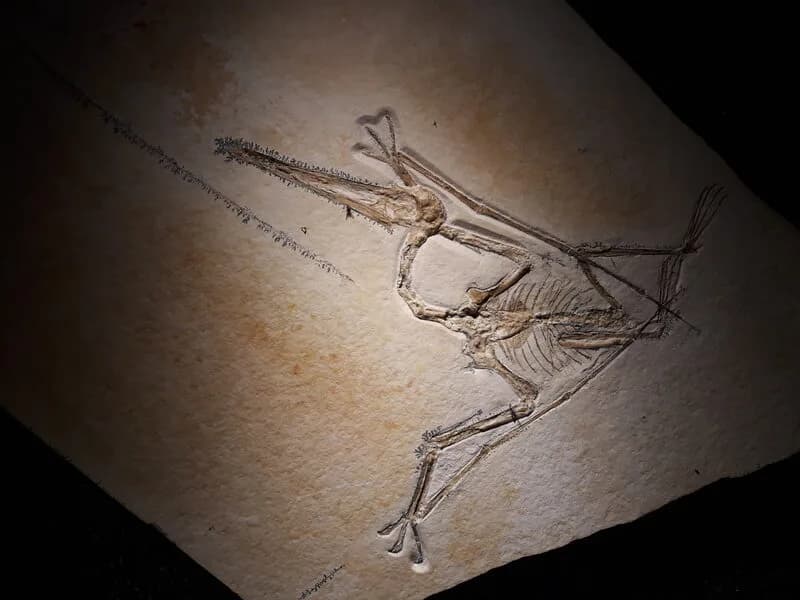
Mounted skeleton of Dimorphodon macronyx
Wikimedia Commons