Dracorex
Dracorex hogwartsia owes its name to the school of witchcraft in the Harry Potter series: « dragon king of Hogwarts », chosen in 2006 for its spiky, domeless skull. It measured 3 to 4 metres and around 45 kilograms, 66 million years ago in North America. Several palaeontologists see it as a juvenile Pachycephalosaurus rather than a genus in its own right.
Dracorex hogwartsia lived at the very end of the Late Cretaceous, approximately 66 million years ago (Maastrichtian stage), in what is now South Dakota, United States. This dinosaur belongs to the pachycephalosaur group (family Pachycephalosauridae), bipedal ornithischians with thickened skulls. It was contemporary with giants such as Tyrannosaurus rex and Triceratops. Its appearance in the fossil record corresponds to one of the richest — and most dramatic — periods in dinosaur history, just before the mass extinction at the end of the Cretaceous. Its exact taxonomic status is the subject of ongoing scientific debate: several researchers believe it may simply represent a juvenile growth stage of Pachycephalosaurus wyomingensis, making it not a distinct species but an immature individual of an already-known genus.
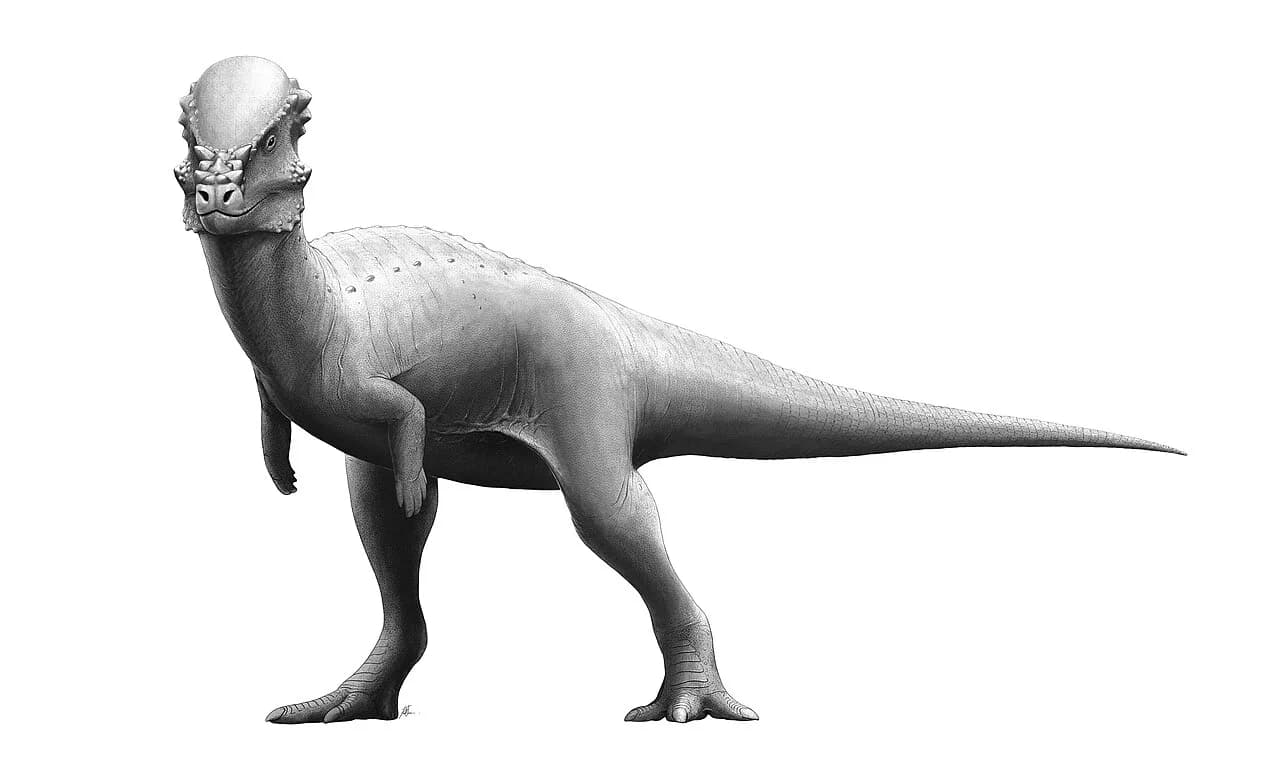
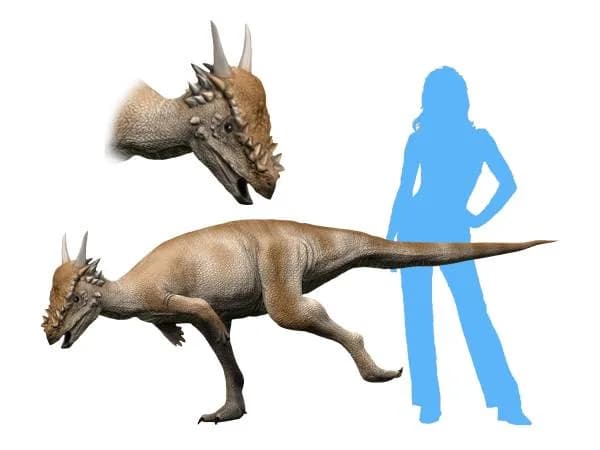
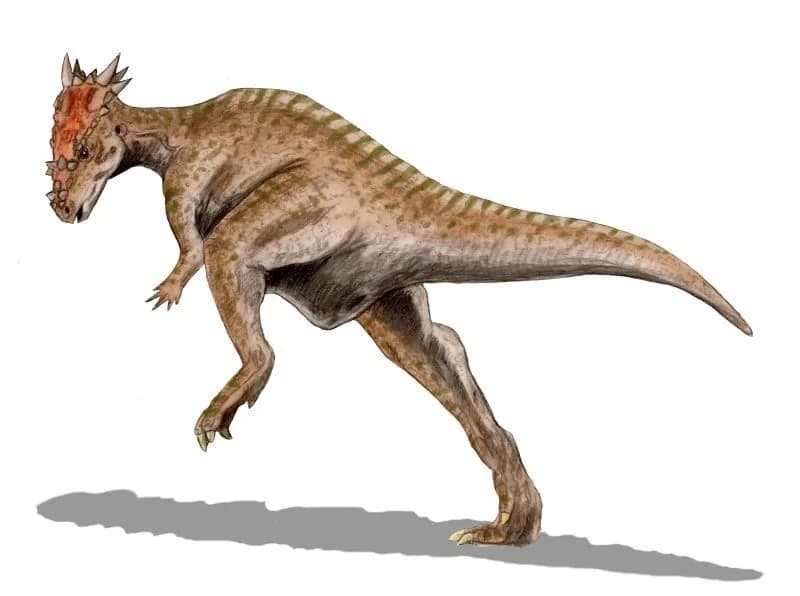
Dracorex was a modestly sized pachycephalosaur compared to its probable relative Pachycephalosaurus. It measured between 3 and 4 meters in total length, approximately 1.2 meters tall at the hips, and weighed an estimated 45 kilograms. Its silhouette was typically bipedal, with robust hind limbs, short forelimbs, and a stiffened tail serving as a counterbalance. The most striking feature of its anatomy remains its elongated and relatively flat skull, adorned with numerous spines, nodes, and bony projections — a morphology radically different from the smooth, hemispherical cranial dome of adult Pachycephalosaurus, which fuels the debate about a possible synonymy between the two taxa.
Dracorex was likely an herbivore or opportunistic omnivore, like the majority of pachycephalosaurs. Its small, leaf-shaped teeth were adapted for processing soft plant material such as leaves, fruits, seeds, and possibly insects or small invertebrates. Its horny beak at the tip of the snout allowed it to grasp and cut low-growing vegetation. Although direct evidence of its diet remains limited, jaw anatomy and dental morphology observed in pachycephalosaurs generally suggest a varied diet, likely opportunistic depending on seasonally available resources in the plains and forests of Late Cretaceous North America.
Dracorex inhabited the fluvial environments and alluvial plains of the Hell Creek Formation, which extended across present-day South Dakota, Montana, and Wyoming. This paleoenvironment was characterized by dense forests of conifers and flowering plants, crossed by seasonal rivers and wetlands. The climate was warm and subtropical, with distinct seasons. Dracorex shared this rich ecosystem with numerous other species: ceratopsians like Triceratops, hadrosaurs, ankylosaurs, dromaeosaurids, and of course the formidable Tyrannosaurus rex, which was likely the primary predator of this modestly sized pachycephalosaur with such a distinctive morphology.
Dracorex's cranial anatomy is its most distinctive and debated feature. Unlike the very thick, rounded cranial dome of Pachycephalosaurus, Dracorex's skull is relatively flat and adorned with a multitude of bony projections: elongated temporal spines, frontal nodes, parietal bumps, and complex squamosal ornaments. This spiny morphology contrasts sharply with the smooth skull surface of adult Pachycephalosaurus. Researchers Jack Horner and Mark Goodwin argued in 2009 that these differences are explained by ontogenetic growth: the bony ornaments of a juvenile would progressively resorb as the cranial dome thickens with age, transforming the spiny skull of Dracorex into the smooth dome characteristic of adult Pachycephalosaurus.
Dracorex's precise behaviors remain difficult to reconstruct due to the very limited fossil material available. By analogy with other pachycephalosaurs, Dracorex likely used its skull during intraspecific behaviors: the thick sides of its skull could absorb shocks during flank-to-flank combat between rival individuals, rather than true head-on frontal clashes. Biomechanical studies have shown that pachycephalosaur skulls were better adapted to lateral pushing than direct frontal impacts. If Dracorex is indeed a juvenile Pachycephalosaurus, its social behaviors were probably similar to those described for that genus, involving visual displays using its spectacular bony ornaments.
The only known specimen of Dracorex hogwartsia (TCMI 2004.17.1) is a nearly complete skull with several associated cervical vertebrae, discovered in 2004 in the Hell Creek Formation of South Dakota by amateur fossil hunters — brothers Steve, Pat, and Brian Saulsbury. The animal was formally described in 2006 by Robert Bakker and colleagues in the New Mexico Museum of Natural History and Science Bulletin. The specimen is housed at the Children's Museum of Indianapolis (Indiana, USA). The scarcity of available fossil material — a single skull — considerably limits phylogenetic analyses and fuels the taxonomic debate about the validity of the species as an independent taxon from Pachycephalosaurus.
| Period | Crétacé supérieur / Late Cretaceous |
| Era | Mésozoïque / Mesozoic |
| Age | 66 Ma |
| Location | Amérique du Nord / North America |
| Length | 3-4 m |
| Height | 1.2 m |
| Weight | ~45 kg |
| Diet | Omnivore |
| Discovery | 2006 |
The status of Dracorex hogwartsia remains debated. Paleontologists Jack Horner and Mark Goodwin proposed in 2009 that this dinosaur is not a distinct species but a juvenile growth stage of Pachycephalosaurus wyomingensis. The spiny bony ornaments of the young would progressively resorb with age to form the thick, smooth cranial dome of the adult. This hypothesis is based on ontogenetic growth but remains controversial.
Dracorex hogwartsia measured between 3 and 4 meters in length with an estimated weight of around 45 kilograms. Its skull is flat and adorned with numerous bony spines, nodes, and projections — radically different from the smooth, hemispherical dome of adult Pachycephalosaurus. This unusual spiny morphology is precisely what fuels the ongoing debate over synonymy between the two taxa.
The name means 'dragon king of Hogwarts' in Latin, a tribute to J.K. Rowling's school whose authors noted the spiny skull's resemblance to a dragon. The only known specimen (TCMI 2004.17.1), discovered in 2004 in the Hell Creek Formation of South Dakota by amateur brothers, is housed at the Children's Museum of Indianapolis.
Artistic reconstruction of Dracorex hogwartsia showing the spiny skull and bipedal silhouette
Wikimedia Commons, CC BY-SA
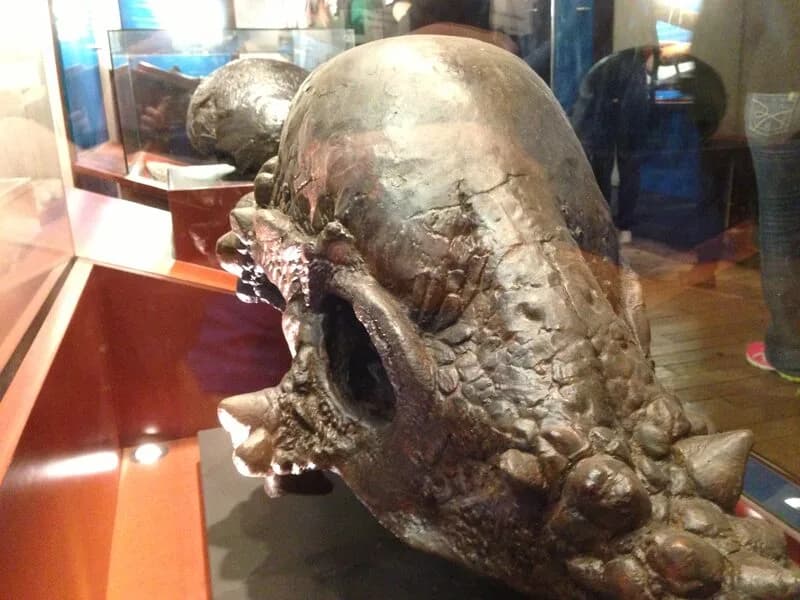
Comparative skulls of Dracorex, Stygimoloch and Pachycephalosaurus illustrating the ontogenetic debate
Wikimedia Commons, CC BY-SA