Loup terrible
Aenocyon dirus is not a wolf in the strict sense: a DNA analysis published in 2021 showed it split from the grey wolf lineage 5.7 million years ago, which earned it a genus of its own. At 1.5 to 1.7 metres and 50 to 80 kilograms, it ranged the Americas between 125,000 and 9,500 years ago. Rancho La Brea trapped over four thousand of them.
The dire wolf lived during the Pleistocene, approximately 125,000 to 9,500 years ago, making it one of the largest canids ever to exist. It first appeared in North America and later colonized South America during the Great American Biotic Interchange. Long classified as Canis dirus, a genomic study published in 2021 in Nature revealed it belonged to a distinct lineage diverging from grey wolves approximately 5.7 million years ago, justifying its reclassification into the genus Aenocyon. It vanished at the end of the Pleistocene during the American megafaunal extinction.
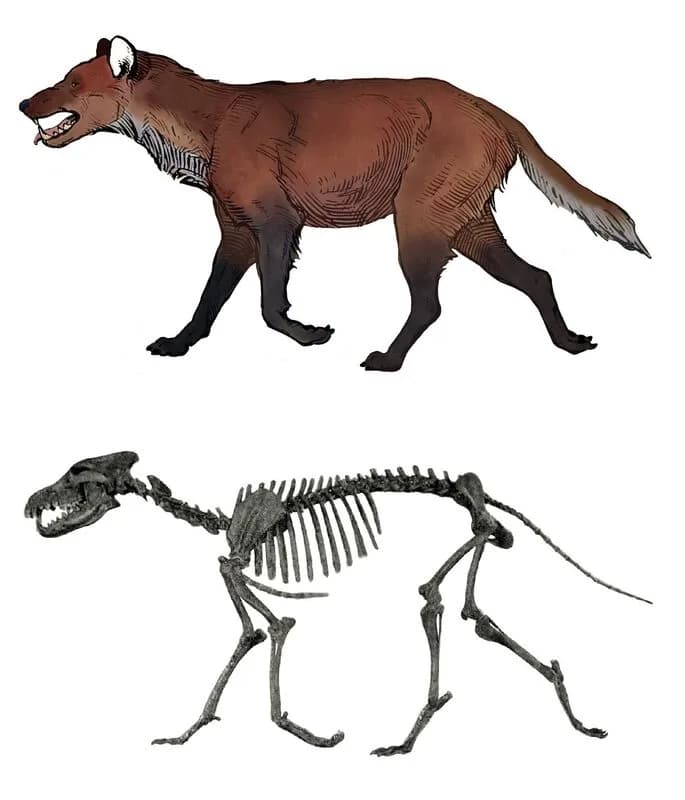
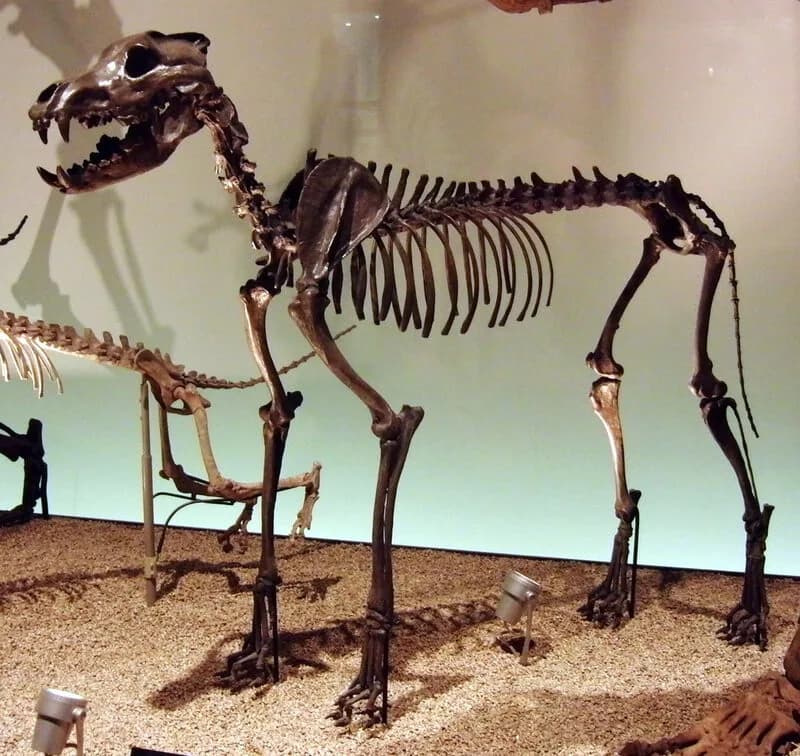
Aenocyon dirus measured approximately 1.5 meters in body length (excluding the tail) with a shoulder height of about 80 centimeters, making it slightly larger than the modern grey wolf. Its weight ranged between 50 and 80 kg, with particularly robust specimens possibly reaching 90 kg. Its overall build was considerably more massive and stocky than the modern grey wolf, with proportionally shorter and more robust limbs designed for powerful close-range combat rather than endurance running. Its skull was broader, its jaws significantly more powerful, and its dentition specifically adapted for crushing the bones of large Pleistocene herbivores.
The dire wolf was a hypercarnivore whose diet consisted primarily of large Pleistocene herbivores: American horses, ancient bison, camels, deer, and ground sloths. Isotopic analysis of its bones and dental wear patterns confirm a diet extremely rich in meat and bone. Its jaw possessed a bite force markedly superior to that of the grey wolf, capable of fracturing large bones to extract the nutritious marrow within. Unlike the grey wolf, its heavier and more muscular build suggests an ambush-style hunting strategy rather than prolonged pursuit, preferentially targeting weakened, injured, or trapped megafauna.
The dire wolf occupied a wide variety of habitats across the Americas, from open grasslands to temperate forests, from coastal plains to mountainous regions at various elevations. Its geographic range extended from southern Canada all the way to Bolivia and Venezuela in South America. It was particularly abundant in the plains and valleys of the American West. The Rancho La Brea tar pits in Los Angeles represent its most famous and prolific fossil site, where over 4,000 individual specimens have been extracted from the natural asphalt seeps, making it by far the most common mammal recovered from this exceptional Pleistocene locality.
The dire wolf's anatomy reflected a clear adaptation to megafaunal predation. Its skull, broader and considerably more robust than the grey wolf's, housed powerful jaw muscles generating an estimated bite force approximately 30% greater than that of modern wolves. Its premolars were massive and reinforced, specifically designed for bone-crushing. Its forelimbs, shorter and thicker than those of the grey wolf, indicate an animal less suited for endurance running but considerably more powerful in close-quarters combat with large prey. The landmark 2021 genomic study revealed it shared no gene flow whatsoever with grey wolves or coyotes despite millennia of coexistence across overlapping territories.
The dire wolf likely lived in organized packs with complex social hierarchies, as evidenced by the extraordinary abundance of remains at Rancho La Brea, where entire groups appear to have been lured by prey already trapped in the natural asphalt seeps. Specimens exhibiting severe healed fractures strongly suggest cooperative social behavior that allowed injured individuals to survive through communal food sharing and pack support. Its hunting strategy targeted large weakened or trapped herbivores. The millennia-long coexistence with grey wolves without any hybridization whatsoever confirms complete reproductive isolation between the two species despite occupying similar habitats.
The dire wolf was first described in 1858 by paleontologist Joseph Leidy, based on a fragmentary skull discovered along the banks of the Ohio River in Indiana. The species name dirus means 'dire' or 'fearful' in Latin, reflecting its imposing stature. Rancho La Brea in Los Angeles is by far the most prolific site, having yielded over 4,000 individual specimens since systematic excavations began in the early 20th century. In 2021, ancient DNA analysis extracted from five well-preserved specimens revolutionized its entire taxonomic classification, removing it from the genus Canis and placing it in the newly established genus Aenocyon, meaning 'terrible wolf.'
| Period | Pléistocène / Pleistocene |
| Era | Cénozoïque / Cenozoic |
| Age | 125 000 - 9 500 ans |
| Location | Amériques / Americas |
| Length | 1.5-1.7 m |
| Height | 0.8-0.9 m |
| Weight | 50-80 kg |
| Diet | Carnivore |
| Discovery | 1858 |
Aenocyon dirus measured about 1.5 meters in body length, stood 80 centimeters at the shoulder, and weighed between 50 and 80 kg — slightly larger and notably more massive than the modern grey wolf. Its stocky build and broader jaws gave it an estimated bite force roughly 30% greater than that of a living grey wolf.
No. Despite its name, Aenocyon dirus was not a true wolf. A 2021 genomic study published in Nature revealed its lineage diverged from grey wolves approximately 5.7 million years ago. Despite millennia of coexistence in North America, the two species never produced hybrids, confirming complete reproductive isolation throughout their shared history.
Rancho La Brea in Los Angeles has yielded over 4,000 Aenocyon dirus specimens, making it the most abundant mammal at the site. Dire wolves were likely drawn in by prey already trapped in the natural asphalt seeps and became ensnared themselves. Some specimens show healed fractures, indicating cooperative pack living where injured individuals were supported by the group.
Information on this page is based on peer-reviewed scientific publications.
Reconstructed Aenocyon dirus skeleton at the George C. Page Museum
Wikimedia Commons
Artistic reconstruction of the dire wolf in its Pleistocene environment
Wikimedia Commons