Dragon empereur
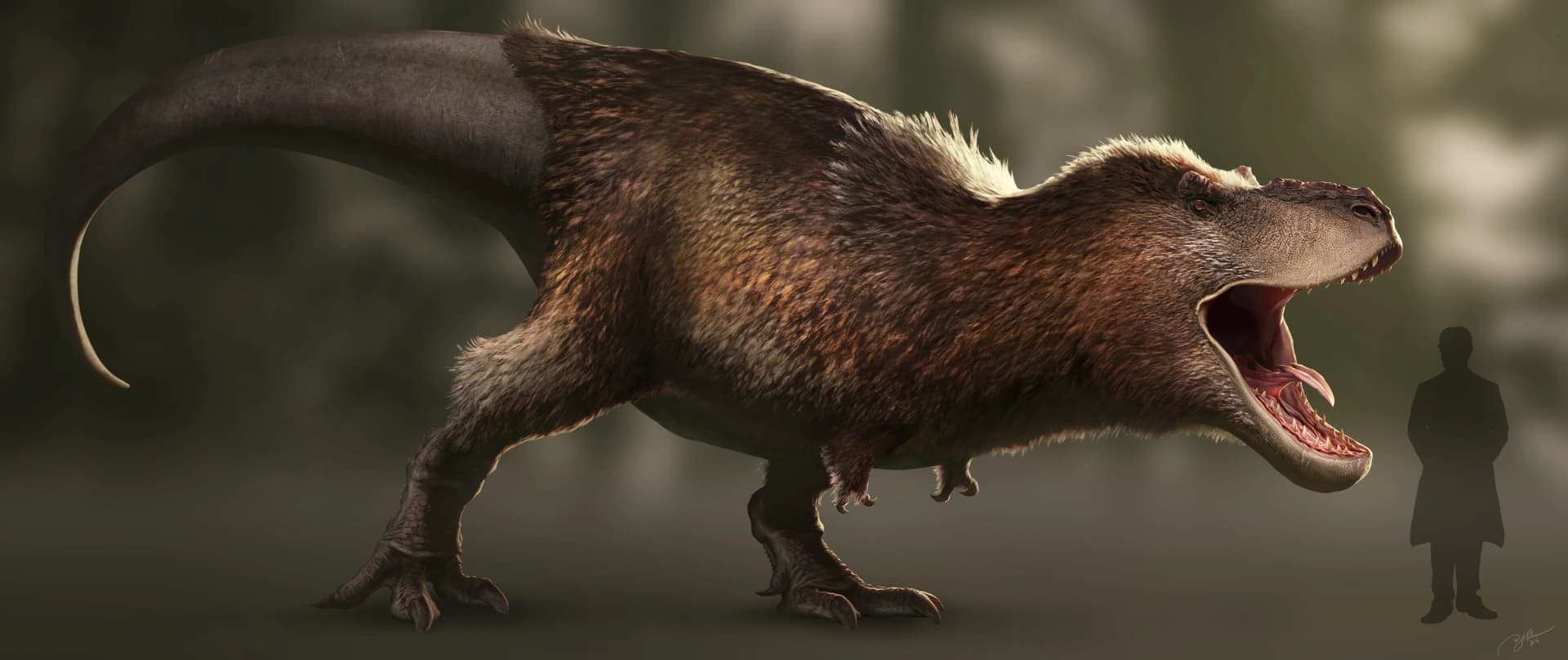
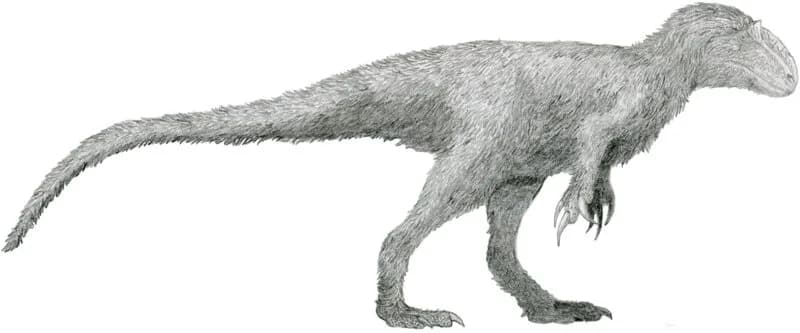
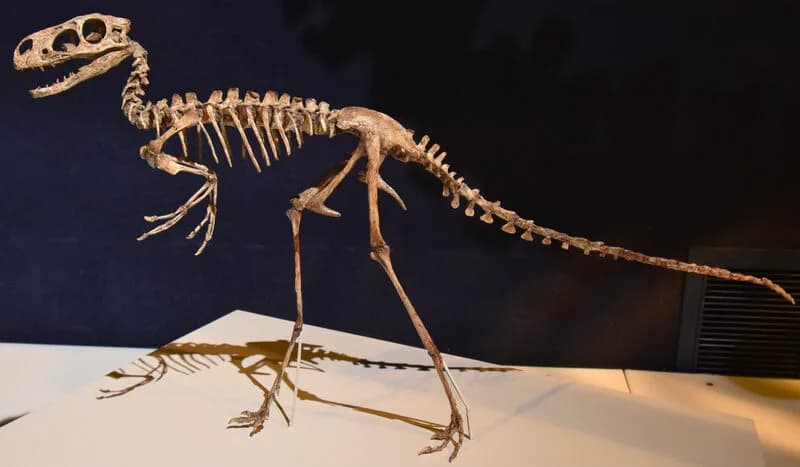
Dilong paradoxus is the first tyrannosauroid found with proto-feathers, in 2004 in Liaoning province: evidence that the ancestors of Tyrannosaurus rex were feathered. It measured just 1.6 metres and 5 to 10 kilograms, 126 million years ago. Its name, « emperor dragon », sits oddly on an animal the size of a turkey.
Dilong lived during the Early Cretaceous, approximately 126 million years ago, during the Aptian stage. It inhabited Liaoning Province in China, in the same extraordinarily rich Jehol biota ecosystem that yielded so many feathered dinosaurs. This period predates its giant descendant, Tyrannosaurus rex, by 60 million years, offering a notable glimpse into the humble origins of the tyrannosaurid lineage. The exceptional fossilization conditions of this region, linked to intense volcanic activity, preserved remarkable anatomical details including soft tissue structures and filamentous integumentary coverings.
Dilong was a small primitive tyrannosaurid measuring approximately 1.6 meters in length, 50 centimeters tall at the hips, and weighing an estimated 5 to 10 kilograms. Compared to its famous descendant T. rex at 12 meters, Dilong appears tiny, but its modest size was typical of early tyrannosaurids from the Early Cretaceous. Its gracile body and long hind legs made it an agile and fast runner. Its proportions more closely resemble those of a small generalist coelurosaur than those of an apex predator.
An active carnivore, Dilong hunted small vertebrates, lizards, primitive mammals, and possibly young dinosaurs in the undergrowth of its forested environment. Its teeth were characteristic of tyrannosaurids: D-shaped in cross-section at the premaxilla, a distinctive trait of the entire lineage. Unlike its descendant T. rex with bone-crushing jaws, Dilong possessed a much more modest bite adapted to small-sized prey. Its lateral teeth, finely serrated along the edges, were effective for slicing through the flesh of its small quarry. This predatory niche was shared with several other small theropods in the Jehol ecosystem.
Dilong lived in the temperate forests and lacustrine zones of Liaoning Province in northeastern China. The Jehol biota ecosystem of the Early Cretaceous was a volcanic environment with lakes, rivers, and forests of conifers and ferns. This habitat supported a diverse fauna including other feathered dinosaurs, primitive birds, mammals, pterosaurs, and numerous invertebrates. Frequent volcanic eruptions periodically buried the local fauna under layers of fine ash, preserving fossils of exceptional quality. The region's seasonal climate, with warm summers and cool winters, likely influenced Dilong's activity patterns and prey availability throughout the year.
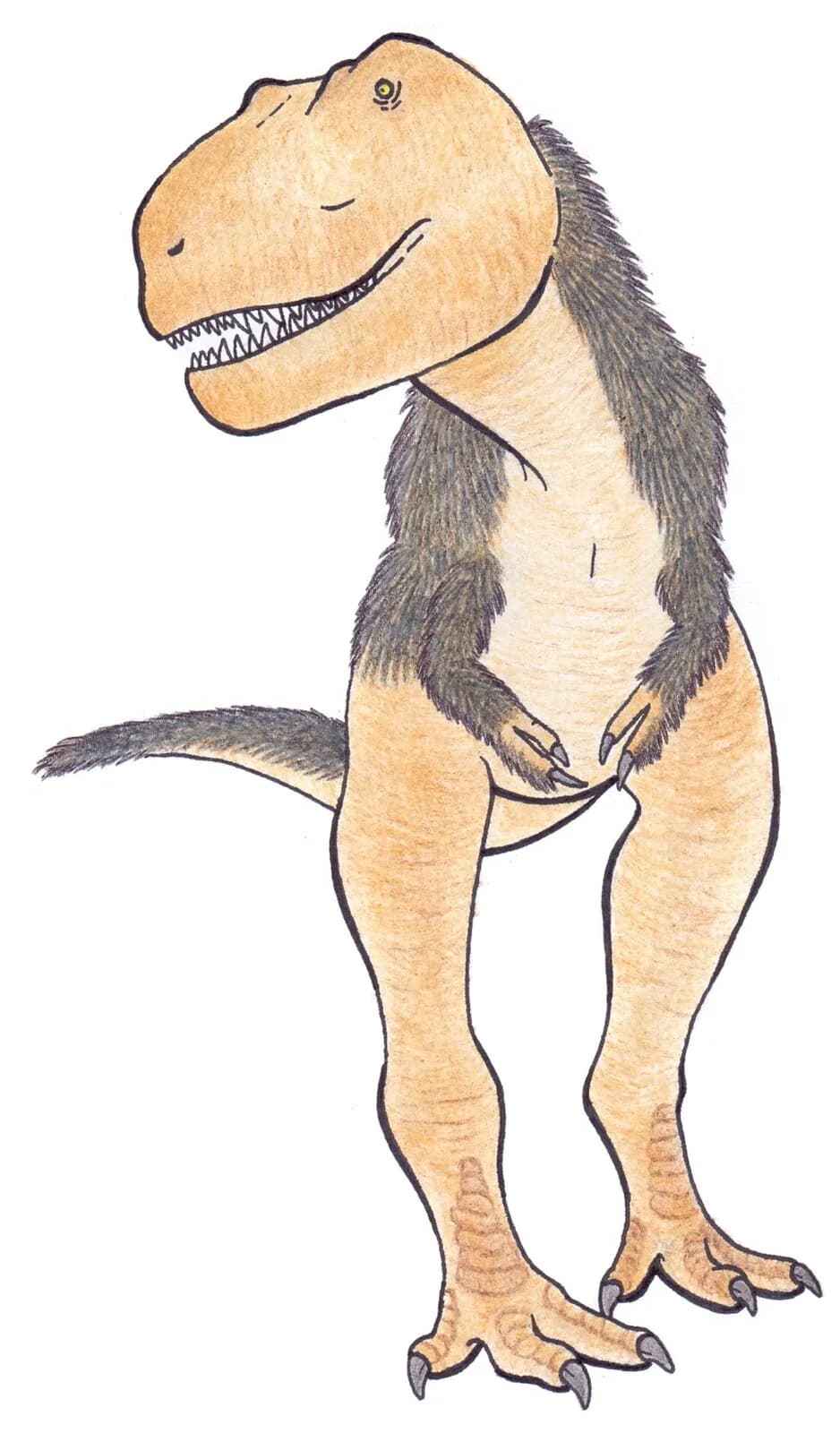
The anatomy of Dilong presents a notable mix of primitive traits and tyrannosauroid characteristics. Its elongated skull already showed the D-shaped premaxillary teeth typical of tyrannosaurids. Remarkably, the fossil exhibited filamentous integumentary structures — proto-feathers — on the tail and along the body, proving that T. rex ancestors bore plumage. Its forelimbs were proportionally longer than those of T. rex, with three functional digits instead of two. The braincase indicates a relatively large brain for its body size, consistent with the intelligence observed across the tyrannosauroid lineage.
Dilong was likely an active, agile terrestrial predator, hunting by ambush in the undergrowth or pursuing prey at speed. Its filamentous proto-feather plumage served primarily for thermal insulation, essential for maintaining body temperature in the temperate climate of Liaoning. As a small predator, it had to be wary of larger theropods in its ecosystem. Its modest size and agility allowed it to exploit ecological niches inaccessible to larger predators. Its binocular vision, a trait shared with other tyrannosauroids, gave it excellent depth perception for hunting.
Dilong paradoxus was described in 2004 by Xu Xing and colleagues from a remarkably complete specimen discovered in the Yixian Formation in Liaoning, China. The name means 'paradoxical emperor dragon' — 'Di' for emperor and 'long' for dragon in Mandarin — referencing its unexpected position as a feathered ancestor of the tyrannosaurid lineage. The discovery was revolutionary because it demonstrated for the first time that even tyrannosaurids bore feathers at a stage in their evolution. The holotype specimen is catalogued as IVPP V14243 at the Institute of Vertebrate Paleontology and Paleoanthropology in Beijing.
| Period | Crétacé inférieur / Early Cretaceous |
| Era | Mésozoïque / Mesozoic |
| Age | 126 Ma |
| Location | Chine (Liaoning) / China (Liaoning) |
| Length | 1.6 m |
| Height | 0.5 m |
| Weight | 5-10 kg |
| Diet | Carnivore |
| Discovery | 2004 |
Yes. The Dilong paradoxus fossil displays filamentous integumentary structures — proto-feathers — on the tail and along the body. This discovery by Xu Xing in 2004 (Yixian Formation, Liaoning, China) proved that Tyrannosaurus rex ancestors bore plumage, likely for thermal insulation in the temperate Early Cretaceous climate.
Dilong paradoxus measured only 1.6 meters long and weighed 5 to 10 kilograms, living some 60 million years before T. rex which reached 12 meters and 8 tonnes. This small primitive tyrannosaurid from the Jehol biota (Liaoning) had proportionally longer forelimbs than T. rex with three functional digits rather than two.
Dilong paradoxus was carnivorous, hunting small vertebrates, lizards, primitive mammals, and possibly young dinosaurs in the Liaoning undergrowth. Its D-shaped premaxillary teeth in cross-section — a distinctive trait of all tyrannosaurids — and finely serrated lateral teeth were adapted for slicing through small prey flesh, not for bone-crushing as in T. rex.
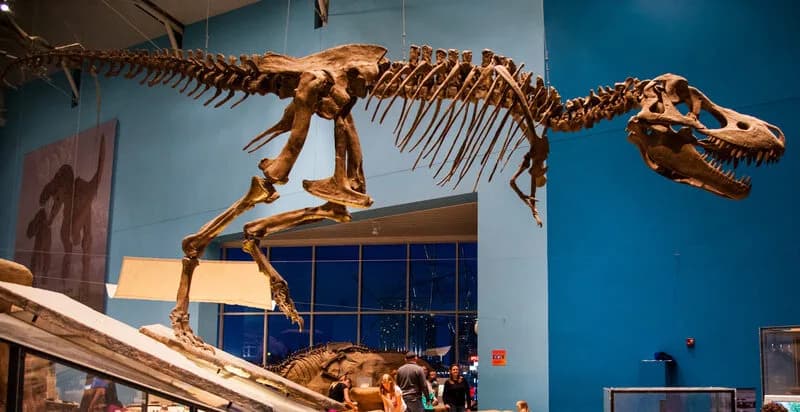
Dilong paradoxus cast
Wikimedia Commons, CC BY-SA
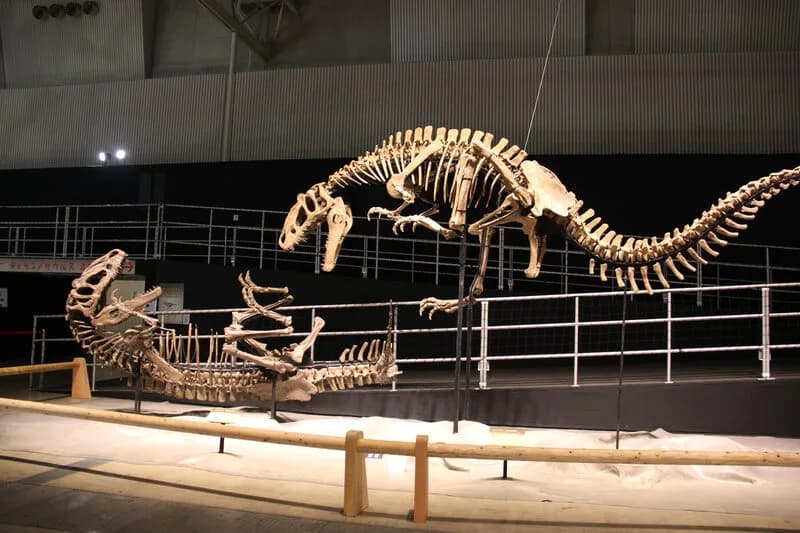
Restoration of a primitive feathered tyrannosauroid
Wikimedia Commons, CC BY-SA