Cochon terrible
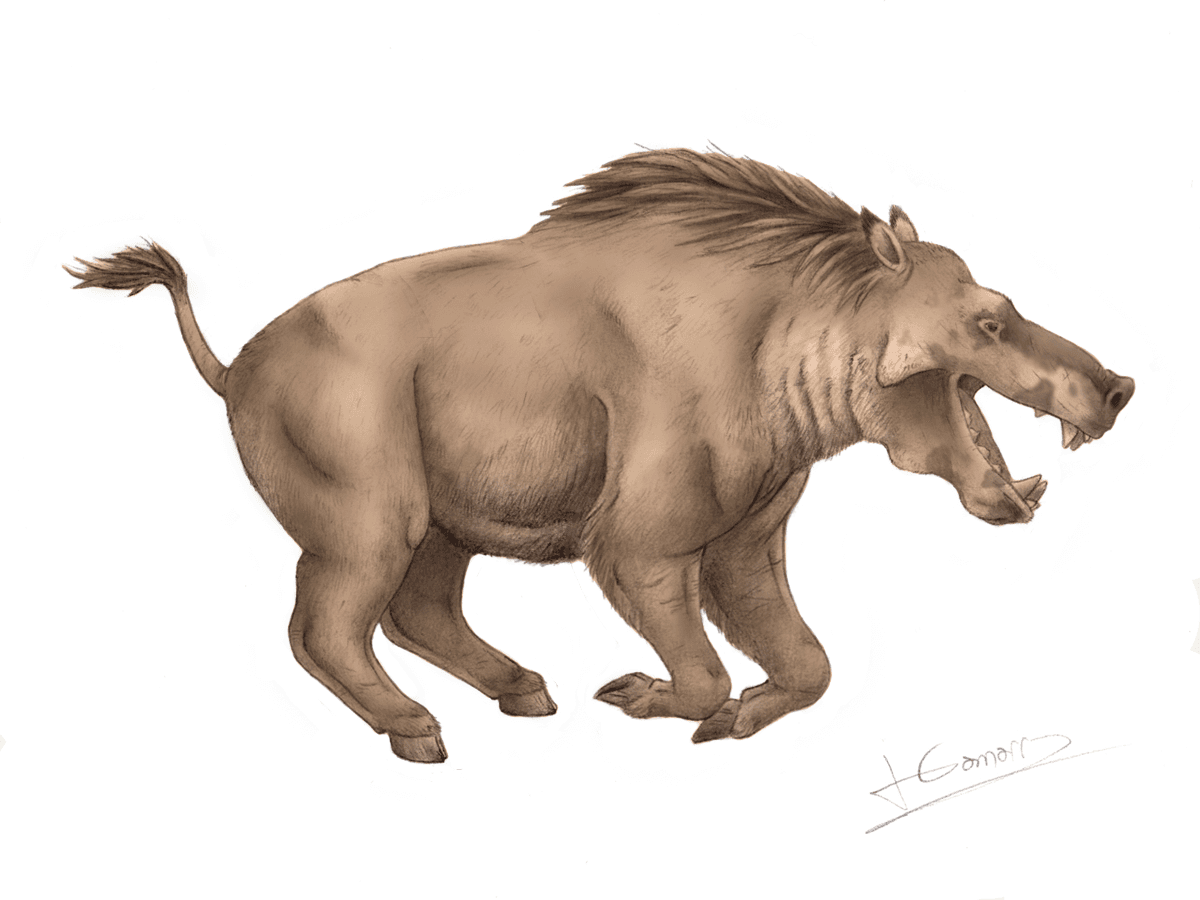
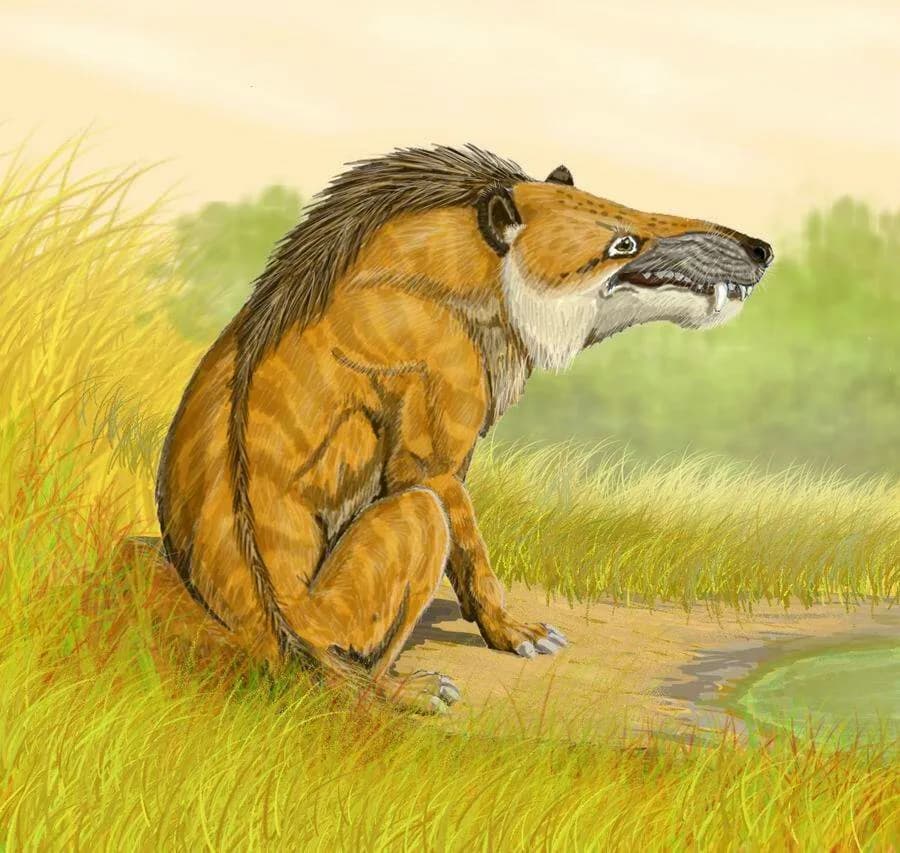
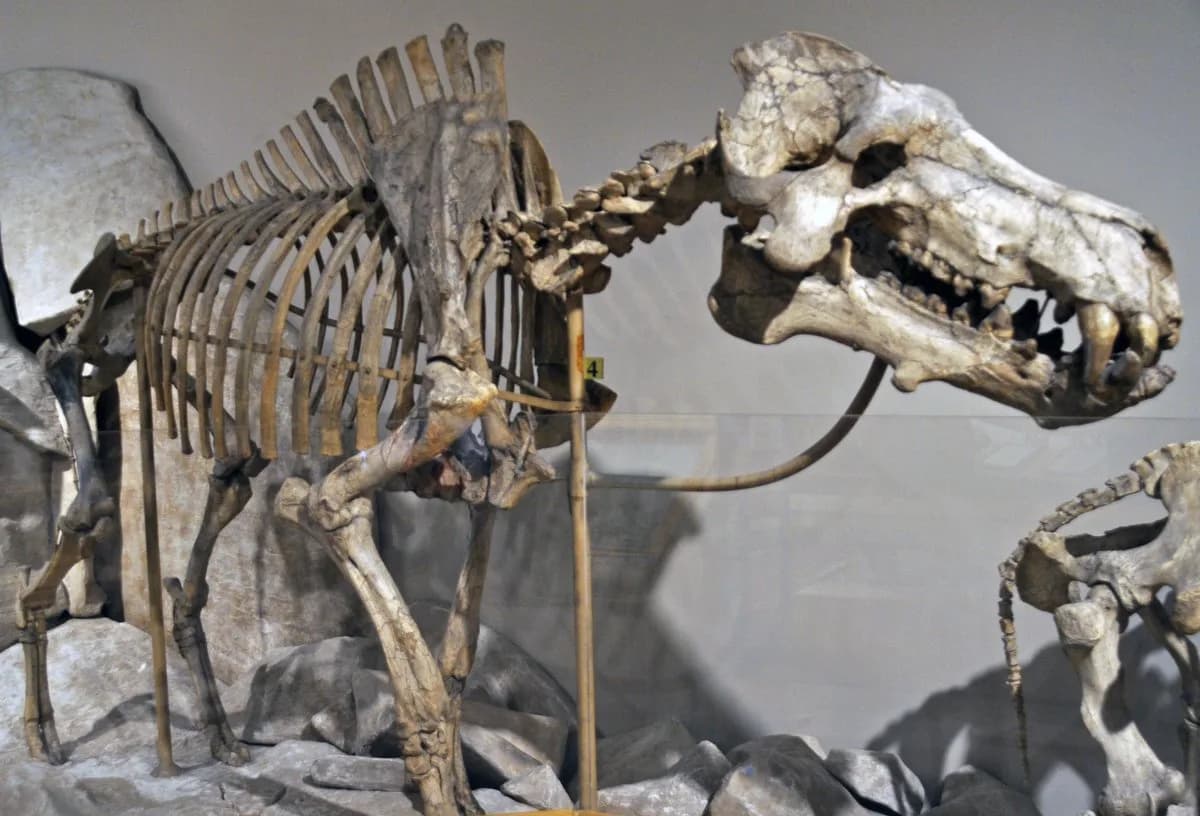
Daeodon shoshonensis was a North American entelodont described in 1879, living 29 to 19 million years ago. At 3 metres long and 600 to 900 kilograms, it carried a 90-centimetre skull — one of the largest known for any non-elephant land mammal. Nicknamed hell pig, it was not a pig at all: its closest relatives are hippos and whales.
Daeodon shoshonensis lived during the Early Miocene in North America, approximately 29 to 19 million years ago, a period of major transition for the continent's terrestrial ecosystems. This colossus belonged to the family Entelodontidae, a group of artiodactyl mammals often nicknamed 'hell pigs' due to their terrifying appearance, although they were not truly related to modern pigs. Daeodon was the last and largest representative of its family, dominating the North American Miocene plains alongside early horses, rhinoceroses, and camels. It disappeared around 19 million years ago, likely due to climate changes that transformed forests into open grasslands and competition with new predators and scavengers better adapted to these changing environments.
Daeodon shoshonensis was the largest known entelodont and one of the most imposing terrestrial omnivorous mammals of the Cenozoic. It measured approximately 3 meters in length with an impressive shoulder height of 1.8 meters, roughly the height of an adult human. Its estimated weight ranged between 600 and 900 kilograms, rivaling that of the largest modern bears. Its skull alone measured nearly 90 centimeters long, almost a full meter, making it one of the largest non-proboscidean terrestrial mammal skulls ever discovered. Its build was massive and robust, with a barrel-shaped torso supported by powerful but relatively gracile limbs relative to its mass. Males were probably larger than females, a sexual dimorphism common among large social mammals.
Daeodon shoshonensis was an opportunistic omnivore with strongly carnivorous and scavenging tendencies. Its diet was remarkably diverse, including carrion, live prey, roots, tubers, and probably fruits. Its titanic jaws were capable of crushing bones with ease, allowing it to access nutrient-rich bone marrow, a considerable advantage in the competitive Miocene ecosystems. Dental wear analyses and cranial morphology studies suggest it combined active predation of small and medium-sized herbivores with regular scavenging of carcasses abandoned by other predators. Its jaw possessed an estimated bite force of over 450 kilograms, comparable to that of a modern grizzly bear. Bite marks attributed to Daeodon have been found on fossil bones of primitive horses and rhinoceroses.
Daeodon shoshonensis occupied the vast plains and open woodlands of North America during the Early Miocene, a period when the continent was undergoing profound ecological transformation. Its range extended across the western and central present-day United States, with fossils discovered in Nebraska, South Dakota, Wyoming, Oregon, and California. The North American landscape of this era consisted of mosaics of emerging grasslands, riparian forests, and scrubland zones, offering this large omnivore a variety of food resources. The climate was warmer and more humid than today, with less pronounced seasons. Daeodon shared its habitat with a diverse fauna including the first American mustangs, hornless rhinoceroses, oreodonts, and other herbivores that constituted its potential prey.
The anatomy of Daeodon shoshonensis was spectacularly adapted to its lifestyle as a large-scale predator-scavenger. Its massive 90-centimeter skull was equipped with lateral bony protuberances on the cheekbones and lower jaw, forming bumps and ridges that likely served as anchors for hypertrophied masticatory muscles and as visual signals during intraspecific confrontations. Its dentition was heterodont and versatile: robust incisors for tearing flesh, conical canines for grasping and killing, and broad flat molars for crushing bones and tough vegetation. Its neck was short and extremely muscular, supporting the enormous head with cervical vertebrae bearing elongated spinous processes. Its legs terminated in two main toes with hooves, typical of artiodactyls, but its posture was more digitigrade than that of modern pigs.
Daeodon shoshonensis was probably a social animal living in small hierarchical groups, similar to modern peccaries or warthogs. The pronounced bony protuberances on its skull, often showing traces of healed trauma, suggest frequent ritualized fighting between males for access to females and group dominance. Its feeding strategy was most likely that of a dominant kleptoparasite: using its imposing size and aggression to drive other predators from their kills, while being capable of killing medium-sized herbivores itself. Fossil accumulations of multiple individuals at certain sites indicate at least occasional gregarious behavior. Its travel speed was probably moderate, compensated by considerable endurance and relative intelligence, as evidenced by its proportionally large brain for an artiodactyl of this period.
The genus Daeodon was first described in 1879 by American paleontologist Edward Drinker Cope, one of the protagonists of the famous 'Bone Wars' against his rival Othniel Charles Marsh. The name Daeodon means 'destructive tooth' in ancient Greek, an apt reference to its formidable dentition. The first fossils were discovered in the Agate Springs geological formations in Nebraska and the Badlands of South Dakota, sites that have yielded some of the richest fossil mammal deposits in North America. The most complete specimen, a nearly entire skull measuring 90 centimeters, is housed at Yale University's Peabody Museum of Natural History. Other important discoveries include partial skeletons in Oregon and California. For a long time, Daeodon was confused with another entelodont named Dinohyus, but taxonomic studies confirmed they were the same genus.
| Period | Miocène inférieur / Early Miocene |
| Era | Cénozoïque / Cenozoic |
| Age | 29 - 19 Ma |
| Location | Amérique du Nord / North America |
| Length | 3 m |
| Height | 1.8 m (au garrot / at shoulder) |
| Weight | 600-900 kg |
| Diet | Omnivore |
| Discovery | 1879 |
Daeodon shoshonensis was neither a dinosaur nor a pig. It was an entelodont, an artiodactyl mammal of the Early Miocene (29-19 Ma), appearing long after the extinction of dinosaurs. Despite its nickname 'hell pig,' entelodonts are phylogenetically closer to hippos and whales than to modern suids. Daeodon was the last and largest representative of this entirely extinct family.
Daeodon shoshonensis had an estimated bite force of over 450 kg, comparable to a modern grizzly bear. Its 90 cm skull bore hypertrophied masticatory muscles anchored on lateral bony protuberances. This jaw allowed it to crush bones to access nutrient-rich marrow, a resource ignored by most predators. Bite marks attributed to Daeodon have been found on fossil bones of primitive horses and rhinoceroses.
For a long time, Daeodon shoshonensis and Dinohyus hollandi were treated as distinct genera based on incomplete fossil material from different Nebraska and South Dakota localities. Taxonomic studies comparing more complete specimens from the Agate Springs Formation — including the 90 cm skull housed at Yale's Peabody Museum — eventually established that Dinohyus was a junior synonym of Daeodon, described in 1879 by Edward Drinker Cope.
Fossil skeleton of Daeodon shoshonensis on museum display
Wikimedia Commons
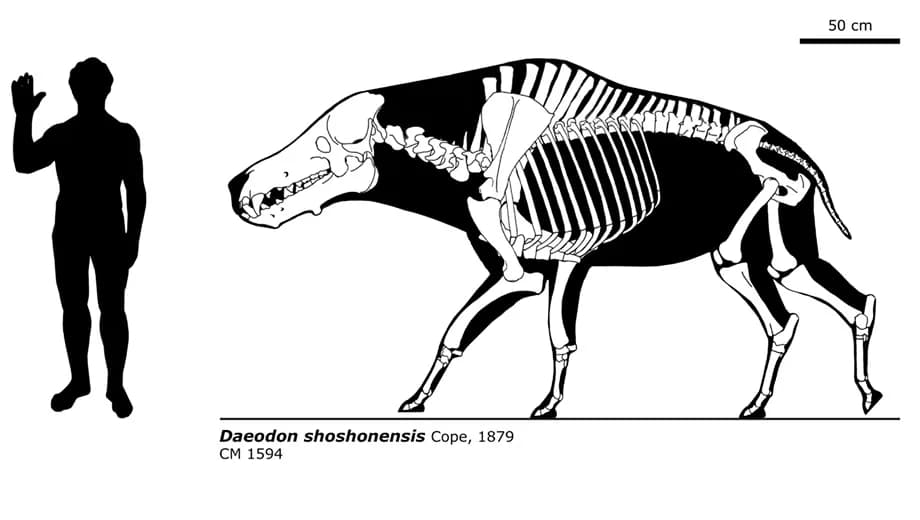
Skeletal diagram of Daeodon showing its massive proportions
Wikimedia Commons