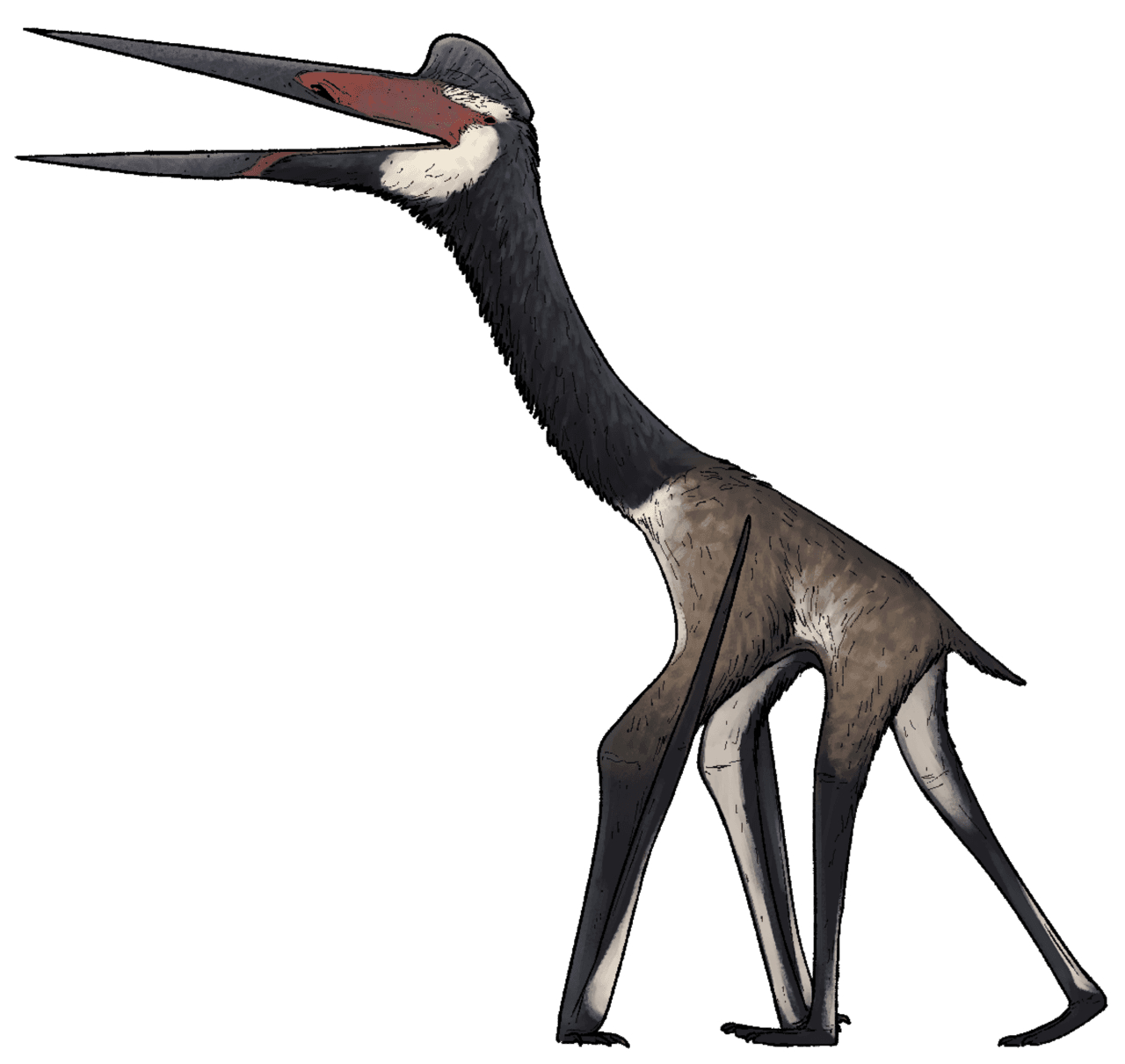
Cryodrakon
Cryodrakon boreas is the first giant pterosaur named from Canadian fossils: around 250 kilograms, described in 2019 from bones found in Dinosaur Provincial Park, Alberta, dated to 76 million years ago. Its name means « frozen dragon », echoing the province's winters. Its remains had long been wrongly filed among those of Quetzalcoatlus.
Cryodrakon boreas ruled the skies of North America during the Late Cretaceous period, approximately 76 million years ago (Campanian stage). This giant pterosaur soared above the alluvial plains and subtropical forests of what is now the province of Alberta, Canada. It shared its environment with many famous dinosaurs from Dinosaur Provincial Park, including ceratopsians and hadrosaurs that populated the banks of winding rivers in this lush region. Its time period corresponds to an era of tremendous biological diversity in western North America, just before the catastrophic end-Cretaceous mass extinction event.
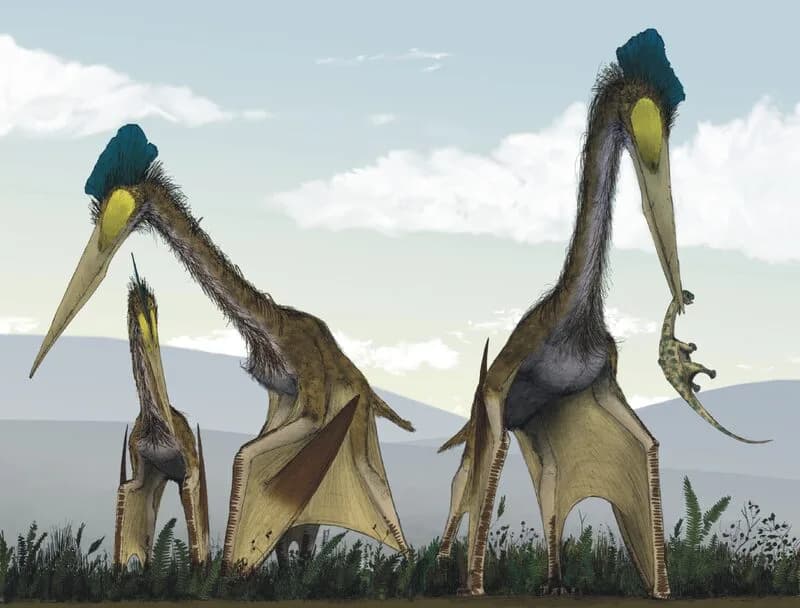
Cryodrakon boreas ranked among the largest flying animals that ever existed on Earth. Its wingspan reached approximately 10 meters, rivaling that of the famous Quetzalcoatlus. On the ground, standing on all four limbs, it was as tall as a modern giraffe, probably reaching 3.5 to 4 meters in height. Despite this colossal size, its weight remained relatively moderate thanks to its hollow, pneumatized bones characteristic of pterosaurs. Its mass is estimated at around 250 kilograms, making it a lightweight giant capable of flight despite its impressive terrestrial proportions and enormous overall dimensions.
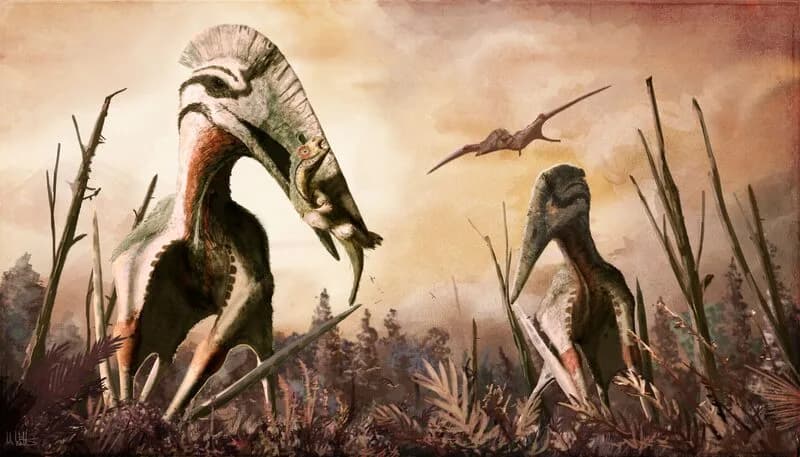
Cryodrakon boreas was an opportunistic carnivore that fed primarily on the ground rather than in flight. Like other azhdarchids, it adopted a terrestrial hunting strategy similar to that of modern storks and marabous, striding across plains in search of prey. Its diet likely included small juvenile dinosaurs, lizards, primitive mammals, amphibians, and possibly fish from shallow waterways. Its long neck and powerful toothless beak allowed it to seize and swallow sizeable prey in a single rapid and precise movement, making it a formidable terrestrial predator in its ecosystem.
Cryodrakon boreas lived in the rich and diverse environment of Dinosaur Provincial Park in southern Alberta, Canada. During the Campanian, this region was a vast subtropical coastal plain bordering the Western Interior Seaway, featuring winding rivers, conifer forests, and tree fern groves. The climate was warm and humid, fostering exceptional biodiversity. This giant pterosaur coexisted with iconic dinosaurs such as Centrosaurus, Corythosaurus, Gorgosaurus, and Styracosaurus, as well as numerous crocodilians, turtles, and freshwater fish that inhabited the waterways of this incredibly productive ecosystem.
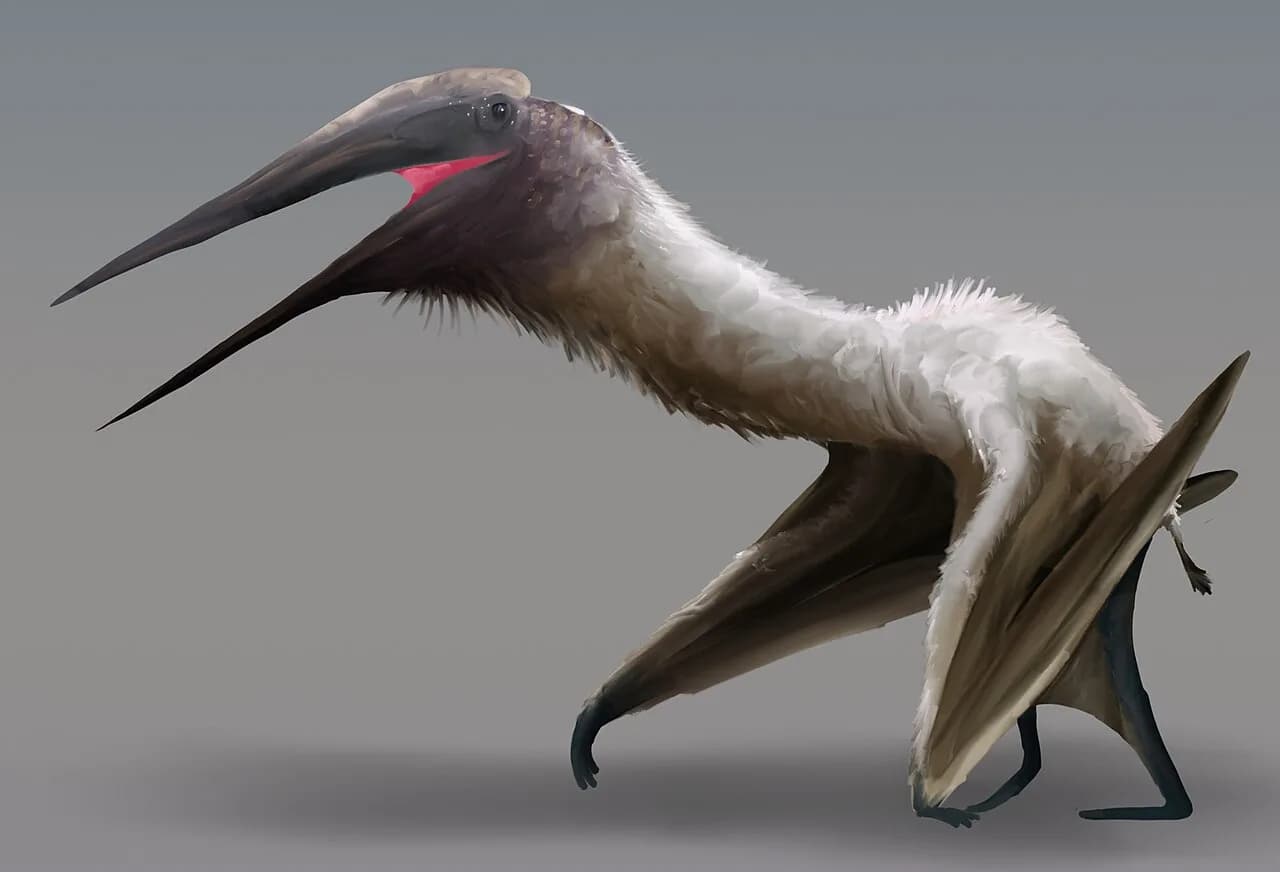
Cryodrakon boreas displayed the characteristic anatomy of giant azhdarchids. Its elongated skull bore a massive, toothless, pointed beak perfectly adapted for seizing prey on the ground. Its exceptionally long and rigid neck, composed of reinforced tubular cervical vertebrae, gave it considerable reach for catching prey. Its immense wings were supported by a hypertrophied fourth finger, and its wing membrane extended to the hind limbs. On the ground, it walked quadrupedally by folding its wings, with its robust forelimbs supporting a significant portion of its total body weight during terrestrial locomotion.
Cryodrakon boreas behaved as a terrestrial stalker, roaming plains and riverbanks in search of prey, much like a giant marabou stork. Unlike the popular image of pterosaurs constantly soaring above seas, azhdarchids like Cryodrakon spent a considerable amount of their time on the ground hunting. To take off, it likely used a quadrupedal launch technique, powerfully propelling itself with its muscular forelimbs before deploying its immense wings. In flight, it exploited rising thermal currents to soar over very long distances with minimal effort, covering vast territories across the Late Cretaceous landscape.
The fossils of Cryodrakon boreas were officially described in 2019 by David Hone and colleagues, but the first specimens had been discovered as early as 1992 in Dinosaur Provincial Park in Alberta, Canada. For 27 years, these bones were incorrectly attributed to the genus Quetzalcoatlus, the famous giant pterosaur from Texas. Detailed analysis of cervical vertebrae and other skeletal elements revealed significant anatomical differences justifying the creation of a new genus. Cryodrakon boreas is the first giant pterosaur species named from Canadian fossils, a landmark discovery for Canadian paleontology and our understanding of azhdarchid diversity.
| Period | Crétacé supérieur / Late Cretaceous |
| Era | Mésozoïque / Mesozoic |
| Age | 76 Ma |
| Location | Dinosaur Provincial Park, Alberta, Canada / Dinosaur Provincial Park, Alberta, Canada |
| Length | N/A |
| Height | 3.5-4 m (au sol / on ground) |
| Weight | ~250 kg |
| Diet | Piscivore |
| Discovery | 2019 |
No, Cryodrakon boreas was an azhdarchid pterosaur, a flying reptile distinct from dinosaurs. It lived during the Late Cretaceous, approximately 76 million years ago, in what is now Alberta, Canada. Pterosaurs form their own group of archosaurian reptiles, separate from dinosaurs since the Triassic. Cryodrakon was described in 2019 from fossils discovered as early as 1992 at Dinosaur Provincial Park.
Cryodrakon boreas reached a wingspan of approximately 10 meters with an estimated weight of 250 kg, as tall as a giraffe on the ground (3.5 to 4 m). Like other azhdarchids, it hunted primarily on the ground like a giant marabou stork, stalking plains and riverbanks to seize small juvenile dinosaurs, lizards, and primitive mammals with its elongated toothless beak.
The fossils of Cryodrakon boreas, discovered in 1992 at Dinosaur Provincial Park in Alberta, were attributed to Quetzalcoatlus, the only giant North American azhdarchid known at the time. It was the detailed analysis by David Hone and colleagues (2019) of cervical vertebrae and other skeletal elements that revealed sufficient anatomical differences to create a new genus. Cryodrakon is thus the first giant pterosaur named from Canadian fossils.
Cryodrakon boreas reconstruction
Wikimedia Commons
Cryodrakon illustration
Wikimedia Commons