Queue à plumes
Caudipteryx zoui is a small feathered theropod about one metre long and 5 to 7 kilograms, described in 1998 from Liaoning province, China. It lived 125 to 120 million years ago. Its wing feathers, too short to carry its weight, most likely served for display. Its discovery weighed heavily in showing that birds descend from theropod dinosaurs.
Caudipteryx lived during the Early Cretaceous, approximately 125 to 120 million years ago, in Liaoning Province, China. This small feathered theropod dinosaur is one of the most important fossils in the history of paleontology, as it constitutes one of the most direct pieces of evidence for the evolutionary link between dinosaurs and birds. Caudipteryx was discovered in the famous fossil beds of the Yixian Formation, an exceptional Lagerstätte that preserved feathers, soft tissues, and anatomical details with stunning fidelity. Its discovery in 1998 contributed decisively to closing the centuries-old debate about the dinosaurian origin of birds.
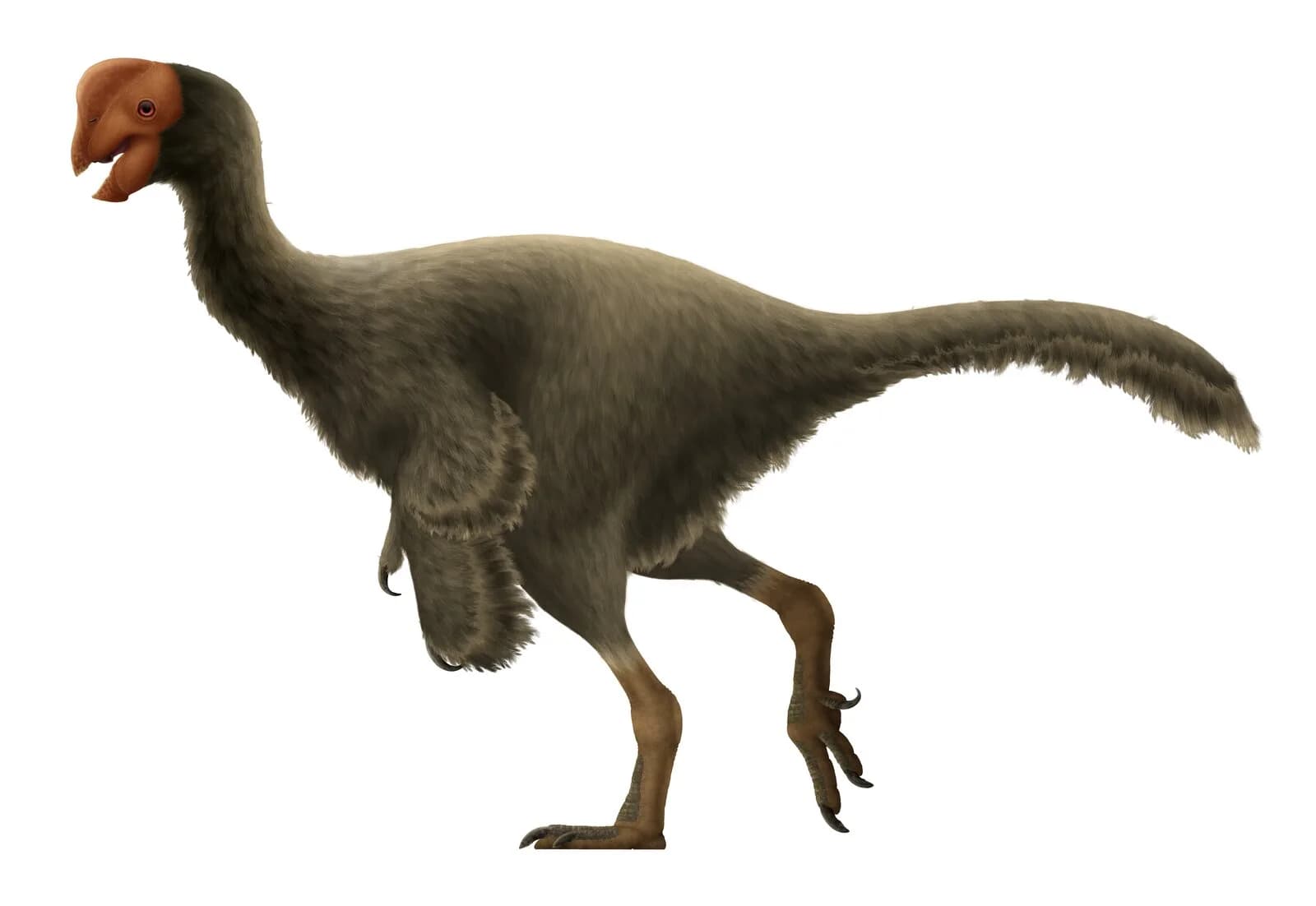
Caudipteryx was a small dinosaur approximately the size of a modern peacock, measuring about 1 meter long with an estimated weight of 5 to 7 kilograms. Its small head measured only about 8 centimeters long, perched on a relatively short and flexible neck. Its body was compact and light, with elongated, slender hindlimbs adapted for fast running, recalling the silhouette of a ground-dwelling bird like a pheasant or peacock. Its short arms bore long pennaceous feathers forming a structure similar to small wings, and its short tail was adorned with a fan of symmetrical feathers — the characteristic that gave it its name.
Caudipteryx was most likely an omnivore with a predominantly herbivorous tendency. Its short beak, toothless at the front of the jaw with only a few small teeth on the upper premaxilla, was adapted for pecking seeds, fruits, and small invertebrates. The discovery of gastroliths — small stones swallowed to aid digestion — in the abdominal cavity of several specimens confirms a diet rich in plant material, a trait shared with many modern herbivorous birds. These gastroliths served to grind seeds and tough vegetation in the gizzard, compensating for the absence of grinding teeth. Its diet likely varied seasonally, with more insects in spring.
Caudipteryx inhabited the lacustrine and forested environments of the Yixian Formation in northeastern China. This region was dominated by volcanic lakes surrounded by conifer and ginkgo forests, in a temperate to subtropical climate. Periodic volcanic eruptions producing toxic ash clouds are paradoxically responsible for the exceptional fossil preservation, as the ash rapidly buried organisms and prevented their decomposition. Caudipteryx shared this ecosystem with a multitude of other feathered dinosaurs, primitive birds, mammals, and pterosaurs, forming one of the most diverse known Cretaceous ecosystems.
The anatomy of Caudipteryx is an extraordinary blend of dinosaurian and avian characters that makes it an almost perfect 'transitional fossil.' Its body was covered in different types of feathers: filamentous down on the torso, asymmetrical pennaceous feathers on the arms, and symmetrical pennaceous feathers forming a caudal fan. Its arms, too short to permit flight, nonetheless bore true remiges, flight feathers without aerodynamic function, a crucial evolutionary vestige. Its toothless beak resembled that of modern birds, but its skeleton retained many theropod traits: clawed hands, a long bony tail, and dinosaurian pelvic structure. Its long, slender hind legs were clearly adapted for running.
The behavior of Caudipteryx can be reconstructed thanks to the excellent preservation of multiple specimens and by comparison with modern ground-dwelling birds. It was a fast terrestrial animal, running on its long hind legs in the manner of a modern ground bird like a pheasant or prairie chicken. Its wing feathers, too small for flight, were probably used during courtship displays, a behavior similar to that of modern ostriches that spread their wings during mating dances. The fan of tail feathers likely played a similar role in visual signals for social communication and sexual selection. It probably lived in small groups in the understory of lakeside forests.
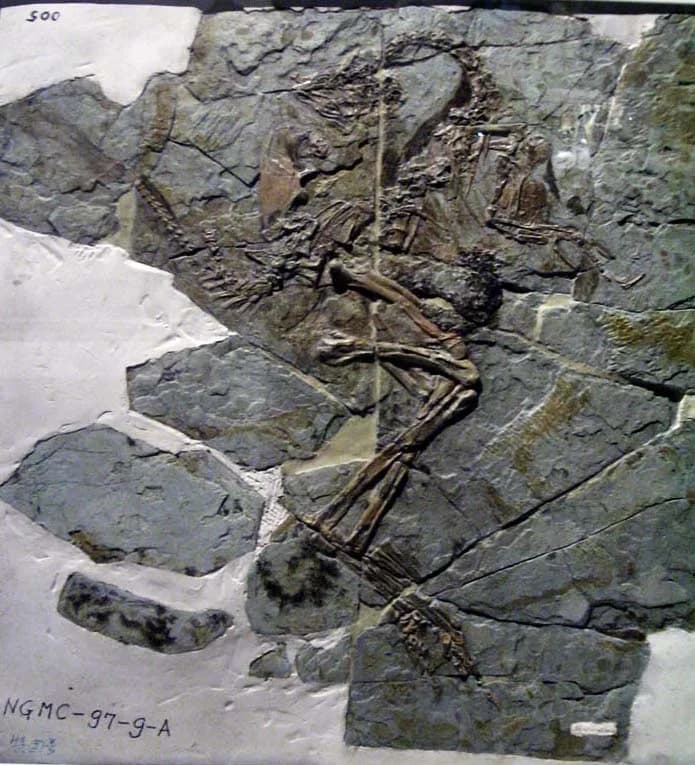
The first fossils of Caudipteryx were discovered in Liaoning Province, China, and described by Ji Qiang, Currie, Norell, and Ji Shu-An in 1998 in the journal Nature, sending shockwaves through the paleontological world. The holotype specimen, remarkably preserved, clearly showed pennaceous feathers on the arms and tail, providing irrefutable proof that non-avian dinosaurs possessed true feathers. Two species are recognized: C. zoui and C. dongi. Several complete specimens have been found since, some even preserving stomach contents (gastroliths) and microscopic details of the plumage. The Yixian Formation continues to yield extraordinary fossils that complete our understanding of this key animal in avian evolution.
| Period | Crétacé inférieur / Early Cretaceous (Aptien) |
| Era | Mésozoïque / Mesozoic |
| Age | 125–120 millions d'années / 125–120 million years ago |
| Location | Chine (Liaoning) / China (Liaoning) |
| Length | ~1 m |
| Height | ~50 cm |
| Weight | 5–7 kg |
| Diet | Omnivore |
| Discovery | 1998 |
Caudipteryx zoui could not fly: its roughly 1-meter arms bore pennaceous feathers too short to generate lift. But these true feathers — described in 1998 in Nature by Ji Qiang, Currie, Norell, and Ji Shu-An — provided direct evidence that non-avian dinosaurs possessed pennaceous feathers, closing the debate on the dinosaurian origin of birds.
Caudipteryx was omnivorous with a predominantly herbivorous tendency. Gastroliths — small stones swallowed to grind food in the gizzard — were found in the abdominal cavity of multiple specimens from the Yixian Formation (Liaoning, China). This trait, shared with modern herbivorous birds such as geese, confirms a plant-rich diet including seeds and fruits, supplemented by insects seasonally.
Caudipteryx zoui lived during the Early Cretaceous, approximately 125 to 120 million years ago, in the lacustrine and volcanic forests of Liaoning Province, China. The Yixian Formation, a world-renowned Lagerstätte, preserved its feathers, gastroliths, and microscopic details thanks to volcanic ash that rapidly buried organisms, preventing decomposition.
Fossil of Caudipteryx zoui showing feather impressions
Wikimedia Commons
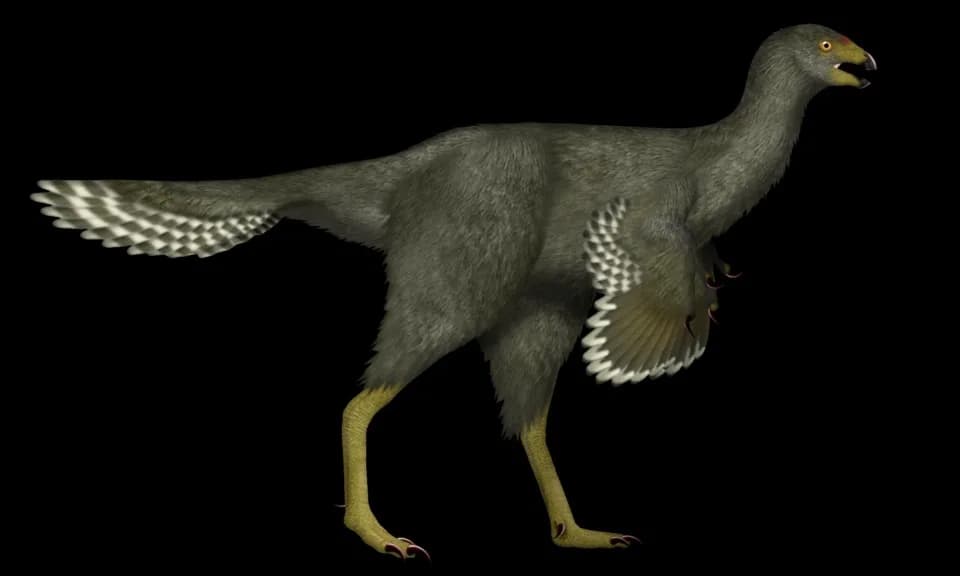
Artistic reconstruction of Caudipteryx with its plumage
Wikimedia Commons