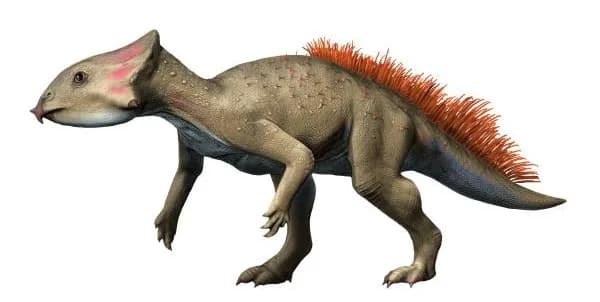
Visage d'aigle
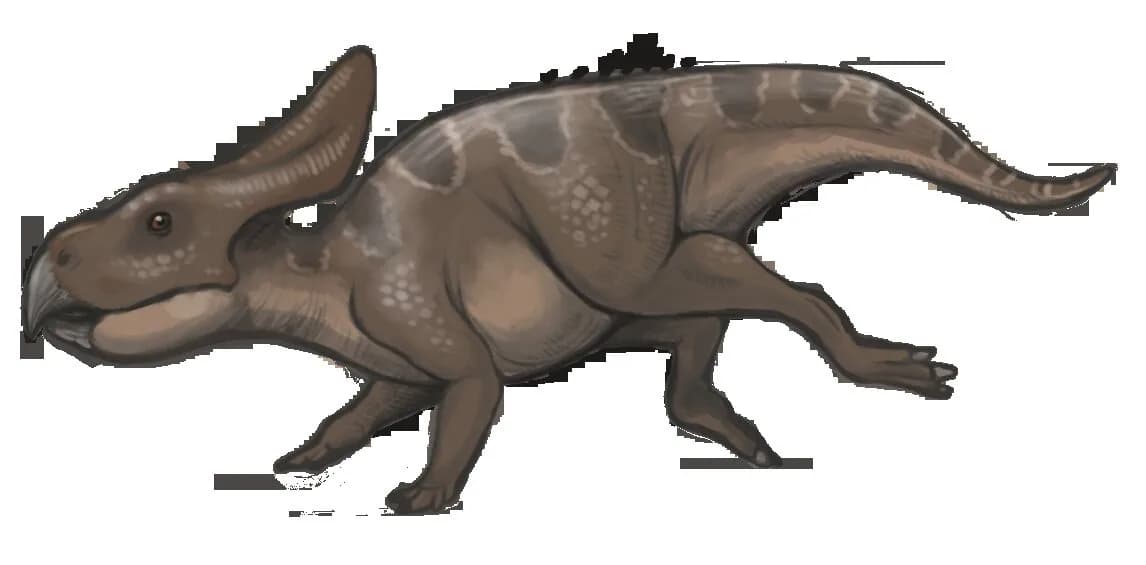
Aquilops americanus is one of the smallest ceratopsians known: 60 centimetres long and around 1.5 kilograms, barely more than a house cat. Described in 2014 from fossils in Montana, it lived 108 to 104 million years ago. Its name means eagle face, a reference to its strongly down-curved rostrum.
Aquilops americanus lived during the Early Cretaceous, in the Albian stage, approximately 108 to 104 million years ago. This tiny ceratopsian represents one of the oldest known neoceratopsians in North America, filling a crucial gap in the fossil record of horned dinosaurs on this continent. Its discovery in the Cloverly Formation of Montana revolutionized the understanding of ceratopsian biogeography, as Aquilops's closest relatives are found in Asia, suggesting a trans-Beringian migration in the Early Cretaceous. Described in 2014 by Andrew Farke and colleagues, Aquilops coexisted with other well-known dinosaurs such as Deinonychus and Tenontosaurus in an environment of floodplains and scattered forests.
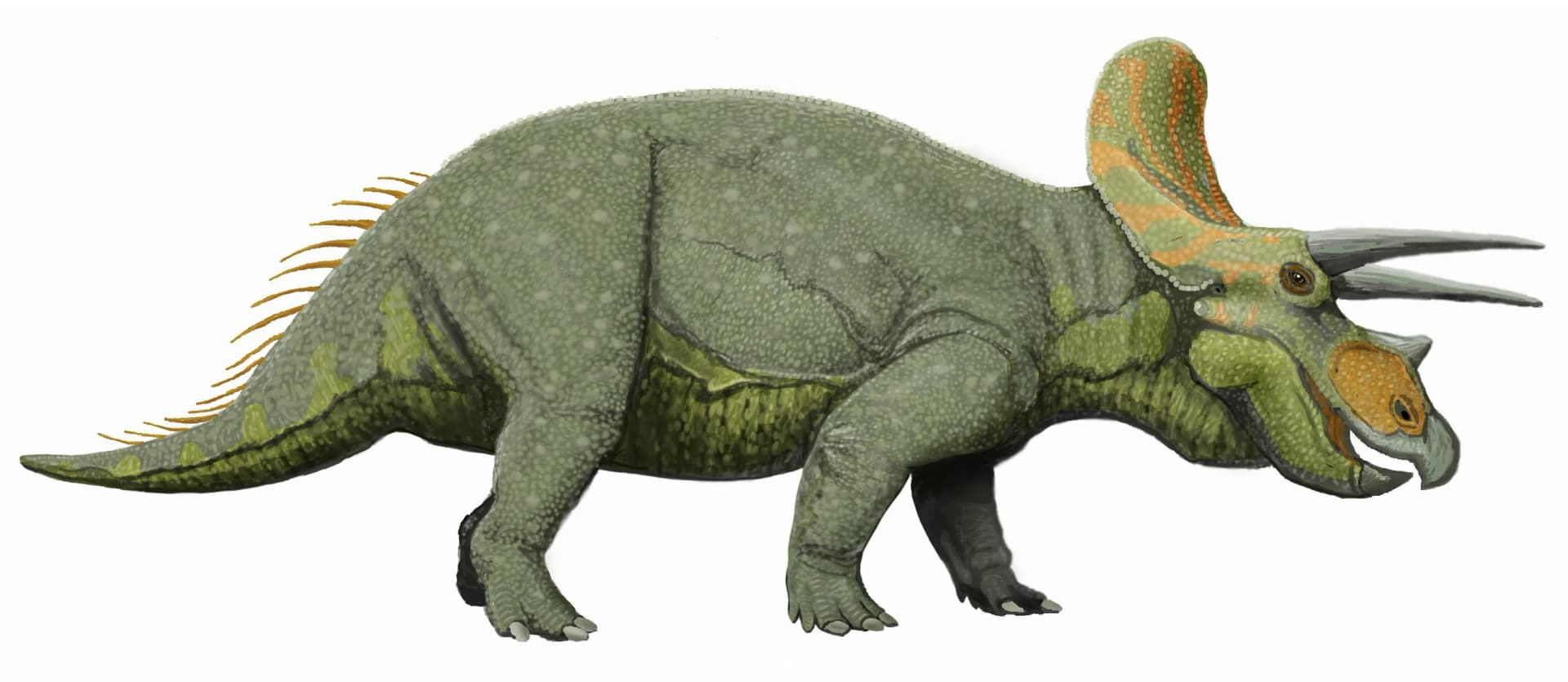
Aquilops was a remarkably small dinosaur for a ceratopsian, measuring only about 60 centimeters in total length with an estimated weight of approximately 1.5 kilograms. Its skull, the only known skeletal element, measures just 8.4 centimeters long — barely larger than a rabbit's skull. The reduced size of this dinosaur makes it one of the smallest ceratopsians ever discovered, comparable to Liaoceratops from China. This small stature contrasts starkly with its giant descendants like Triceratops, which could reach 9 meters in length and weigh over 10 tons. Aquilops perfectly illustrates the humble beginnings of the horned dinosaur lineage that would dominate North American ecosystems at the end of the Cretaceous.
A strict herbivore, Aquilops fed on low vegetation suited to its small size: ferns, mosses, young conifer shoots, and cycads. Its pointed rostral beak, slightly curved downward, was ideal for selecting and plucking tender plants at ground level. Unlike later ceratopsians that possessed complex dental batteries for grinding fibrous vegetation, Aquilops had simpler teeth adapted to a diet of less tough plants. Its small size confined it to the lowest vegetation layer, competing with insects and small reptiles rather than the large ornithopod herbivores like Tenontosaurus that shared its habitat.
Aquilops lived on the floodplains and open forests of what is now Montana in western North America. The Cloverly Formation, where its fossils were discovered, represents a floodplain environment crossed by seasonal rivers, bordered by conifer forests and fern-covered areas. The climate was warm and semi-humid, with well-defined seasons. Aquilops shared this habitat with a diverse fauna including the formidable Deinonychus, the large herbivore Tenontosaurus, the sauropod Sauroposeidon, and various crocodilians and turtles. Small ceratopsians like Aquilops likely occupied an ecological niche similar to that of modern hares or small rodents.
The anatomy of Aquilops is known only from a single but remarkably well-preserved skull (OMNH 34557). This skull features a strongly downward-curved rostrum, a unique characteristic among North American ceratopsians that earned it the name meaning 'eagle face.' The rostrum surface bears rough textures indicating the presence of a horny covering in life. Unlike later ceratopsians, Aquilops had neither horns nor a developed frill, only a slight jugal projection beneath each eye. The eye socket is proportionally large, typical of a small animal possibly active at twilight. The maxillary teeth, seven per row, show simple morphology without the complexity of advanced ceratopsid dental batteries.
In the absence of postcranial fossils, the behavior of Aquilops remains largely speculative, but inferences can be drawn from its morphology and close relatives. Its small size and lack of significant bony defenses suggest it relied primarily on flight and camouflage to escape predators. Like related small Asian ceratopsians (Liaoceratops, Archaeoceratops), Aquilops was likely bipedal or semi-bipedal, capable of rapid sprints on its hind legs. It possibly lived in small family groups, like many small herbivores, to increase collective vigilance against predators. Its twilight activity, suggested by its large eye sockets, would have been a strategy to avoid diurnal predators.
The only known specimen of Aquilops americanus (OMNH 34557) is a nearly complete skull discovered in 1997 by paleontologist Rich Cifelli in the Cloverly Formation, Carbon County, Montana. The fossil was found in a deposit dated to the Albian (approximately 108-104 million years ago). Despite its discovery in 1997, it took 17 years of preparation and study before its official description in 2014 by Andrew Farke, W. Desmond Maxwell, Richard Cifelli, and Matthew Wedel in the journal PLOS ONE. Phylogenetic analysis revealed that Aquilops is closer to Asian ceratopsians (Liaoceratops, Archaeoceratops) than to any other North American ceratopsian, providing the oldest evidence of a ceratopsian migration from Asia to North America via Beringia.
| Period | Crétacé inférieur / Early Cretaceous |
| Era | Mésozoïque / Mesozoic |
| Age | 108-104 Ma |
| Location | Montana, États-Unis / Montana, United States |
| Length | 0.6 m |
| Height | 0.2 m |
| Weight | ~1.5 kg |
| Diet | Herbivore |
| Discovery | 2014 |
Aquilops americanus measured only 60 centimeters in length and weighed approximately 1.5 kilograms — barely larger than a rabbit. It is one of the smallest known ceratopsians, starkly contrasting with its giant descendants like Triceratops (9 m, 10 tonnes). This tiny herbivore illustrates the humble origins of the entire horned dinosaur lineage that would dominate North America by the Late Cretaceous.
Aquilops americanus gets its name (Latin aquila 'eagle', ops 'face') from its skull's rostrum, which curves strongly downward — a feature unique among North American ceratopsians. This eagle-hook beak was ideal for selecting tender plants at ground level. The holotype skull (OMNH 34557), just 8.4 cm long, is the only skeletal element known from this species.
The phylogenetic analysis published by Farke et al. in 2014 in PLOS ONE reveals that Aquilops americanus is more closely related to Asian ceratopsians (Liaoceratops, Archaeoceratops) than to any North American ceratopsian. Found in Montana's Cloverly Formation (108-104 Ma), it represents the oldest evidence of a ceratopsian migration from Asia to North America via Beringia.
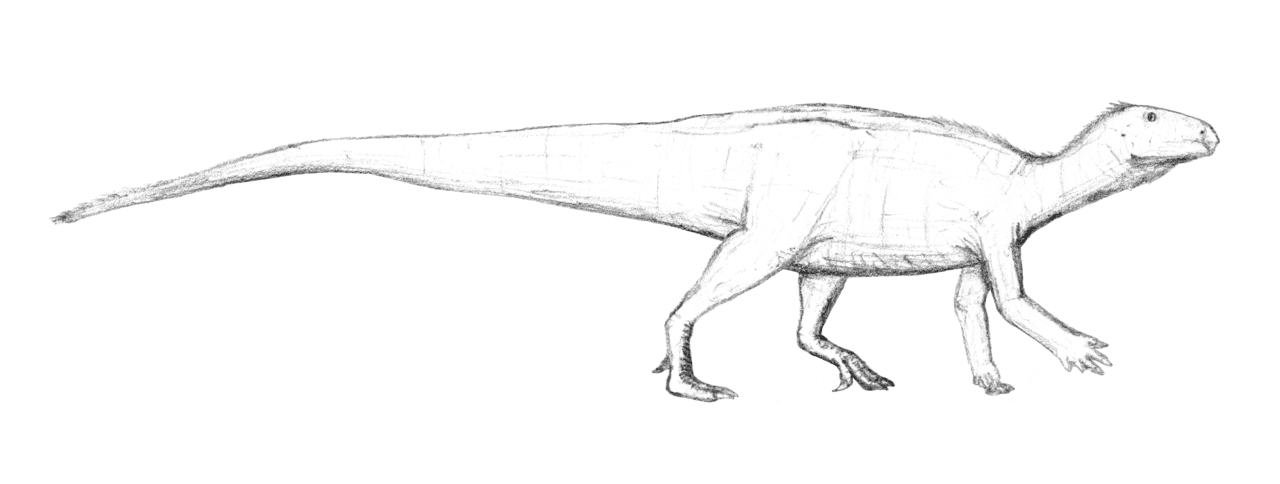
Aquilops americanus life reconstruction
Nobu Tamura, CC BY-SA 4.0
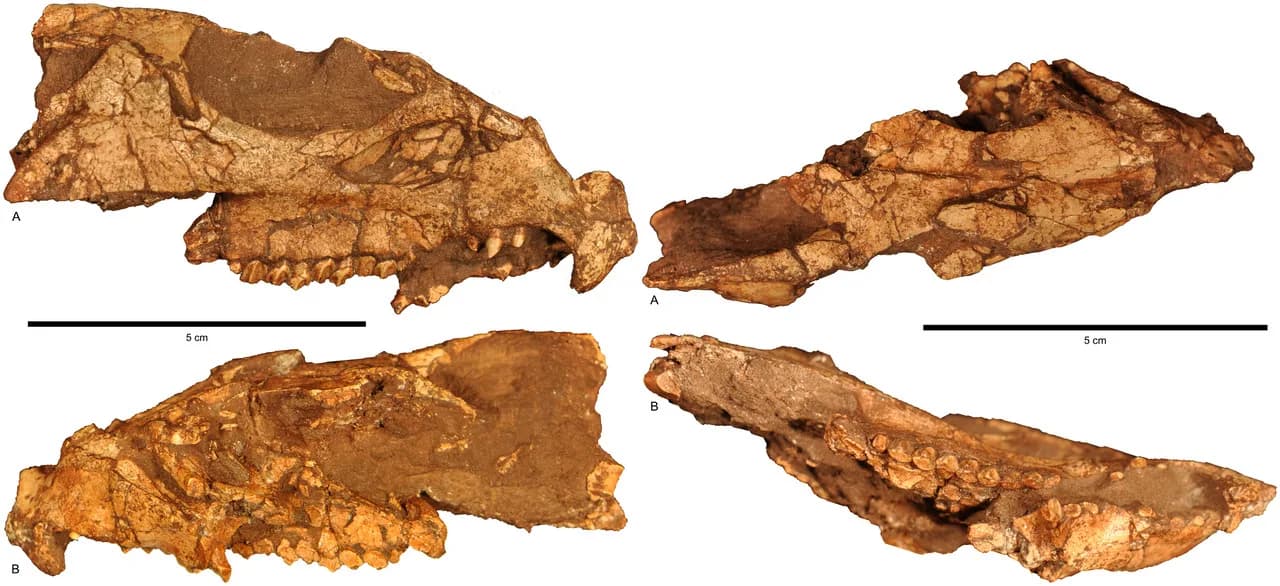
Aquilops americanus fossil skull
Wikimedia Commons