Anurognathus
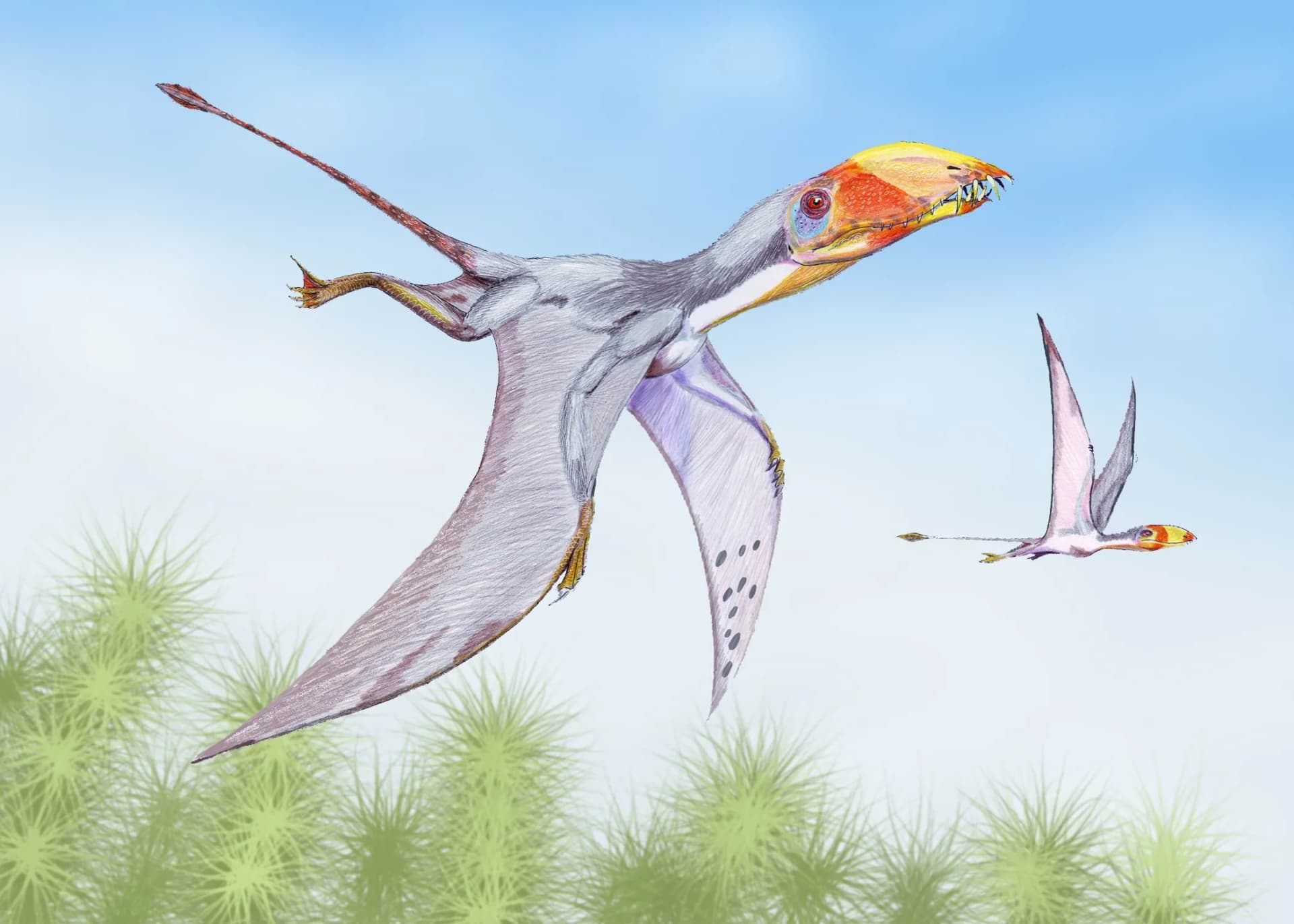
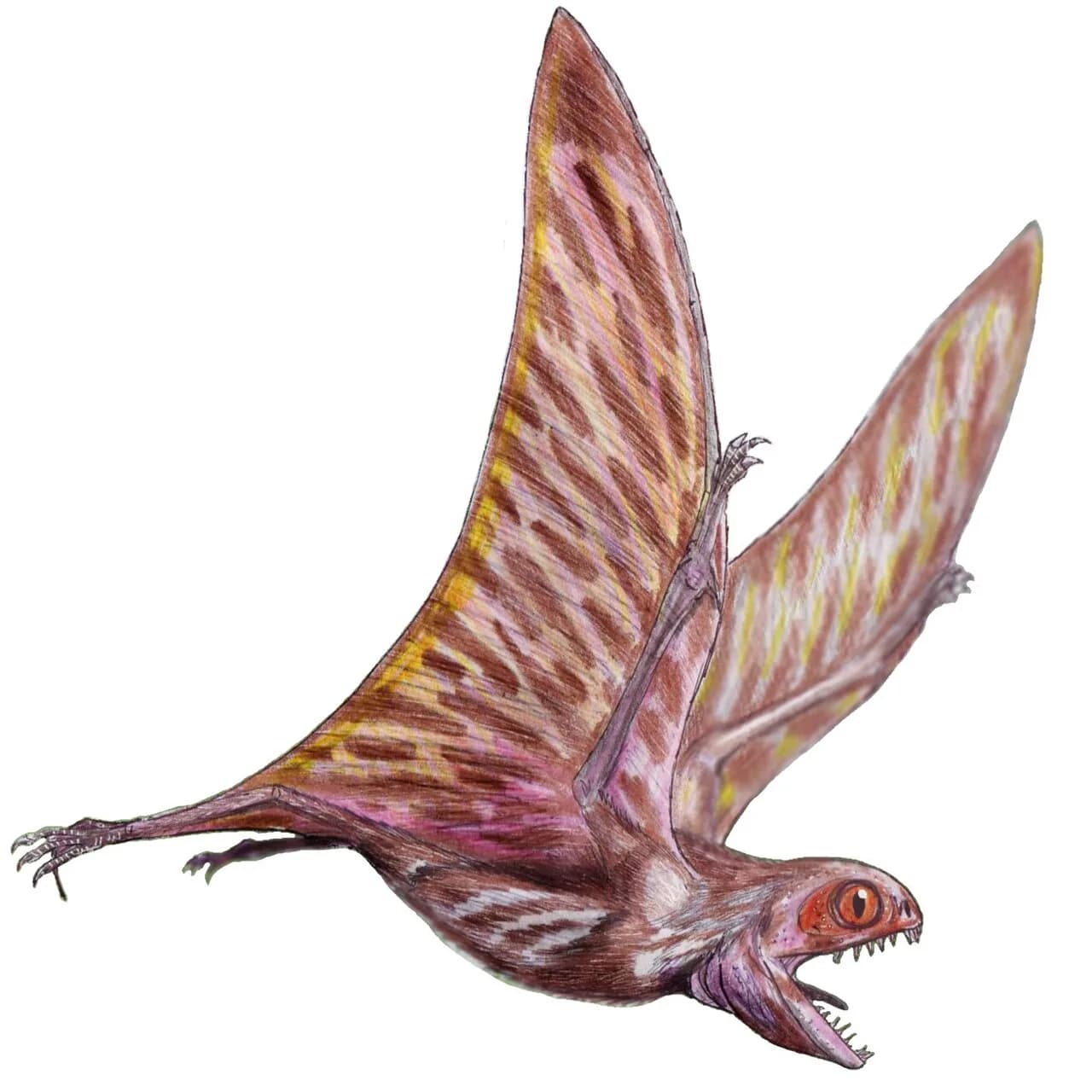
Anurognathus ammoni is one of the smallest pterosaurs known: a 50-centimetre wingspan and 30 to 40 grams, about the size of a sparrow. Described in 1923 from fossils at Solnhofen in Bavaria, it flew 150 million years ago. Its short, flattened skull gave it a frog-like face, unique among Mesozoic flying reptiles.
Anurognathus lived during the Late Jurassic, approximately 150 million years ago, at the same time and in the same region as the famous Archaeopteryx. This tiny pterosaur inhabited the tropical lagoons of Solnhofen in Bavaria, southern Germany. The Late Jurassic was a period of remarkable diversity for flying reptiles, and Anurognathus represented the extreme opposite end of the size spectrum from the large soaring pterosaurs. It shared its environment with numerous other small flying vertebrates and abundant insects that formed its primary food source within this exceptionally rich island and lagoon ecosystem during this warm geological period.
Anurognathus is one of the smallest pterosaurs ever discovered in the fossil record. Its wingspan reached only about 50 centimeters, barely wider than that of a modern pigeon. Its tiny body measured just 9 centimeters in length, comparable in size to that of a house sparrow. Despite its diminutive stature, its wings were perfectly proportioned for agile and rapid flight maneuvers. Its weight is estimated at only a few grams, making it one of the lightest flying vertebrates of the entire Mesozoic Era. This remarkably small size allowed it exceptional maneuverability in the air, perfectly suited for catching insects during flight.
Anurognathus was a specialized insectivore that caught its prey on the wing, much like modern insectivorous bats and swifts do today. Its wide, frog-like mouth was perfectly adapted for snatching flying insects during rapid aerial pursuits. Its small, pin-like teeth, numerous and sharply pointed, formed an efficient trap against airborne insects captured in mid-flight. The tropical lagoons of Solnhofen harbored a diverse and abundant insect fauna, including dragonflies, beetles, and numerous other flying arthropods that constituted the primary dietary source for this remarkably agile and swift little aerial hunter throughout the warm Jurassic seasons.
Anurognathus inhabited the tropical lagoons and islands of the Solnhofen limestone formation in present-day Bavaria, Germany. This environment consisted of an archipelago of low-lying islands surrounded by warm, shallow lagoons under a tropical to subtropical climate with consistently warm temperatures year-round. The calm waters and coral reefs supported a rich ecosystem teeming with life, with abundant insects flying above aquatic surfaces and coastal vegetation. This sheltered island habitat, largely protected from large terrestrial predators, was ideal for such a small flying pterosaur. The exceptional fossilization conditions of the lithographic limestone at Solnhofen enabled the remarkable preservation of such delicate specimens.
The anatomy of Anurognathus is unique among pterosaurs and immediately distinguishable from all its relatives. Its short, wide skull resembled that of a frog, with a flattened snout and a very wide mouth capable of opening considerably to capture insects in flight. Its eyes were enormous relative to its head size, suggesting excellent vision, possibly adapted for hunting at twilight or even during nighttime hours. Its tiny pin-like teeth were arranged in tightly packed rows along both jaws. Its tail was extremely short, unlike most other rhamphorhynchoid pterosaurs of its era. Its body was likely covered in pycnofibers, a type of primitive fur-like covering that helped regulate its body temperature in varying conditions.
Anurognathus was an agile and rapid aerial acrobat, specialized in capturing insects on the wing during swift flight maneuvers. Its short, broad wings allowed rapid turns and sudden directional changes, similar to those performed by modern insectivorous bats hunting at dusk. It likely hunted at twilight or dawn, when insects were most active above the warm tropical lagoons of its island habitat. The BBC documentary series 'Walking with Dinosaurs' popularized this tiny pterosaur by depicting it perched on the backs of large sauropod dinosaurs, feeding on insects attracted to these giants. While this hypothesis remains speculative and unproven, such oxpecker-like behavior is considered plausible given its small size and insectivorous feeding habits.
Anurognathus was first described by Ludwig Döderlein in 1923, based on a specimen discovered in the famous Solnhofen lithographic limestone of Bavaria, Germany. This exceptional fossil deposit is the same formation that yielded the renowned Archaeopteryx specimens, making the discovery all the more scientifically significant and noteworthy. The holotype specimen is relatively complete but crushed flat during fossilization, which long complicated the interpretation of its unusual skull morphology. A second, better-preserved specimen discovered later allowed scientists to better understand its unique frog-like cranial anatomy. Anurognathus became widely famous through its memorable appearance in the BBC documentary series 'Walking with Dinosaurs' in 1999.
| Period | Jurassique supérieur / Late Jurassic |
| Era | Mésozoïque / Mesozoic |
| Age | 150 Ma |
| Location | Solnhofen, Bavière, Allemagne / Solnhofen, Bavaria, Germany |
| Length | Envergure / Wingspan: 50 cm |
| Height | ~10 cm |
| Weight | 30-40 g |
| Diet | Insectivore |
| Discovery | 1923 |
Anurognathus ammoni was tiny even for a pterosaur: a wingspan of only 50 cm and a body just 9 cm long, roughly the size of a house sparrow. Its weight is estimated at 30-40 grams, making it one of the lightest flying vertebrates of the Mesozoic — comparable in mass to a large butterfly.
Anurognathus ammoni had a short, wide, flattened skull unlike other long-snouted pterosaurs. This 'frog-face' morphology allowed an extremely wide gape, ideal for catching insects in flight. Its disproportionately large eyes suggest vision adapted for crepuscular hunting above the Solnhofen lagoons, likely at dusk when insects were most active.
Anurognathus ammoni was first described in 1923 by Ludwig Döderlein from a specimen in the Solnhofen lithographic limestone of Bavaria, Germany — the same famous deposit that yielded Archaeopteryx fossils. A second, better-preserved specimen discovered later helped clarify its unique cranial anatomy and confirmed its placement within the Anurognathidae family.
Anurognathus ammoni illustration
Wikimedia Commons
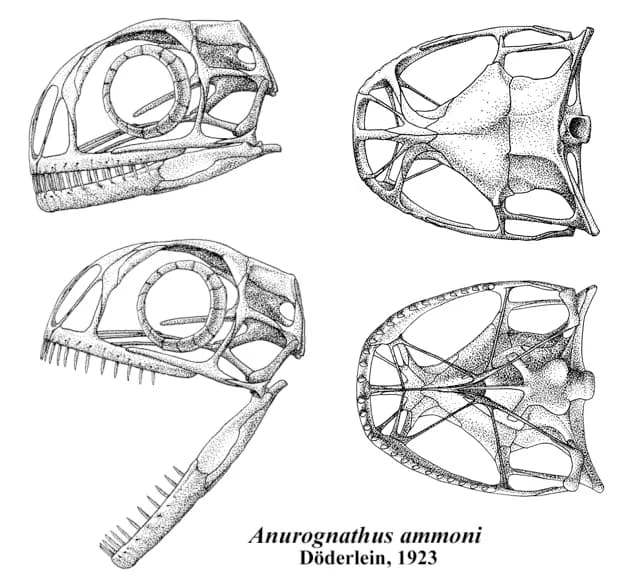
Anurognathus fossil skull
Wikimedia Commons