Rhamphorhynque
Rhamphorhynchus muensteri had a 1.8-metre wingspan and weighed 1 to 2 kilograms, flying 150 to 148 million years ago. The Solnhofen limestones preserved its diamond-shaped tail vane, a soft tissue that rarely fossilises. One striking specimen shows an individual dead with an Aspidorhynchus fish tangled in its wing: both perished together.
Playable in Path of Titans
See Rhamphorhynchus muensteri's stats, abilities and role on our survival server.
Rhamphorhynchus muensteri lived during the Late Jurassic, approximately 150 to 148 million years ago, during the Kimmeridgian and Tithonian ages. This long-tailed pterosaur is one of the best-known flying reptiles of the Mesozoic thanks to the extraordinary fossils from the lithographic limestones of Solnhofen in Bavaria, Germany — the same deposits that yielded Archaeopteryx. Rhamphorhynchus belongs to the rhamphorhynchoids, the basal group of pterosaurs that dominated the skies during the Jurassic before being progressively replaced by the more advanced pterodactyloids in the Cretaceous. It coexisted with a rich marine fauna in the shallow tropical lagoons of the Jurassic European archipelago. The exceptional quality of its preservation, sometimes including wing membrane and tail vane impressions, makes it a reference model for studying pterosaur biology.
Rhamphorhynchus exhibited a range of sizes varying by species and growth stage, with a maximum wingspan of approximately 1.8 meters for the largest adults. The body measured about 40 to 50 centimeters long, with a remarkably long tail of 50 to 60 centimeters terminating in a diamond-shaped vane. Its estimated weight ranged between 1 and 2 kg. The skull was elongated and narrow, measuring about 20 centimeters, with a beak armed with long, forward-curving teeth. The wings were relatively long and narrow, an aerodynamic profile suggesting efficient flight adapted to marine fishing. Juvenile specimens were considerably smaller, with wingspans of 30 to 50 centimeters, and ontogenetic studies based on the numerous Solnhofen fossils have allowed reconstruction of the complete growth pattern.
Rhamphorhynchus was a specialized piscivore, as evidenced by its dentition, jaw morphology, and direct evidence found in fossils. Its long, pointed, forward-curving teeth formed an effective trap for grasping slippery fish. Several exceptional Solnhofen specimens preserve identifiable stomach contents, revealing the presence of small fish (notably Leptolepides) and occasionally small cephalopods. One spectacular fossil shows a Rhamphorhynchus with an Aspidorhynchus fish entangled in its wing membrane, both animals having perished together — the predatory fish apparently having attacked the pterosaur while it was fishing at the water's surface. This discovery provides a dramatic snapshot of Jurassic feeding ecology. Rhamphorhynchus likely fished by skimming low over the water surface, grasping fish with its elongated jaws.
Rhamphorhynchus lived in the Late Jurassic European tropical archipelago, a chain of low-lying islands surrounded by warm, shallow lagoons that characterized present-day central Europe 150 million years ago. The Solnhofen lithographic limestones, which yielded the vast majority of fossils, formed in these hypersaline lagoons where anoxic bottom conditions allowed exceptional fossilization of organisms that fell in. The climate was tropical, with average temperatures far exceeding modern Bavaria. Rhamphorhynchus shared this environment with Pterodactylus, Archaeopteryx, the small dinosaur Compsognathus, crocodilians, sea turtles, and an abundant fauna of fish and marine invertebrates. The archipelago's islands provided nesting sites, while the lagoons and nearby Tethys Sea provided fishing grounds.
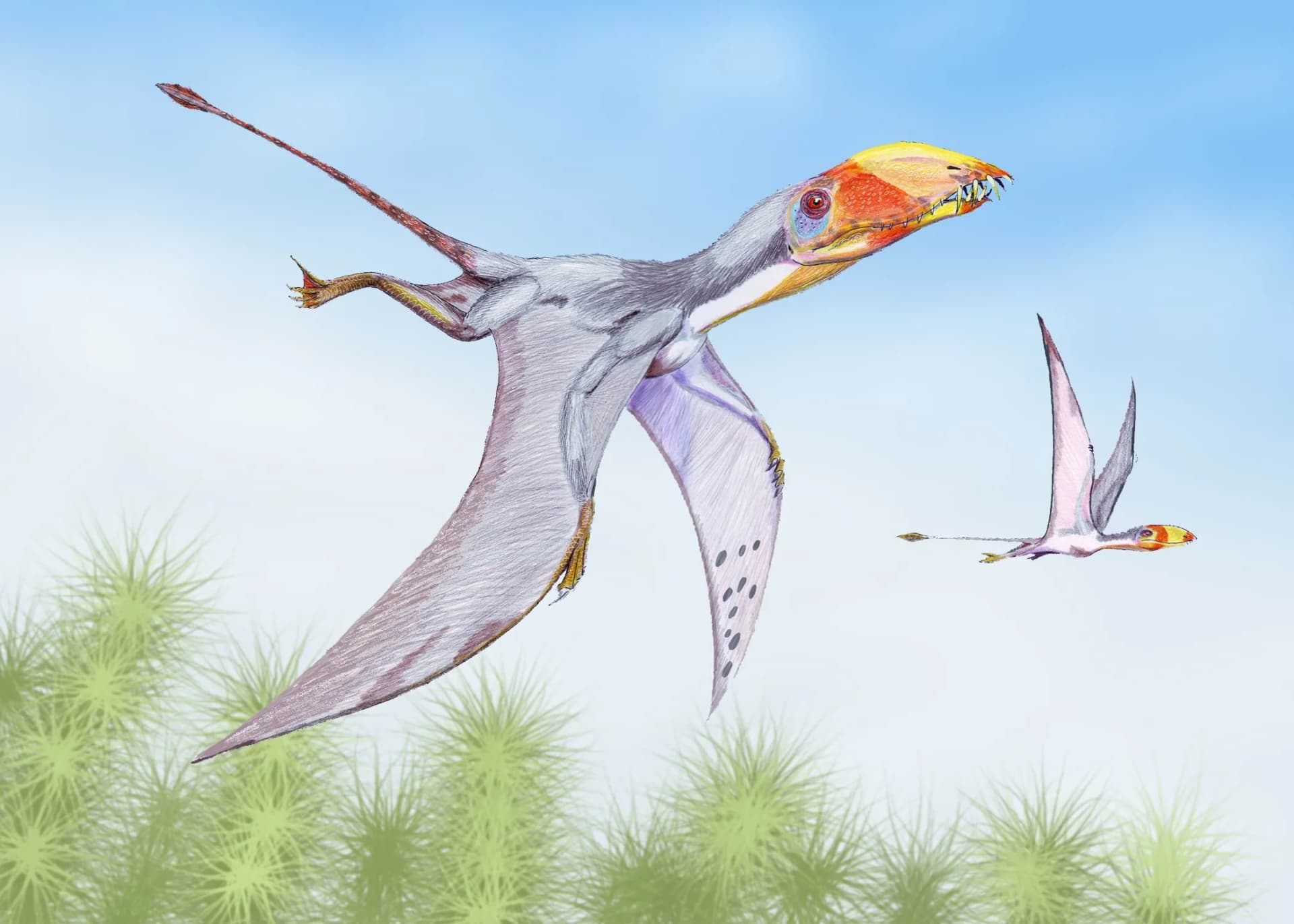
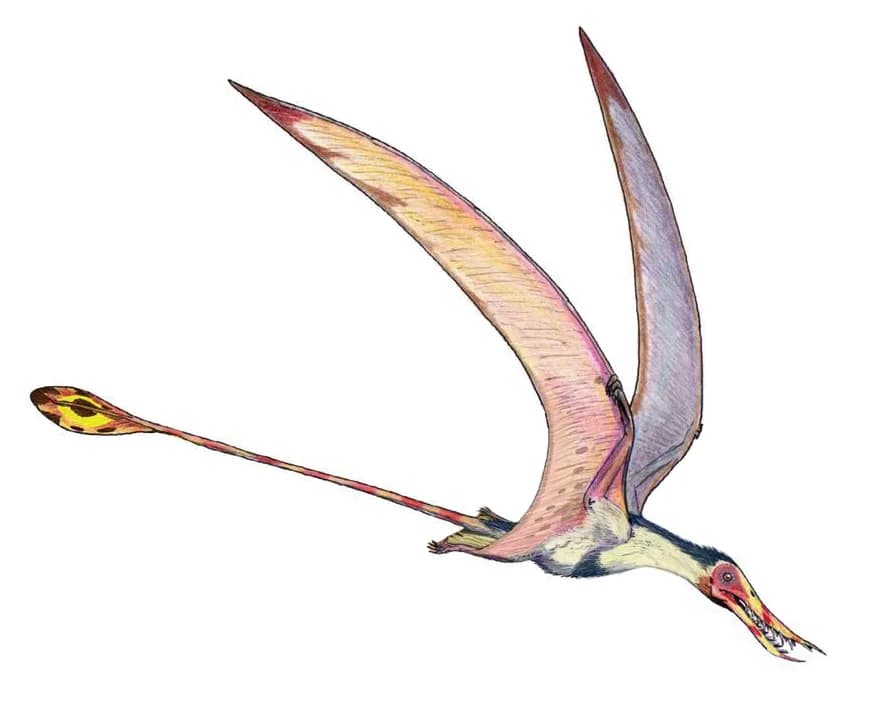
Rhamphorhynchus anatomy is known in exceptional detail thanks to fossils preserving not only bones but also soft tissue impressions. The elongated skull bore teeth that pointed forward and interlocked when the jaw was closed, forming an effective trap for slippery prey. The tip of the snout was probably toothless and covered with a keratinous beak. The exceptionally long, rigid tail was reinforced by ossified tendon extensions of the caudal vertebrae and terminated in a diamond-shaped vane made of soft tissue, perfectly preserved in some specimens. This vane functioned as a stabilizer and rudder in flight. The wings showed a complex patagium, with a main membrane supported by the elongated fourth finger and a propatagium stretched between the shoulder and wrist. The first three fingers of the hand were free and clawed, used for clinging to rock faces.
Rhamphorhynchus behavior can be reconstructed with unusual precision thanks to the abundance and quality of its fossils. Analysis of its wing shape — long, narrow, with a high aspect ratio — indicates efficient soaring flight adapted to marine conditions, similar to modern albatrosses and petrels. The diamond-shaped tail vane served as a stabilizer and rudder, compensating for the lack of the short, mobile tail of more advanced pterodactyloids. Rhamphorhynchus probably fished by flying low over lagoon surfaces, dipping its jaw into the water to seize fish — a technique similar to modern skimmers. The presence of numerous juvenile specimens of varying sizes at Solnhofen suggests a nursery area for young in the protected lagoons. Nesting colonies were probably located on the archipelago's islands, safe from terrestrial predators. CT studies have revealed a brain with well-developed optic lobes, indicating excellent vision adapted for detecting underwater prey.
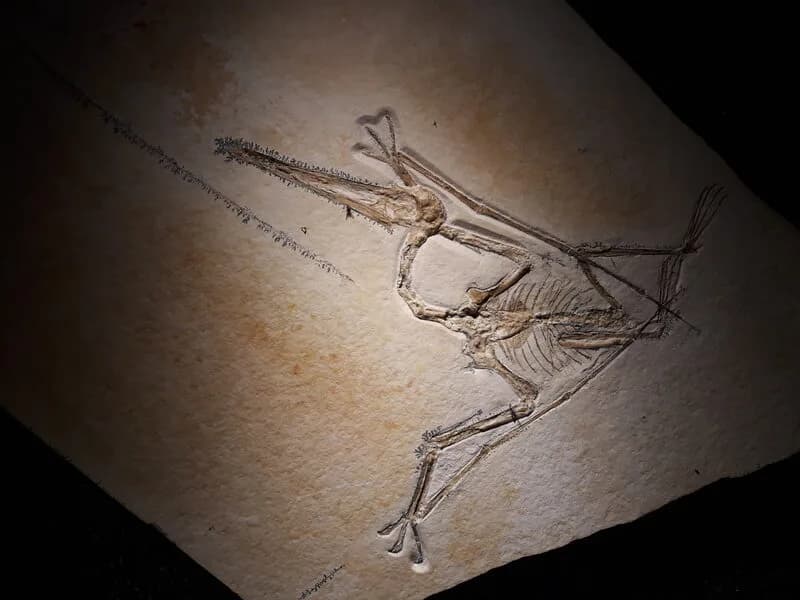
Rhamphorhynchus was first described in 1847 by German paleontologist Hermann von Meyer from fossils in the Solnhofen lithographic limestones of Bavaria. The name means 'beak snout' (Greek: rhamphos 'beak' + rhynchos 'snout'). The Solnhofen deposits have yielded hundreds of specimens, making Rhamphorhynchus one of the best-represented pterosaurs in the world. The fine grain of the limestone allowed extraordinary preservation of details such as wing membranes, the tail vane, pelage fibers (pycnofibers), and even stomach contents. The most famous specimen is the 'Dark Wing,' which preserves in detail the complete wing membrane structure with its reinforcing fibers. Another remarkable fossil shows the fatal interaction between a Rhamphorhynchus and a predatory Aspidorhynchus fish. Fossils attributed to Rhamphorhynchus have also been found in England, Portugal, and Tanzania, indicating a broader geographic distribution than the Bavarian deposits alone.
| Period | Jurassique supérieur / Late Jurassic |
| Era | Mésozoïque / Mesozoic |
| Age | 150 - 148 Ma |
| Location | Europe (Allemagne, Angleterre, Portugal, Tanzanie) / Europe (Germany, England, Portugal, Tanzania) |
| Length | Envergure / Wingspan: 1.8 m |
| Height | ~25 cm |
| Weight | 1-2 kg |
| Diet | Piscivore |
| Discovery | 1825 |
No. Rhamphorhynchus muensteri was a rhamphorhynchoid pterosaur, not a dinosaur. Both groups are archosaurs, but pterosaurs form a separate lineage that independently evolved powered flight. Rhamphorhynchus is recognized by its long tail ending in a diamond-shaped vane, characteristic of basal Jurassic pterosaurs.
The largest adults reached a wingspan of approximately 1.8 meters, weighing 1 to 2 kg. Rhamphorhynchus fished by skimming low over lagoon surfaces, dipping its elongated jaws into the water to seize fish. Several Solnhofen fossils preserve identifiable stomach contents, including Leptolepides fish.
The Solnhofen lithographic limestones, formed in Late Jurassic hypersaline lagoons, preserved not only bones but also wing membranes, the tail vane, and pycnofibers (fur) of Rhamphorhynchus. One famous specimen shows an intact diamond-shaped vane; another shows an Aspidorhynchus fish entangled in the wing, both animals having perished together.
Artistic reconstruction of Rhamphorhynchus by Dmitry Bogdanov
Dmitry Bogdanov / Wikimedia Commons
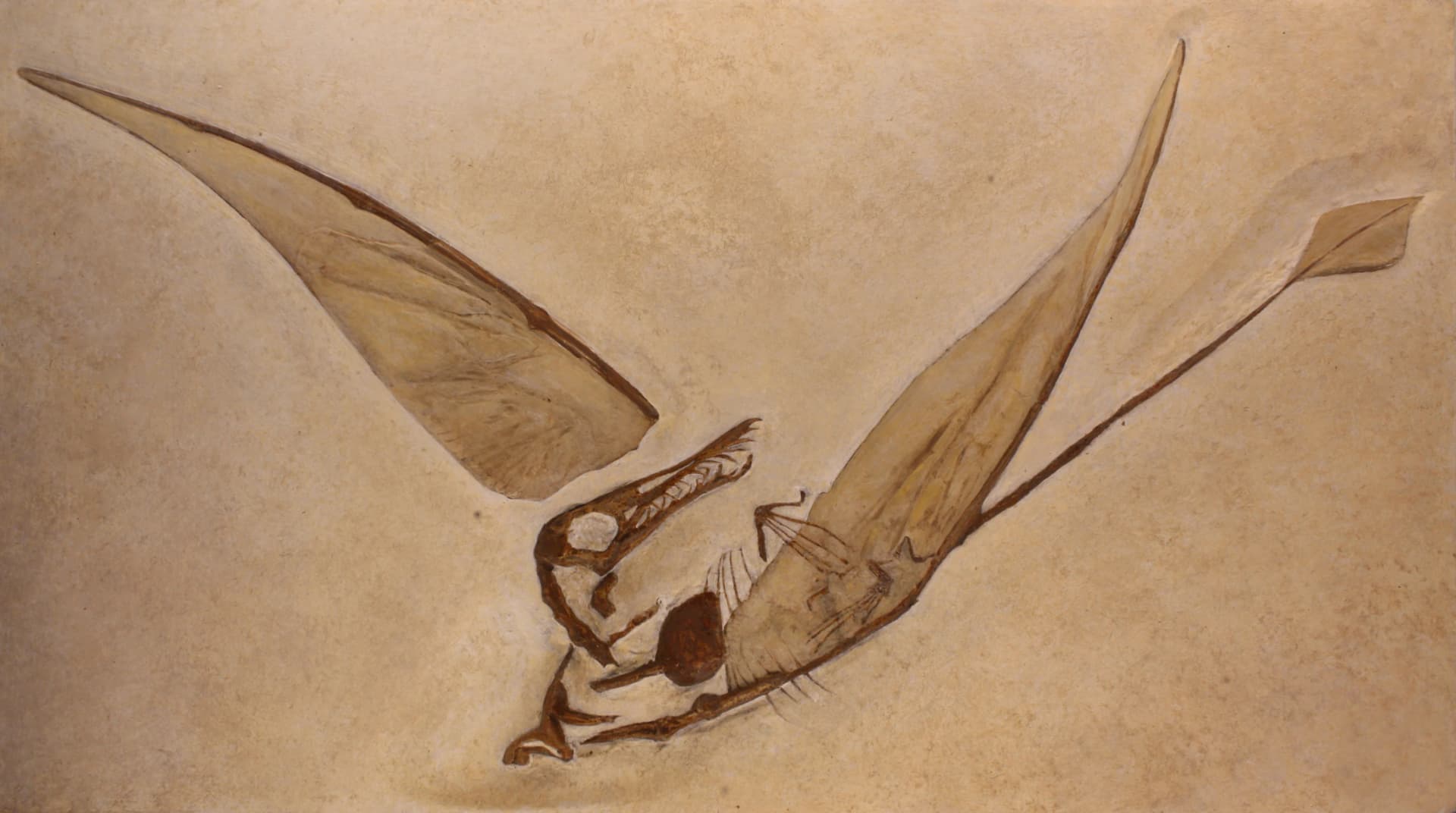
Fossil of Rhamphorhynchus muensteri (specimen YPM 1778)
Wikimedia Commons